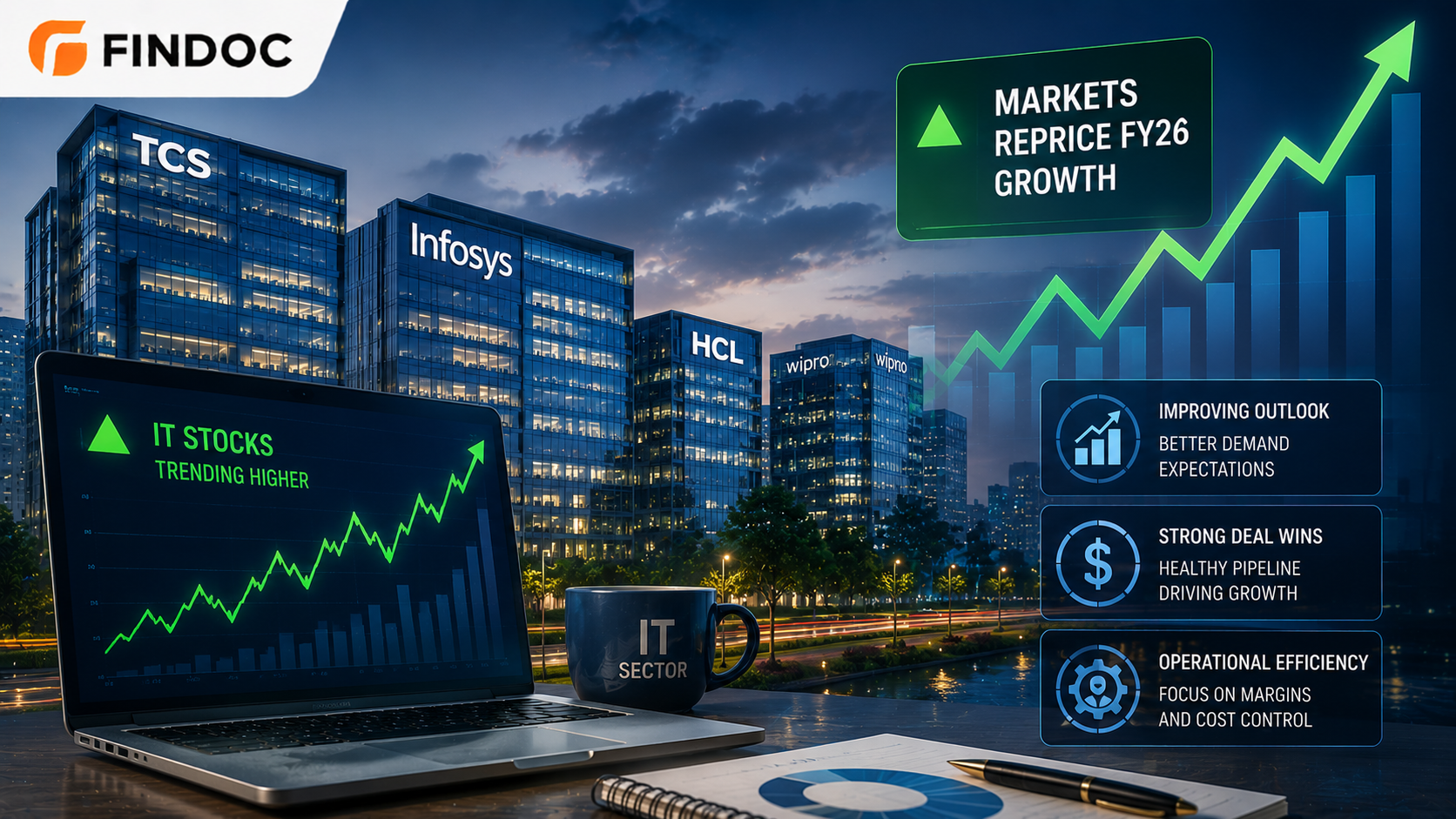
Indian technology stocks traded with a firm bias in the latest session as institutional investors selectively added positions in large-cap IT services names on expectations of a gradual recovery in FY26 deal flows. The Nifty IT index outperformed the benchmark Nifty 50, aided by modest gains in Infosys, TCS, Wipro and HCL Tech, even as near-term revenue visibility remains constrained by weak US and European discretionary spending. Market participants are increasingly positioning for a bottoming of the earnings cycle, with commentary from managements and brokers suggesting a shift from outright pessimism to cautious accumulation.
Key Highlights
- Nifty IT index outperforms headline indices as investors price in FY26 recovery in tech demand
- Infosys, TCS, Wipro and HCL Tech see selective buying amid continued weakness in discretionary spending
- Mid-cap IT remains volatile with sharper moves on stock-specific deal wins and guidance resets
- INR stability and benign wage inflation support margin resilience despite mixed top-line trends
- Institutional flows rotate gradually from defensives into large-cap IT on improving medium-term risk-reward
Indian IT Stocks: Positioning for a Slow Cyclical Turn
The Indian IT services pack continues to trade as a macro and rate-sensitive proxy, with price action closely tracking expectations around US Federal Reserve cuts, global tech capex and corporate IT budgets. Over the past few weeks, the Nifty IT index has modestly outperformed both the Sensex and Nifty 50, as investors reassess worst-case recession fears and begin to price in a cyclical bottom in FY25, followed by a more visible demand uptick in FY26.
Large-cap bellwethers such as Tata Consultancy Services (TCS), Infosys, HCL Tech and Wipro are seeing steady institutional interest on declines, with foreign portfolio investors (FPIs) selectively rebuilding exposure after several quarters of underweight positioning in the sector. The prevailing thesis is that while near-term revenue growth will likely remain in the low- to mid-single digits in constant currency, the combination of stable INR, easing attrition and normalization of subcontracting and hiring costs should help preserve — and in some cases expand — operating margins. This has created a valuation set-up where downside risks from earnings cuts appear more limited, even as any positive surprise on large deal closures or discretionary spend improves the risk-reward skew. Investors looking to participate in this market movement can open free demat account through SEBI-registered brokers to access Indian IT equities listed on NSE and BSE.
Large-Cap IT: Company-Specific Trends and Valuation Backdrop
Among the heavyweights, TCS remains the preferred structural pick for several domestic and global brokerages owing to its diversified vertical mix, execution track record and relatively resilient performance through the current downcycle. The stock continues to command a valuation premium to the sector, often trading at a high-teens to low-20s one-year forward earnings multiple, supported by strong cash generation, a consistent dividend and buyback track record, and lower volatility in client budgets relative to peers.
Infosys, which had earlier cut its revenue guidance in the face of weaker discretionary spends and delayed decision-making in key markets, is now being watched closely for signs of stabilization in its order book and commentary around AI-led transformation deals. Investors are particularly focused on the company’s ability to convert its strong large deal pipeline into revenue, as well as on the traction of its generative AI and platform offerings with global clients. The stock’s valuation has de-rated from previous cycle peaks, and market participants are treating it as a high-beta play on a potential recovery in US and European tech spending.
HCL Tech has emerged as a relative outperformer in recent quarters due to its higher share of annuity-style services and engineering R&D, which have offered better resilience in a weak macro environment. Its products and platforms business, while smaller in absolute terms compared to services, provides incremental margin support. Investors are closely tracking management’s commentary on cloud, infrastructure services, and engineering deals, all of which have been comparatively more stable than pure discretionary digital transformation work.
Wipro, in contrast, is still seen as a turnaround story. The company has been undergoing multi-year portfolio and leadership changes aimed at sharpening its go-to-market strategy and improving growth consistency. While valuation remains lower than peers on a price-to-earnings basis, the market continues to demand clear evidence of sustained execution improvements and competitive win-rates before re-rating the stock meaningfully. For now, Wipro tends to move more sharply with sector sentiment, amplifying both upswings and corrections.
| Company | Market Position | Key Strength | Current Market View |
|---|---|---|---|
| TCS | Sector Leader | Diversified vertical mix, strong cash generation, consistent buybacks | Preferred structural pick; trades at valuation premium |
| Infosys | Large-Cap | Large deal pipeline, generative AI and platform offerings | Watched for order book stabilization; high-beta recovery play |
| HCLTech | Large-Cap | Annuity-style services, engineering R&D, products and platforms | Relative outperformer; stable cloud and infrastructure deals |
| Wipro | Large-Cap | Portfolio restructuring, lower valuation versus peers | Turnaround story; market awaiting execution consistency |
Sector Positioning, Risks and Peer Comparisons
From a market-structure perspective, IT remains one of the most significant sectoral contributors to both the Sensex and Nifty 50, with large-cap tech names accounting for a meaningful portion of overall index earnings. For institutional investors and domestic mutual funds, this ensures IT’s continued centrality in asset allocation discussions, particularly at a time when other export-oriented sectors such as pharma and chemicals are facing their own idiosyncratic challenges. Broader stock investment considerations in the Indian IT space are therefore closely tied to global macro developments, domestic currency dynamics and institutional flow patterns.
Key drivers supporting the current constructive stance include:
- Stable to mildly appreciating INR versus the US dollar, which helps protect rupee revenue while containing imported cost pressures.
- Moderating employee attrition and more rational wage inflation, improving operating leverage and contractor cost management.
- Strong balance sheets and net cash positions across most large IT firms, enabling continued high payout ratios through dividends and buybacks.
- A robust secular backdrop for digital transformation, cloud migration, cybersecurity, and AI-driven automation over a multi-year horizon.
Key risks investors are monitoring include:
- A sharper-than-expected slowdown or renewed recessionary risk in the US and Europe, leading to further cuts in discretionary IT budgets and project deferrals.
- Delays in large deal ramp-ups, especially in cost-takeout and vendor consolidation programs, which could push out revenue recognition timelines.
- Rising competitive intensity from global consulting firms and cloud hyperscalers expanding deeper into managed services and transformation work.
- Potential currency volatility if global risk sentiment weakens or if domestic macro conditions trigger abrupt INR moves.
- Regulatory or policy changes in key client geographies affecting on-site deployment models, visa regimes or offshoring economics.
Within the Indian IT space, large caps continue to trade at a premium to mid-caps, reflecting better client diversification, stronger governance profiles, and greater resilience through cycles. However, mid-cap IT stocks remain a high-beta play on any demand inflection, often delivering sharper earnings and price moves when deal wins or guidance surprises are announced.
Market Outlook
Looking ahead, the Indian IT sector’s performance will largely hinge on the timing and strength of the next global tech spending upcycle. Market consensus currently embeds a scenario where FY25 remains a year of muted growth and portfolio consolidation, while FY26 offers a clearer inflection point as deferred projects restart and AI-driven and cloud-native transformation programs scale. For Indian investors, the key variables to track are quarterly commentary from TCS, Infosys, Wipro and HCL Tech on deal pipelines and conversion, any upgrades or downgrades to revenue and margin guidance, as well as macro indicators from the US and Euro area, including corporate confidence and capex intentions.
At the market level, the correlation between Nifty IT and global tech indices, as well as domestic bond yields and currency moves, will remain high. A benign interest rate environment, steady INR and gradual improvement in global risk sentiment would all be supportive of further re-rating in Indian tech stocks, especially from current levels where valuations sit around long-term averages for many names rather than at frothy highs. Retail and institutional participants monitoring these developments typically rely on a good trading platform to track real-time index movements, sector rotations and deal-flow announcements across listed IT names.
Conclusion
Indian IT remains a market where investors are navigating a narrow path between cyclical caution and structural optimism. The sector has moved past the phase of widespread earnings downgrades and severe de-rating but has not yet entered a broad-based growth upturn. This transitional backdrop is driving a barbell strategy among institutional investors: accumulating quality large caps such as TCS, Infosys and HCL Tech for steady compounding and selective exposure to mid-cap IT as a leveraged bet on a stronger-than-expected FY26 rebound. As long as balance sheets stay strong and cash returns remain generous, the downside appears reasonably contained; the upside, however, will depend on how quickly global enterprises turn intent into signed transformation deals and sustained technology spending.
Leave a Reply