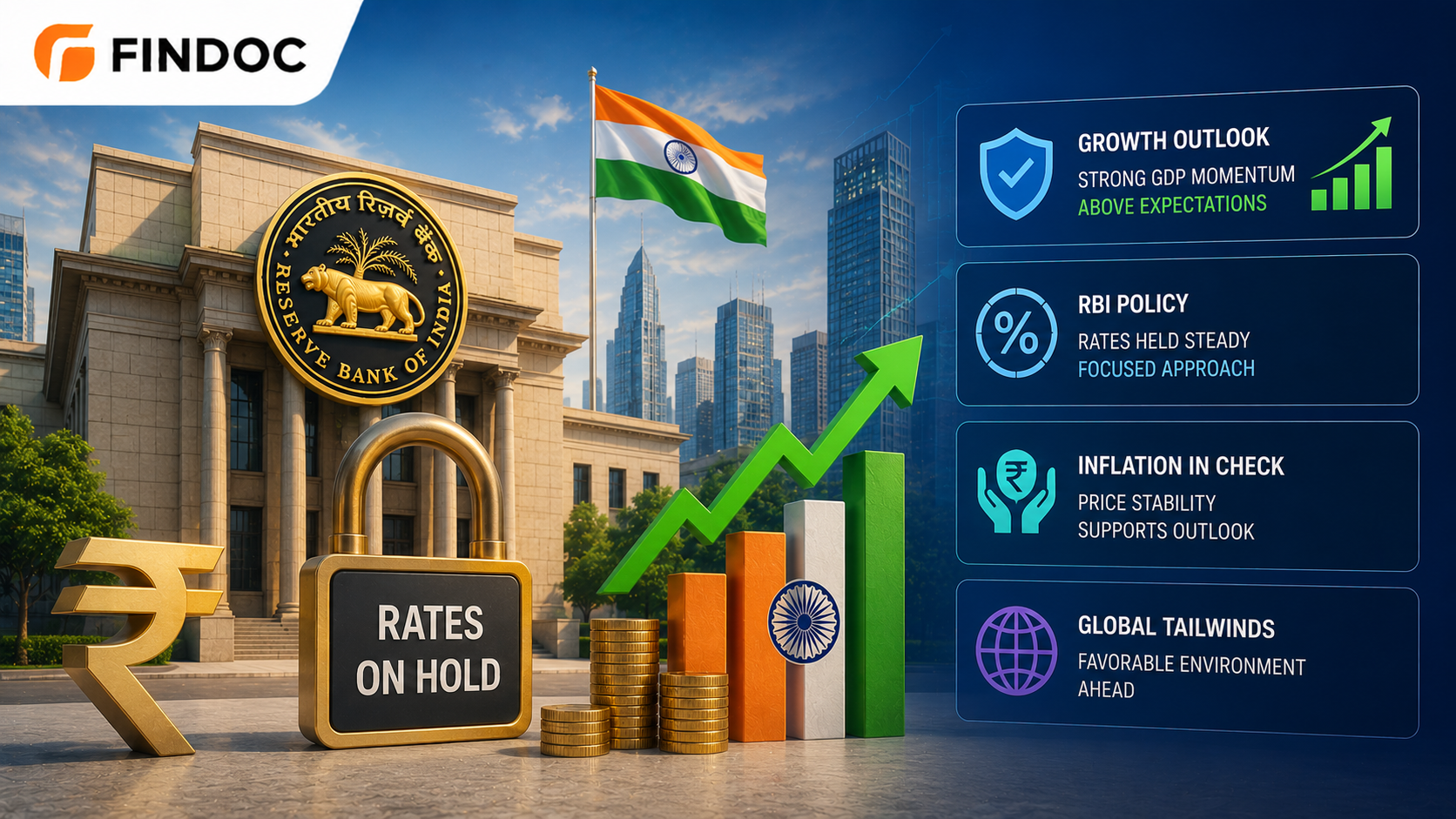
India’s macroeconomic narrative on Thursday, 25 June 2026, is increasingly defined by the coexistence of robust growth and a still-watchful inflation stance from the Reserve Bank of India (RBI). With real GDP widely expected to sustain growth above 7 per cent this fiscal, a stable yet vigilant monetary policy, a firmer rupee and buoyant equity markets, the macro backdrop remains broadly supportive for Indian risk assets. At the same time, sticky components of consumer inflation and evolving global crude dynamics are keeping policymakers cautious, tempering expectations of an early rate cut cycle and shaping positioning across rates, currency and equity markets.
Key Highlights
- RBI’s Monetary Policy Committee (MPC) keeps repo rate unchanged at 5.25 per cent, stance neutral.
- Growth commentary turns more upbeat, with RBI officials indicating potential for GDP growth above 7 per cent in FY27.
- CPI inflation stays within target band but core and food components warrant continued vigilance; WPI prints remain benign.
- Rupee appreciates to around 94.24 against the US dollar, tracking softer crude and strong domestic equities.
- Sensex reclaims levels near 77,000 and Nifty 50 around 24,000, led by banks, large-cap cyclicals and select domestically oriented sectors.
RBI Monetary Policy and Growth Outlook
The latest communication from the RBI’s Monetary Policy Committee has reinforced a message of continuity: policy rates remain on hold at 5.25 per cent, with a neutral stance and a clear emphasis on anchoring inflation expectations while not derailing the growth momentum. Recent commentary from an MPC member has gone a step further, flagging the possibility that India’s real GDP growth this year could exceed the RBI’s current forecast and potentially top 7 per cent if global crude prices remain near the USD 70 per barrel mark. That conditional upgrade underscores the degree to which imported inflation through oil remains the key swing factor for both growth and inflation.
From an institutional investor’s standpoint, the policy setup is best characterised as patient but not inert. The MPC appears comfortable that headline CPI inflation has moved decisively back within the 2–6 per cent target band, aided by base effects, softer global commodity prices and tight real policy rates. However, the committee is signalling that the balance of risks around food inflation — particularly cereals, pulses and vegetables — and services components of core inflation still does not justify premature easing. The neutral stance, rather than an explicitly accommodative one, suggests that any rate cuts are likely to be data-dependent and back-ended, possibly aligning with further confirmation of disinflation and global central bank easing.
On growth, the RBI’s communication is incrementally constructive. The underlying drivers remain domestic: resilient private consumption at the upper end of the income distribution, strong central and state capital expenditure, steady bank credit growth and ongoing formalisation of the economy. Manufacturing and construction activity, as evident from high-frequency indicators such as GST collections, power demand and PMI prints, continue to provide support. If the RBI does revise its official growth forecast closer to or above 7 per cent in upcoming policy reviews, it will strengthen the case for India’s relative outperformance within emerging markets, particularly in multi-asset allocation frameworks. Investors considering stock investment opportunities may find the domestic cyclicals and financial sectors especially relevant in this macro context.
Inflation, Rupee and Equity Market Reaction
Recent CPI and WPI data suggest that India’s inflation profile is manageable but not yet benign enough to warrant dovish action. Headline CPI is running comfortably inside the 2–6 per cent band, with recent prints in the mid-4s on a year-on-year basis, while wholesale price inflation remains modest, reflecting subdued input cost pressures for producers. That divergence — relatively higher CPI vis-à-vis softer WPI — indicates that price stickiness is concentrated in retail-level items, especially food and certain services segments. For policymakers, this combination allows them to avoid further tightening while retaining room to respond quickly to any renewed supply shocks.
On the currency front, the rupee has firmed meaningfully, trading around 94.24 against the US dollar in early Thursday trade. The appreciation reflects a mix of supportive factors: a fall in global crude prices below prior reference levels, robust foreign portfolio inflows into equities, and broadly favourable risk sentiment towards India. The RBI’s historical pattern of managing volatility rather than targeting a level suggests that while it may lean against excessive one-way moves, a stronger rupee is tolerable so long as it does not threaten export competitiveness in a material way. For global investors, the currency strength is incrementally positive for unhedged INR exposures and reduces imported inflation risks.
Equity markets have responded positively to the evolving macro backdrop and the latest central bank signalling. The Sensex has surged close to 77,000, while the Nifty 50 has reclaimed the 24,000 mark, with both benchmarks staging a sharp rebound. Bank Nifty has significantly outperformed, reflecting the market’s view that a stable rate environment, combined with better-than-expected asset quality and credit growth, is supportive for financials. Dovish nuances in RBI commentary — particularly the openness to stronger growth outcomes and the absence of hawkish surprises — have further underpinned risk appetite. Domestic cyclicals, rate-sensitive sectors and financials have led gains, while defensives have lagged somewhat in relative terms. Retail participation has grown significantly as access to a best trading platform has become more widespread, contributing to increased volumes during this market recovery phase.
Market Snapshot and Sectoral Implications
The current configuration of key macro and market variables is summarised in the table below.
| Indicator / Segment | Latest Indication | Investor Takeaway |
|---|---|---|
| RBI Repo Rate | 5.25% (unchanged), neutral stance | Policy on extended hold; cuts contingent on inflation trajectory. |
| Real GDP Outlook | Potential to exceed 7% in FY27 if crude near USD 70/bbl | Supports overweight India within EM; positive for domestic cyclicals. |
| CPI Inflation | Within 2–6% target band; mid-4% YoY region | Comfortable but not yet low enough for aggressive easing; food inflation still a watchpoint. |
| WPI Inflation | Benign, low single digits | Indicates limited upstream cost pressures; margin support for manufacturers. |
| USD/INR | Around 94.24, rupee appreciating | Favourable for imported inflation; positive for INR assets, watch export impact. |
| Sensex | Near 76,900–77,000 after 700–800 point rebound | Risk sentiment constructive; dips being bought by domestic and foreign investors. |
| Nifty 50 | Around 24,000–24,050 | Market pricing in strong earnings and macro resilience. |
At the sectoral level, banks and diversified financials are clear beneficiaries of a prolonged pause with healthy growth. Stable rates and improving macro conditions support loan growth and asset quality, especially for large private banks and well-capitalised public sector banks. Rate-sensitive segments such as autos, real estate and consumer durables stand to gain if, later in the year, disinflation opens the door for limited policy easing, though valuations in some sub-sectors already discount a favourable macro outcome.
For exporters — IT services, pharma and select engineering companies — a firmer rupee is a modest headwind, but this is partially offset by robust global demand in key verticals and the diversification of client bases. Commodity-linked companies benefit from lower input costs stemming from softer crude and stable global prices, supporting margins even if top-line growth remains moderate. Investors looking to participate in this market environment can open free demat account through SEBI-registered brokers to access both equity and debt instruments across these sectors.
Market Outlook
Looking ahead, the central question for Indian markets is whether the economy can sustain growth above 7 per cent while inflation gradually converges towards the 4 per cent target mid-point, creating space for a measured easing cycle in 2027. The RBI is likely to prioritise inflation credibility, which means that any rate cuts will be slow and contingent on a continued benign evolution of food prices and global commodities. In the interim, a stable policy rate, firm rupee and solid domestic demand provide a constructive backdrop for earnings growth, particularly in financials, industrials, select consumer names and infrastructure plays. Institutional investors should monitor upcoming CPI prints, the monsoon’s impact on food prices, and global crude dynamics as key triggers for both yields and currency.
Conclusion
India’s macro story as of 25 June 2026 remains one of resilient growth underpinned by a cautious, credibility-focused central bank and a currency supported by favourable external conditions. With the repo rate anchored at 5.25 per cent, inflation under control but not conquered, and benchmark indices hovering near record territory, the risk-reward for Indian assets continues to appear noteworthy relative to peers, though selectivity and valuation discipline are paramount. For institutional investors, the current environment argues for maintaining core overweight exposure to Indian equities and high-quality financials, complemented by a nuanced approach in rates and FX that recognises both the upside of a growth-positive, stable regime and the residual risks from inflation shocks and global volatility.
Leave a Reply