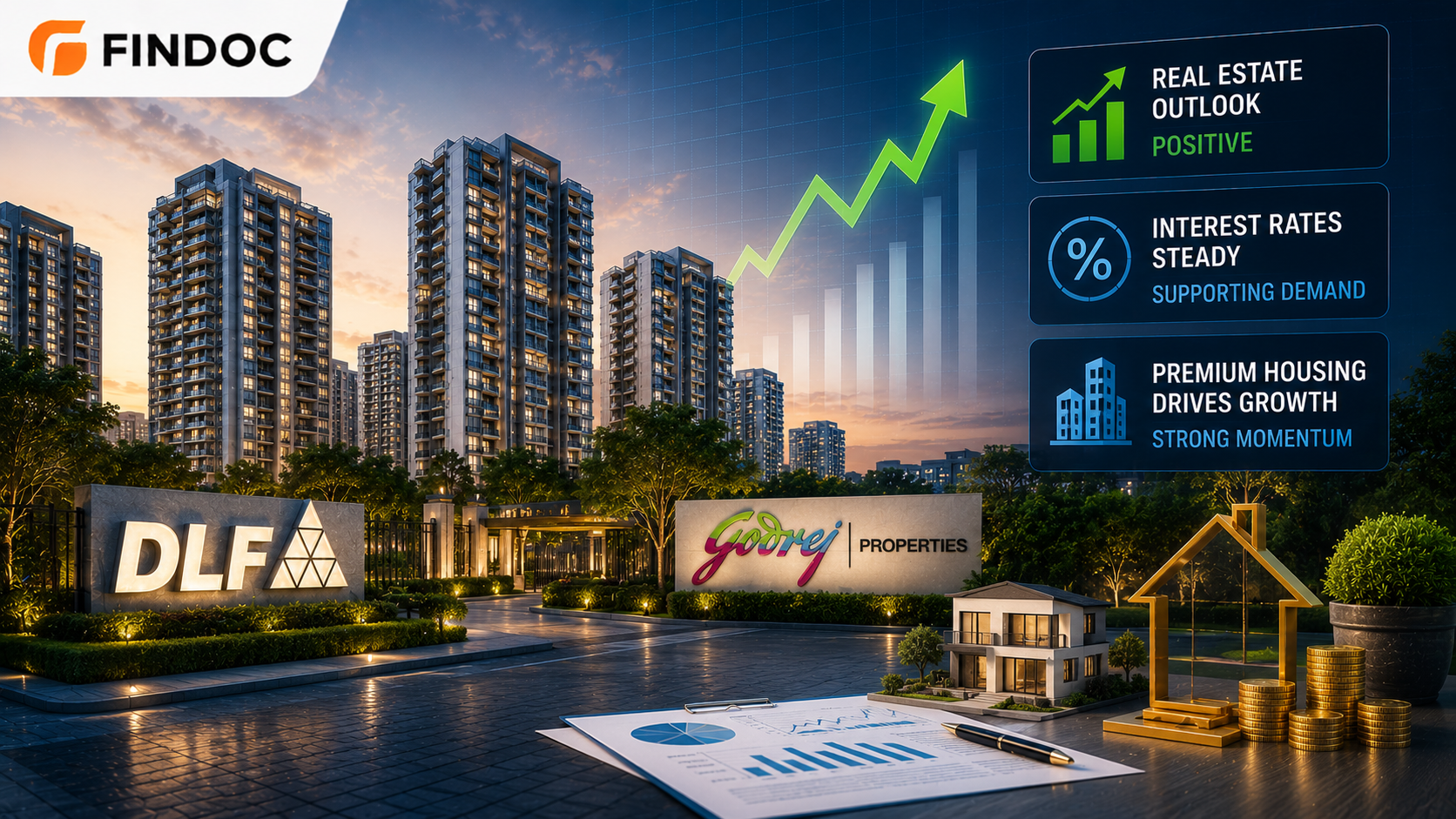
India’s listed real estate universe is extending its outperformance as easing inflation, stable RBI policy and robust pre-sales underpin institutional appetite for residential and Grade-A commercial assets. With Nifty Realty rallying over 2% in the latest session and large developers such as DLF and Godrej Properties reporting record pre-sales and deep pipelines, domestic and foreign investors are rotating into quality realty names despite lingering rate and affordability risks. Mumbai and Delhi-NCR continue to anchor demand, with premium and mid-income housing driving volumes even as regulatory scrutiny and execution discipline rise.
Key Highlights
- Nifty Realty index gains over 2% as realty and auto stocks lead a broad market rally.
- DLF trades around the ₹618 level, implying a market capitalisation above ₹1.5 lakh crore.
- Top 28 listed developers clock approximately ₹1.95 lakh crore in pre-sales in FY26, led by Godrej Properties.
- Mumbai and NCR see aggressive launches by national developers, with Godrej dominating NCR supply.
- Institutional real estate investments in India rise by over 20% year-on-year in the first half of 2026.
Residential Momentum and Nifty Realty Strength
The domestic real estate cycle remains in an upswing, reflected in the Nifty Realty index closing near 823–824 after a more than 2% gain in the previous session. The index has been one of the better-performing sectoral gauges on the NSE, helped by strong pre-sales, cleaner balance sheets, and a consolidation of market share in favour of large, branded developers. Realty stocks also participated in the latest broad-based rally that took the Nifty 50 beyond the 24,200 mark and lifted the Sensex by over 600 points, underlining risk-on sentiment towards rate-sensitive sectors.
Within the pack, DLF, Godrej Properties and a clutch of South- and West-focused developers have benefited from a structural shift: institutional and retail buyers are increasingly preferring developers with strong governance and execution track records. This has allowed top-tier names to pass on selective price increases without materially hurting volumes. Stable policy from the Reserve Bank of India—keeping the policy repo rate unchanged through recent reviews—has supported mortgage affordability even as home loan rates remain above the post-Covid trough. For institutional investors, the combination of steady end-user demand, rising pre-sales visibility and disciplined leverage is reinforcing the view that the current up-cycle has room to run, particularly in urban and suburban micro-markets of Mumbai, NCR, Bengaluru and Hyderabad. Investors looking to participate in this market movement can open demat account through SEBI-registered brokers to gain access to listed realty names on the NSE and BSE.
DLF, Godrej Properties and the Scale of the Up-Cycle
DLF remains a bellwether for listed Indian realty. The stock is currently trading around ₹618 per share, with a market capitalisation in the region of ₹1.5 lakh crore, placing it firmly among India’s top-value real estate developers. The counter has delivered double-digit returns year to date and strong multi-year compounding, with one-year performance significantly outpacing the broader market and the sector’s benchmark, aided by robust residential launches in Gurugram and sustained traction in its commercial leasing portfolio. For institutional investors, DLF’s low net debt, annuity income from rental assets, and high-visibility launch pipeline in Delhi-NCR remain key pillars of the investment case.
The broader industry data underscores the scale of the current up-cycle. Across the 28 largest listed real estate firms in India, pre-sales in FY26 are estimated at around ₹1.95 lakh crore, marking a healthy year-on-year expansion. Within this cohort, Mumbai-based Godrej Properties stands out with sales bookings rising to roughly ₹34,171 crore in the last fiscal, up from about ₹29,444 crore in the previous year—a growth of nearly 16%. This escalation in bookings reflects both volume gains and pricing power across its Mumbai, NCR, Pune and Bengaluru portfolios. Analysts tracking the sector note that Godrej’s brand strength, asset-light joint development model and aggressive launch cadence in key micro-markets have enabled it to capture incremental market share from smaller, capital-constrained developers.
National developers are also deepening their presence in Delhi-NCR. Recent data suggests that between 2022 and the first quarter of 2026, leading pan-India players such as Adani Realty, Tata Realty, Mahindra Lifespaces and Godrej Properties together launched over 15,000 residential units across roughly 30 projects in the region. Godrej Properties alone is estimated to account for close to half of these units, underlining its status as a dominant NCR player despite being headquartered in Mumbai. For investors, this is significant: Delhi-NCR has historically been a fragmented, volatile market with execution and regulatory risks; the rising share of established national developers could structurally de-risk the region’s supply profile over the medium term.
| Developer | FY26 Sales Bookings | Prior Year Bookings | YoY Growth | Key Markets |
|---|---|---|---|---|
| Godrej Properties | ₹34,171 crore | ₹29,444 crore | ~16% | Mumbai, NCR, Pune, Bengaluru |
| DLF | — | — | Double-digit YTD returns | NCR (Gurugram), Commercial Leasing |
| Top 28 Listed Developers (Combined) | ~₹1.95 lakh crore | — | Healthy YoY expansion | Pan-India |
Mumbai, NCR and Institutional Flows: Key Metrics and Risks
From an institutional perspective, India’s real estate market is again attracting meaningful capital. In the first half of 2026, institutional real estate investments are estimated to have risen by roughly 23% year-on-year to about USD 4.3 billion. Office assets in Mumbai, Bengaluru and NCR remain primary targets, complemented by growing interest in residential-led platforms, data centres, warehousing and alternative real estate. This inflow is being driven by global funds looking to capitalise on India’s relative macro-stability, strong corporate earnings, and structural urbanisation trends, even as they remain cautious on regulatory and currency risks. For participants evaluating their stock investment strategies, the combination of rising institutional flows and disciplined developer balance sheets presents a distinct set of considerations within the broader Indian equities landscape.
Key comparative themes for investors evaluating Indian real estate exposure are outlined below.
Demand Profile
- Mumbai and MMR continue to see strong end-user and investor demand in mid-income and premium segments, supported by high-income employment clusters and infrastructure upgrades such as metro expansions and coastal road connectivity.
- NCR demand is increasingly skewed towards projects by national and top-tier regional developers in Gurugram and Noida, with greater buyer sensitivity to developer reputation and construction progress.
Developer Positioning
- DLF has a relatively higher tilt towards NCR, with a strong annuity portfolio and premium branding in residential and commercial segments.
- Godrej Properties offers greater geographical diversification with meaningful exposure to Mumbai, Pune, Bengaluru and NCR, and a scalable joint development model that limits land capital intensity.
Policy and Rate Environment
- RBI’s focus remains on anchoring inflation while supporting growth; the current stance suggests limited near-term room for aggressive rate cuts. For real estate, this implies a scenario of stable to mildly easing home loan rates rather than a sharp down-cycle, supporting steady but not explosive affordability gains.
- State-level stamp duty policies, property tax regimes and development regulations in Maharashtra, Karnataka and Uttar Pradesh remain critical variables for project viability and pricing.
Risks
- A delay in rate normalisation, renewed inflation pressures, or a sharper-than-expected slowdown in IT/financial services hiring could weigh on housing demand, particularly in higher-ticket segments in Mumbai and Bengaluru.
- Construction cost inflation, regulatory delays in approvals, and any tightening in project finance availability could compress margins and slow execution.
- For listed names, sector valuations already discount a fair portion of the positive cycle, making them vulnerable to earnings disappointments or policy shocks.
Market Outlook
The near- to medium-term outlook for Indian real estate remains constructive. Pre-sales momentum for the top 20–30 developers is likely to stay strong, supported by healthy booking pipelines, favourable demographics, and rising urban household incomes. For Mumbai and NCR, continued infrastructure build-out should expand the radius of viable micro-markets and support price realisations, even if the pace of price growth moderates from recent peaks. From a macro perspective, as long as the RBI maintains a broadly stable policy rate environment and inflation stays within the tolerance band, mortgage affordability should remain manageable and support steady absorption.
For institutional investors, the sector offers a mix of listed equity plays—such as DLF, Godrej Properties and other Nifty Realty constituents—with strong cash flow visibility, and private market exposure to rent-yielding office, logistics and data centre assets. Access to a reliable trading platform has become increasingly important as retail participation in listed realty names has grown alongside institutional interest. The key will be discriminating between well-capitalised, governance-strong platforms and leveraged, speculative developers, particularly if the cycle matures and becomes more selective.
Conclusion
India’s real estate sector is entering a more institutional, consolidated phase, with large developers like DLF and Godrej Properties setting the tone on governance, execution and capital discipline. Robust FY26 pre-sales of around ₹1.95 lakh crore across the top listed firms, rising institutional inflows, and the leadership of Mumbai and NCR in both launches and investments point to a structurally stronger market than in previous cycles. Yet, with valuations rich and the interest rate trajectory still crucial, investors must remain selective, focusing on balance sheet resilience, geographic diversification and execution visibility. For long-term Indian and global investors, exposure to high-quality real estate names and assets remains a credible way to participate in the country’s urbanisation and income growth story, while maintaining a clear eye on cyclical and policy-linked risks.
Leave a Reply