findocblog

Author: findocadmin

  • Nifty July Futures Trade at Premium IT Giants Lead Volume

    Nifty July Futures Trade at Premium IT Giants Lead Volume

    India’s equity derivatives market showed firm activity on Friday, July 24, 2026, as Nifty July futures traded at a notable premium to the spot index. The session drew significant participation from institutional and retail traders alike. Infosys, HDFC Bank, and Tata Consultancy Services (TCS) emerged as the top traded contracts in the futures and options segment, reflecting sustained investor interest in heavyweight blue-chip names.

    What Changed

    Nifty July futures closed at a premium over the underlying spot index, signaling a broadly positive sentiment in the near-term outlook among derivatives traders. The cost of carry remained elevated, suggesting that participants are willing to hold long positions into the expiry cycle. Trading volumes were robust across the top three contracts.

    Contract Segment Rank by Volume Futures Sentiment
    Infosys IT / Technology #1 Active participation
    HDFC Bank Banking / Financial Services #2 Active participation
    Tata Consultancy Services IT / Technology #3 Active participation
    Nifty July Futures Index Derivatives Benchmark Trading at premium

    The dominance of IT majors Infosys and TCS in trading volumes underscores continued market focus on the technology sector. Meanwhile, HDFC Bank’s high activity reflects ongoing attention to private banking performance amid evolving credit and deposit dynamics.

    Why It Matters for Investors

    When Nifty futures trade at a premium, it generally reflects positive market bias. Traders are pricing in expectations of further upside or are hedging long equity portfolios. This is an important signal for short-term positioning decisions. However, premiums can narrow quickly if sentiment shifts.

    For investors tracking large-cap exposure, the high volume in Infosys, HDFC Bank, and TCS contracts is meaningful. These three stocks carry significant weight in both the Nifty 50 and benchmark mutual fund portfolios. Their derivatives activity often influences broader index movement. Open demat and trading account online platforms have made accessing these derivative products significantly easier for retail investors seeking to participate in futures markets efficiently.

    Potential Financial Impact

    The premium in July futures indicates a positive cost of carry. This reflects market confidence heading into the near-term expiry. Infosys and TCS, both of which recently reported quarterly earnings, have provided forward revenue guidance that traders are actively pricing into futures contracts. HDFC Bank’s loan growth trajectory and net interest margin outlook also remain central to institutional positioning strategies in the banking segment.

    Expert or Market Reaction

    Market participants noted that IT sector contracts attracted the bulk of speculative and hedging interest following recent earnings releases. Analysts observed that the Nifty July futures premium reflects a constructive tone among domestic institutional investors. However, some traders flagged caution around global macroeconomic cues that could influence index direction before expiry.

    In addition, options data from the session revealed significant open interest build-up at key strike prices. This suggests that the market is watching critical support and resistance zones closely. Derivative analysts noted that implied volatility remained moderate, pointing to a measured rather than euphoric sentiment environment.

    Broader Context

    India’s futures and options market has grown substantially in recent years. The NSE remains one of the largest derivatives exchanges globally by contract volume. The participation of heavyweight stocks like Infosys, HDFC Bank, and TCS as top traded contracts is consistent with historical patterns, particularly around earnings seasons.

    Factor Current Observation
    Nifty Futures Premium Positive, reflecting bullish near-term bias
    IT Sector Activity Elevated post Q1 earnings disclosures
    Banking Sector Focus HDFC Bank credit growth and margin trends
    Global Macro Environment Uncertain; monitored for index direction

    Therefore, the current derivatives activity provides a snapshot of where large market participants are placing their bets for the remainder of the July series. The expiry date will be a key moment of price discovery for all active contracts.

    Key Risks and Factors to Consider

    While positive futures premiums signal short-term optimism, investors must weigh several risk factors carefully. Global macroeconomic headwinds, including interest rate decisions by major central banks, could quickly alter risk appetite. A sharp reversal in global IT spending sentiment could pressure Infosys and TCS contracts significantly.

    For HDFC Bank, execution risk around deposit mobilization and credit quality remains a monitored area. Regulatory changes in the banking sector add another layer of uncertainty. Furthermore, elevated valuations in the broader market mean limited room for error if earnings disappoint. Margin pressure and competitive dynamics in the IT sector also deserve close attention from derivatives traders.

    What Investors Should Watch Next

    • Monitor the Nifty July futures premium closely as the expiry date approaches, any narrowing could signal shifting sentiment.
    • Track weekly open interest changes in Infosys and TCS contracts for directional cues on IT sector positioning.
    • Watch HDFC Bank’s loan growth and asset quality data releases for impact on banking futures contracts.
    • Follow global cues, including US Federal Reserve commentary and currency movements, which directly affect IT earnings estimates.
    • Use a reliable stock trading platform to monitor real-time open interest, volume trends, and cost-of-carry data across these key contracts efficiently.

    Conclusion

    Nifty July futures trading at a premium reflects a cautiously positive near-term market tone. The leadership of Infosys, HDFC Bank, and TCS in traded contract volumes highlights concentrated institutional interest in these benchmark names. Investors should treat derivatives activity as a directional indicator rather than a definitive forecast.

    As always, risk management remains critical. The July expiry cycle will provide clearer answers on whether current premiums are justified by underlying fundamentals. Staying informed and disciplined remains the most prudent approach in this environment.

    • Nifty July futures traded at a premium, indicating positive near-term market sentiment among derivatives participants.
    • Infosys, HDFC Bank, and TCS dominated contract volumes, reflecting sustained institutional focus on IT and banking sectors.
    • Key risks include global macro uncertainty, valuation concerns, and potential margin pressure in the IT and banking segments.

    Explore Nifty 50 Stocks
    Adani Enterprises Share Price Apollo Hospital Ent. Share Price
    Asian Paints Share Price Axis Bank Share Price
    Bajaj Auto Share Price Bharat Electronics Share Price
    Bharti Airtel Share Price Cipla Share Price
    Dr. Reddy’s Labs. Share Price Eicher Motors Share Price
  • Geopolitical Risks May Push Brent Crude to $120

    Geopolitical Risks May Push Brent Crude to $120

    Mohammed Imran, a senior analyst at Mirae Asset, has issued a sharp warning about rising geopolitical risks in global energy markets. According to Imran, escalating tensions in the Red Sea and the Strait of Hormuz could push Brent crude oil prices to $120 per barrel. This warning has drawn significant attention from institutional and retail investors alike. Energy stocks and commodity-linked assets are now firmly in the spotlight.

    Deal Highlights

    This is not a corporate deal in the traditional sense. Instead, it represents a critical analyst forecast that carries major implications for oil markets. The key details from Mirae Asset’s assessment are summarised below.

    Parameter Details
    Analyst Mohammed Imran, Mirae Asset
    Source Business Standard
    Current Brent Crude Level Not disclosed
    Projected Brent Crude Target $120 per barrel
    Key Risk Factors Red Sea tensions, Strait of Hormuz disruptions
    Timeline for Price Target Not disclosed
    Firm Mirae Asset

    Imran’s forecast highlights two critical chokepoints in global oil supply chains. The Red Sea and the Hormuz Strait together handle a massive share of the world’s daily oil shipments. Any sustained disruption in either region could tighten global supply significantly.

    Why It Matters

    Potential Business Impact

    Global oil supply depends heavily on safe maritime passage through key shipping lanes. The Strait of Hormuz alone handles roughly 20% of the world’s oil trade daily. As a result, any blockage or conflict in this region directly affects crude oil prices worldwide.

    Meanwhile, ongoing tensions in the Red Sea have already disrupted commercial shipping routes. Several major shipping firms have rerouted vessels around the Cape of Good Hope. This adds time, cost, and uncertainty to global energy logistics.

    Higher crude prices directly affect industries like aviation, logistics, manufacturing, and power generation. In addition, oil-importing nations like India face pressure on their trade deficits and currency values. This, in turn, can influence inflation and monetary policy decisions.

    Market Reaction

    Oil-linked stocks and energy funds tend to react swiftly to geopolitical forecasts of this magnitude. Investors have begun reassessing positions in upstream oil companies, refiners, and energy ETFs. However, exact stock price movements following this specific report are not disclosed.

    Asset Class Expected Impact Direction
    Upstream Oil Stocks Higher crude boosts revenue Positive
    Refining Companies Margins may compress with higher input costs Mixed
    Aviation Stocks Higher fuel costs squeeze profits Negative
    Energy ETFs Broad rally expected in oil-linked funds Positive
    Indian Rupee Higher import bill may weaken currency Negative

    Commodity traders and hedge funds are closely watching Brent crude futures. Furthermore, retail investors with exposure to oil PSUs and energy mutual funds are on alert. Market sentiment around crude has clearly shifted toward the bullish side.

    Industry Context

    The global oil market has faced repeated supply shocks in recent years. Following the Russia-Ukraine conflict, energy security became a top priority for governments worldwide. As a result, any new geopolitical flashpoint triggers outsized market reactions.

    The Red Sea crisis, driven largely by Houthi attacks on commercial vessels, has already raised shipping insurance premiums. In addition, transit delays have pushed up freight costs across multiple industries. These costs eventually pass through to consumers and businesses alike.

    The Strait of Hormuz remains one of the most strategically sensitive waterways on earth. Iran controls significant influence over this narrow passage. Therefore, any escalation involving Iran could immediately threaten global crude supply flows.

    What Investors Should Watch Next

    Investors should monitor the following key developments closely over the coming weeks:

    • Brent crude futures movement: Watch daily price action for signs of a sustained move toward $100 and beyond.
    • Geopolitical developments in the Red Sea and Hormuz: Any escalation could trigger rapid price spikes in crude oil markets.
    • India’s trade deficit data: Higher oil prices will likely widen India’s import bill and pressure the rupee.
    • Central bank responses: Rising inflation driven by energy costs may delay rate cuts in key economies.
    • Energy sector earnings: Track quarterly results from major oil producers and refiners for margin impact signals.

    Conclusion

    Mohammed Imran’s forecast from Mirae Asset serves as a timely reminder of how quickly geopolitical events can reshape global commodity markets. The Red Sea and Hormuz risks are real, ongoing, and directly tied to crude oil prices. Investors with energy exposure must stay informed and agile. A best trading platform helps investors track and act on such developments in real time.

    Investor Takeaways

    • Monitor energy stocks actively: Oil price spikes at $120 per barrel would significantly boost upstream producers while squeezing oil-dependent industries.
    • Diversify with caution: Consider balancing energy holdings with sectors less exposed to commodity price volatility, such as technology or domestic consumption.
    • Start investing today: Investors can open demat account online to access energy stocks, ETFs, and commodity-linked instruments quickly and efficiently.
    Also Explore
    Top Gainers Today Top Losers Today
    Top Performers Under Performers
    Advances & Declines Heat Map
    ADR Prices Bulk Deals Today
    Penny Stocks Penny Stocks Under ₹1
  • Mirae Asset Warns Higher Oil Prices May Outweigh

    Mirae Asset Warns Higher Oil Prices May Outweigh

    Mirae Asset has issued a notable market advisory. The firm warns that rising oil prices could reduce gold’s appeal as a safe-haven asset. This shift may significantly affect how investors allocate funds across commodities. As a result, both gold and energy markets are drawing close attention from traders worldwide.

    The advisory comes at a time when global commodity markets face mounting pressure. Oil prices have climbed steadily due to supply constraints and geopolitical tensions. Meanwhile, gold has traditionally benefited from uncertainty. However, Mirae Asset suggests this dynamic may now be changing.

    Deal Highlights

    Mirae Asset’s research team has outlined a clear position on the gold-versus-oil debate. The firm believes that elevated oil prices create inflationary pressure. This, in turn, raises the cost of holding gold as a non-yielding asset. Investors may therefore shift preference toward energy-linked investments.

    Factor Gold Oil
    Current Demand Driver Safe-haven sentiment Supply constraints + geopolitical risk
    Inflation Sensitivity Moderate positive Strong positive
    Yield None Indirect (via energy stocks)
    Mirae Asset Outlook Cautious Relatively Favourable
    Key Risk Oil price surge reducing appeal Demand slowdown

    The figures above reflect Mirae Asset’s current analytical framework. Specific price targets were not disclosed. However, the directional call is clear oil may lead commodity performance in the near term.

    Why It Matters

    Potential Business Impact

    Rising oil prices affect nearly every sector of the economy. In addition, they raise input costs for businesses and squeeze consumer spending power. This creates a complex environment for investors managing diversified portfolios.

    Gold has long served as a hedge during times of crisis. However, if inflation becomes a dominant concern, oil and energy assets may offer stronger returns. Mirae Asset’s view suggests investors should reassess their commodity exposure now.

    For gold-focused funds and ETFs, this outlook presents a challenge. Outflows could increase if institutional investors follow Mirae Asset’s guidance. Meanwhile, energy funds may see increased inflows in the coming months.

    Market Reaction

    Markets responded with moderate caution following Mirae Asset’s advisory. Gold prices showed signs of softening as traders absorbed the firm’s comments. Oil, on the other hand, held firm near recent highs.

    Asset Reaction to Advisory Trend Direction
    Gold Slight softening in sentiment Cautious/Bearish short-term
    Crude Oil Stable to positive Bullish short-term
    Energy Stocks Modest upside interest Positive
    Gold ETFs Increased scrutiny Under review

    Exact price movements at the time of publication were not disclosed. However, market participants noted a visible shift in tone across commodity trading desks. Following this advisory, several analysts echoed Mirae Asset’s concerns about gold’s near-term prospects.

    Industry Context

    The gold market has faced a mixed environment in recent months. On one hand, geopolitical uncertainty typically boosts safe-haven demand. On the other hand, persistent inflation and energy price surges complicate the picture.

    Oil-producing nations have maintained supply discipline. This has kept crude prices elevated for an extended period. As a result, energy inflation continues to ripple through global economies.

    Historically, gold and oil move in different directions during inflation cycles. However, when oil-driven inflation dominates, gold can underperform. Mirae Asset’s position aligns with this historical pattern, making it a view worth taking seriously.

    What Investors Should Watch Next

    • Oil supply updates from OPEC+ and major producers any further cuts could push prices higher and weigh on gold demand
    • Inflation data releases in the US and Europe strong readings may reinforce Mirae Asset’s cautious gold outlook
    • Central bank policy signals interest rate decisions directly affect gold’s attractiveness as a non-yielding asset
    • Gold ETF flow data sustained outflows would confirm weakening institutional interest in gold
    • Energy sector earnings strong results could accelerate rotation from gold into oil-linked equities

    Conclusion

    Mirae Asset’s advisory delivers a clear and timely message for commodity investors. Higher oil prices may erode the traditional safe-haven premium that gold commands. Investors should review their commodity allocations carefully and act on updated research.

    This is not a moment for complacency. The interplay between oil inflation and gold sentiment is shifting quickly. A best trading platform helps investors track and act on such developments in real time, ensuring they never miss a critical market move.

    Investor Takeaways

    • Reassess gold exposure — Mirae Asset’s outlook suggests reducing overweight positions in gold until oil price pressures ease
    • Increase energy sector watch — Oil-linked stocks and ETFs may outperform in the current inflationary environment, making them worth monitoring closely
    • Start investing efficiently — Investors can open demat account online to gain quick access to commodity ETFs, energy stocks, and gold instruments without delay
    Also Check Market Data
    Penny Stocks Penny Stocks Under ₹1
    Penny Stocks Under ₹10 Penny Stocks Under ₹5
    Stocks Under ₹20 FMCG Stocks
    Automobile Stocks Information Technology Stocks
    Bank Stocks High Return Penny Stocks
  • Brent Crude Hovers Above $100 on Red Sea Disruptions

    Brent Crude Hovers Above $100 on Red Sea Disruptions

    Brent crude oil prices climbed above the $100 per barrel mark as geopolitical tensions escalated in the Middle East. Red Sea shipping disruptions and growing fears of a broader Iran-linked conflict pushed energy markets into high alert. As a result, energy stocks surged globally, while investors scrambled to reassess their portfolios. This development marks a significant moment for commodity traders and equity investors alike.

    Deal Highlights

    The price spike stems from two major pressure points: ongoing Red Sea disruptions and rising concerns over potential Iran-linked military conflict. These factors combined to tighten oil supply expectations sharply. Meanwhile, shipping companies rerouted vessels away from the Red Sea, adding cost and time to global trade routes.

    Metric Detail
    Brent Crude Price Above $100 per barrel
    Key Trigger 1 Red Sea shipping disruptions
    Key Trigger 2 Iran war escalation concerns
    Previous Price Level Not disclosed
    Date of Spike Not disclosed
    Major Impacted Region Middle East / Global shipping lanes

    In addition, energy analysts noted that the combination of supply-side shocks and geopolitical uncertainty created a rare convergence of upward price pressures.

    Why It Matters

    Potential Business Impact

    Oil prices above $100 per barrel carry wide-ranging effects across industries. Airlines, logistics firms, and manufacturers face higher input costs immediately. However, energy producers and oil-linked equities stand to benefit significantly from elevated prices.

    Shipping companies that reroute around the Red Sea face longer voyages and higher fuel bills. This means consumers could eventually see price increases on imported goods. In addition, central banks may face renewed inflationary pressures, complicating their monetary policy decisions.

    Energy-exporting nations gain budget windfalls at these price levels. Meanwhile, energy-importing economies face growing current account pressures. The broader economic ripple effect touches nearly every sector of the global market.

    Market Reaction

    Energy stocks responded sharply to the price surge. Oil majors saw their share prices climb as investors priced in stronger earnings ahead. Meanwhile, broader equity indices showed mixed reactions, reflecting uncertainty about inflation and interest rates.

    Market Segment Reaction
    Global Energy Stocks Strong gains
    Shipping Stocks Mixed; cost pressures noted
    Broader Equity Indices Mixed reaction
    Commodity Markets Bullish on crude and related assets
    Bond Markets Not disclosed

    Following this spike, trading volumes in energy futures rose sharply. Investors moved quickly to add energy exposure to their portfolios. As a result, crude oil futures contracts saw heightened activity across major exchanges.

    Industry Context

    The Red Sea is one of the world’s most critical shipping corridors. It connects Europe and Asia through the Suez Canal, carrying a significant share of global trade. Therefore, any disruption in this route immediately affects supply chains and commodity pricing.

    Iran’s role in regional geopolitics adds another layer of complexity. Tensions involving Iran have historically triggered sharp oil price movements. However, the current situation appears more severe due to the simultaneous nature of multiple disruptions occurring together.

    Global oil markets were already navigating tight supply conditions before this escalation. OPEC+ production cuts had kept inventory levels lean. In addition, demand from Asia remained robust, leaving little buffer for unexpected supply shocks.

    What Investors Should Watch Next

    • Red Sea situation updates: Any escalation or resolution will directly move oil prices.
    • Iran-related diplomatic developments: Watch for statements from the U.S., EU, and regional powers.
    • OPEC+ response: Member nations may adjust output targets in response to price levels.
    • Inflation data releases: Higher oil prices could push inflation figures upward in coming months.
    • Central bank commentary: Fed and ECB officials may signal policy adjustments tied to energy-driven inflation.

    Conclusion

    Brent crude’s move above $100 per barrel signals a new phase of energy market volatility. Geopolitical risk, shipping disruptions, and tight supply conditions are all pushing prices higher simultaneously. However, investors who stay informed and act decisively can navigate this environment effectively.

    Energy sector exposure looks increasingly attractive under these conditions. In addition, commodity-linked assets may offer portfolio diversification benefits during this period of uncertainty. A best trading platform helps investors track and act on such developments in real time, ensuring they never miss a critical market move.

    Investor Takeaways

    • Act on energy exposure: Oil above $100 makes energy stocks worth reviewing in your portfolio immediately.
    • Diversify with commodities: Consider crude oil futures or ETFs to hedge against further supply shocks.
    • Start investing today: Investors can open demat account online to access energy stocks and commodity instruments quickly and efficiently.
    Also Explore
    Top Gainers Today Top Losers Today
    Top Performers Under Performers
    Advances & Declines Heat Map
    ADR Prices Bulk Deals Today
    Penny Stocks Penny Stocks Under ₹1
  • Gold and Silver Regain Momentum as Crude Oil Falls Below

    Gold and Silver Regain Momentum as Crude Oil Falls Below

    Gold and silver prices staged a strong recovery recently, regaining upward momentum after a brief pullback. Meanwhile, crude oil dropped below the key $100-per-barrel level. These moves have drawn significant attention from commodity investors and market analysts worldwide.

    The shift in commodity prices reflects broader market forces, including inflation concerns, currency movements, and shifting demand signals. As a result, investors are closely watching how these trends develop in the coming weeks.

    Deal Highlights

    The key commodity price movements are summarized below for quick reference:

    Commodity Previous Level Recent Level Change Direction
    Gold Not disclosed Regained momentum Upward
    Silver Not disclosed Regained momentum Upward
    Crude Oil Above $100/barrel Below $100/barrel Downward

    These movements represent notable shifts across major commodity markets. In addition, they signal changing investor sentiment toward risk and safe-haven assets. The exact price figures were not disclosed in full detail by the source.

    Why It Matters

    Potential Business Impact

    Gold and silver are traditional safe-haven assets. Investors often turn to them during periods of economic uncertainty or inflation. Their renewed momentum suggests that market participants may be growing cautious about broader economic conditions.

    However, the fall in crude oil below $100 a barrel carries different implications. Lower oil prices can reduce input costs for businesses and ease inflationary pressure. This means consumers and industries dependent on energy may see some relief in the near term.

    For commodity-linked stocks and funds, these movements matter significantly. In addition, companies in the energy sector may face revenue pressure as crude oil prices decline. Meanwhile, gold and silver miners could benefit from higher precious metal prices.

    Market Reaction

    Investor reaction to these commodity moves has been notable. Gold and silver recovering momentum tends to attract buying interest in related exchange-traded funds (ETFs) and mining stocks. As a result, volumes in these segments typically rise during such periods.

    On the other hand, crude oil’s decline below $100 per barrel may weigh on oil and gas stocks. Energy companies often see their earnings closely tied to benchmark crude prices. Following this drop, analysts will likely reassess near-term earnings forecasts for major oil producers.

    Market Segment Likely Reaction Key Driver
    Gold ETFs / Miners Positive sentiment Rising gold prices
    Silver ETFs / Miners Positive sentiment Rising silver prices
    Oil & Gas Stocks Negative pressure Crude below $100
    Broader Equity Markets Mixed Balancing inflation vs. energy relief


    Industry Context

    Commodity markets have experienced heightened volatility in recent months. Global supply chain disruptions, geopolitical tensions, and central bank policy shifts have all contributed to sharp price swings. Meanwhile, energy markets in particular have remained sensitive to global demand signals.

    Gold and silver had faced selling pressure earlier, as rising interest rates reduced the appeal of non-yielding assets. However, renewed buying interest suggests that investors are once again seeking protection against inflation and currency risks. This is a pattern that has repeated several times in recent market cycles.

    Crude oil, in contrast, had surged sharply earlier in the year. Geopolitical factors and supply concerns drove prices well above $100 per barrel. As a result, the recent decline may reflect easing supply fears or softening demand expectations.

    What Investors Should Watch Next

    • Gold and silver price levels: Watch for sustained momentum above key resistance levels in both metals.
    • Crude oil supply data: Weekly inventory reports will indicate whether the drop below $100 is short-term or sustained.
    • Central bank policy signals: Interest rate decisions directly impact gold and silver prices.
    • Currency movements: A stronger or weaker US dollar significantly influences commodity prices globally.
    • Earnings updates from energy and mining companies: These will reflect the real business impact of current commodity price trends.

    Conclusion

    Gold and silver regaining momentum while crude oil falls below $100 per barrel marks a meaningful shift in commodity markets. Investors should treat these developments as signals of changing risk appetite and inflation expectations. In addition, the divergence between precious metals and energy prices creates both opportunities and risks across different sectors.

    Monitoring these trends in real time is essential for timely decision-making. A best trading platform helps investors track and act on such developments in real time. Staying informed and disciplined remains the key to navigating commodity market volatility effectively.

    Investor Takeaways

    • Precious metals offer a hedge: Gold and silver regaining momentum suggests safe-haven demand is returning. Consider reviewing exposure to gold and silver ETFs or related stocks.
    • Energy sector caution: Crude oil below $100 may pressure oil and gas earnings. In addition, this could affect dividend outlooks for energy-heavy portfolios.
    • Start investing with ease: Investors can open demat account online to start trading commodities, ETFs, and stocks quickly and efficiently in today’s fast-moving markets.
    Explore Trending Stocks
    Adani Enterprises Share Price Adani Green Energy Share Price
    Adani Power Share Price Aditya Infotech Share Price
    Ambuja Cement Share Price Apollo Tyres Share Price
    Asahi India Glass Share Price Asian Paints Share Price
    Ather Energy Share Price Bajaj Finance Share Price
  • Notandas Realty Acquires Juhu’s Villa Wilson for ₹135 Cr

    Notandas Realty Acquires Juhu’s Villa Wilson for ₹135 Cr

    Directors of Notandas Realty have acquired Villa Wilson, a prominent property located in Juhu, Mumbai, for ₹135 crore. The transaction signals continued investor appetite for prime land parcels in Mumbai’s western suburbs, where supply remains constrained and demand stays elevated among luxury developers.

    What Changed

    The deal involves the acquisition of Villa Wilson in Juhu, one of Mumbai’s most sought-after residential micro-markets. The purchase was executed by directors of Notandas Realty, a firm with an established presence in Mumbai’s premium real estate segment. The transaction value stands at ₹135 crore.

    Detail Information
    Property Name Villa Wilson
    Location Juhu, Mumbai
    Acquirer Directors of Notandas Realty
    Deal Value ₹135 crore
    Intended Development Not disclosed
    Project Timeline Not disclosed

    The specific development plans for the acquired property have not been disclosed. However, the acquisition expands the firm’s land bank in a location known for strong capital value appreciation and limited available inventory.

    Why It Matters for Investors and Homebuyers

    Juhu remains one of Mumbai’s most premium residential zones. It consistently attracts high-net-worth buyers and luxury developers. Land transactions of this scale in the area are relatively rare. Therefore, this deal draws attention from across the investment community.

    For investors tracking Mumbai’s luxury segment, such acquisitions highlight ongoing confidence in the city’s high-end residential market. Those looking to diversify their real estate exposure can use such transactions as market signals. Investors who already open demat account online to track listed realty stocks may find this deal relevant when assessing Mumbai-focused developer performance.

    Homebuyers eyeing Juhu should note that large land acquisitions often precede premium residential launches. In addition, they tend to place upward pressure on surrounding property values over time.

    Potential Financial Impact

    A ₹135 crore land acquisition in Juhu carries significant financial implications. Juhu properties regularly command some of Mumbai’s highest per-square-foot rates. As a result, any future development on this site could generate substantial revenue for Notandas Realty.

    However, the financial outcome depends heavily on the development type, regulatory approvals, and prevailing market conditions at the time of launch. Without disclosed project plans, precise revenue projections remain unavailable at this stage.

    Expert or Market Reaction

    Market observers note that high-value land acquisitions in Juhu reflect broader trends in Mumbai’s luxury real estate sector. Demand for premium properties in the western suburbs has remained resilient despite macroeconomic pressures seen in other asset classes.

    Meanwhile, developers have been actively consolidating land parcels in key micro-markets across Mumbai Metropolitan Region. This deal aligns with that broader pattern of strategic land bank expansion. Industry watchers see such moves as a sign that established developers expect sustained demand in the luxury and ultra-luxury segments over the medium term.

    Broader Context

    Mumbai’s western suburbs have witnessed a steady increase in high-value real estate transactions over the past two to three years. Juhu, Bandra, and Versova have seen growing developer interest. Limited re-developable land supply has made large plots particularly valuable.

    Market Factor Current Status
    Luxury Demand in Juhu Strong and sustained
    Land Supply Scarce in prime zones
    Mumbai Luxury Price Trend Upward over recent years
    Developer Activity Rising land bank consolidation

    Regulatory frameworks under RERA have also increased buyer confidence in new project launches. For instance, buyers in luxury segments now expect greater transparency in project timelines and fund utilisation. This regulatory clarity has encouraged more high-value land transactions by credible developers.

    Key Risks and Factors to Consider

    Despite the positive signals, investors and market observers should account for several risks associated with this transaction and its potential development.

    • Regulatory and approval delays: Large Mumbai redevelopments frequently encounter prolonged approval timelines from civic and state authorities.
    • Construction execution risk: High-value projects in dense urban zones face logistical and construction complexity.
    • Demand slowdown: A global or domestic economic downturn could dampen appetite for ultra-luxury properties.
    • Financing constraints: Rising interest rates can affect both developer financing costs and buyer affordability.
    • Undisclosed development plan: Without clarity on the intended project type, investors cannot yet assess revenue visibility or timeline.

    What Readers Should Watch Next

    • Official announcement of development plans or RERA registration for the Villa Wilson site.
    • Any further land acquisitions by Notandas Realty directors in Mumbai’s western suburbs.
    • Regulatory approvals from the Brihanmumbai Municipal Corporation related to this property.
    • Movement in Juhu area property prices following this high-profile acquisition.
    • Investors tracking real estate sector stocks can monitor developments through a reliable investing and trading platform for timely updates on listed developer performance.

    Conclusion

    The ₹135 crore acquisition of Villa Wilson by Notandas Realty directors represents a significant land deal in one of Mumbai’s most premium residential markets. It underscores continued developer confidence in Juhu’s long-term value proposition. However, with development plans not yet disclosed, the full impact of this transaction remains to be seen.

    Investors and homebuyers should monitor regulatory filings, project announcements, and market pricing trends in the Juhu micro-market closely in the months ahead.

    • Key Takeaway 1: Notandas Realty directors have acquired Juhu’s Villa Wilson for ₹135 crore, expanding the firm’s land bank in a high-demand Mumbai micro-market.
    • Key Takeaway 2: Development plans remain undisclosed, making regulatory approvals and project launch timelines critical factors to watch.
    • Key Takeaway 3: The deal reflects broader momentum in Mumbai’s luxury real estate segment, though execution and demand risks remain real considerations for investors.
    Explore Real Estate Stocks
    Aditya Birla Real Share Price Anant Raj Share Price
    Brigade Enterprises Share Price DLF Share Price
    Godrej Properties Share Price Lodha Developers Share Price
    Oberoi Realty Share Price Phoenix Mills Share Price
    Prestige EstatesProj Share Price Sobha Share Price
  • US Housing Market Stalls: High Rates Crush Summer Sales

    US Housing Market Stalls: High Rates Crush Summer Sales

    The American housing market is experiencing one of its most difficult summers in recent memory. A combination of elevated mortgage rates, limited inventory, and stretched affordability has pushed many buyers and sellers to the sidelines. The market slowdown is not temporary noise it reflects deeper structural pressures that investors and homebuyers must understand clearly.

    What Changed

    Mortgage rates have remained stubbornly high throughout 2024. The 30-year fixed mortgage rate has hovered near 7% for an extended period, making monthly payments significantly more expensive than just two years ago. Meanwhile, existing homeowners with locked-in rates below 4% are reluctant to sell. This dynamic has created what analysts now call a “lock-in effect.”

    As a result, the supply of available homes remains historically low. Fewer listings mean less transaction volume. Home prices, however, have not fallen meaningfully in most markets. Instead, prices have stayed elevated due to the same inventory shortage that is suppressing sales activity.

    Market Indicator Current Status Comparison (2021–2022)
    30-Year Fixed Mortgage Rate ~7% ~3–4%
    Existing Home Sales Volume Near multi-decade lows Above 6 million annually
    Available Housing Inventory Historically constrained Already low, worsening since
    Median Home Price Trend Elevated, not declining Rising sharply


    Why It Matters for Investors and Homebuyers

    For real estate investors, the current environment presents a difficult entry point. High borrowing costs erode returns on leveraged acquisitions. Rental yield calculations must now account for significantly higher financing expenses. For first-time buyers, affordability has reached crisis levels in many metropolitan areas.

    Investors who want exposure to real estate markets without direct property ownership are increasingly exploring REITs and real estate-linked securities. Those who are new to financial markets and want to explore such instruments should consider starting by opening a free demat account to access real estate investment trusts and other publicly traded property vehicles efficiently.

    However, the high-rate environment also creates selective opportunities. Distressed sellers, motivated by relocation or financial need, may offer negotiating room. In addition, markets where new construction is active may present better value than resale-dominated markets.

    Potential Financial Impact

    The financial impact of current conditions is measurable. A buyer purchasing a $400,000 home at 7% versus 3.5% faces roughly $700–$800 more per month in mortgage payments. Over a 30-year term, that difference exceeds $250,000 in total interest paid. This dramatically reduces purchasing power across all income brackets.

    For real estate investors using leverage, the math is equally sobering. Cap rates in many markets have not expanded fast enough to offset the higher cost of debt. Therefore, cash flow-positive acquisitions are harder to find without a substantial down payment or an all-cash purchase strategy.

    Expert or Market Reaction

    Industry observers have pointed out that the Federal Reserve’s prolonged high-rate stance is the primary driver of housing market stress. Many economists had expected rate cuts earlier in 2024, which would have provided relief to buyers. Those expectations have been repeatedly pushed back as inflation data remained persistent.

    Real estate industry groups have reported declining agent transaction volumes. Some builders have responded by offering mortgage rate buydowns to attract buyers, effectively subsidizing financing costs to keep new home sales moving. Meanwhile, existing homeowners continue to hold their properties rather than trade up.

    Broader Context

    The current housing slowdown is not isolated to one region. It reflects a national repricing of risk following the ultra-low rate environment of 2020–2021. During that period, home prices surged by 30–40% in many markets. That run-up was largely fueled by cheap debt. As rates normalized, transaction volume collapsed but prices did not follow proportionally.

    This divergence between volume and price is unusual. Historically, falling sales volume eventually leads to price corrections. However, the extreme supply shortage is acting as a floor under prices. New construction has not kept pace with long-term demand, a structural deficit that predates the pandemic by over a decade.

    Key Risks and Factors to Consider

    Risk Factor Description Investor Implication
    Prolonged High Rates Fed holds rates longer than expected Reduced deal volume, tighter margins
    Demand Slowdown Buyers exit market due to affordability Longer hold periods, weaker exits
    Financing Constraints Lenders tighten credit standards Harder to leverage acquisitions
    Price Correction Risk Volume decline may eventually pressure prices Valuation risk on recent acquisitions
    Regulatory Changes Zoning or housing policy shifts Supply dynamics could shift quickly


    What Readers Should Watch Next

    • Federal Reserve rate decisions in the coming months any pivot toward cuts could immediately revive buyer demand and transaction volume.
    • Monthly existing home sales data from the National Association of Realtors, which will signal whether the market is stabilizing or deteriorating further.
    • New housing starts and builder confidence indexes, as new construction remains a critical supply relief valve.
    • Investors tracking real estate stocks, REITs, and homebuilder equities should use a reliable investing and trading platform to monitor price movements and sector news in real time.
    • Regional market divergence some Sun Belt and Midwest markets may outperform coastal cities due to relative affordability and population growth trends.

    Conclusion

    The 2024 summer housing market is being defined by a painful standoff between sellers unwilling to give up low-rate mortgages and buyers unable to afford current financing costs. This gridlock has suppressed transactions without delivering the price relief that buyers need. The market is not broken but it is deeply imbalanced.

    For investors, patience and selectivity are essential in this environment. Opportunities exist, but they require disciplined underwriting and realistic return expectations. The path forward depends heavily on the Federal Reserve’s next moves and whether supply conditions improve meaningfully in the near to medium term.

    • Key Takeaway 1: The lock-in effect from low legacy mortgage rates is the central driver of today’s inventory shortage and transaction freeze.
    • Key Takeaway 2: High financing costs have made leveraged real estate investment significantly more challenging, requiring investors to reassess return expectations and deal structures carefully.
    • Key Takeaway 3: Monitoring Federal Reserve policy and regional supply trends will be critical for identifying when and where market conditions begin to normalize.
    Trending Stocks
    TVS Motor Company Share Price Bajaj Auto Share Price
    Polycab India Share Price JSW Steel Share Price
    Bharat Heavy Elect. Share Price Nestle India Share Price
    Infosys Share Price Adani Enterprises Share Price
    ONGC Share Price Titan Company Share Price
  • Canara HSBC Life Insurance Surges 8.64% on Strong Q1 FY27

    Canara HSBC Life Insurance Surges 8.64% on Strong Q1 FY27

    Shares of Canara HSBC Life Insurance climbed sharply on Tuesday, July 21, 2026, rising 8.64% to Rs 162.71 during intraday trading on the BSE. The move came after the insurer reported strong quarterly results for Q1 FY27, drawing significant investor attention to the stock.

    What Changed

    The stock saw a notable single-session surge, outperforming the broader market on the back of better-than-expected earnings. The insurer posted results that appear to have exceeded market expectations, triggering a sharp re-rating of the stock in early trading hours.

    Metric Detail
    Stock Price (Intraday) Rs 162.71
    Single-Day Gain 8.64%
    Period Reported Q1 FY27 (April-June 2026)
    Specific Financial Figures Not disclosed
    Exchange BSE

    Detailed financials such as net premium income, net profit, and value of new business (VNB) figures were not disclosed in the initial release. However, the market reaction suggests the headline numbers were notably positive.

    Why It Matters for Investors

    A single-session gain of over 8% is a meaningful signal in the insurance sector. It reflects genuine investor confidence in the company’s near-term earnings trajectory. For those tracking the life insurance space, Canara HSBC Life Insurance’s performance points to possible sector-wide tailwinds.

    The life insurance industry in India has been gradually recovering from post-pandemic product restructuring and regulatory adjustments. A strong Q1 print from a mid-sized insurer could indicate improving persistency ratios, healthier new business margins, or stronger premium collection. Investors looking to track earnings-driven stories in the financial sector may want to consider whether they have the right tools to act on such opportunities, including whether they open demat and trading account online with a broker offering real-time alerts.

    Potential Financial Impact

    Without full disclosure of the Q1 figures, the exact financial impact remains partially unclear. However, strong quarterly results typically improve forward earnings estimates. Higher VNB growth and improved cost ratios would be the key drivers of any upward revision to full-year projections.

    If persistency rates improved year-on-year, this would have a direct positive effect on embedded value, a critical metric for life insurers. Any upgrade from analysts tracking the stock could attract further institutional interest in subsequent sessions.

    Expert or Market Reaction

    The market’s reaction was swift and decisive. An 8.64% intraday jump reflects strong buying interest, likely from both retail and institutional participants. Markets tend to price in forward expectations rapidly when a company beats on core metrics.

    Formal analyst commentary and target price revisions were not disclosed at the time of this report. However, the volume-driven price action suggests traders and fund managers reacted positively to the earnings update. Any formal brokerage upgrades or revised price targets would be important to watch in the coming days.

    Broader Context

    The Indian life insurance sector has faced several headwinds in recent quarters. Regulatory changes around high-value policy taxation and product guidelines have impacted product mix at various insurers. Against this backdrop, a strong Q1 result stands out as a positive outlier.

    Sector Factor Status
    Regulatory Environment Evolving; policy taxation rules tightened
    Industry Premium Growth Trend Gradually recovering
    Competition High; multiple private and public sector players
    Interest Rate Environment Moderating; affects investment income

    Canara HSBC Life Insurance benefits from its bancassurance model, leveraging the distribution networks of Canara Bank and HSBC. This gives it a relatively stable and cost-efficient customer acquisition channel compared to agency-heavy peers.

    Key Risks and Factors to Consider

    Despite the positive earnings signal, investors should weigh several risks carefully. The insurance sector remains subject to evolving IRDAI regulations, which could affect product structures and margins. In addition, any slowdown in bancassurance partner activity could directly impact premium volumes.

    Margin pressure from competitive pricing in term and ULIP segments continues to be an industry-wide concern. Furthermore, rising operating costs and technology investment requirements could weigh on profitability in subsequent quarters. Valuation also becomes a consideration after a sharp single-day price movement, the stock’s price-to-embedded-value multiple should be assessed carefully.

    What Investors Should Watch Next

    • Full Q1 FY27 earnings disclosure, including net premium income, VNB margin, and net profit figures
    • Analyst target price revisions and brokerage coverage updates following the results announcement
    • Management commentary on persistency ratios, product mix shifts, and bancassurance channel performance
    • Any regulatory developments from IRDAI that could affect product pricing or distribution norms in H1 FY27
    • Investors tracking this story actively should use a top stock market trading and investing platform that provides earnings alerts and sector-specific research tools

    Conclusion

    Canara HSBC Life Insurance’s 8.64% intraday surge reflects strong market confidence in its Q1 FY27 performance. The move highlights the stock’s sensitivity to earnings outcomes and the market’s appetite for well-performing financial sector names.

    However, investors must balance the positive momentum against ongoing sector risks. These include regulatory uncertainty, competitive pressure, and the absence of fully disclosed financial details. Monitoring full earnings data and analyst reactions in the near term will be essential before drawing firm conclusions about the company’s trajectory for the rest of FY27.

    • Key Takeaway 1: Canara HSBC Life Insurance surged 8.64% following strong Q1 FY27 results, signaling positive earnings momentum
    • Key Takeaway 2: Full financial details were not disclosed; investors should track VNB margins, persistency, and analyst updates closely
    • Key Takeaway 3: Regulatory and competitive risks remain present; the sharp single-day move warrants a careful review of valuation before making any portfolio decisions
    Explore Life Insurance Sector Stocks
    Life Insurance Corp. Share Price HDFC Life Insurance Share Price
    SBI Life Insurance Share Price PNB Met Life India Share Price
    General Ins. Corpn. Share Price Niva Bupa Health Ins Share Price
    Star Health & Allied Share Price ICICI PrudentialLife Share Price
    Go Digit General Ins Share Price ICICI Lombard Gen. Share Price
  • SBI Funds Management Surges 8.88% Above IPO Price on Debut

    SBI Funds Management Surges 8.88% Above IPO Price on Debut

    SBI Funds Management made a strong market debut on the BSE on Tuesday, July 21, 2026. Shares listed at ₹610.00 apiece, reflecting a 6.21% premium over the issue price of ₹574.00 per share. The stock extended gains post-listing, touching a high of ₹625, which translates to an 8.88% gain from the issue price and a 2.45% rise from the listing price.

    What Changed

    The IPO of SBI Funds Management, the asset management arm of State Bank of India, generated notable investor interest. The listing performance exceeded the issue price by a meaningful margin. Below is a summary of the key price milestones recorded on debut day.

    Price Point Value (₹) Change vs. Issue Price
    Issue Price ₹574.00
    Listing Price (BSE) ₹610.00 +6.21%
    Intraday High ₹625.00 +8.88%
    Gain from Listing Price ₹15.00 +2.45%

    The stock’s continued rise after listing suggests sustained buying interest from both retail and institutional participants. However, intraday momentum alone does not confirm long-term price direction.

    Why It Matters for Investors

    A strong listing premium on an AMC stock carries specific implications. SBI Funds Management benefits from its parentage, State Bank of India is one of India’s largest financial institutions. This association offers brand trust and a wide distribution network, which are critical advantages in the asset management business.

    For those looking to participate in India’s growing mutual fund industry, this listing represents a direct equity play on the sector. Investors who want exposure to this segment should first open demat account online with a registered broker to access BSE-listed securities like this one.

    In addition, the AMC sector in India continues to benefit from rising financial awareness and increasing retail participation in mutual funds. Systematic Investment Plan (SIP) inflows remain strong, supporting revenue visibility for fund managers.

    Potential Financial Impact

    SBI Funds Management earns revenue primarily through management fees on assets under management (AUM). A higher AUM base typically translates to stronger fee income. As India’s mutual fund industry grows, fund houses with large and diversified AUM are positioned to generate consistent earnings. Specific financial details, including FY2026 AUM figures and net profit, were not disclosed at the time of publication.

    Therefore, investors should monitor upcoming quarterly disclosures closely to assess actual earnings performance relative to the IPO valuation.

    Expert or Market Reaction

    Market participants generally viewed the debut positively. The listing premium above 6% on a large-cap financial stock signals solid demand. Meanwhile, the further rise to ₹625 post-listing suggests that buyers remained active even after initial allottees had the opportunity to book profits.

    However, analysts have also noted that post-listing price action can be volatile. IPO allottees who entered at ₹574 now sit on gains, creating a natural incentive for profit-taking. This dynamic can lead to short-term price consolidation or pullbacks, even for fundamentally sound companies.

    Broader Context

    India’s asset management industry has seen rapid expansion in recent years. Rising middle-class incomes, increased digital access to financial products, and regulatory push toward formal savings have all contributed to AUM growth across the sector.

    Factor Impact on AMC Sector
    Rising SIP inflows Stable, recurring AUM growth
    Strong parentage (SBI) Distribution and brand advantage
    SEBI regulatory framework Structured but compliance-intensive
    Market volatility Can impact equity AUM valuations

    As a result, AMC stocks tend to correlate with overall equity market sentiment. A broad market downturn can reduce AUM values and compress fee income, directly affecting profitability.

    Key Risks and Factors to Consider

    Despite a strong debut, several risks remain for investors evaluating SBI Funds Management at current market prices.

    • Valuation risk: Post-listing prices may reflect a premium that assumes continued AUM growth. Any slowdown could pressure the stock.
    • Regulatory changes: SEBI periodically revises fee structures and expense ratio caps, which can affect AMC revenue directly.
    • Competitive pressure: The mutual fund industry is highly competitive. Private AMCs with aggressive distribution and product innovation pose ongoing challenges.
    • Market-linked revenue: A significant portion of AUM is in equity schemes. A sustained market correction would reduce AUM and therefore management fees.
    • Execution risk: Scaling operations while maintaining performance track records across schemes is operationally demanding.

    What Investors Should Watch Next

    • Quarterly AUM data disclosures and net profit figures for FY2026 and beyond.
    • SIP inflow trends and equity fund net flows, which directly influence revenue.
    • SEBI regulatory updates on expense ratios or distribution fee structures.
    • Broader equity market performance, given its direct link to AUM valuations.
    • Investors tracking this and similar listings can use a reliable investing and trading platform to monitor price movements, volume data, and analyst reports in real time.

    Conclusion

    SBI Funds Management’s stock market debut was solid. The 8.88% gain from issue price on listing day reflects healthy demand and investor confidence in the AMC’s long-term growth story. The company’s SBI parentage, large distribution network, and exposure to India’s expanding mutual fund industry provide meaningful structural tailwinds.

    However, valuation, regulatory risk, and market-linked revenue remain important considerations. Investors should study the company’s AUM composition, profitability metrics, and competitive positioning before making any portfolio decisions. Short-term listing gains do not always reflect long-term fundamental value.

    • SBI Funds Management listed at ₹610, rising to a high of ₹625, an 8.88% gain over the ₹574 issue price on debut day.
    • The AMC sector benefits from rising SIP inflows and India’s growing retail investment base, but regulatory and market-linked risks must not be overlooked.
    • Investors should monitor quarterly AUM and earnings data before drawing conclusions about long-term valuation.


    Explore More Trending Stocks
    Adani Enterprises Share Price TVS Motor Company Share Price
    Yes Bank Share Price HDFC Bank Share Price
    Hindustan Unilever Share Price Kotak Mahindra Bank Share Price
    NTPC Share Price ONGC Share Price
    Reliance Industries Share Price Tata Steel Share Price
  • SBI Funds Management Lists at 7% Premium on NSE and BSE

    SBI Funds Management Lists at 7% Premium on NSE and BSE

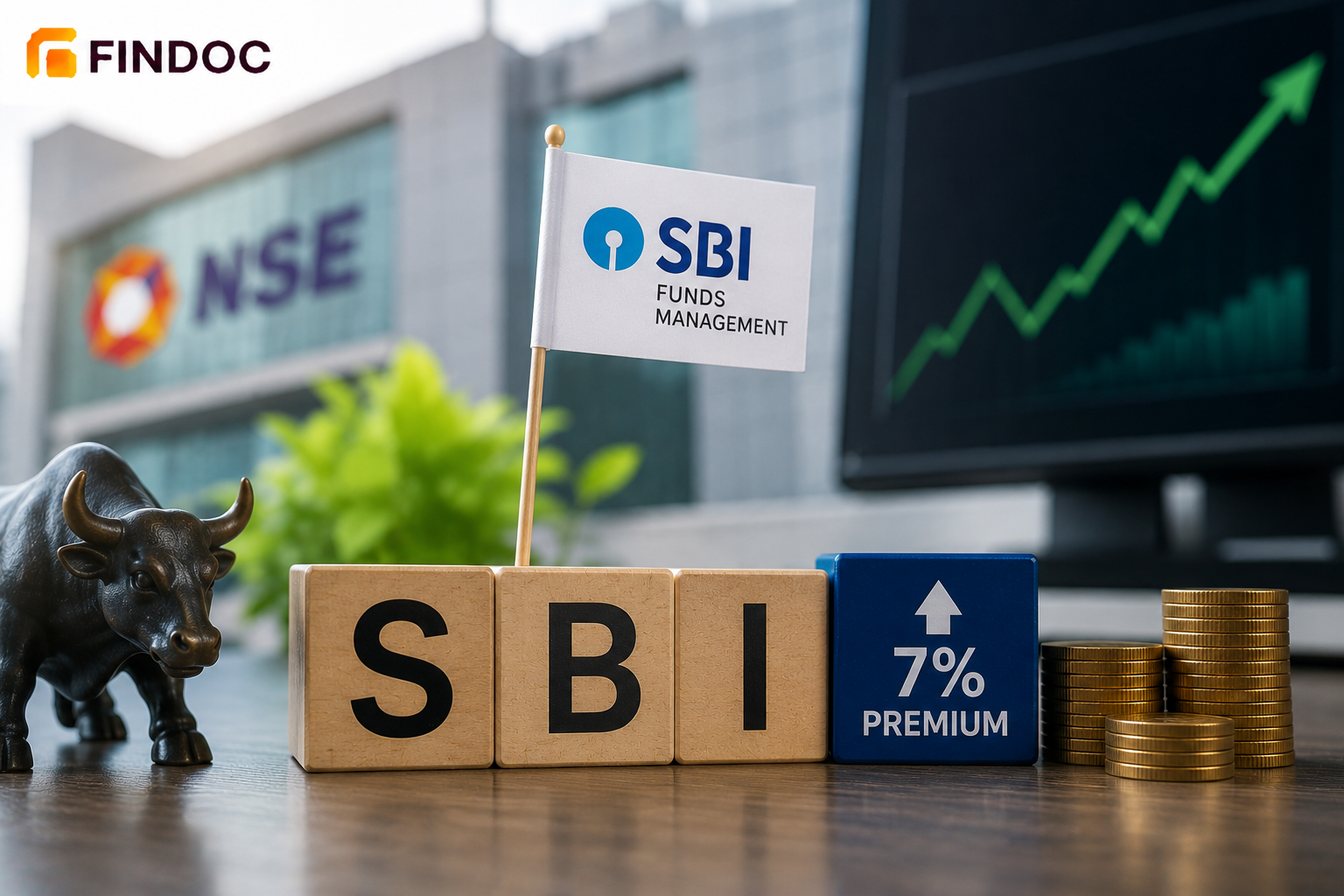
    SBI Funds Management Limited made a strong market debut on Tuesday, July 21, 2026. The stock listed at nearly a 7% premium on both the National Stock Exchange (NSE) and the Bombay Stock Exchange (BSE). This listing drew significant attention from institutional and retail investors alike.

    What Changed

    The shares of SBI Funds Management began trading above their issue price on debut day. A 7% premium listing signals robust demand from the market. The company, which is the asset management arm of State Bank of India, entered the public market with considerable momentum.

    Detail Information
    Listing Exchange NSE and BSE
    Listing Premium ~7% above issue price
    Listing Date Tuesday, July 21, 2026
    Issue Price Not disclosed
    Offer Size Not disclosed
    Parent Company State Bank of India

    The listing price reflects strong investor confidence. However, trading volatility on debut day is common, and the stock’s performance in subsequent sessions will be closely monitored.

    Why It Matters for Investors

    SBI Funds Management is one of India’s largest asset management companies (AMCs) by assets under management (AUM). Its public listing gives investors direct exposure to India’s fast-growing mutual fund industry. For those seeking portfolio diversification within the financial services sector, this listing is notable.

    The AMC sector benefits directly from rising retail participation in equity markets. As more Indians invest in mutual funds through SIPs and lump-sum routes, AMCs like SBI Funds Management stand to gain fee income. Open demat account online platforms have made it easier for retail investors to participate in such listings and track AMC stocks in real time.

    In addition, the SBI brand carries significant trust and distribution strength. This gives SBI Funds Management a competitive advantage over smaller or newer AMC peers in capturing new investors.

    Potential Financial Impact

    SBI Funds Management’s financials were not fully disclosed at the time of reporting. However, AMCs typically generate revenue through management fees linked to AUM. A larger AUM base directly translates to higher revenue visibility. As India’s mutual fund industry continues to grow, top-tier AMCs are positioned to benefit meaningfully.

    Margin profiles of asset management businesses are generally strong. Fixed costs remain relatively low compared to revenue growth potential. Therefore, any increase in AUM can have a positive multiplier effect on earnings over time.

    Expert or Market Reaction

    The 7% premium listing was widely seen as a positive signal by market participants. Analysts noted that demand for AMC stocks has remained resilient, given the structural growth story of India’s financial sector. Meanwhile, the SBI parentage was considered a key factor in driving investor confidence during the IPO subscription phase.

    Market observers also pointed out that listing gains of this magnitude are moderate rather than extraordinary. This suggests the IPO was fairly priced. As a result, the stock may attract long-term investors rather than those seeking quick listing-day profits.

    Broader Context

    India’s mutual fund industry has witnessed exponential growth over the past decade. Systematic Investment Plan (SIP) inflows have reached record levels in recent years. This growth has made AMC stocks increasingly attractive to investors looking for exposure to India’s financialization story.

    Context Factor Relevance
    India Mutual Fund Industry Growth Strong AUM expansion trend
    SIP Inflow Trend Consistently rising retail participation
    AMC Sector Listed Peers HDFC AMC, Nippon India AMC, UTI AMC
    Regulatory Body SEBI (Securities and Exchange Board of India)

    SBI Funds Management will now compete as a publicly listed entity alongside established AMC peers. Its scale and brand recognition give it a strong starting position in this competitive landscape.

    Key Risks and Factors to Consider

    Despite the positive listing, investors should carefully consider several risks. Equity market downturns can reduce AUM significantly, directly impacting fee income. In addition, regulatory changes by SEBI regarding fee structures or distribution norms could compress margins.

    Competitive pressure from both large private AMCs and fintech-driven platforms remains a concern. Furthermore, valuation concerns may arise if the stock trades at a premium to peers without proportionate earnings growth. Execution risk in expanding distribution channels also warrants attention.

    What Investors Should Watch Next

    • Post-listing trading volumes and price stability over the first two to four weeks of trading.
    • Quarterly AUM disclosures and any changes in SIP inflow trends specific to SBI Mutual Fund schemes.
    • Management commentary on growth strategy, fee structures, and distribution expansion plans.
    • SEBI regulatory updates that could affect AMC profitability or product offerings industry-wide.
    • Investors tracking this stock should use a reliable investing and trading platform to monitor real-time price movements and institutional activity closely.

    Conclusion

    SBI Funds Management’s debut at a 7% premium reflects solid market confidence in the company’s business model. The AMC sector remains structurally well-positioned within India’s broader financial services growth story. However, investors must weigh valuation levels against peer comparisons and sector-specific risks before making any decisions.

    The listing marks a significant milestone for SBI’s asset management business. Its long-term performance will depend on AUM growth, regulatory stability, and competitive execution. Continued monitoring of financial disclosures and market conditions will be essential for investors tracking this stock.

    • SBI Funds Management listed at approximately 7% premium on both NSE and BSE on July 21, 2026, signaling healthy IPO demand.
    • The AMC sector’s structural growth story supports long-term investor interest, though valuation risks and regulatory factors must not be overlooked.
    • Post-listing price stability and AUM disclosures will be the key metrics to watch in the weeks ahead.
    Explore More Trending Stocks
    Adani Enterprises Share Price Eicher Motors Share Price
    Yes Bank Share Price HDFC Bank Share Price
    Hindustan Unilever Share Price Kotak Mahindra Bank Share Price
    NTPC Share Price ONGC Share Price
    Reliance Industries Share Price Tata Steel Share Price

WPS电脑版

telegram中文

telegram中文

Telegram中文

搜狗五笔输入法

网易有道翻译

Telegram电脑版

Telegram电脑版

Telegram手机版

有道音视频翻译

有道音视频翻译

汽水音乐播放器

Telegram电脑版

rar压缩包

Telegram电脑版

Telegram电脑版