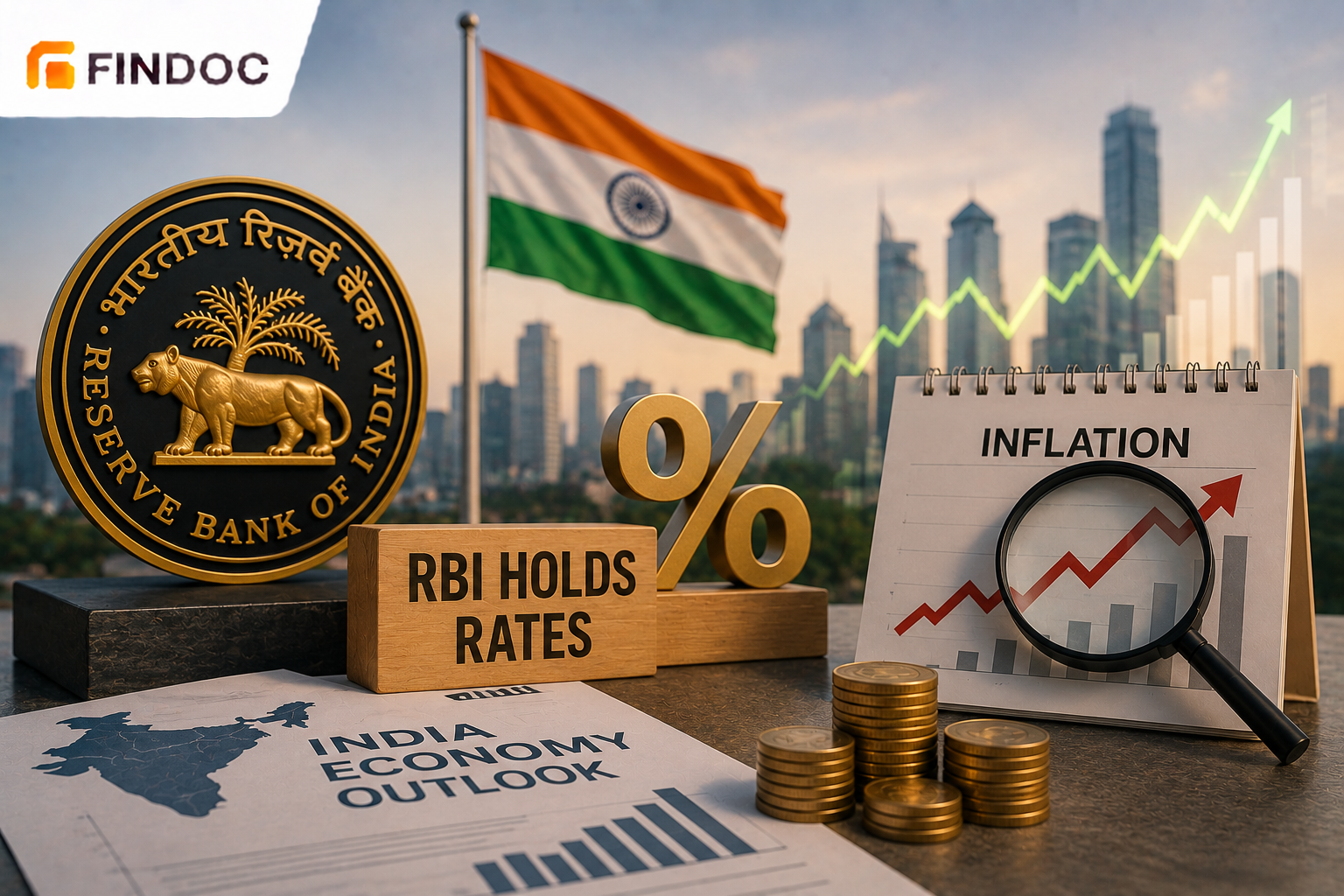
India’s macroeconomic backdrop remains broadly supportive, with growth holding above 6% even as inflation risks persist and the Reserve Bank of India (RBI) maintains a cautious stance on rates. Real GDP projections for FY27 remain robust, but the central bank’s tolerance for price pressures is narrowing, making monetary policy, rupee stability, and global risk sentiment key drivers for domestic markets. Equity benchmarks are oscillating near record highs, reflecting resilience among large-cap financials and consumption names, even as foreign flows and commodity prices inject volatility into the near-term outlook.
Key Highlights
- RBI keeps repo rate unchanged at 5.25%, maintains neutral stance on liquidity
- Real GDP growth for 2026-27 projected at 6.6% amid resilient domestic demand
- CPI inflation for 2026-27 pegged at 5.1%, above the 4% medium-term target
- Sensex and Nifty 50 recover from intraday lows as rupee stabilises and oil softens
- Maharashtra, Tamil Nadu, Uttar Pradesh and Karnataka remain key growth engines by state GDP
Macroeconomic Trends and RBI Monetary Policy
The June Monetary Policy Committee (MPC) meeting underscored the RBI’s strategy of preserving growth while keeping a firm watch on inflation expectations. The policy repo rate was left unchanged at 5.25%, with the Marginal Standing Facility and Bank Rate held at 5.50% and the Standing Deposit Facility at 5.00%. The MPC reiterated a neutral stance, signalling flexibility in managing liquidity rather than committing to an explicit tightening or easing bias. The decision follows a series of steady policy meetings, underlining the RBI’s preference for stability in the current environment of mixed global cues and lingering supply-side price pressures.
On growth, the RBI projects real GDP expansion of 6.6% for 2026-27, down marginally from an earlier estimate of 6.9%, but still signalling strong momentum relative to most major economies. The quarterly distribution — 6.6% in Q1, 6.3% in Q2, 6.5% in Q3 and 6.8% in Q4 — suggests an expectation of modest consolidation in the middle of the year followed by a pickup into the fiscal year-end, in line with typical investment and government spending cycles. Domestic consumption, public capex and a gradual recovery in private investment are assumed to remain the primary growth drivers, while net exports face headwinds from global demand softness.
On prices, the RBI has projected CPI inflation for 2026-27 at 5.1%, implying that headline inflation will stay above the formal 4% target but within the 2-6% tolerance band. The central bank’s recent communication highlights food and fuel as key sources of risk, alongside imported inflation linked to currency movements and global commodity prices. This inflation profile, combined with robust but not overheated growth, argues for a prolonged pause rather than an imminent rate cut cycle. Several street economists now expect the RBI to be one of the last major central banks to ease policy rates, with many pencilling in a data-dependent, gradual normalisation rather than a sharp pivot.
| Policy Rate / Facility | Rate |
|---|---|
| Policy Repo Rate | 5.25% |
| Marginal Standing Facility / Bank Rate | 5.50% |
| Standing Deposit Facility | 5.00% |
| Real GDP Growth Projection (FY2026-27) | 6.6% |
| CPI Inflation Projection (FY2026-27) | 5.1% |
Market Reaction, Rupee Dynamics and Sectoral Trends
Equity markets have absorbed the RBI’s cautious stance with relative resilience. Recent trading sessions saw the Sensex rebound by roughly 400 points from intraday lows, while the Nifty 50 regained levels above 24,250, helped by a mix of local buying and easing concerns over global risk sentiment. The recovery has been broad-based, with financials, large-cap IT and select consumption stocks leading gains, although periodic profit-taking and rotation into defensives remain notable as investors weigh valuations against macro risks. Retail participation has grown significantly as access to a reliable trading platform has become more widespread, enabling a broader investor base to engage with these market movements in real time.
Analysts attribute the market’s ability to pare losses to three main factors: a stabilising rupee, softer crude oil prices, and expectations that policy changes on capital gains for foreign portfolio investors (FPIs) in government securities could enhance foreign appetite for Indian assets. A more stable currency reduces imported inflation risk, while lower oil prices improve corporate margin visibility and the overall current account position. For FPIs, potential rationalisation of tax treatment on government securities would make rupee debt comparatively more attractive, particularly against the backdrop of India’s inclusion in major global bond indices.
At the sectoral level, banking and financial services remain central to the macro narrative. Healthy credit growth, improving asset quality indicators, and adequate capital buffers position large private banks and select public sector lenders to benefit from sustained GDP expansion. Meanwhile, consumption-oriented companies in staples and discretionary segments are sensitive to inflation trajectories; elevated food prices or fuel costs could compress real incomes and temper volume growth, although middle- and upper-income demand remains resilient. Export-facing sectors such as IT and pharmaceuticals track global conditions more closely, with currency moves providing an additional lever for earnings. Domestic cyclical plays capital goods, cement, and infrastructure are anchored by the government’s continued focus on capex, even as private capex intentions remain somewhat uneven across industries.
Growth Distribution, State GDP Data and Investor Watchpoints
India’s aggregate growth story continues to be underpinned by a handful of large states with deep industrial and services bases. Recent data place Maharashtra at the top of the state GDP league table, with an economic output estimated at approximately ₹49.3 lakh crore, contributing around 13.46% of national GDP. Tamil Nadu, Uttar Pradesh and Karnataka follow, with GDPs of about ₹33 lakh crore, ₹30 lakh crore and ₹29 lakh crore respectively. For institutional investors, these regional dynamics matter in terms of infrastructure pipelines, urbanisation trends and state-level policy ecosystems that affect corporate earnings and project execution. Those looking to gain exposure to these growth themes can open demat account through SEBI-registered brokers to access listed instruments across relevant sectors.
| State | Estimated State GDP | Share of National GDP (Approx.) |
|---|---|---|
| Maharashtra | ₹49.3 lakh crore | ~13.46% |
| Tamil Nadu | ₹33 lakh crore | — |
| Uttar Pradesh | ₹30 lakh crore | — |
| Karnataka | ₹29 lakh crore | — |
Key areas for investors to watch in the coming months include:
- Inflation path: The trajectory of CPI, particularly food and fuel components, will be crucial in shaping real consumption growth and the RBI’s room to manoeuvre on rates.
- Rupee performance: Currency stability against the US dollar and other majors will influence imported inflation, FPI flows, and the relative attractiveness of Indian equities and bonds.
- Policy signals: Any change in the RBI’s stance from neutral, alterations in liquidity management, or tax/regulatory measures affecting FPIs and domestic institutions could trigger re-pricing across asset classes.
- Global backdrop: Developments in global monetary policy cycles, commodity prices, and geopolitical risks will continue to feed into risk sentiment, especially given India’s integration into global indices and portfolios.
- State-level execution: Progress on large infrastructure projects, industrial policy initiatives, and fiscal positions of major states like Maharashtra, Tamil Nadu, Uttar Pradesh and Karnataka will shape medium-term corporate earnings trajectories, particularly in sectors such as construction, power, logistics, and manufacturing.
Market Outlook
Looking ahead, India’s economy appears positioned to remain one of the fastest-growing major markets, even as the balance of risks shifts more visibly towards inflation and global uncertainties. The OECD has recently reaffirmed this relative strength, projecting GDP growth of 7.6% for 2025-26, moderating to 6.1% in 2026-27 and 6.4% in 2027-28, in line with the RBI’s own medium-term view of sustained but gradually moderating expansion. For institutional investors, the key implication is that India is likely to offer a blend of growth and relative macro stability, albeit with pockets of volatility driven by global liquidity cycles, commodity swings and domestic policy adjustments.
Monetary policy is likely to stay on hold in the near term, with the RBI prioritising credibility on inflation over aggressive growth support. This stance should help anchor expectations but could also restrain leverage-driven segments if borrowing costs remain elevated for longer. Equity valuations, particularly in frontline indices, already reflect a significant part of the growth narrative, which means active investors will need to discriminate sharply between sectors and stocks based on earnings visibility, balance sheet strength and sensitivity to interest rates and currency moves. A considered approach to stock investment in this environment requires careful analysis of both macro signals and company-level fundamentals.
Conclusion
For India-focused institutional investors, the current environment demands a nuanced approach. Macroeconomic indicators stable-to-strong GDP growth, controlled but above-target inflation, and a cautious RBI support a constructive medium-term view on Indian equities and credit, especially relative to many emerging market peers. At the same time, elevated valuation multiples in key indices, lingering inflation risks, and the possibility of episodic global risk-off events argue for disciplined portfolio construction and selective risk-taking.
The most attractive opportunities are likely to emerge in areas where structural growth drivers intersect with improving balance sheets and regulatory support: high-quality financials, infrastructure-linked plays, and select consumption and manufacturing names leveraged to rising incomes and policy-led capex. Monitoring inflation data, RBI communication, rupee trends and fiscal signals from both the Centre and large states will be critical to calibrating exposure. In this backdrop, India remains a core allocation candidate in emerging market portfolios, but one that increasingly rewards investors who combine macro awareness with bottom-up rigour and a clear tolerance.
| Also Explore | |
|---|---|
| Top Gainers Today | Top Losers Today |
| Top Performers | Under Performers |
| Advances & Declines | Heat Map |
| ADR Prices | Bulk Deals Today |
| Penny Stocks | Penny Stocks Under ₹1 |
Leave a Reply