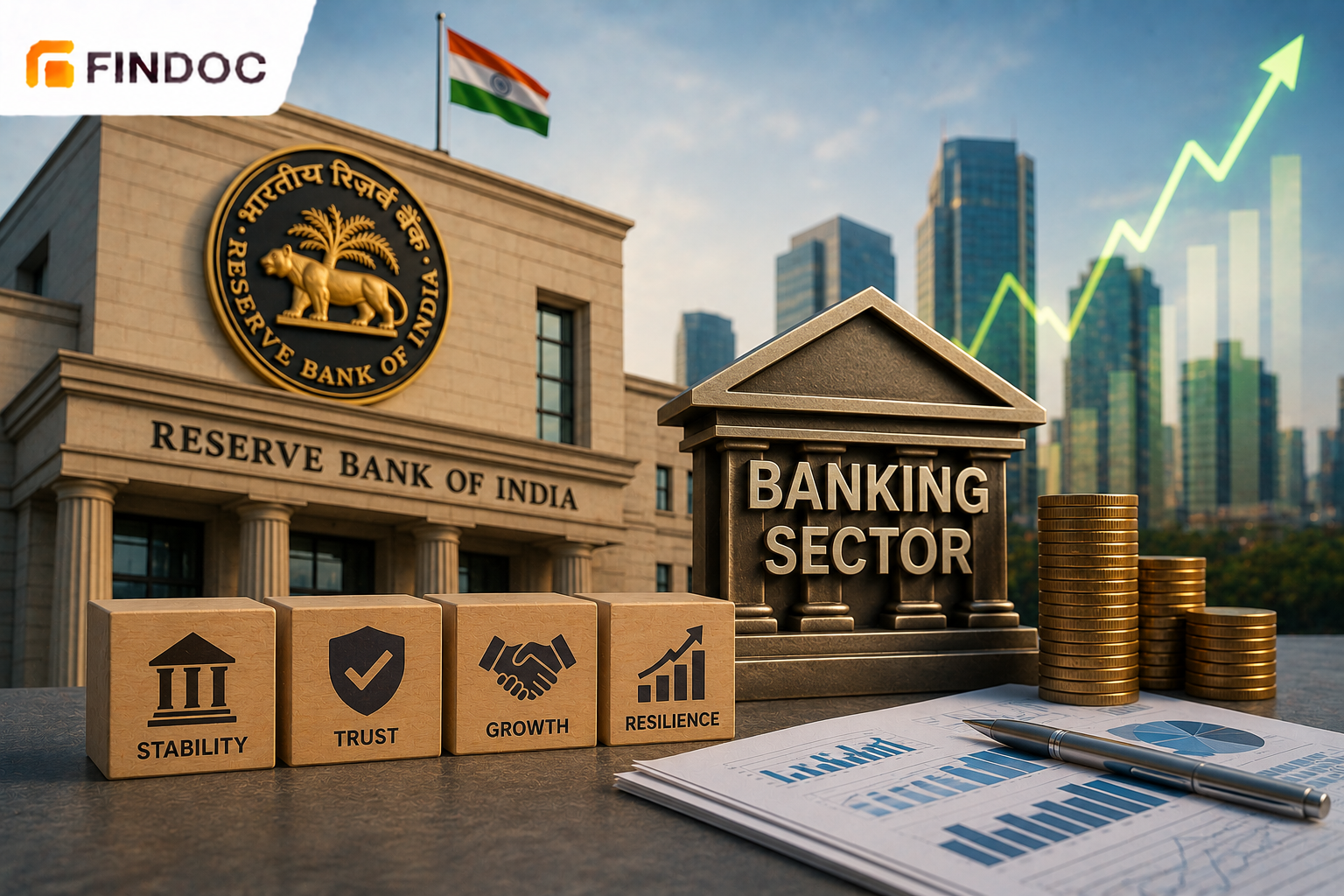
Indian banking stocks traded in a narrow range as the market continued to digest the Reserve Bank of India’s latest Monetary Policy Committee (MPC) decision to keep the repo rate unchanged at 5.25% and maintain a neutral stance. Recent regulatory updates on digital payments, NBFC oversight, and transaction norms are reshaping operational metrics for leading lenders including SBI, HDFC Bank, ICICI Bank and Axis Bank, even as the rupee stabilises around 96 per US dollar and benchmark indices remain supported by financials. The sector now faces a phase of stable rates, tighter compliance and selective credit growth.
Key Highlights
- RBI maintains repo rate at 5.25% with neutral stance, reinforcing stable rate environment
- Core inflation projected at 4.7% and CPI at about 5.1% for FY27, limiting scope for near-term easing
- Rupee trades around 96–96.5 per US dollar, supported by regulatory steps on forex and digital transactions
- RBI’s 2026 regulatory package tightens NBFC oversight, digital lending norms and transaction rules, impacting bank fees and compliance costs
- Large banks (SBI, HDFC Bank, ICICI Bank, Axis Bank) seen benefiting from stronger regulatory moat and stable funding costs despite near-term margin pressure
RBI Monetary Policy and the Indian Banking Sector
The RBI’s June MPC meeting, led by Governor Sanjay Malhotra, left the policy repo rate unchanged at 5.25% and retained a neutral stance, signalling a preference for policy stability while inflation remains close to the upper end of the target band. The committee also left the Standing Deposit Facility (SDF) at 5.00%, the Marginal Standing Facility (MSF) and Bank Rate at 5.50%, keeping the interest rate corridor intact and providing banks with predictable funding and liquidity benchmarks. For lenders, this effectively locks in the current interest rate regime into the early part of FY27, anchoring loan pricing, wholesale funding costs and treasury strategies.
On the macro front, the RBI projected core inflation at 4.7% for the current fiscal, with headline CPI inflation for FY27 estimated at around 5.1%, driven in part by higher costs in commercial LPG, base metals, plastics and rubber. These projections restrict room for near-term rate cuts and suggest that credit growth will need to be driven more by sectoral demand and structural reforms than by further monetary easing. A senior economist quoted in policy coverage noted that with inflation still above the midpoint of the target range, the RBI is likely to stay in a prolonged hold mode, leaving banks to optimise asset-liability management rather than chase volume growth at the expense of margins.
In parallel, RBI has adjusted certain reserve and liquidity norms, giving banks greater flexibility in managing their buffers while insisting on robust risk controls. This combination of a neutral stance, moderate inflation and more nuanced liquidity frameworks positions Indian banks for an environment of steady, but not exuberant, expansion. For investors evaluating stock investment opportunities in the financial sector, the takeaway is a lower probability of rate-driven re-rating in the immediate term, but higher visibility on earnings stability and credit quality.
Regulatory Changes, Rupee Dynamics and Key Bank Implications
Beyond rates, regulatory updates announced through 2026 are materially altering the operating architecture for Indian banks. Recent RBI guidelines have tightened NBFC oversight through revised registration categories and clarified which entities fall under central bank supervision, reducing regulatory arbitrage between banks and shadow lenders. This is broadly positive for large deposit-taking institutions like SBI, HDFC Bank, ICICI Bank and Axis Bank, which gain from a more level competitive field and lower systemic risk, although it may compress fee-based business linked to lightly regulated NBFC partners.
Digital payment security has been strengthened with mandatory two-factor authentication across UPI, cards and wallets from April 2026, moving beyond single-factor OTP-based verification. For banks, this means higher compliance and technology costs upfront, but a likely reduction in fraud losses and chargebacks over time. ATM and digital transaction rules have been revised to adjust free monthly transaction limits, raise interchange charges beyond those limits, and impose stricter timelines for refunds on failed transactions. These measures could modestly improve fee income metrics for leading retail banks, while also compelling them to fine-tune customer communication and dispute resolution processes.
On the currency side, the rupee has been trading near 96.1–96.55 against the US dollar, stabilising after hitting a seven-week low, helped by softer US inflation and reduced expectations of further near-term Fed hikes. RBI has complemented this macro backdrop with tighter norms on speculative forex trading, including curbs on certain derivative products such as non-deliverable forwards (NDFs), in a bid to reduce volatility and arbitrage-driven flows. A market strategist noted that the combination of forex regulation and digital payment safeguards is aimed at lowering tail risk in the system, which should ultimately benefit bank funding and capital flows, even if near-term trading income takes a hit. Retail participants who use a reliable trading platform to access banking and financial sector equities should factor in these evolving regulatory dynamics when assessing sector exposure.
For frontline lenders:
- SBI, with its extensive branch and ATM network, stands to gain incrementally from higher interchange fees and expanded free transaction limits, while absorbing the largest compliance burden on digital regulations.
- HDFC Bank and ICICI Bank, both heavy users of digital channels and credit cards, will need to manage higher authentication costs but could see improved asset quality in unsecured portfolios as speculative forex and digital fraud risks are curtailed.
- Axis Bank’s strong corporate and treasury franchise may face tighter constraints in derivative-linked products but should benefit from a more transparent and less volatile forex market.
Banking Sector Positioning and Investor Considerations
The following table summarises the key regulatory and macro themes currently impacting Indian banks and their near-term implications for lenders and investors.
| Theme | Key Data Points | Implication for Banks |
|---|---|---|
| Stable Policy Rates | Repo rate at 5.25%; SDF at 5.00%; MSF/Bank Rate at 5.50% | Predictable funding costs; limited scope for near-term NIM expansion purely from rate moves |
| Inflation Trajectory | Core inflation at 4.7%; CPI around 5.1% for FY27 | Prolonged hold stance likely; banks must emphasise risk-adjusted growth over aggressive loan pricing |
| NBFC Oversight Tightening | New registration and supervision norms reduce regulatory arbitrage | Advantage to large banks (SBI, HDFC Bank, ICICI, Axis) in corporate and retail lending; potential pressure on NBFC-dependent fee income |
| Digital Payments and ATM Rules | Mandatory two-factor authentication; revised transaction limits and interchange fees; stricter refund timelines | Higher operating and technology costs; improved customer protection; scope for modest fee income gains and lower fraud-related losses |
| Forex and Rupee Stability | Rupee around 96–96.5 per USD; speculative forex products curtailed | Lower volatility in treasury operations; more stable capital flows; moderate impact on trading income but positive for systemic stability |
For institutional investors, the composite picture is of a system in which regulatory tightening is front-loaded, while monetary policy remains broadly supportive of gradual credit expansion and stable asset quality. This favours well-capitalised, diversified banks with strong digital and risk management capabilities. Investors looking to participate in this segment of the market can open demat account through SEBI-registered brokers to access BSE and NSE listed banking sector equities.
Market Outlook
Looking ahead into the rest of FY27, the Indian banking sector appears set for a period of moderate growth underpinned by stable rates, disciplined regulatory oversight and incremental improvements in fee and digital revenues. As long as inflation stays close to the RBI’s current projection and the rupee remains broadly stable, the central bank is unlikely to deviate from its neutral stance, keeping the repo rate anchored and allowing previous policy actions to filter through. For NIFTY Bank constituents, earnings trajectories will hinge more on loan mix (retail vs corporate), deposit repricing and operating leverage from digital platforms than on further monetary easing. Any upside surprise would likely come from better-than-expected asset quality, faster-than-anticipated transmission of regulatory benefits, or stronger credit demand in segments catalysed by government capex and consumption revival.
Conclusion
For institutional investors tracking Indian banks on the BSE and NSE, the current environment presents a classic carry-and-compliance dynamic: policy rates are stable, systemic risks are being actively addressed through regulation, and digital and transaction frameworks are being upgraded to global standards. While this may cap near-term valuation expansion driven solely by rate expectations, it enhances the durability of earnings and the resilience of balance sheets for major lenders such as SBI, HDFC Bank, ICICI Bank and Axis Bank. Portfolio positioning in the sector should therefore focus on names with robust capital adequacy, superior liability franchises and demonstrated execution in digital and risk management, as these are best placed to convert regulatory stability and moderate macro tailwinds into sustained shareholder returns.
Leave a Reply