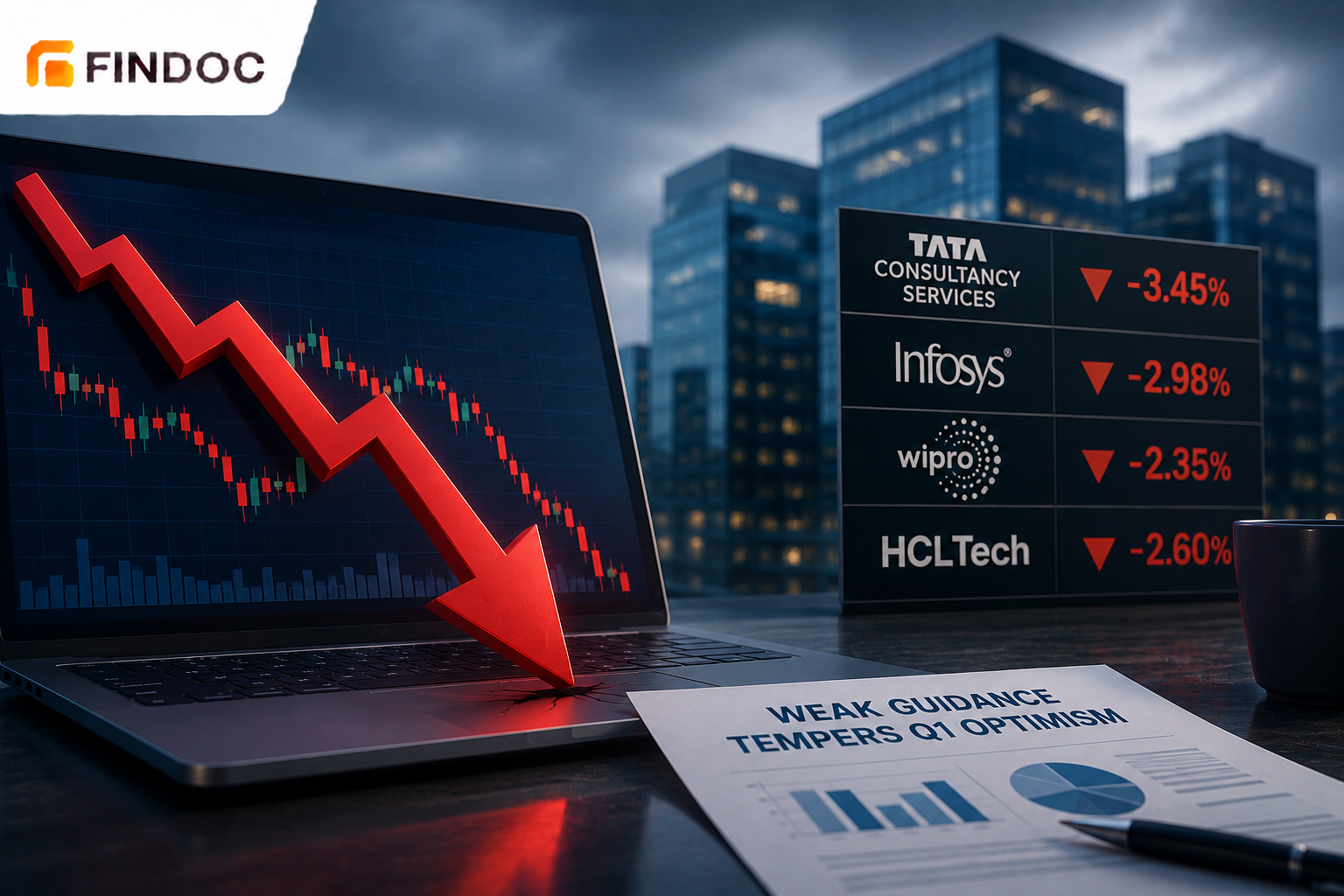
India’s information technology majors opened the week on a cautious note, with investors weighing mixed Q1 earnings, soft FY27 guidance and an uncertain global demand environment against early signs of deal pipeline stabilisation. Large-cap IT stocks underperformed the broader market in early trade, even as upbeat results from Tech Mahindra last week had briefly lifted sentiment across the sector. With the rupee weakening, pricing power limited, and BFSI and tech spending in the US and Europe still uneven, institutional investors are reassessing positions in Infosys, TCS, Wipro, HCLTech and the broader Nifty IT basket.
Key Highlights
- Nifty IT underperforms frontline indices amid renewed concerns on FY27 growth and deal ramp-ups
- Infosys, TCS, Wipro and HCLTech trade mixed after soft commentary and cautious guidance from tier-I peers
- Tech Mahindra Q1 beat on revenue and margins offers a rare positive surprise in an otherwise muted earnings season
- Rupee weakness past 96 against the US dollar offers near-term margin support but underscores macro risk
- Budget proposal to expand safe harbour thresholds to ₹2,000 crore seen as structurally positive for Indian IT services
Indian IT Sector: Cautious Sentiment Despite Selective Q1 Beats
In early trade, Indian equity benchmarks slipped, with the Sensex down over 450 points and the Nifty 50 dragged lower primarily by financials, even as IT stocks, which had helped drive gains late last week, showed signs of fatigue. Recent market action suggests that the short-lived rally triggered by better-than-expected numbers from Tech Mahindra and select mid-cap IT names is giving way to a more sober reassessment of the earnings and demand cycle across the sector.
Analysts tracking tier-I IT firms warn that the current financial year is unlikely to deliver a decisive turnaround. Several brokerages have indicated that leading services providers may struggle even to reach the mid-point of their FY27 growth guidance, reflecting a softer-than-expected demand outlook for the first half of the year. Commentaries from global clients continue to point to prolonged decision cycles, delayed ramp-ups and ongoing cost-optimisation priorities, especially in key verticals such as BFSI, retail and hi-tech.
The macro backdrop is adding another layer of complexity. The rupee has weakened, recently logging its sharpest weekly drop since May, as elevated crude prices and strong merchant dollar demand revive concerns about India’s external balances. A softer currency typically supports operating margins for export-heavy IT firms, but it also signals broader risk aversion and raises the risk of near-term equity volatility. For IT, this means a modest FX tailwind to earnings, but little relief on the fundamental question of when discretionary tech spending will fully normalise. Retail participation has grown significantly as access to a reliable trading platform has become more widespread, bringing greater scrutiny to sector-level developments such as these.
Stock-Specific Moves: Infosys, TCS, Wipro and HCLTech in Focus
Investors in Infosys, TCS, Wipro and HCLTech are parsing early Q1 trends and peer prints for clues on the rest of the year. While detailed Q1 numbers from these four bellwethers are staggered through the ongoing earnings season, commentary from managements and sell-side analysts suggests a continuation of the pattern seen over the past 18–24 months: relatively resilient large outsourcing and cost-takeout deals, but persistent weakness in high-margin discretionary projects and transformation programmes.
Tech Mahindra has been the standout among large-cap IT names so far this season. The company reported a consolidated net profit of around ₹1,465 crore for the first quarter, up approximately 28% year-on-year and over 8% sequentially. Revenue from operations grew about 18% on a year-on-year basis to roughly ₹15,712 crore, reflecting a broad-based recovery across key verticals and geographies. The margin and growth beat has prompted some analysts to argue that the worst may be over for telecom and enterprise-focused portfolios, although they caution that sustainability will hinge on deal conversions and execution over the next two quarters.
In contrast, Wipro’s print has been more measured, reinforcing the theme of gradual, rather than sharp, improvement. The company posted a modest 1% year-on-year rise in June-quarter net profit to about ₹3,352 crore, while revenue grew 11%. The numbers are not weak in absolute terms, but for a stock that has derated materially from its pandemic-era highs, investors are looking for clearer evidence of operating leverage, better utilisation and stronger commentary on large deal inflows. For Infosys, TCS and HCLTech, the street focus in the immediate term is on:
- Growth in key verticals such as BFSI, manufacturing and hi-tech
- Net new large deal total contract value (TCV) and the timing of ramp-ups
- Commentary on pricing, wage-cost management and pyramid optimisation
- Any revisions to FY27 revenue and margin guidance bands
Large-Cap Indian IT: Relative Positioning and Key Metrics
Below is a comparative snapshot of key tier-I Indian IT services players, focusing on how institutional investors are currently framing the trade across each name in the context of stock investment decisions within Indian equities.
| Company | Current Market Positioning | Key Watch Factors |
|---|---|---|
| Infosys | High-beta play on demand recovery; strong capabilities in digital and cloud but higher sensitivity to discretionary spending cuts | Stabilisation in large North American client budgets; improvement in margin band discipline |
| Tata Consultancy Services (TCS) | Sector bellwether with the most diversified client base and relatively stable execution metrics | Premium valuation supported by consistency of payout, lower volatility and strong order book visibility |
| Wipro | In the midst of a multi-year portfolio and operational reset; valuation at a discount to top-tier peers | Proof of sustainable growth inflection beyond cost actions |
| HCLTech | Beneficiary of strong engineering and infrastructure services credentials | Resilience via annuity and product-linked revenues in a slow discretionary environment |
| Tech Mahindra | Q1 performance marks a notable positive surprise after a period of underperformance and client-specific challenges | Potential re-rating contingent on sustaining double-digit revenue growth and margin expansion |
From a sector perspective, Nifty IT remains highly sensitive to global risk sentiment, particularly US tech earnings and macro data that shape enterprise IT budgets. Elevated volatility in US tech indices, combined with heightened investor scrutiny of AI-related capex and returns, is feeding into Indian IT valuations. While the structural story around AI, cloud and digital remains intact, the near-term is dominated by questions around when AI-related deal flow will scale meaningfully enough to offset pressure in legacy and discretionary segments.
Market Outlook: What Institutional Investors Should Watch
For Indian IT, the next two quarters will be critical in determining whether FY27 turns out to be a transition year or the beginning of a more durable upcycle. Key data points for institutional investors include:
- Large deal TCV and conversion rates at Infosys, TCS, Wipro and HCLTech, especially in the $100 million-plus segment
- The trajectory of US and European macro indicators, including recession probabilities, which directly influence discretionary tech budgets
- Management commentary on AI and automation-led deals, including monetisation models and impact on pricing and margins
- Currency trends and any Reserve Bank of India signals on liquidity and interest rates that may influence capital flows into Indian equities
Structurally, the recent Union Budget proposal to raise the safe harbour threshold for eligible IT services from ₹300 crore to ₹2,000 crore is viewed as a positive for compliance certainty and ease of doing business, especially for mid-sized and captive service units. Investors looking to participate in this segment can open demat account through SEBI-registered brokers to access listed IT securities on Indian exchanges. Over the medium term, such policy support, combined with India’s cost and talent advantages, should help the sector defend its global market share even in a slower growth environment.
Conclusion
Indian IT remains at a complex juncture: valuations have corrected from peak levels, offering selective entry opportunities, but the earnings recovery is still uneven and highly contingent on global capex cycles. Large caps such as Infosys, TCS, Wipro and HCLTech provide liquidity and relative safety, yet differentiation will increasingly hinge on execution in AI, cloud, engineering and platform-based services. For institutional investors, the message from the latest numbers and commentary is clear: this is a stock-picking market within Indian tech, not a blanket sector trade. Monitoring deal wins, guidance credibility and margin discipline will be crucial in separating potential compounders from value traps in the next phase of the IT cycle.
Leave a Reply