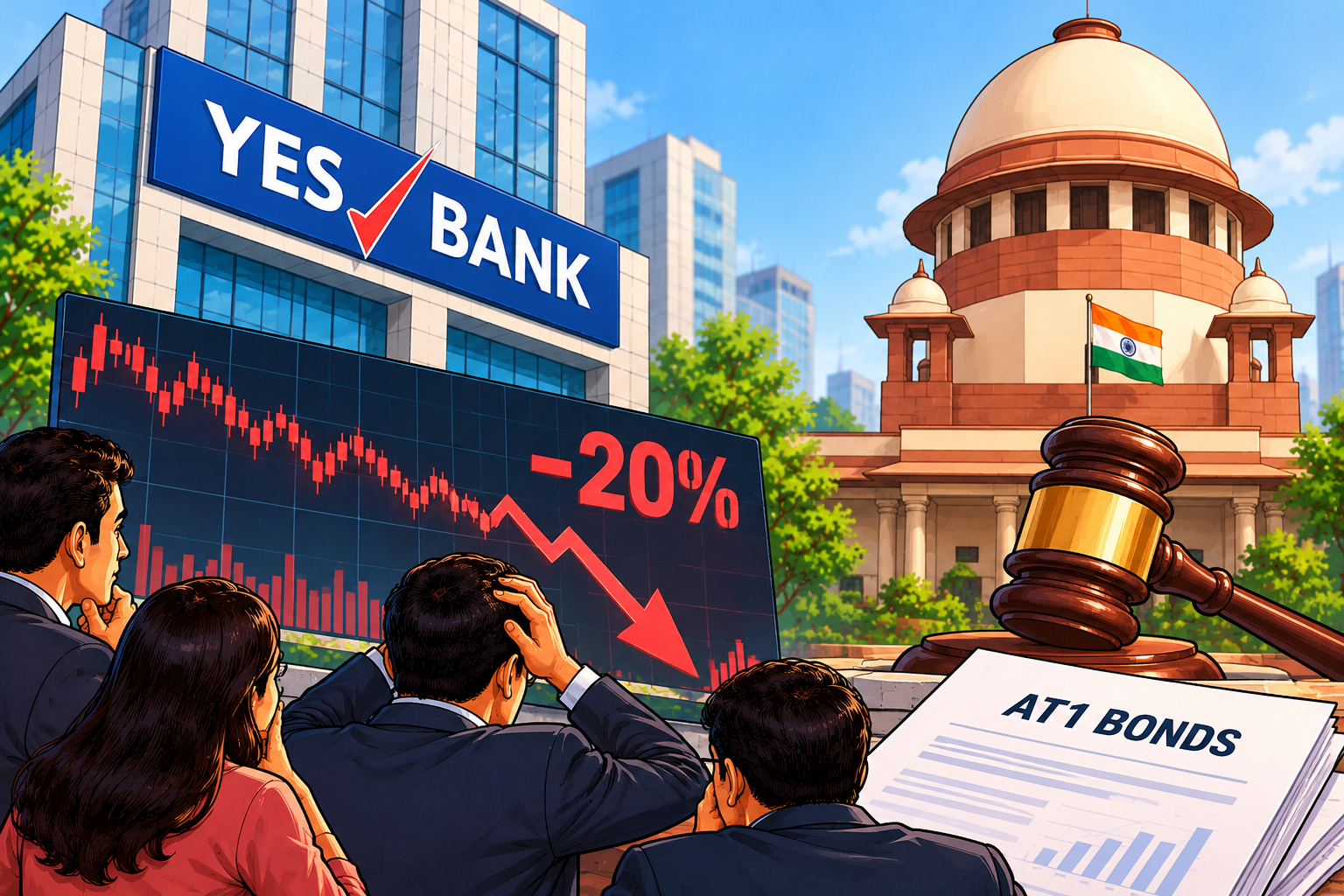
Yes Bank shares fell as much as 20% on 15 October 2026 after the Supreme Court upheld a Bombay High Court order that quashed the bank’s ₹8,415 crore write-off of Additional Tier 1 (AT1) bonds. The stock touched an intraday low of ₹16.96 on the NSE, against a previous close of ₹21.20.
Trading volumes were heavy, with more than 622 million shares changing hands across NSE and BSE during the session.
What the Supreme Court Decided on Yes Bank’s AT1 Bonds
A bench of Justices Dipankar Datta and Augustine George Masih dismissed the appeals filed by Yes Bank, the Reserve Bank of India (RBI) and the Union of India. The appeals challenged the Bombay High Court judgment of 20 January 2023, which had set aside the write-off of the bonds. The Supreme Court said it saw no reason to interfere with that judgment.
The bench had reserved its verdict on 20 May, after hearing the Centre, the RBI, Yes Bank and bondholders represented by Axis Trustee Services and other investors. The Solicitor General, appearing for the Centre, the finance ministry, the RBI and Yes Bank, had argued that the write-off was necessary to rebuild the bank’s capital and support its rescue. The bondholders argued that the administrator acted unilaterally and exceeded his authority.
The central question was whether Yes Bank’s administrator had the legal power to extinguish the AT1 bonds after the bank’s reconstruction, even though the write-off provision was left out of the final scheme. The Supreme Court answered that in the negative. The ruling therefore turns on the administrator’s legal authority in March 2020, and not on the bank’s current operations or its recent financial results.
How the Yes Bank AT1 Write-Off Dispute Unfolded
AT1 bonds are perpetual bonds issued by banks that count towards regulatory capital because they are designed to absorb losses. In March 2020, the RBI placed Yes Bank under a moratorium and a reconstruction scheme followed. On 14 March 2020, a day after the reconstruction was announced, the bank’s administrator informed the stock exchanges that its outstanding AT1 bonds had been written down in full. Bondholders, including Axis Trustee Services, challenged that decision before the Bombay High Court.
Yes Bank AT1 bond case: key dates
| Date | Development |
|---|---|
| 14 March 2020 | Administrator informs exchanges that ₹8,415 crore of AT1 bonds are written down |
| 20 January 2023 | Bombay High Court quashes the write-off |
| 20 May 2026 | Supreme Court reserves its judgment |
| 15 October 2026 | Supreme Court dismisses the appeals |
Yes Bank, the RBI and the Centre then appealed to the Supreme Court. The 15 October verdict leaves the High Court’s 2023 ruling in place.
How Yes Bank Shares Reacted on 15 October
The selling in Yes Bank was sharp and fell within a single session. The stock slid from ₹21.20 to an intraday low of ₹16.96, a drop of 20%. The market capitalisation stood at ₹56,876 crore at the Thursday session.
The fall added to a weak run for the stock. NSE data cited in market reports show that Yes Bank shares were down about 21% over one year and nearly 15% in 2026 so far. The shares had also lost about 20% over one month and about 10% over the last five sessions.
- Intraday low on 15 October 2026: ₹16.96 on the NSE
- Previous close: ₹21.20
- Combined volume on NSE and BSE: more than 622 million shares
- Market capitalisation: ₹56,876 crore
Why the Ruling Matters for Yes Bank’s Capital Position
Investors focused on the potential liability that the verdict creates. If the write-off cannot stand, the AT1 bonds are not treated as extinguished, which could leave the bank with a significant liability. Market reports said this would weaken the bank’s ability to absorb losses in a future financial or funding stress.
The bank had addressed this scenario earlier. In January 2023, after the High Court order, the then Managing Director and CEO of Yes Bank, Prashant Kumar, said that even if AT1 bonds were restored in an extreme case, the total capital adequacy ratio would not be affected. He said Common Equity Tier 1 (CET1) capital may come down while AT1 capital would go up.
The reports reviewed do not give a verified figure for how the verdict changes the bank’s capital ratios. Any such estimate would come from the bank’s own disclosures.
What Shareholders and Bondholders Can Track Next
The full text of the Supreme Court judgment sets out the reasoning and any directions on bondholder claims. Yes Bank is also bound by stock exchange disclosure rules, so its filings on NSE and BSE are the place where any assessment of the verdict’s financial impact would appear.
Shares of Yes Bank are held in demat form, and a demat and trading account is needed to buy or sell them. Holders can see their positions and the day’s price movement in their account statements and on trading screens. Investors who follow volatile large-volume stocks on an online trading platform will notice that the exchanges also publish price band information, circuit limits and traded volumes for every listed stock.
The reaction on 15 October is a reminder of how court rulings on legacy banking disputes can move stock prices. In this case the dispute took more than six years to reach a final decision, from the March 2020 write-off to the October 2026 verdict.
Related Stock Market Insights
- What is a Demat Account?
- How to Open a Demat Account?
- What is Trading Account?
- What is Algo Trading?
- Algo Trading Platform in India
Leave a Reply