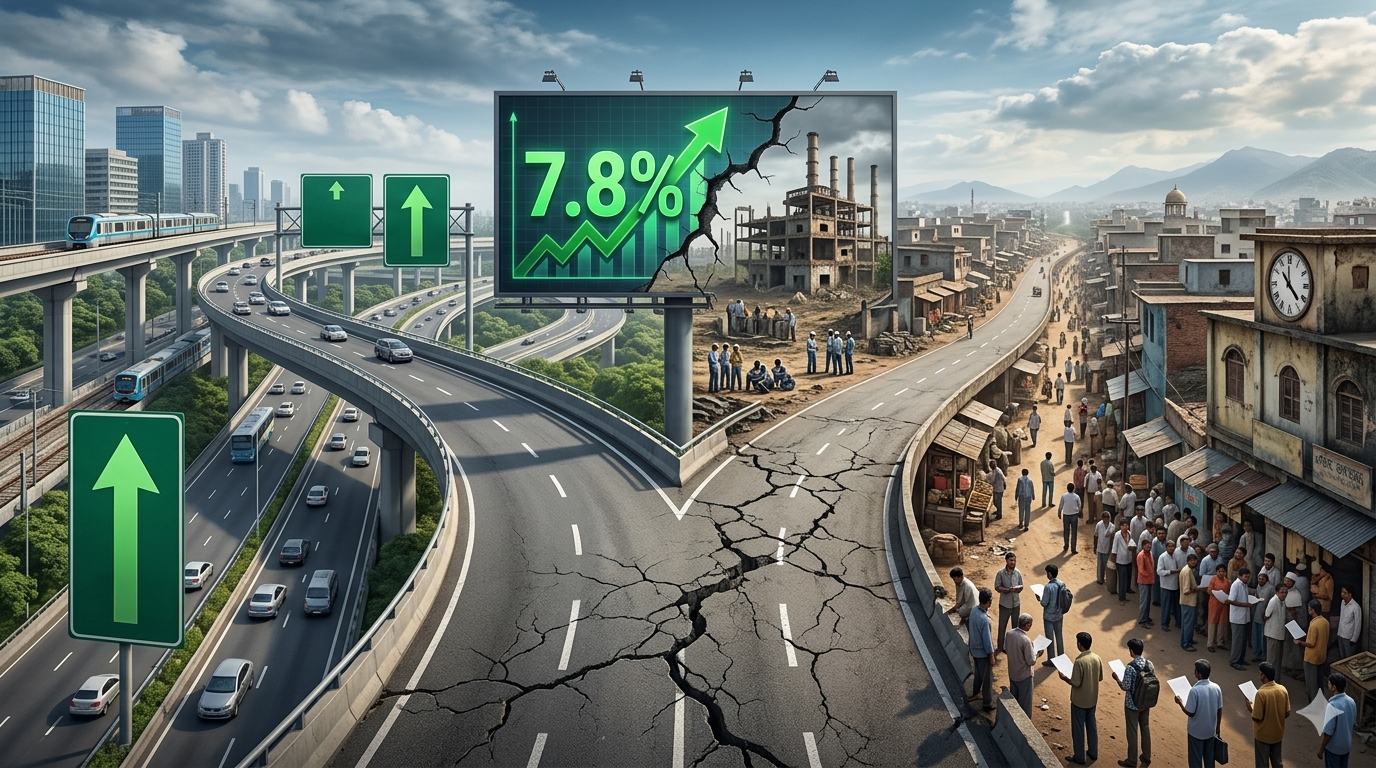
India’s economy continues to demonstrate headline resilience with a robust 7.8% GDP growth in the first quarter of fiscal year 2025-26, positioning the nation as a top performer among emerging markets. However, beneath these impressive growth figures lies a complex economic landscape marked by rising inflation pressures, weakening private consumption, and mounting external vulnerabilities. As the Reserve Bank of India navigates an increasingly challenging policy environment amid geopolitical tensions and trade uncertainties, institutional investors face critical decisions about India’s medium-term growth trajectory and market positioning.
Key Highlights
- Q1 FY26 GDP growth reached 7.8%, a five-quarter high, though heavily dependent on public spending rather than private sector dynamism
- Headline CPI inflation surged to a 10-month high of 3.2% to 3.35% in February, driven primarily by food and beverage price increases
- Private Final Consumption Expenditure decelerated to 7% from 8.3% year-on-year, signaling widespread household financial stress
- Foreign exchange reserves declined by over $11 billion in early March 2026 due to RBI intervention to support the rupee against mounting pressures
- Labour Force Participation Rate remains critically low at 54.2%, with female participation languishing at just 30.2%, indicating jobless growth concerns
Growth Driven by Public Spending, Not Private Demand
India’s 7.8% quarterly growth represents the strongest performance in five quarters, yet the composition of this expansion raises significant concerns for long-term sustainability. The growth engine is predominantly fueled by government investment and infrastructure capital expenditure rather than organic private sector expansion. This state-funded expansion masks a fundamental weakness in the economy’s foundation: private consumption, which accounts for nearly 60% of GDP, has decelerated sharply to 7% from 8.3% year-on-year.
The deterioration in private consumption reflects deeper household distress across the economy. Financial savings as a share of GDP have plummeted to 5.1%, the lowest level in over a decade, indicating that families are drawing down accumulated savings to maintain consumption levels. This trend is particularly alarming when coupled with stagnant or declining real wages for both informal and formal sector workers, even as corporate profits have soared. The resulting K-shaped recovery, where a small segment of the population thrives while the majority struggles, creates a dangerous disconnect between headline growth figures and ground-level economic reality.
The International Monetary Fund projects full-year FY26 GDP growth at 7.3%, expected to moderate to 6.4% in subsequent years, while the World Bank forecasts 6.7% growth for the next fiscal year. These projections, though respectable by global standards, depend critically on sustained public spending and favorable external conditions that appear increasingly uncertain. Investors looking to participate in this market movement can open demat account online through SEBI-registered brokers.
Inflation Pressures Mount Amid Geopolitical Tensions
The benign inflation environment that characterized much of 2025 has decisively ended. Headline CPI inflation rose to 3.2% to 3.35% in February, marking a 10-month high and signaling the return of price pressures across the economy. The primary culprit has been food and beverage inflation, with notable price spikes in meat, oils, fruits, nuts, and particularly tomatoes. Additionally, precious metals including gold and silver have contributed to the inflationary surge.
The disappearance of favorable base effects that previously kept inflation subdued means future price pressures will depend on supply-side dynamics and external shocks. The Middle East conflict has already pushed Brent crude oil prices sharply higher between February and March 2026, directly impacting India’s import costs. Given that India imports 85% of its crude oil, this geopolitical vulnerability poses a significant risk to both the inflation trajectory and the current account deficit.
Climate-related disruptions, particularly El Niño effects, and ongoing global supply chain disruptions affecting fertilizer production present additional near-term inflationary risks. The Reserve Bank of India faces mounting pressure to balance inflation control against the need to support fragile growth. Bank liquidity has tightened recently, creating a record-high gap between loans and deposits, which prompted RBI interventions. Any interest rate cuts will depend on inflation steadily decreasing, a condition that appears increasingly difficult to achieve given external commodity price pressures.
Rupee Under Pressure, Forex Reserves Declining
The Indian rupee has come under significant pressure in recent weeks, forcing the Reserve Bank to intervene aggressively to defend the currency. Foreign exchange reserves declined by over $11 billion in early March 2026 alone, reflecting the intensity of RBI support measures. This vulnerability stems from India’s structural dependence on commodity imports and the current geopolitical environment that has disrupted global energy markets.
The rupee’s weakness creates a policy trilemma for the RBI: the central bank must simultaneously defend the currency, control inflation, and support fragile growth, with any decision carrying significant trade-offs. The ongoing U.S. trade investigations pose additional risks to key export sectors, particularly those utilizing Chinese components, which could lead to higher compliance costs and trade barriers. Retail participation has grown significantly as access to a reliable trading platform has become more widespread. Analysts estimate that new U.S. tariffs could create a potential GDP drag of 60-80 basis points, representing an estimated $15 billion to $10 billion net export loss.
Labour Market Weakness Threatens Demographic Dividend
Perhaps the most concerning structural challenge facing India’s economy is the severe weakness in the labour market. The Labour Force Participation Rate stands at an alarmingly low 54.2%, with female participation at just 30.2%. Youth unemployment exceeds 45%, particularly among educated youth in urban areas, indicating a critical jobless growth trend that jeopardizes India’s demographic dividend.
This labour market dysfunction directly correlates with the weakness in private consumption and household financial stress. A large portion of the working-age population has effectively detached from the workforce, suggesting that headline growth figures do not translate into broad-based employment creation or income generation for the majority of Indians. The combination of low LFPR and declining real wages creates a vicious cycle where household purchasing power deteriorates even as GDP grows.
Market Outlook
Despite these structural challenges, international financial institutions maintain a cautiously optimistic outlook for India’s equity markets. Jefferies forecasts that India’s stock markets will outperform other emerging markets in 2026, setting a target of 28,300 for the Nifty 50 index. Goldman Sachs Asset Management identifies India as a top investment choice for 2026, citing strong GDP growth, steady earnings, and a young population as key attractions. Moody’s expects India to continue leading growth in the Asia-Pacific region and emerging markets through 2026, predicting 7% growth for 2025 and 6.4% for 2026.
Analysts believe current market valuations have become more attractive following recent market dips, supported by domestic demand and structural improvements in the economy. However, investors must carefully weigh these positive assessments against the mounting risks: inflation pressures, rupee weakness, labour market dysfunction, and the potential impact of U.S. trade investigations. This development presents new considerations for stock investment strategies focused on Indian equities. The Reserve Bank is expected to maintain a cautious monetary policy stance, closely monitoring inflation and liquidity conditions.
Conclusion
India’s economy stands at a critical inflection point. The 7.8% quarterly growth provides a window of opportunity, but it cannot be mistaken for a structural transformation. Public spending has propped up the economy, but it cannot serve as a long-term substitute for broad-based private demand and investment. For institutional investors, the key question is whether policymakers can address the deep-seated cracks in the foundation: boosting household incomes, creating meaningful employment for youth, and implementing reforms that foster genuine private sector dynamism. Without these fundamental changes, current growth risks being a fleeting headline rather than a lasting reality. Market participants should monitor RBI policy decisions, inflation trends, and labour market indicators closely as these will ultimately determine whether India can sustain its growth trajectory or faces a more significant slowdown ahead.
Leave a Reply