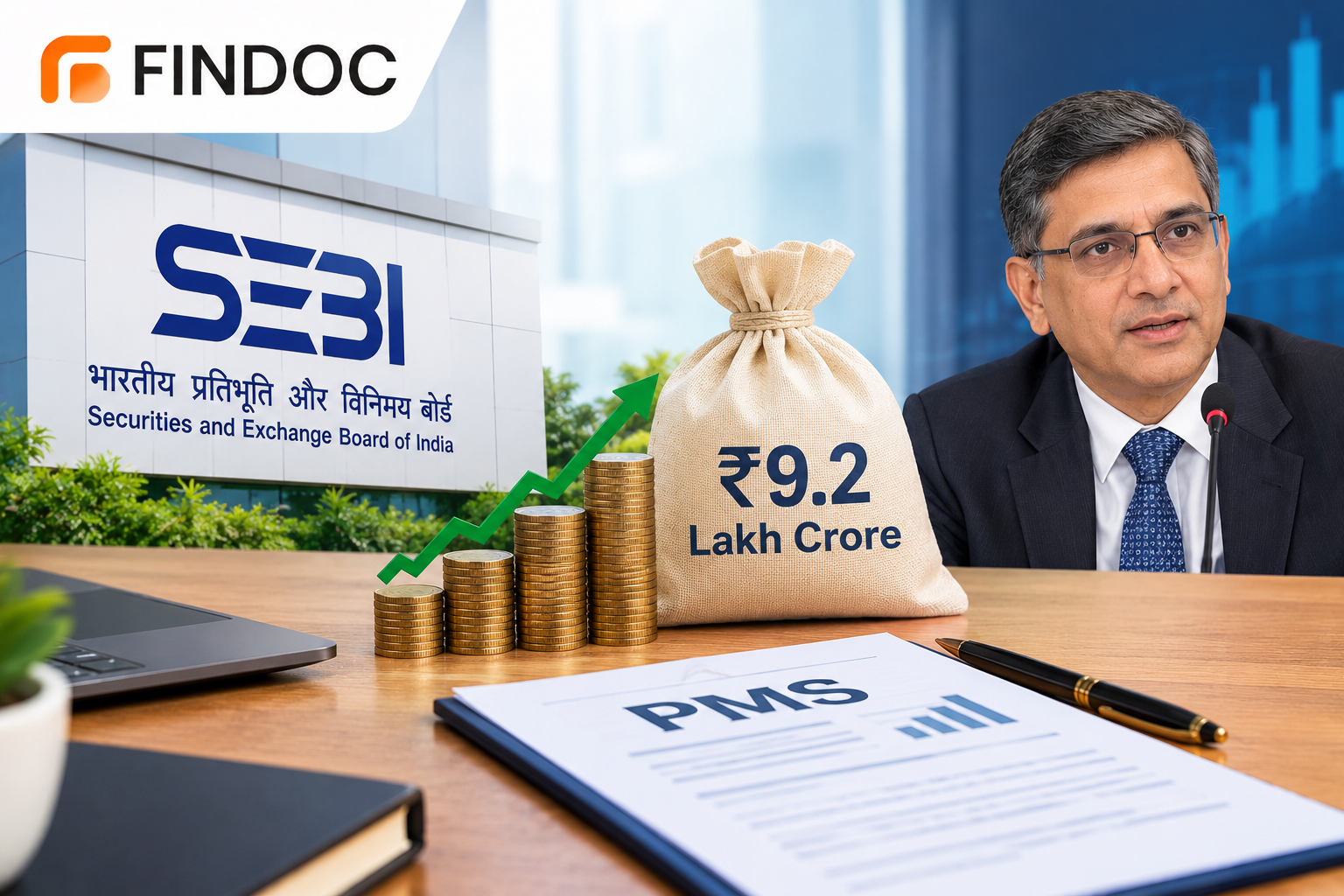
SEBI Chairman Tuhin Kanta Pandey said on 30 September 2026 that portfolio managers now handle about ₹9.2 lakh crore in assets, up from ₹1.4 lakh crore in FY16. He also outlined faster foreign investor onboarding.
How Fast Has the PMS Industry Grown?
Portfolio Management Services, or PMS, let a professional manager invest on behalf of a client in a personal portfolio. In a discretionary PMS, the manager takes the investment decisions for the client.
Pandey said the assets under management (AUM) of portfolio managers, leaving out PF and EPFO money, rose to about ₹9.2 lakh crore by August 2026. At the end of FY16, the same figure was ₹1.4 lakh crore. That is growth of around 20% a year.
| Measure | Latest figure |
|---|---|
| AUM excluding PF and EPFO assets, August 2026 | About ₹9.2 lakh crore |
| AUM excluding PF and EPFO assets, end of FY16 | ₹1.4 lakh crore |
| Registered portfolio managers | More than 530 |
| Discretionary PMS clients | About 2.2 lakh |
What the New Portfolio Managers Rules Allow
Pandey spoke about the new PMS framework approved by the SEBI Board on 24 September 2026. It is called the SEBI (Portfolio Managers) Regulations, 2026, and it replaces the 2020 regulations. SEBI says the aims are to develop the PMS industry, ease compliance, simplify language and remove redundant provisions.
SEBI’s press release (PR No. 59/2026) lists these key measures:
- Portfolio managers can invest in IPOs and in primary market debt issues.
- Up to 10% of client AUM can go into investment-grade, non-convertible, unlisted debt under discretionary PMS, with client consent.
- Exposure to exchange-traded derivatives can go up to 1.25 times of client AUM.
- Investment in foreign securities is allowed under both discretionary and non-discretionary PMS, within FEMA rules and the RBI’s Liberalised Remittance Scheme.
- Independent Fund Managers can run client portfolios in association with a registered portfolio manager, who stays fully responsible for them.
PRIM: A New Route to Mutual Funds
The most talked-about change is the Portfolio Managers Route for Investing in Mutual Fund units, or PRIM. It lets portfolio managers invest client money in direct plans of mutual funds.
These include ETFs, index funds and Specialised Investment Funds (SIFs) of Indian asset management companies. A direct plan is a mutual fund plan that does not carry distributor commission.
| PRIM condition | Requirement |
|---|---|
| Minimum ticket size | ₹25 lakh |
| Net worth for a new PRIM-only registration | ₹2 crore |
| Management fee | Fixed fee capped at 1% of client AUM; performance-based fee also allowed |
| Investment in schemes of affiliated AMCs | Capped at 25% |
| Exit load | Provisions waived |
An existing portfolio manager can offer PRIM through a separate investment approach and accept the ₹25 lakh minimum. A new applicant that will work only within PRIM needs a fresh registration. SEBI also wants the activities and clients of mutual fund distributors and PRIM kept separate, except for accredited investors.
Lighter Compliance for Smaller Portfolio Managers
The new rules also cut paperwork. SEBI says the regulations shrink from 70 pages to 33 pages, a reduction of 53%.
Even a graduate can now act as Principal Officer. Portfolio managers with AUM below ₹100 crore get relaxed dealing room requirements, and SEBI says 48% of registered portfolio managers fall in this group.
A standard Investment Management Agreement will be used for clients. Under it, authority to operate the client’s demat and trading account is built into the agreement.
The power of attorney for the bank account, which the RBI requires, stays separate. Clients who hand over such authority should still review their holdings and statements regularly.
Suitability, Not Just Eligibility
Pandey made a point about investor protection. A client may meet the minimum investment limit, he said, but eligibility and suitability are not the same thing. Portfolio managers understand a strategy’s concentration, liquidity, volatility and downside risks better than clients do, so they must understand each investor equally well.
He also said performance should be shown with context. That means stating the risks taken, the right benchmarks, portfolio concentration and drawdowns. A drawdown is the fall in a portfolio from its peak value to its lowest point.
Faster FPI Onboarding and Bond Indices
Pandey said SEBI and the RBI have already sorted out many issues in foreign portfolio investor (FPI) onboarding and want to go further. The steps he listed include:
- Onboarding within five working days has been tested for certain jurisdictions, with help from custodians and depositories.
- Documents can be filed with digital signatures, replacing physical signatures that earlier needed apostille or notarisation.
- The NSDL front end has been revamped, and an India Market Access portal now gives requirements, FAQs and documents in one place.
- Physical powers of attorney have moved to e-powers of attorney.
- The RBI has allowed corresponding branches of foreign commercial banks to certify documents, and it is examining whether the SWIFT process can be used to upload registration documents.
On bonds, Pandey said SEBI is working on bond indices that can be fitted on exchanges. The RBI has prepared draft guidelines and asked for comments, and SEBI is pursuing with the RBI to finalise them.
What It Means for Retail Investors
PMS and PRIM suit investors with larger sums, since PRIM alone needs ₹25 lakh. Most retail investors reach mutual funds through other routes. Those who prefer to manage money on their own can compare direct plans on an investing platform and invest in mutual funds online with smaller amounts.
The press release does not give an effective date for the new Portfolio Managers Regulations, 2026. Readers should watch for the SEBI notification, which will set the timeline for portfolio managers to adopt the changes.
Investments are subject to market risks. This is not investment advice.
Related Stock Market Insights
- What is a Demat Account?
- How to Open a Demat Account Online?
- What is Algo Trading?
- What are Growth Stocks?
- Top AI Stocks in India
- Top Semiconductor Stocks in India
| Check Indices | |
|---|---|
| BSE BANKEX Companies | BSE Largecap Comapnies |
| FINNIFTY Companies | Nifty Midcap 50 Companies |
| NIFTY MIDCAP 150 Companies | Nifty Pharma Companies |
| BSE 500 Companies | Nifty Smallcap 100 Companies |
Leave a Reply