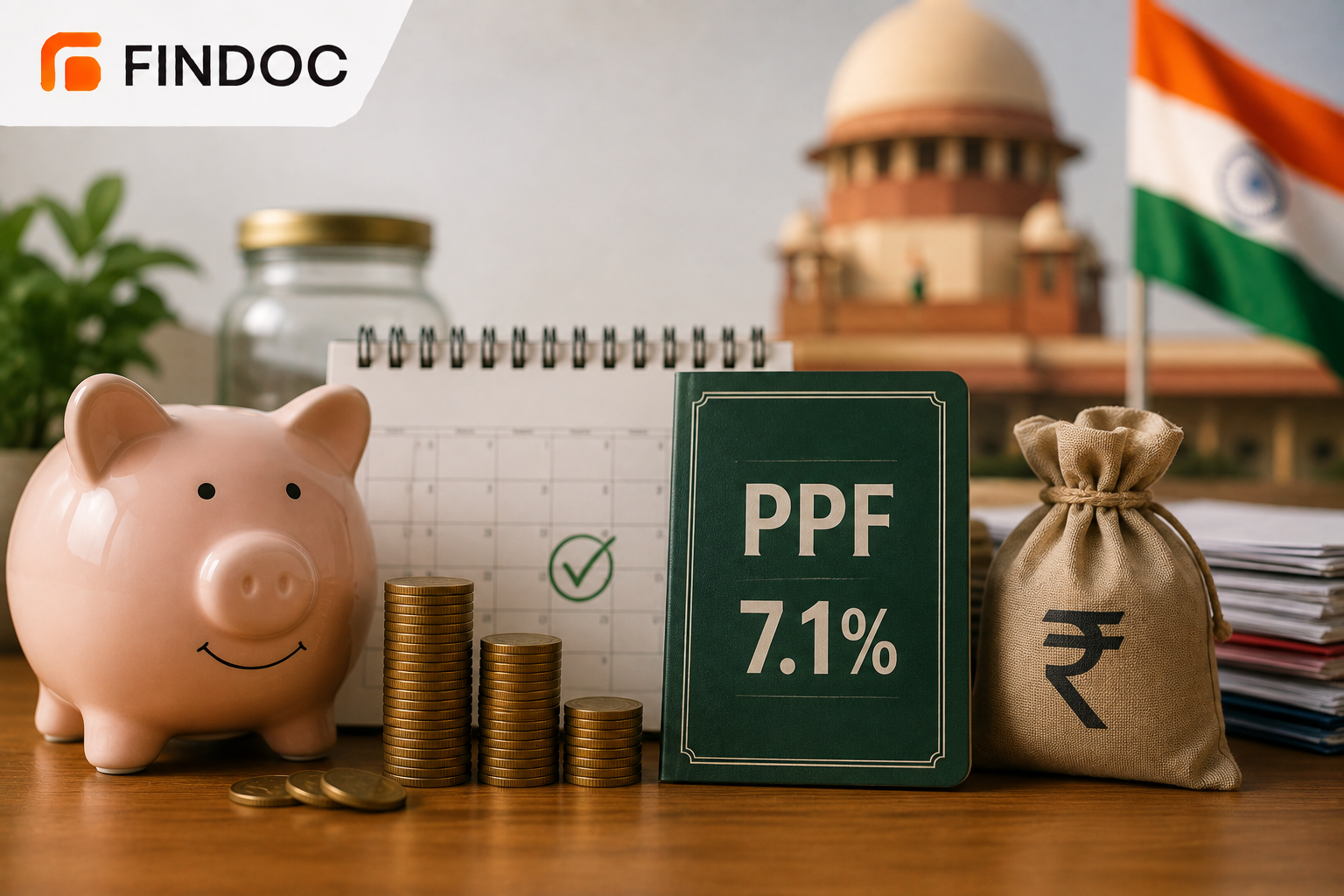
The government kept small savings interest rates unchanged for October to December 2026, per a Finance Ministry notification on 30 September. PPF stays at 7.1%, NSC at 7.7% and Sukanya Samriddhi at 8.2%.
Small Savings Rate Card for Q3 of FY 2026-27
The notification says rates for the third quarter of FY 2026-27 stay the same as those for July to September 2026. Here are the rates reported from the notification:
| Scheme | Interest rate (% per year) |
|---|---|
| Sukanya Samriddhi Yojana (SSY) | 8.2 |
| National Savings Certificate (NSC) | 7.7 |
| Kisan Vikas Patra (KVP) | 7.5 (matures in 115 months) |
| Monthly Income Scheme (MIS) | 7.4 |
| Public Provident Fund (PPF) | 7.1 |
| 3-year time deposit | 7.1 |
| Post office savings deposit | 4.0 |
Small savings schemes are run mainly through post offices and banks. They are backed by the Government of India, and the rate for each quarter is announced in advance.
Why the Rates Did Not Change
The government last changed rates on some small savings schemes in the fourth quarter of FY 2023-24, according to PTI. Since then, each quarterly review has kept them where they were. Rates are reset every quarter using a formula recommended by the Shyamala Gopinath Committee in 2011, which links them to government bond yields.
The wider backdrop matters. A personal finance analysis published after the announcement said inflation is rising and government bond yields are higher, but yields still sit below small savings rates. India’s 10-year government bond yield was near 7.15% on 30 September, according to PL Capital.
The analysis added that high inflation could push the government to consider higher small savings rates later. That is a view, not an official plan.
Who Uses These Schemes
Small savings schemes are popular with salaried people, parents saving for a child and retirees who want predictable income. The Monthly Income Scheme and the Senior Citizens’ Savings Scheme pay interest at regular intervals, while PPF and SSY are built for long-term goals. Because rates are announced one quarter at a time, savers cannot know the rate for future quarters when they open an account.
The Kisan Vikas Patra works differently. At 7.5%, it matures in 115 months, which is a little over nine and a half years, so the money stays invested for a fixed period.
What the Unchanged Rates Mean for Savers
The impact differs by scheme. Here are the points savers should know:
- PPF: the rate declared for a quarter applies to the whole outstanding balance, so 7.1% covers every rupee in the account for these three months.
- PPF lock-in: a PPF account matures after 15 years.
- SSY: the 8.2% rate is the highest on the list, and it is meant for a girl child’s savings.
- Rate changes are not locked in: PPF, SSY and SCSS rates are reviewed every quarter, so the rate on the day you open an account does not stay forever.
- Post office savings: the 4% rate is far lower than the other schemes.
Tax treatment differs by scheme, so savers should check the current rules for each one before planning.
A Quick Look at Three Months of Interest
The table below shows a simple, rough calculation of interest for one quarter on a balance of ₹1,00,000. It uses the annual rate divided by four and ignores compounding. Real payouts depend on each scheme’s own rules for compounding and payment, so treat these as illustrations only.
| Scheme | Annual rate (%) | Rough interest for 3 months on ₹1,00,000 (₹) |
|---|---|---|
| Sukanya Samriddhi Yojana | 8.2 | 2,050 |
| National Savings Certificate | 7.7 | 1,925 |
| Monthly Income Scheme | 7.4 | 1,850 |
| Public Provident Fund | 7.1 | 1,775 |
| Post office savings deposit | 4.0 | 1,000 |
How the Rates Compare with Bond Yields
The 3-year time deposit and PPF both pay 7.1%. The 10-year government bond yield, near 7.15%, is roughly in the same range.
A bond yield changes every day with trading, while the small savings rate is fixed for a quarter. That is the main practical difference between the two.
Small savings schemes carry a government backing. Market-linked options such as shares and equity mutual funds do not offer fixed returns, and their value can fall.
Adding Market-Linked Options
Savers who want to add shares or ETFs to their mix can open a demat account for direct equity holdings. Those who prefer SIPs can start on an investing platform and choose funds by risk level and time horizon. Market-linked returns are not fixed, so investors should match the amount to their goals and their ability to bear losses.
When the Next Review is Due
The government reviews small savings rates every quarter. The next announcement will cover the January to March 2027 quarter, which begins on 1 January 2027. Until then, the rates in the table above apply.
Investments are subject to market risks. This is not investment advice.
Related Stock Market Insights
Leave a Reply