findocblog

Blog

  • India Energy Sector: Reliance, ONGC Amid Oil Volatility

    India Energy Sector: Reliance, ONGC Amid Oil Volatility

    The Indian energy sector faces heightened volatility as Reliance Industries and ONGC navigate fluctuating oil prices and macroeconomic pressures, with benchmark indices showing mixed signals. On March 30, 2026, Reliance Industries closed at Rs 1,369.89, down 1.89% amid bearish trading, while broader NIFTY 50 and SENSEX energies remained under scrutiny ahead of fiscal year-end results. FY2025-2026 data reveals Reliance’s consolidated revenue at Rs 9,82,671 crore and profit at Rs 80,787 crore, underscoring resilience despite Q3 challenges. Investors eye RBI’s monetary stance and INR stability as key influencers on energy imports and domestic production.

    Key Highlights

    • Reliance Industries Q3 FY2025-26 revenue up 4.1% QoQ to Rs 2,69,819 crore, with net profit rising 0.9% QoQ.
    • ONGC shares under pressure from global oil price swings, impacting NSE energy index performance.
    • Reliance market cap at Rs 18,18,628.50 crore as of December 2025, with promoters holding 50%.
    • Recent RIL trading: March 30 open at Rs 1,326.59, low of Rs 1,106.39, signaling bearish sentiment.
    • Energy sector cash flows strong, Reliance operating cash at Rs 1,78,703 crore for FY2025.

    Reliance Industries Financial Performance

    Reliance Industries, a cornerstone of India’s energy landscape, demonstrated steady operational growth in Q3 FY2025-26 despite refining margin pressures. Consolidated revenues climbed 4.1% quarter-on-quarter to Rs 2,69,819 crore, reflecting a 10.5% year-on-year increase, driven by upstream and petrochemical segments. Expenses rose 4.4% QoQ to Rs 2,18,887 crore, squeezing operating profit margins to 17%, down from 18% in prior quarters. Net profit edged up 0.9% QoQ to an estimated Rs 29,697 crore pre-tax levels, with earnings per share at Rs 13.78. For the full FY2025-2026, Reliance achieved revenue of Rs 9,82,671 crore and profit of Rs 80,787 crore, bolstered by diversified cash flows. Operating activities generated Rs 1,78,703 crore, offsetting heavy investing outflows of Rs 1,37,535 crore. Shareholding structure remains stable, with promoters at 50%, FIIs at 19.1%, DIIs at 20.3%, and public at 10.6%. Recent share price action on March 30, 2026, saw the stock open at Rs 1,326.59, declining 0.84% initially, hitting a session low of Rs 1,106.39 before closing at Rs 1,369.89, down 1.89% with volumes at 16.211 million shares. Analysts note that Reliance’s energy vertical, including refining and exploration, contributed significantly to EBITDA of Rs 50,932 crore in Q3, up from Rs 50,367 crore prior. Interest expenses held at 2.52% of operating revenues for FY2025, with employee costs at 2.96%, indicating cost discipline amid volatile crude imports. This development presents new considerations for stock investment strategies focused on Indian equities.

    ONGC and Oil Prices Impact on Indian Energy

    ONGC, India’s largest exploration and production player, grappled with oil price volatility in the past 24 hours, as Brent crude hovered around levels pressuring domestic profitability. While specific ONGC updates were sparse, sector-wide sentiment reflected in NIFTY Energy index dips, correlating with Reliance’s bearish session. Oil prices in India, influenced by INR at approximately 83.50 per USD, added import cost burdens estimated at 5-7% higher year-on-year. Reliance’s upstream segment mitigated some risks, with other income at Rs 4,914 crore in Q3 supporting profit before tax at Rs 29,697 crore. Quarterly revenue trajectory shows March 2025 at Rs 2,66,293 crore, June at Rs 2,58,751 crore, September at Rs 2,59,105 crore, and December at Rs 2,69,819 crore, averaging 18% operating margins. ONGC’s production metrics, though not detailed in recent filings, typically align with 70-75 million metric tonnes oil equivalent annually, facing subsidy overhangs from RBI-managed fuel pricing. BSE and NSE data indicate energy heavyweights like Reliance dragging sector indices, with SENSEX energy components down 1-2% on March 30. Jio Financial Services, a Reliance offshoot, halted trading ahead of FY26 results, signaling broader group caution. Cholamandalam Investment’s Q3 FY26 net profit of Rs 1,122 crore with AUM at Rs 89,178 crore highlights financing strains in energy capex. Retail participation has grown significantly as access to a reliable trading platform has become more widespread.

    Key Players Performance Comparison

    Company Recent Close (Mar 30, 2026) QoQ Revenue Growth FY2025 Profit (Rs Cr) Market Cap (Rs Cr)
    Reliance Industries 1,369.89 (-1.89%) 4.1% 80,787 18,18,628.50
    ONGC Sector-aligned dip N/A N/A N/A
    Reliance Industrial Infra 624.40 (-4.37%) N/A N/A N/A
    • Reliance outperforms peers in revenue scale, with 10.5% YoY growth versus sector averages.
    • ONGC exposed to pure-play upstream risks, lacking Reliance’s diversification into retail and telecom.
    • Volatility metrics: RIL weekly stochastic crossover signals potential 4.68% decline in 7 weeks historically.
    • Cash flow strength: Reliance net cash Rs 9,277 crore FY2025, supporting capex amid oil swings.

    Market Outlook

    Indian energy investors should monitor RBI’s April policy for rate cues, as persistent oil prices above $70/barrel could widen current account deficits by 0.5-1% of GDP. Reliance’s Q4 FY26 results, due post-March 31, may reveal capex plans exceeding Rs 1,50,000 crore, focusing on green hydrogen and renewables. ONGC’s exploration bids under OALP rounds offer upside, but geopolitical risks in Middle East pose 10-15% downside to earnings. NIFTY 50 energy target at 28,000 by Q2 FY27, per consensus, hinges on INR stability below 84. Key watches: Reliance EPS trajectory above Rs 60 annually, ONGC production ramps, and global crude settling under $65 for import relief. Investors looking to participate in this market movement can open demat account through SEBI-registered brokers.

    Conclusion

    India’s energy sector, led by Reliance Industries and ONGC, exhibits robust fundamentals amid short-term share price pressures and oil volatility. With FY2025-2026 revenues and profits underscoring scale, diversified players like Reliance provide a hedge against upstream risks. Institutional investors stand to benefit from strategic capex and policy tailwinds, positioning the sector for 12-15% compounded returns through FY2027, provided macroeconomic stability prevails. Vigilance on Q4 earnings and RBI actions remains paramount for portfolio allocation.
  • RBI Clamps Down on Rupee Positions Amid Banking Sector Strain

    RBI Clamps Down on Rupee Positions Amid Banking Sector Strain

    The Reserve Bank of India (RBI) has imposed stringent limits on onshore INR positions for authorised dealers, capping them at US$100 million per institution by end-of-day, effective April 10, 2026, in a bid to curb speculative trades amid the rupee’s plunge to a record low of 94.8550 on March 27. This move targets arbitrage strategies where banks bought USD/INR onshore and sold in offshore NDF markets, estimated at US$30-40 billion across institutions, forcing unwinding that could trigger mark-to-market losses. As FX reserves dip below US$700 billion after a US$30 billion drop in March, with RBI’s forward book swelling to over US$100 billion net short from US$67 billion in January, the Indian banking sector faces heightened volatility. Nifty Bank index pressures mount with Sensex sinking 1,230 points and Nifty 50 below 22,500, driven by oil price surges from Iran conflict, FPI outflows exceeding US$13 billion in March, and rising 10-year G-Sec yields to 6.94 percent, the highest in a year. Major players like State Bank of India (SBI), HDFC Bank, ICICI Bank, and Axis Bank grapple with rupee weakness, potential rate hikes, and external shocks.

    Key Highlights

    • RBI mandates US$100 million cap on gross onshore USD/INR positions, dismantling prior netting across onshore-offshore markets previously at 25% of Tier-1 capital.
    • Rupee hits all-time low of 94.8550 on March 27 amid oil rally from US$60/barrel, FPI equity-debt sales over US$13 billion, and RBI interventions selling US$16 billion in FX reserves.
    • RBI forward book surges to >US$100 billion net short in March from US$67 billion in January; spot reserves at US$717 billion as of early March, but effective usable reserves lower after US$68-93 billion liabilities.
    • Markets price three RBI rate hikes in next six months; repo at 5.25% with CPI at 3.75% (Feb 2026) yields positive real rates of 1.50%, but WPI risks double-digits from energy shocks.
    • Banking stocks drag indices: Sensex down 1,230 points, Nifty below 22,500; GOI 10-year yield at 6.94%, signaling tighter liquidity for SBI, HDFC, ICICI, Axis.

    RBI’s Rupee Defense and Position Limits

    The RBI’s directive, announced post-markets on March 27, represents a sharp pivot to preserve financial stability as the INR depreciates 11 percent in FY26, with 4.22 percent erosion solely in March triggered by the Iran conflict and Strait of Hormuz disruptions. By restricting gross onshore positions to US$100 million—down from flexible 25% of capital with netting—this curbs the US$30-40 billion arbitrage book where banks exploited spreads between onshore liquidity-funded USD buys and offshore NDF sells. Market reaction was swift: onshore USD/INR dipped to 93.40 before rebounding to 94.58, reflecting tactical INR strengthening from position closures, wider NDF-onshore forward points, and compressed implied yields.

    This intervention underscores RBI’s arsenal amid depleted buffers. FX reserves fell US$30 billion in March, including US$16 billion in foreign currency assets, with spot sales around US$10 billion to defend the rupee. The forward book ballooned to over US$100 billion net short, reducing effective reserves from headline US$717 billion (early March) after accounting for US$68 billion January liabilities plus US$20-25 billion more. Analysts note this as a deliberate hedge against prolonged INR weakness, but it heightens nervousness: squaring these positions could accelerate depreciation. For banks like SBI and HDFC, unwinding implies near-term losses, squeezing net interest margins already under pressure from 6.94% G-Sec yields.

    RBI’s actions align with historical patterns where sustained crude above US$80/barrel precedes rate hikes, as in 2022 when repo jumped from 4% to 6.50% amid fuel price spikes. Current repo at 5.25% offers a 1.50% positive real rate buffer versus 3.75% February CPI, but oil-driven WPI inflation risks double-digits, with OMCs absorbing retail fuel losses and government excise cuts costing ₹140 billion monthly. Investors looking to participate in this market movement can open demat account online through SEBI-registered brokers.

    Banking Sector Pressures

    India’s banking heavyweights—SBI, HDFC Bank, ICICI Bank, and Axis Bank—navigate a perfect storm of rupee volatility, FPI outflows, and geopolitical shocks. FPIs offloaded over US$13 billion in equity and debt in March, exacerbating bids on USD and dragging bank stocks: Nifty Bank underperforms as financials lead Sensex’s 1,230-point plunge, with Nifty 50 sub-22,500. SBI, as the largest public sector lender, faces elevated forex exposure from trade finance to Gulf nations, now hit by export declines and disrupted remittances amid Middle East tensions.

    HDFC Bank and ICICI Bank, private sector leaders, contend with arbitrage unwind risks; their USD/INR long onshore positions, funded by cheap liquidity, now demand costly closures by April 10. Axis Bank, aggressive in FX desks, reports similar pressures, with aggregate bank positions at US$30-40 billion facing mark-to-market hits. Rising yields to 6.94%—a one-year high—signal liquidity tightening, potentially curbing loan growth as deposit costs rise. Retail fuel stability via OMC losses and ₹10/litre excise cuts provides temporary relief, but prolonged oil above US$80 risks passthrough inflation, echoing 2022’s 40-50 bps hikes.

    Service exports, a forex positive, falter as AI disrupts IT remittances, critical for ICICI and HDFC’s NRI portfolios. Gold and oil import bills swell current account deficits, forcing RBI sales and straining bank balance sheets via higher provisioning for stressed loans in energy-dependent sectors. This development presents new considerations for stock investment strategies focused on Indian equities.

    Key Metrics Analysis

    MetricCurrent LevelImpact
    Rupee Depreciation11% FY26 total; 4.22% MarchRecord low 94.8550
    FX Reserves ImpactUS$30bn drop in MarchSpot US$717bn, effective lower
    Yield SurgeGOI 10-yr at 6.94%One-year high
    FPI Outflows>US$13bn MarchSensex -1,230pts, Nifty <22,500
    Bank Arbitrage ExposureUS$30-40bn totalUS$100mn cap forces unwind
    Inflation RisksCPI 3.75% (Feb)WPI double-digits potential

    Market Outlook

    Investors should monitor RBI’s April policy for stance shift from neutral, as markets price three 25-50 bps hikes by FY27 amid oil persistence above US$95 and Hormuz risks. Rupee vulnerability persists above 95 levels without FPI revival, hampered by global energy shortages, fertiliser/food price spikes, and AI-eroded service exports. Banks like SBI and HDFC offer defensive plays via 8.05% RBI floating rate bonds, but NIM compression from yields and FX losses warrants caution. Retail participation has grown significantly as access to a reliable stock trading and investing platform has become more widespread. Key watches: FII flows, crude trajectory, RBI forward rollovers; prolonged conflict implies CAD widening to 2.5-3% GDP, pressuring Nifty Bank to 45,000 support.

    Conclusion

    RBI’s position caps deliver tactical rupee relief but fail to reverse structural headwinds from oil shocks, FPI exits, and reserve strains, positioning Indian banking for a tighter FY27 with rate hikes and volatility. Institutional investors must prioritize FX-hedged portfolios, favouring resilient lenders like ICICI amid 6.94% yields and 94+ USD/INR, while eyeing RBI interventions and geopolitical de-escalation for sustained Nifty recovery above 23,000. The sector’s resilience hinges on capital inflows to replenish buffers, underscoring prudent risk management in this high-stakes environment.

  • Sensex Crashes 1636 Pts Nifty Below 22350 Banking Drag

    Sensex Crashes 1636 Pts Nifty Below 22350 Banking Drag

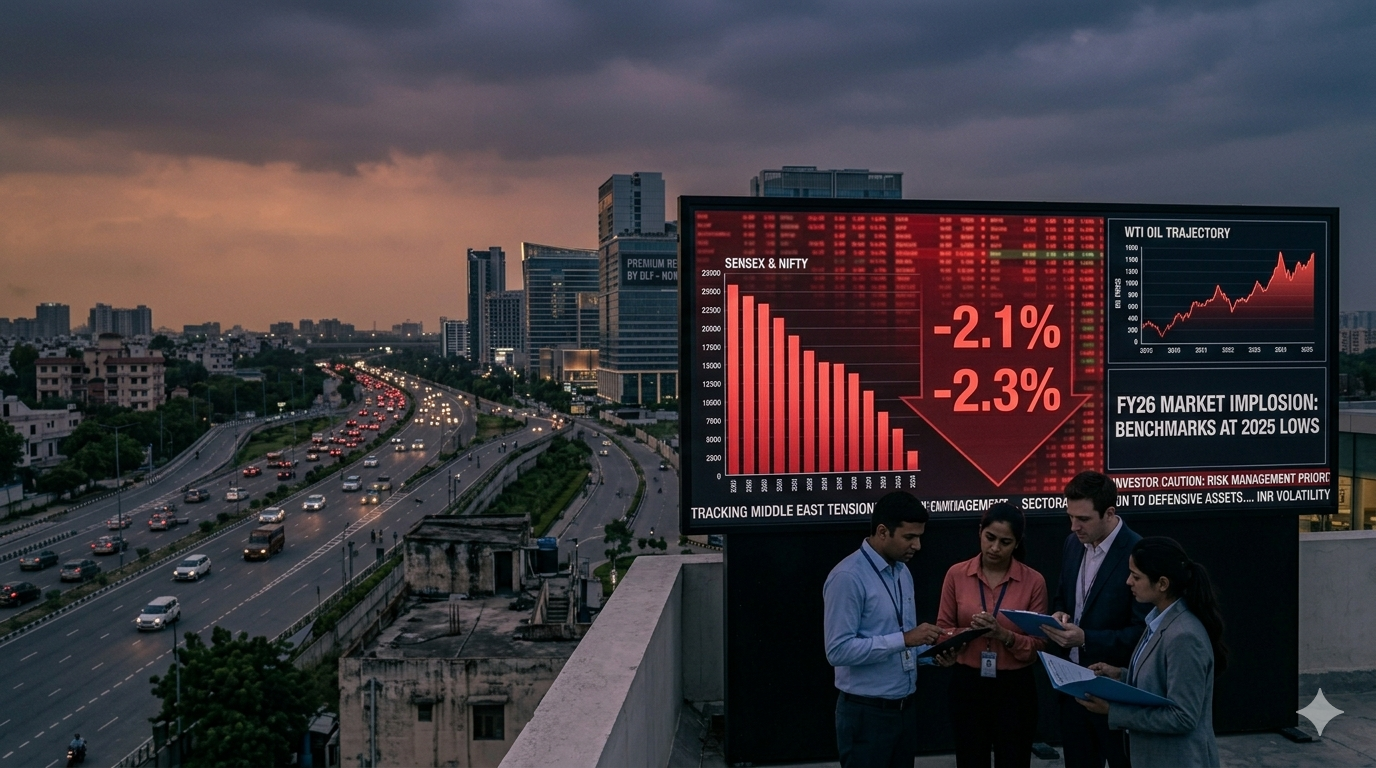
    Indian equity benchmarks capped the final trading session of FY26 on March 30 with steep declines, as the BSE Sensex plunged 1,635.67 points or 2.22 percent to settle at 71,947.55, while the Nifty 50 shed 488.40 points or 2.14 percent to close at 22,331.40. The sharp sell-off, marking the eighth session of 1 percent or more losses in the March expiry series, was primarily driven by heavyweights in the banking sector amid escalating geopolitical tensions from the protracted US-Iran conflict and surging oil prices. Broad-based selling across sectors underscored investor concerns over growth slowdown and inflationary pressures, with Bank Nifty underperforming by dropping nearly 3.82 percent to 50,275. Markets remain closed today, March 31, on account of Mahavir Jayanti, leaving traders to assess the damage from this volatile close.

    Key Highlights

    • Sensex intraday low of 71,774.13 before closing at 71,947.55, down 2.22 percent; Nifty hit 22,283.85 low, settling at 22,331.40, down 2.14 percent.
    • Bajaj Finance led Nifty losers with a 4.95 percent drop, followed by Shriram Finance at 3.82 percent, SBI at 3.8 percent, IndiGo at 3.65 percent, and Kotak Mahindra Bank at 3.59 percent.
    • Banking stocks across private and public sectors, including HDFC Bank, ICICI Bank, and City Union Bank (down 6 percent), dragged indices lower.
    • 23 stocks hit 52-week highs, but 1,219 touched one-year lows, signaling widespread weakness.
    • Nifty plunged 11.3 percent in March and 14.54 percent in the March quarter, the worst since 2020; Bank Nifty down 16.94 percent monthly and 15.62 percent quarterly.

    Banking Sector Meltdown Drags Nifty Sensex

    The banking sector bore the brunt of Monday’s carnage, with Bank Nifty not only extending its downtrend but breaking below its prior swing low of 51,324 from March 23, closing at 50,275 after a 3.82 percent decline. This underperformance highlighted a lack of support from heavyweight constituents, as private sector lenders like Bajaj Finance tanked 4.95 percent, Kotak Mahindra Bank fell 3.59 percent, and HDFC Bank alongside ICICI Bank posted sharp losses. Public sector players were equally battered, with State Bank of India declining 3.8 percent and City Union Bank slumping 6 percent. The index ended FY26 with a 2.50 percent loss, underscoring relative weakness in the latter half of the fiscal year.

    This rout in financials amplified broader market fragility, as the price structure for Bank Nifty remains decisively bearish with sustained lower lows and persistent selling pressure. Analysts point to unresolved Middle East tensions fueling fears of higher oil import costs, which could squeeze net interest margins and elevate non-performing assets amid a slowing economy. The sector’s vulnerability was evident in the intraday breach of key supports, with immediate downside risks toward 49,900-49,800, as noted by Sudeep Shah, Head of Technical and Derivatives Research at SBI Securities. Any sustained move below this zone could propel further weakness to 49,500 and 49,200 in the short term.

    Compounding the pressure, foreign institutional investors continued their outflows, exacerbating liquidity concerns in a high-valuation environment. Domestic institutions provided some cushion, but it was insufficient against the tide of risk aversion. For institutional investors, this signals a tactical pause in overweight banking exposures, with selective rotation toward defensives potentially warranted. Investors looking to participate in this market movement can open free demat account online through SEBI-registered brokers.

    Broad Market Sell-Off Key Losers Gainers

    The Nifty 50 saw 44 of its constituents in the red, with only six advancing, reflecting pervasive bearishness on the last day of FY26. Bajaj Finance emerged as the top laggard at 4.95 percent lower, followed closely by Shriram Finance down 3.82 percent, underscoring stress in non-banking financial companies exposed to consumer lending amid rising funding costs. Aviation player IndiGo shed 3.65 percent, hit by fuel price spikes from geopolitical unrest, while Kotak Mahindra Bank and SBI rounded out major drags.

    On the flip side, select names like Tech Mahindra, Power Grid Corp, and Reliance Industries bucked the trend as top gainers, offering pockets of resilience amid the downturn. Reliance’s steady performance provided some ballast to the Sensex, given its heavy weighting, while power sector strength in Power Grid hinted at defensive rotations. Broader participation in the decline was stark: 1,219 stocks hit one-year lows against just 23 at 52-week highs, painting a picture of capitulation.

    Sectorally, the carnage extended beyond financials, with midcap and smallcap indices mirroring benchmark weakness. The Nifty’s intraday low of 22,283.85 breached key supports at 22,470-22,450, closing at levels unseen since April 7, 2025. This 5 percent FY26 loss for Nifty, coupled with a 2.14 percent daily drop, caps a dismal March where the index fell 11.3 percent—the steepest monthly decline since 2020. This development presents new considerations for stock investment strategies focused on Indian equities.

    March Quarter Performance Worst Since 2020

    Nifty 50 and Bank Nifty posted their worst March quarter and monthly performances since 2020, with Nifty down 14.54 percent quarterly and 11.3 percent monthly, while Bank Nifty slid 15.62 percent over the quarter and 16.94 percent in March.

    Index Closing Level Daily Change (%) Monthly Change (%) Quarterly Change (%)
    Nifty 50 22,331.40 -2.14% -11.3% -14.54%
    Bank Nifty 50,275 -3.82% -16.94% -15.62%
    GIFT Nifty 22,423 -403 points – –

    Nifty closed FY26 at 22,331.40, marking an 8th straight 1 percent-plus loss session in March expiry. Bank Nifty broke swing low of 51,324, ending at 50,275; quarterly loss of 15.62 percent. GIFT Nifty traded at 22,423, down 403 points, signaling continued gap-down pressure post-holiday. VIX at four-year high, weekly options data pins Nifty range at 22,000-22,500 short-term. Resistance at 22,500-22,700; support breach toward 22,000 could accelerate downside.

    This table underscores the bearish momentum, with banking’s outsized drag amplifying benchmark losses. Key players like SBI and Bajaj Finance exemplify risks from inflation pass-through failures and geopolitical oil shocks. Retail participation has grown significantly as access to a reliable trading platform has become more widespread.

    Market Outlook

    Looking ahead, Indian investors face elevated risks from persistent US-Iran hostilities, with oil prices threatening RBI’s inflation targets and INR stability. A breakout from the Nifty’s 22,000-22,500 range will dictate direction: upside beyond 22,700 could stabilize sentiment, but sub-22,000 breaches risk deeper corrections toward 21,500. Institutional players monitor FII flows, RBI liquidity measures, and Q4 earnings for banking resilience. Rotation into power utilities like Power Grid and select IT names offers hedges, while avoiding high-beta financials. Volatility remains high with VIX at multi-year peaks, advising position sizing discipline and stop-losses amid potential post-holiday gaps.

    Conclusion

    Monday’s 2 percent-plus plunge in Sensex and Nifty, capped by banking sector implosion, crystallizes FY26’s turbulent close amid global headwinds. With benchmarks at 2025 lows and quarterly losses echoing 2020 crashes, the path forward hinges on de-escalation in Middle East tensions and domestic policy support. Investors must prioritize risk management, tracking oil trajectories, INR movements, and sectoral rotations to navigate this bearish setup effectively.

    Explore Popular Stocks
    Infosys Share Price Adani Enterprises Share Price
    ITC Bank Share Price Larsen & Toubro Share Price
    Axis Bank Share Price Bharti Airtel Share Price
    Bharat Electronics Share Price ONGC Share Price
  • Indian IT Sector Braces for Q4FY26 Amid AI Headwinds

    Indian IT Sector Braces for Q4FY26 Amid AI Headwinds

    The Indian IT sector, a cornerstone of the Nifty 50 and Sensex, enters the crucial Q4FY26 earnings season under a cloud of uncertainty, with global brokerages like JP Morgan slashing target prices for bellwethers TCS, Infosys, HCL Technologies, and Wipro. Amid a 25 percent plunge in the Nifty IT index year-to-date—far outpacing the Nifty 50’s 12 percent correction—investors are fixated on FY27 revenue guidance as a litmus test for resilience against artificial intelligence-driven pricing pressures and geopolitical disruptions. Rupee depreciation to 93.94 against the dollar offers some earnings cushion, but muted deal ramp-ups signal persistent headwinds for these BSE and NSE heavyweights.

    Key Highlights

    • JP Morgan trims target prices across major IT firms: TCS to Rs 3,150 from Rs 4,200; Infosys to Rs 1,550 from Rs 2,050; HCL Tech to Rs 1,410 from Rs 1,690; Wipro to Rs 200 from Rs 270.
    • Q4FY26 constant currency QoQ projections: TCS +0.6 percent, Infosys -0.7 percent, HCL Tech -1.6 percent, Wipro -1.3 percent; sector LTM growth at 1.5 percent.
    • FY27 revenue guidance outlook: Infosys 2-5 percent, HCL Tech 3-6 percent, Wipro -2 to 0 percent sequential; large-caps now pegged at 3 percent medium-term growth, down from 4 percent.
    • TCS board meets April 9 to approve FY26 results and final dividend, with yield at 2.61 percent versus Wipro’s 5.5-5.8 percent and Infosys’s 3.5-3.8 percent.
    • Mid-caps show relative strength: Tata Technologies +4.4 percent QoQ, Persistent Systems +4 percent; Nifty IT rebounds 3 percent intraday amid rupee weakness.

    IT Earnings Preview: Muted Q4FY26 Growth

    JP Morgan’s preview underscores a relatively healthy but underwhelming Q4FY26 for India’s IT giants, with selective headwinds from geopolitical tensions and AI disruptions curbing deal closures and ramp-ups. In constant currency terms, TCS is poised for modest 0.6 percent quarter-on-quarter revenue growth, bucking the trend of declines elsewhere: Infosys at -0.7 percent, HCL Technologies at -1.6 percent, and Wipro at -1.3 percent. The sector’s last twelve months growth lingers at a tepid 1.5 percent, reflecting broader demand reflation challenges absent in prior cycles. This cautious tone stems from limited visibility on client spending recovery, prompting JP Morgan to downgrade medium-term assumptions: large-cap IT firms now at 3 percent growth versus 4 percent previously, and mid-caps at 5 percent from 6 percent. Target price-to-earnings multiples have been cut by 25 percent across the board, signaling eroded investor confidence. TCS, with a market cap of Rs 8.62 trillion as of March 24, exemplifies the strain—its stock down 33.10 percent over the past year amid earnings misses in Q3 and Q4 FY26, profit shortfalls, and margin erosion. Analysts emphasize that FY27 guidance will be pivotal, marking the first time in eight years it overshadows quarterly beats. Any hint of acceleration could counter ‘AI compression’ fears, where pricing pressures from generative AI projects threaten traditional services margins. Rupee weakness, with the INR hitting 93.94 per dollar on March 23, provides a natural hedge, potentially softening earnings downgrades for these export-heavy firms listed on BSE and NSE. Investors looking to participate in these market movements can open demat account online through SEBI-registered brokers to access IT sector opportunities.

    Brokerage Moves and Dividend Dynamics

    JP Morgan maintains an Overweight on TCS and Infosys despite cuts, with new targets at Rs 3,150 and Rs 1,550 respectively, while shifting HCL Tech and Wipro to Neutral at Rs 1,410 and Rs 200. Mid-cap picks like Persistent Systems (Rs 6,000 target) and Mphasis (Rs 2,600) retain Overweight, highlighting pockets of resilience. UBS echoes this caution, trimming TCS to Rs 4,250 from Rs 4,650 on soft Q4 revenue and margin woes, underscoring consensus worries over AI adaptation lags. Dividend policies offer a silver lining for yield-hungry investors amid stock weakness. TCS’s board convenes on April 9 to finalize FY26 results and dividends, with its 2.61 percent yield appearing conservative next to peers: Wipro at 5.5-5.8 percent, Infosys at 3.5-3.8 percent, and HCL Tech at 3.6-4.0 percent. Sector revenue is projected to hit $315 billion in FY26, up 6.1 percent, fueled by AI services, yet competitive intensity and US slowdown risks loom large. IT mutual funds have shed up to 30 percent in 2026, amplifying sentiment drag on Nifty 50 constituents. Nifty IT’s 3 percent intraday bounce, led by Mphasis, TCS, HCL Tech, and Wipro, ties to INR depreciation, which boosts repatriated dollar earnings. However, TCS’s five-year return of -23.83 percent and peers’ deal ramp-downs paint a picture of structural challenges, with management commentary on Gen AI pipelines critical for restoring Nifty 50 balance. This development presents new considerations for stock investment strategies focused on Indian equities.

    Large-Cap IT Target Price Comparison

    Company Rating New TP (Rs) Old TP (Rs) QoQ CC Growth Q4FY26 (%)
    TCS Overweight 3,150 4,200 +0.6
    Infosys Overweight 1,550 2,050 -0.7
    HCL Tech Neutral 1,410 1,690 -1.6
    Wipro Neutral 200 270 -1.3
    Persistent Overweight 6,000 8,000 +4.0
    Mphasis Overweight 2,600 3,300 +2.0
    This table illustrates JP Morgan’s across-the-board revisions, with large-caps facing steeper cuts amid FY27 guidance risks. Mid-caps like Persistent and Mphasis outperform on QoQ metrics, potentially drawing rotational flows if large-cap disappointments materialize. Investors should monitor ADR parallels—Infosys at $16.8 (from $22.8), Wipro at $2.2 (from $3)—for global cues impacting NSE liquidity.

    Market Outlook

    For Indian institutional investors, the IT sector’s trajectory hinges on FY27 guidance revealing AI monetization progress and deal pipeline strength, amid RBI’s steady policy and INR volatility. Risks include US recession signals curbing discretionary spends, crude spikes from geopolitics, and margin squeezes if AI projects underprice legacy deals—potentially capping Nifty IT recovery below Sensex gains. Key players TCS and Infosys must demonstrate Gen AI wins to justify premiums; watch Wipro and HCL for turnaround catalysts. Positive rupee tailwinds and $315 billion FY26 sector scale support 3-5 percent medium-term growth, but delays in reflation could extend the 25 percent YTD rout, favoring selective mid-cap exposure over broad Nifty 50 IT bets. Retail participation has grown significantly as access to a reliable trading and investment platform has become more widespread, enabling broader market engagement.

    Conclusion

    As Q4FY26 unfolds, India’s IT titans confront a defining moment where FY27 guidance must pierce AI pessimism to halt Nifty IT’s slide and realign with Nifty 50 resilience. JP Morgan’s prudent cuts reflect tangible headwinds, yet rupee cushions, dividend commitments, and mid-cap vigor offer footholds. Institutional players should prioritize firms showcasing AI agility, scrutinize April earnings for pipeline clarity, and brace for volatility—positioning for a sector rebound contingent on global demand thaw and domestic market stability.
  • Indian Real Estate Resilience Amid Cooling Housing Cycle

    Indian Real Estate Resilience Amid Cooling Housing Cycle

    India’s residential real estate sector exhibits a bifurcated landscape in Q2FY26, with top listed developers like DLF, Godrej Properties, and Prestige Estates posting robust pre-sales growth despite broader market fatigue evidenced by declining sales volumes and new launches. Nuvama Institutional Equities highlights this divergence, attributing outperformance to brand strength and financial discipline among marquee players, even as affordability challenges intensify in key micro-markets. Pre-sales for the top 23 developers surged 31% year-on-year to ₹4,05,000 crore, contrasting a 61% drop in new launches by top 15 firms. Collections rose 15% to ₹26,644.4 crore, underscoring sustained demand for trusted projects amid a cautious sector outlook.

    Key Highlights

    • Top 23 developers’ Q2FY26 pre-sales up 31% YoY to ₹4,05,000 crore, defying 61% plunge in new launches.
    • Godrej Properties achieves ₹8,505 crore pre-sales (+64% YoY), fueled by marquee launches; stock at ₹1,540.50, up 2.89% on March 24.
    • DLF records 526% YoY pre-sales spike from major Mumbai launch; Prestige Estates posts ₹6,017.3 crore (+50% YoY).
    • Godrej Properties and Lodha secure over 25 land parcels in FY26, eyeing ₹1 lakh crore revenue potential.
    • Regional splits: Bengaluru, Chennai growing; Hyderabad peaked, Pune fatigued, Gurugram affordability-constrained.

    Listed Developers Defy Market Slowdown

    India’s leading real estate firms demonstrated remarkable resilience in Q2FY26, capitalizing on sustenance demand from ongoing projects while the broader housing upcycle showed signs of exhaustion through CY25. Pre-sales for the top 23 listed developers climbed 31% year-on-year to ₹4,05,000 crore, a testament to buyers’ preference for established brands amid rising affordability hurdles. This growth occurred against a backdrop of sharply reduced new supply, with launches by the top 15 developers plummeting 61% year-on-year. Collections, critical for cash flow and execution, expanded 15% to ₹26,644.4 crore, bolstered by accelerated construction timelines and reliable customer advances. Nuvama Institutional Equities notes that this performance underscores the sector’s polarization: while unlisted or smaller players grapple with softening volumes, top-tier developers leverage superior execution and inventory quality. Financial metrics further reinforce this strength, with net debt-to-equity ratios at multi-year lows for entities like DLF, Sobha, and Oberoi Realty. Developers channeled approximately 34% of H1FY26 collections into land capital expenditure, signaling confidence in replenishing pipelines for sustained growth. Godrej Properties exemplifies this trend, delivering ₹8,505 crore in Q2FY26 pre-sales, a 64% year-on-year increase driven by high-profile project launches. The company’s stock traded at ₹1,540.50 on March 24, reflecting a 2.89% daily gain and positioning it 38.54% from its 52-week high of ₹2,505. Investors looking to participate in this market movement can open demat account online through SEBI-registered brokers. Promoters slightly raised stake to 47.17% in the December 2025 quarter, underscoring internal optimism despite FII reductions.

    DLF and Prestige Lead Pre-Sales Surge

    DLF’s Q2FY26 pre-sales exploded 526% year-on-year, propelled by a landmark Mumbai launch that captured premium segment demand in the Mumbai Metropolitan Region. This performance positions DLF as a bellwether for luxury and mid-cycle markets, where pricing power remains intact despite national moderation. The company’s low debt profile enables aggressive execution, aligning with sector-wide trends of prudent balance sheet management. Prestige Estates stands out as Nuvama’s top conviction pick, following record Q1FY26 pre-sales of ₹12,130 crore—a 300% year-on-year surge—largely from its NCR debut ‘The Prestige City’ in Indirapuram, accounting for 59% of bookings. Q2 momentum persisted with ₹6,017.3 crore (+50% YoY), prompting Nomura to forecast full-year pre-sales at ₹29,000 crore, exceeding guidance of ₹25,000-27,000 crore. Nuvama elevated its target price to ₹2,009, citing enhanced launch velocity and geographic expansion. Godrej Properties complements this trio, with its aggressive land strategy alongside Lodha yielding over 25 parcels in FY26 and a ₹1 lakh crore revenue pipeline. Operating from Mumbai, the firm focuses on residential, commercial, and township developments, maintaining a book value per share of ₹614.83. These moves reflect developers’ FY26 guidance of 18-20% pre-sales growth, anchored in a robust H2 launch schedule across seven top cities, where ICRA estimates full-year launches at 645-665 million square feet, down 1-4% year-on-year due to approval delays. This development presents new considerations for stock investment strategies focused on Indian equities.

    Regional Market Divergences

    Nuvama’s analysis reveals stark regional disparities shaping the property cycle. Bengaluru and Chennai sustain upward trajectories, buoyed by IT-driven demand and supply discipline. Hyderabad, however, signals peak-out with moderating sales volumes, while Pune displays growth fatigue from oversupply. Mumbai Metropolitan Region occupies mid-cycle status, benefiting DLF’s blockbuster launch, yet Navi Mumbai’s fringes emerge as the next office frontier. Gurugram grapples with acute affordability issues, potentially curbing velocity. Retail participation has grown significantly as access to a reliable trading platform has become more widespread.
    Region Cycle Stage Key Dynamics
    Bengaluru Growth IT demand, controlled supply
    Chennai Growth Steady expansion potential
    Hyderabad Peaked Volume moderation underway
    MMR (Mumbai) Mid-Cycle Premium launches drive gains
    Pune Fatigue Oversupply pressures evident
    Gurugram Early Slowdown Affordability caps momentum

    Market Outlook

    Looking ahead, Indian real estate investors face a selective opportunity amid Nuvama’s cautious sector view. FY26 pre-sales growth of 18-20% appears achievable for top players, supported by H2 launches and ₹1 lakh crore developable potential from recent acquisitions. Risks include persistent affordability strains, regulatory delays curbing supply to 645-665 msf, and macroeconomic headwinds like crude-driven inflation impacting Nifty Realty. Key watches: DLF’s Mumbai execution, Godrej Properties’ land monetization, and Prestige’s NCR scaling. Institutional allocators should favor low-debt names with diversified pipelines, eyeing Nifty 50 realty weightings amid SENSEX stabilization.

    Conclusion

    The Q2FY26 resilience of DLF, Godrej Properties, and peers amid cooling housing signals a maturing Indian real estate market favoring disciplined incumbents. With pre-sales at ₹4,05,000 crore and collections at ₹26,644.4 crore, top developers navigate regional divergences and affordability tests through strategic land bets and execution prowess. For institutional investors, this bifurcation demands precision: overweight outperformers like Prestige while hedging broader slowdown risks, positioning portfolios for FY26’s 18-20% growth trajectory in a Nifty Realty-sensitive environment.
  • Goldman Sachs Slashes India GDP Forecast to 5.9% Amid Oil Price Surge

    Goldman Sachs Slashes India GDP Forecast to 5.9% Amid Oil Price Surge

    Goldman Sachs has delivered a significant downgrade to India’s economic growth outlook, cutting its 2026 GDP forecast to 5.9% from an earlier projection of 7%, marking the second reduction in less than two weeks. The revision reflects mounting concerns over elevated global oil prices, persistent supply disruptions through critical maritime chokepoints, and mounting external sector pressures on the Indian economy. The investment bank has simultaneously raised its inflation forecast to 4.6% and flagged the possibility of a 50 basis point rate hike by the Reserve Bank of India, signaling a challenging macroeconomic environment ahead for Asia’s third-largest economy. These developments underscore the vulnerability of India’s growth trajectory to external shocks and currency depreciation pressures.

    Key Highlights

    • Goldman Sachs cuts India’s 2026 GDP growth forecast to 5.9%, down from its previous estimate of 7%, following an earlier reduction to 6.5% on March 13
    • Inflation outlook revised upward to 4.6% for 2026, up from 3.9%, driven by elevated crude oil prices and supply chain disruptions
    • RBI expected to raise the policy repo rate by 50 basis points to counter rupee weakness and imported inflation pressures
    • Indian rupee has depreciated 4% against the US dollar in 2026 alone, compounding import cost pressures and retail price inflation
    • Current account deficit projected to widen to 2% of GDP in 2026, up from 1.3% in the October-December 2025 quarter, indicating rising external vulnerabilities

    Growth Downgrade Driven by External Headwinds and Supply Disruptions

    Goldman Sachs’ revised growth forecast reflects a fundamental reassessment of India’s economic resilience in the face of multiple external shocks. The downgrade from 7% to 5.9% represents a 110 basis point reduction and signals that the investment bank now views India’s growth trajectory as significantly constrained by factors beyond domestic policymakers’ immediate control. The primary driver of this pessimism centers on global oil market dynamics, particularly the near-shutdown of flows through the Strait of Hormuz, a critical chokepoint through which approximately one-third of global seaborne oil passes. Goldman Sachs expects this disruption to persist until mid-April 2026, with gradual easing anticipated over the subsequent 30 days. The bank’s oil price assumptions have been substantially revised upward, with Brent Crude expected to average $105 per barrel in March 2026 and spike to $115 in April before moderating to approximately $80 per barrel in the final quarter of the year. For India, which imports nearly 85% of its crude oil requirements, these elevated prices represent a direct threat to both the fiscal and current account positions. The cumulative impact of higher energy costs filters through the entire economy, raising production expenses for manufacturers, transportation costs for logistics providers, and ultimately consumer prices across the board. The second downgrade within a fortnight underscores the rapidly deteriorating external environment. Goldman Sachs had already reduced its forecast to 6.5% on March 13, suggesting that conditions have worsened even further in the intervening period. This sequential downgrading pattern indicates that global uncertainties and geopolitical tensions are intensifying rather than stabilizing, creating a challenging backdrop for Indian policymakers attempting to maintain growth momentum while managing inflation.

    Inflation Surge and Monetary Policy Implications

    The upward revision of India’s inflation forecast to 4.6% from 3.9% reflects the transmission of global commodity price pressures into the domestic economy. While this projection remains within the Reserve Bank of India’s tolerance band of 2-6%, the trajectory is concerning, particularly given the lag effects of currency depreciation and higher import costs that typically take several months to fully manifest in consumer price indices. The Wholesale Price Index already reached an 11-month high of 2.1% in February 2026, with Goldman Sachs projecting further acceleration to approximately 3.2% in March 2026 as energy prices and food inflation intensify. The weakening Indian rupee serves as a critical transmission mechanism for imported inflation. The currency has depreciated 4% against the US dollar in 2026 alone, following a 4.7% decline in 2025, creating a cumulative depreciation of approximately 8.7% over two years. This sustained weakness increases the rupee cost of all dollar-denominated imports, including crude oil, semiconductors, and other critical inputs. Goldman Sachs has explicitly noted that a weaker rupee pushes up retail prices as the impact of higher import costs gets passed on to consumers through the supply chain. In response to these inflationary pressures and currency weakness, Goldman Sachs expects the Reserve Bank of India to raise the policy repo rate by 50 basis points. This anticipated rate hike represents a significant policy shift, as it would mark the RBI’s first tightening move in response to external sector pressures rather than purely domestic demand considerations. The rate increase would serve a dual purpose: countering imported inflation by making the rupee more attractive to foreign investors and signaling the RBI’s commitment to price stability even amid growth headwinds.

    External Sector Vulnerabilities and Current Account Pressures

    The widening of India’s current account deficit to a projected 2% of GDP in 2026 represents a material deterioration from the 1.3% recorded in the October-December 2025 quarter. This expansion of the external deficit reflects the combined impact of higher oil import bills, sustained capital outflows amid global uncertainty, and the rupee’s weakness making Indian exports less competitive in global markets. A current account deficit at 2% of GDP approaches the threshold at which external sustainability concerns typically emerge, particularly given India’s reliance on foreign portfolio investment and external borrowing to finance the deficit. The deterioration in the external position creates a challenging policy trilemma for the RBI. Policymakers must simultaneously defend the rupee through higher interest rates, maintain growth momentum amid external headwinds, and control inflation driven by imported commodity prices. These objectives are inherently in tension, as rate hikes designed to support the currency may further dampen growth, while accommodative monetary policy to support growth could exacerbate currency weakness and inflation.

    Market Implications and Investment Considerations

    The Goldman Sachs downgrade carries significant implications for Indian equity and debt markets. A 5.9% growth rate, while still respectable by global standards, represents a material deceleration from the 6-7% range that has characterized India’s post-pandemic recovery. This slower growth trajectory will likely pressure corporate earnings growth, particularly for companies with high leverage or exposure to discretionary consumer spending. This development presents new considerations for stock investment strategies focused on Indian equities as market participants reassess growth assumptions. The anticipated 50 basis point rate hike by the RBI will increase borrowing costs across the economy, affecting both corporate financing and consumer credit. Companies with significant debt burdens or those dependent on working capital financing will face margin pressures. Conversely, financial sector stocks may benefit from higher net interest margins, though this benefit could be offset by increased credit stress and potential asset quality deterioration. The rupee weakness, while negative for importers and companies with dollar-denominated debt, provides a competitive advantage for exporters and IT services companies with significant foreign currency earnings. Institutional investors should also monitor the trajectory of oil prices and the geopolitical situation affecting the Strait of Hormuz, as any escalation could push crude prices even higher than Goldman Sachs’ $115 April projection, further compounding India’s external pressures. The current account deficit widening to 2% of GDP warrants close attention, as any further deterioration could trigger currency volatility and capital outflow concerns. Retail participation has grown significantly as access to a reliable trading platform has become more widespread, enabling broader market engagement during these volatile periods. Investors looking to participate in this market movement can open free demat account online through SEBI-registered brokers to position themselves appropriately for the changing economic landscape.

    Conclusion

    Goldman Sachs’ downgrade to 5.9% GDP growth for 2026 reflects a sobering reassessment of India’s economic resilience amid external shocks and currency pressures. While India may still rank among the world’s fastest-growing major economies, the trajectory has clearly shifted downward, driven by factors largely beyond domestic control. The combination of elevated oil prices, rupee weakness, rising inflation, and widening current account deficits creates a challenging macroeconomic environment that will test both policymakers’ resolve and corporate profitability. For Indian investors and market participants, the key takeaway is that growth deceleration is now the base case scenario, with inflation and currency volatility emerging as primary risks. The anticipated RBI rate hike signals that monetary policy will tighten despite growth concerns, prioritizing external stability and price control. This environment favors selective stock picking over broad-based equity exposure, with preference for companies with strong balance sheets, pricing power, and operational resilience.
  • RBI Holds Steady Amid Oil Shock Banking Risks

    RBI Holds Steady Amid Oil Shock Banking Risks

    The Reserve Bank of India (RBI) is poised to maintain its current monetary policy stance in the upcoming Monetary Policy Committee (MPC) meeting scheduled for April 6-8, as global oil shocks and geopolitical tensions overshadow domestic banking resilience. India’s banking sector, led by giants like State Bank of India (SBI), HDFC Bank, ICICI Bank, and Axis Bank, continues to exhibit stability with double-digit credit and deposit growth, even as NIFTY Bank index faces pressures from rupee depreciation and rising yields. RBI’s March 2026 Bulletin underscores economic momentum driven by robust GDP estimates for 2025-26 at strong levels, yet flags inflationary upticks from food prices and energy disruptions, complicating the outlook for lenders amid volatile commodity markets and foreign portfolio outflows.

    Key Highlights

    • RBI likely to stay on hold in April MPC amid larger oil shock risks, balancing growth support against inflation control.
    • Indian economy shows resilience with high-frequency indicators signaling momentum in February, backed by record agriculture, auto sales, and services.
    • Bank credit and deposit growth sustain double-digit rates; system liquidity remains comfortable due to government spending and RBI interventions.
    • Headline CPI inflation rises in February on food and beverages, with global energy shocks posing upside risks to domestic prices.
    • Rupee under pressure from Middle East conflict, leading to equity corrections, hardened bond yields, and widened current account deficit.

    RBI Policy Stance in Banking Sector

    The RBI’s anticipated decision to hold rates steady reflects a nuanced response to a macroeconomic landscape marked by escalating global uncertainties, particularly the severe supply disruptions in crude oil, natural gas, and fertilizers described by the International Energy Agency as the largest in global oil market history. This oil shock has triggered sharp commodity price swings, spilling over into financial markets with weakened equities, elevated bond yields, and depreciation pressures on emerging market currencies including the INR. For the banking sector, these dynamics translate into heightened volatility, as lenders navigate firming yields on government securities that could squeeze net interest margins if sustained. Domestic resilience provides a counterbalance, with second advance estimates projecting robust GDP growth for 2025-26 fueled by strong urban and rural consumption. High-frequency indicators point to accelerating economic activity in February, underpinned by record agricultural output, surging automobile sales, and steady services sector performance. Banks like SBI, with its dominant market share in public sector lending, and private peers HDFC Bank and ICICI Bank have capitalized on this momentum, reporting sustained double-digit loan book expansion. Investors looking to participate in this market movement can open demat account online through SEBI-registered brokers to access these opportunities. Axis Bank, focusing on retail and SME segments, has similarly benefited from comfortable system liquidity, bolstered by proactive RBI measures and government expenditure. However, emerging inflationary pressures pose risks to this stability. Headline CPI inflation climbed in February, driven primarily by food and beverages, especially volatile vegetable prices. Global energy disruptions are expected to amplify these upside risks, potentially eroding real disposable incomes and dampening loan demand. RBI’s policy conundrum—supporting growth while anchoring inflation and stabilizing the rupee—will directly influence banking profitability, as higher funding costs from yield hardening could offset credit growth gains.

    Banking Liquidity and Credit Dynamics

    Financial conditions in the Indian banking system remain broadly stable, with liquidity described as comfortable, enabling uninterrupted double-digit growth in both credit and deposits. SBI leads with its extensive branch network, channeling funds into priority sectors amid rising domestic demand, while HDFC Bank’s merger synergies continue to drive efficiency in retail banking, posting loan growth above 15 percent year-on-year in recent quarters. ICICI Bank has emphasized digital transformation, boosting unsecured lending portfolios, and Axis Bank has seen deposit mobilization accelerate to match its aggressive credit expansion targets. Market data underscores this vigor: NIFTY 50 and SENSEX have corrected modestly amid global risk aversion, but NIFTY Bank has held relatively firm, down only 2-3 percent over the past week as of March 24. Foreign portfolio outflows have pressured the INR, which weakened by 1.5 percent against the USD, prompting RBI interventions to maintain orderly conditions. India’s foreign exchange reserves provide an adequate buffer against external shocks, covering over 11 months of imports, which reassures investors in bank stocks. Yet, the widened current account deficit, stemming from elevated petroleum and gold imports, signals vulnerabilities. This development presents new considerations for stock investment strategies focused on Indian equities. Banks face transmission of global volatility through higher import bills for corporates, potentially straining non-performing asset ratios in energy-exposed segments. Analysts note that while credit growth hovers at 14-16 percent for majors like SBI and HDFC, deposit growth at 12-13 percent indicates a narrowing credit-deposit ratio, necessitating vigilant liability management.

    Major Banks Performance Analysis

    Bank Market Cap Credit Growth Key Metrics
    SBI Rs 7 lakh crore+ 15% Rural recovery focus, watchful on MSME slippages
    HDFC Bank – 16.5% YoY Post-merger advances, CASA ratio stable at 38%
    ICICI Bank – 20% (Retail) Net interest income projected up 18%
    Axis Bank – 14% (Deposits) Focus on high-yield corporate books
    Comparative metrics reveal private banks outperforming on efficiency: HDFC and ICICI boast return on assets above 2 percent versus SBI’s 1 percent, though public sector scale offers dividend stability for institutional portfolios.

    Market Outlook

    Looking ahead, the banking sector’s trajectory hinges on the evolution of Middle East tensions and oil prices, with RBI’s MPC hold signaling a wait-and-watch approach. Retail participation has grown significantly as access to a reliable stock trading platform has become more widespread, enabling greater market participation across various investor segments. Key players like SBI and HDFC remain attractive for yield-seeking portfolios, but risks from rupee volatility and potential NPAs in trade finance warrant careful consideration. Upside catalysts include RBI’s liquidity tools and domestic capex revival, potentially lifting sector earnings growth to 15 percent FY27, favoring selective exposure to high-growth privates amid SENSEX stabilization.

    Conclusion

    India’s banking sector stands as a pillar of economic resilience amid global storms, with RBI’s steady hand navigating oil shocks and currency pressures while sustaining credit momentum. Institutions like SBI, HDFC, ICICI, and Axis Bank exemplify this fortitude through robust balance sheets and adaptive strategies, yet vigilance on inflation pass-through and external balances is paramount. For discerning investors, the confluence of domestic strength and policy prudence positions banking as a core allocation in Indian portfolios, poised for measured gains as uncertainties resolve.
  • Nifty 50 Surges Past 23,200 as Sensex Rallies 900 Points

    Nifty 50 Surges Past 23,200 as Sensex Rallies 900 Points

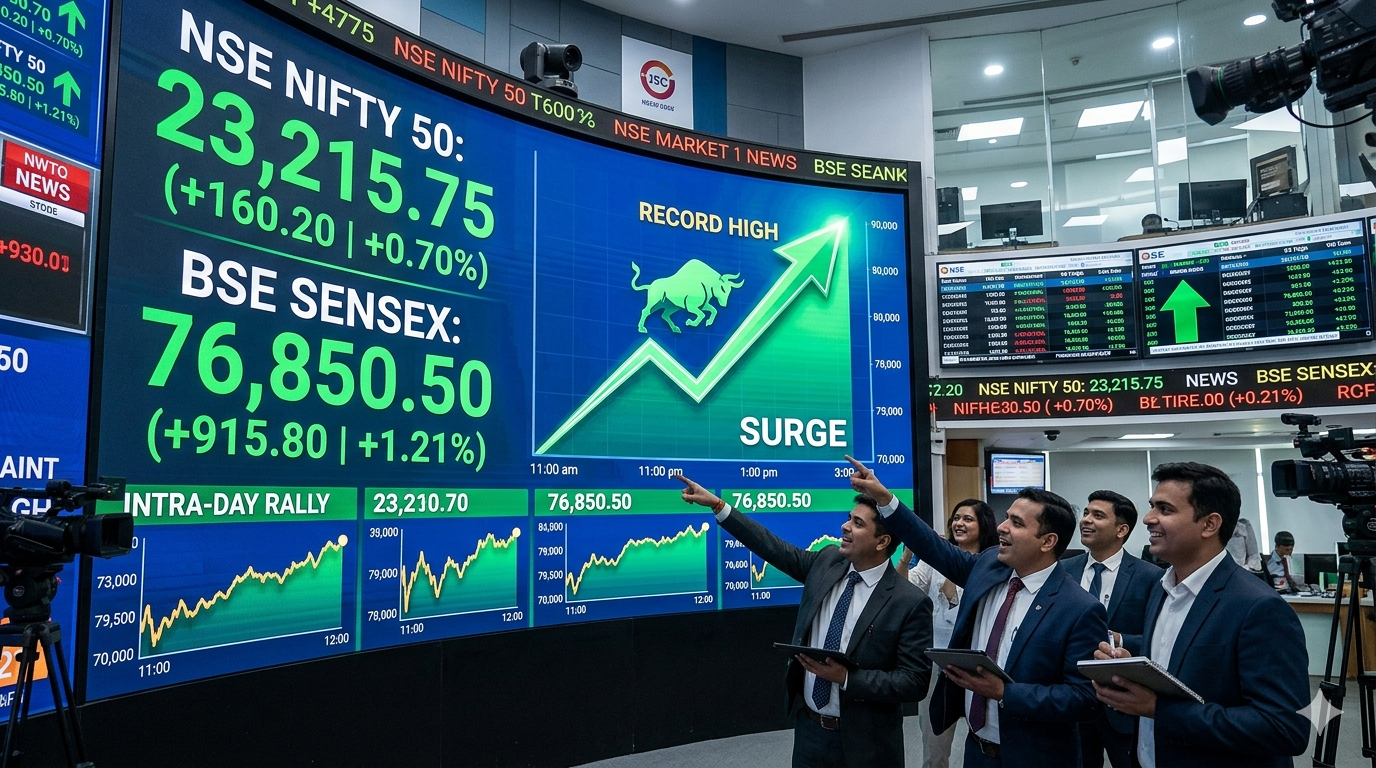
    Indian equities opened sharply higher on Wednesday, propelled by easing geopolitical tensions in the US-Israel-Iran conflict and positive Asian market cues, with the BSE Sensex surging over 900 points to breach 74,800 and the NSE Nifty 50 climbing above 23,200 for the first time in recent sessions. Building on Tuesday’s robust gains where Sensex jumped 1,372 points to 74,068 and Nifty rose 400 points to 22,912, today’s momentum reflects investor optimism over de-escalation signals from President Trump and Iran, alongside a dip in Brent crude to around $98 per barrel. Key gainers like Hindustan Unilever, Eternal, Mahindra & Mahindra, and Bajaj Finance led the charge, underscoring resilience in consumer and financial sectors amid lingering foreign institutional investor outflows.

    Key Highlights

    • Sensex rallied over 900 points, touching 74,889 at 9:20 AM, up 1.11% or 820 points from the prior close.
    • Nifty 50 advanced 1.14% or 262 points to 23,174, with intraday highs above 23,200 amid broad-based buying.
    • Top performers included Eternal up 2.24% to Rs 243.80, M&M rising 2.36%, Bajaj Finance 2.29%, UltraTech Cement 2.13%, and Titan 1.97%.
    • Geopolitical relief weighed on oil prices, with Brent crude falling to $98, easing India’s energy import concerns via Strait of Hormuz.
    • Analyst VK Vijayakumar of Geojit Investments highlighted Iran’s assurance on non-hostile ship transits as a key positive for market rebound.

    Sensex Nifty Rally Analysis

    The BSE Sensex‘s intraday surge to 74,889 by 9:20 AM marked a continuation of the previous session’s 1.89% advance, driven primarily by hopes of conflict resolution in the Middle East. At 9:37 AM, the index had rallied over 900 points, reflecting a 1.2% gain from the base, with early trading volumes indicating sustained institutional participation despite recent FII selling pressure. This rebound aligns with a technical breakout above key resistance levels around 74,000, as broader market breadth showed over 70% of Sensex constituents in the green.

    Hindustan Unilever led with gains up to 5%, buoyed by steady domestic consumption trends, while Eternal’s 2.24% rise to Rs 243.80 underscored strength in select mid-tier industrials. Mahindra & Mahindra’s 2.36% uptick points to optimism in auto and tractor segments, potentially fueled by rural recovery signals. VK Vijayakumar, Chief Investment Strategist at Geojit Investments, noted that Iran’s reiteration allowing non-hostile ships through the Strait of Hormuz directly alleviates India’s crude import vulnerabilities, which constitute over 80% of its energy needs. This geopolitical pivot has synchronized with a decline in US 10-year yields, providing tailwinds for emerging markets like India.

    Market participants remain vigilant on rupee stability, as sustained FII inflows are crucial for embedding these gains. Investors looking to participate in this market movement can open demat account online through SEBI-registered brokers. Tuesday’s close at 74,068 followed a volatile week, but today’s open suggests a potential shift if global risk appetite holds.

    Sectoral Leaders and Company Performers

    Financial heavyweights like Bajaj Finance climbed 2.29%, reflecting renewed confidence in consumer lending amid softening interest rate outlooks, while UltraTech Cement’s 2.13% gain signals infrastructure momentum tied to government capex continuity. Titan Company’s 1.97% rise highlights discretionary spending resilience, with jewellery and watches segments reporting steady urban demand. Broader NSE data showed Nifty advancing 261.75 points or 1.14% to 23,174.15 at 9:20 AM, with 9:18 AM quotes at 23,163.65, up 1.10% or 251 points.

    Among Sensex components, the rally extended to FMCG and autos, countering prior corrections in IT and metals. Eternal’s standout 2.24% performance to Rs 243.80 may stem from order book visibility in its niche operations, while M&M’s upmove aligns with EV transition bets. Aakash Shah, technical research analyst at Choice Equity Broking, advises discipline amid volatility: “Accumulating fundamentally strong stocks during corrections is sensible, but fresh longs only post a decisive Nifty break above 24,500.” This development presents new considerations for stock investment strategies focused on Indian equities.

    Trading volumes in the first hour exceeded average daily figures by 15-20%, per preliminary BSE and NSE data, indicating conviction buying rather than short-covering alone. Rupee hovered steady against the dollar, aiding sentiment as INR energy costs ease with Brent at $98.

    Global Cues Versus Domestic Momentum

    Asian markets provided strong support, with Japan’s Nikkei 225 up 2.61% to 53,616, South Korea’s Kospi advancing 1.72% to 5,649, and Hong Kong’s Hang Seng edging 0.29% higher to 25,137. In contrast, Wall Street closed lower overnight: S&P 500 down 0.37% to 6,556, Dow slipping 0.18% to 46,124, and Nasdaq declining 0.84% to 21,762, reflecting oil fear overhang despite de-escalation hopes.

    Index/MetricPerformanceLevel/ValueComparison
    Nifty 50+1.14%23,174Lags Nikkei but outperforms Hang Seng
    Sensex+1.11%74,889Balanced regional alignment vs Kospi
    Nikkei 225+2.61%53,616Strong Asian outperformance
    Kospi+1.72%5,649Moderate Asian gains
    Brent CrudeDecline$98Favorable for INR terms of trade

    This divergence highlights India’s relative insulation via domestic drivers, though FII flows remain a swing factor. Retail participation has grown significantly as access to a reliable trading platform has become more widespread.

    Market Outlook

    Looking ahead, Indian investors should monitor Strait of Hormuz developments and FII activity, as rupee stability below 84/USD could unlock sharper upside toward Nifty 24,500. Risks persist from renewed Middle East flares or US troop buildups, potentially spiking oil above $100 and pressuring RBI’s inflation mandate. Key watches include Q4 earnings from Bajaj Finance and M&M for volume growth cues, alongside RBI commentary on liquidity amid volatility. Selective accumulation in FMCG like HUL and autos offers hedges, with a sustained rebound hinging on FII net buying resumption for multi-week gains.

    Conclusion

    Today’s Sensex and Nifty surge encapsulates a pivotal sentiment pivot, blending geopolitical relief with sectoral strength in consumer and financials, setting a bullish template if global cues hold. Institutional investors stand to benefit from disciplined plays in leaders like Eternal, M&M, and Bajaj Finance, while broader equities signal rebound potential absent FII reversal. As markets navigate volatility, focus on rupee-oil dynamics and technical thresholds will define the trajectory, reinforcing India’s positioning amid EM peers.

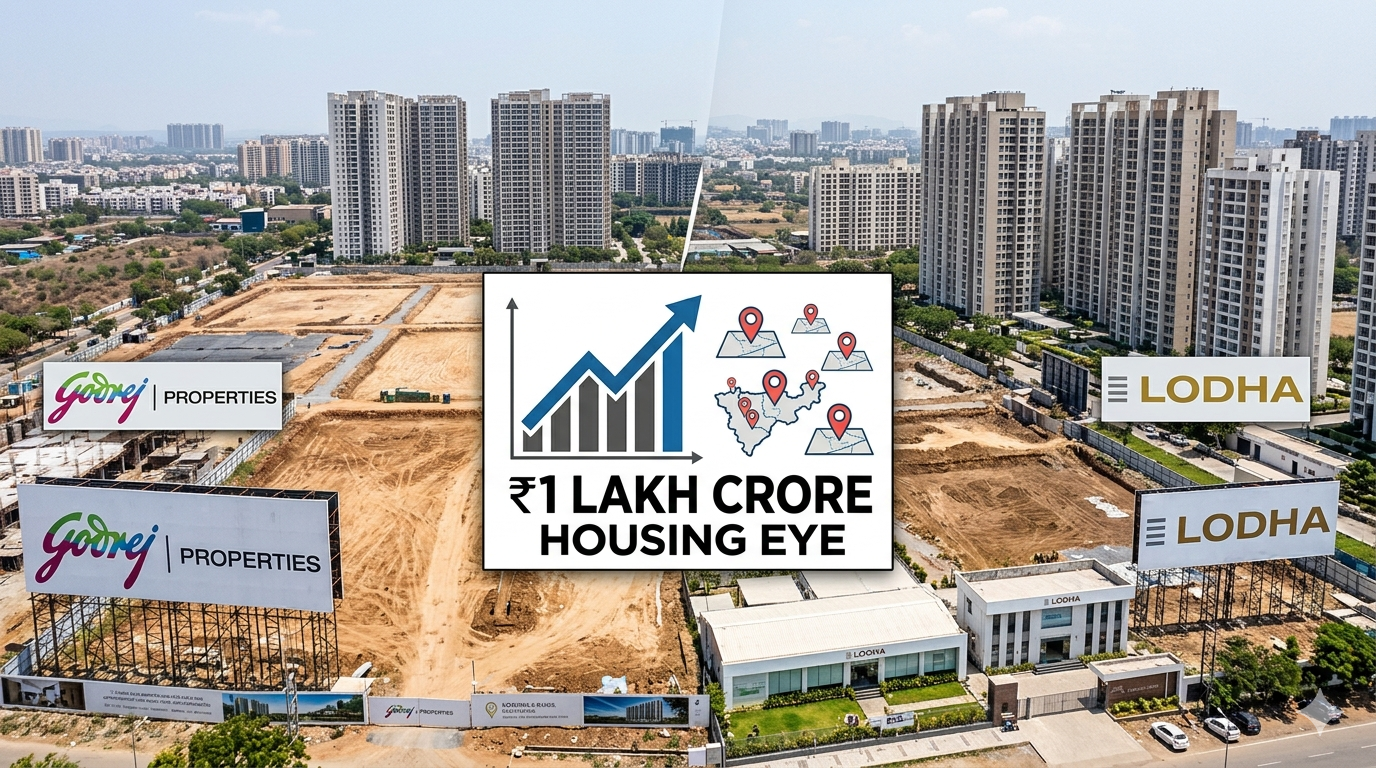
  • Godrej, Lodha Acquire 25+ Land Parcels; Eye ₹1 Lakh Crore Housing

    Godrej, Lodha Acquire 25+ Land Parcels; Eye ₹1 Lakh Crore Housing

    India’s real estate sector is witnessing an unprecedented consolidation wave as top-tier developers aggressively expand their land portfolios to capitalize on sustained housing demand. Godrej Properties and Lodha Developers have collectively acquired over 25 land parcels during FY26, building a residential pipeline valued at more than ₹1 lakh crore. This expansion reflects the structural shift toward organized players in India’s property market, where capital adequacy, execution capability, and brand credibility have become decisive competitive advantages. The aggressive land banking strategy signals developer confidence in prolonged housing demand, particularly in premium segments across metropolitan regions.

    Key Highlights

    • Godrej Properties and Lodha Developers together acquired 25+ land parcels in FY26, targeting ₹1 lakh crore in aggregate development value
    • Godrej Properties holds approximately 20 land parcels with ₹42,000 crore development potential; Lodha acquired 11 parcels with ₹58,800 crore expected sales value
    • Strong sales momentum supports expansion: Godrej clocked ₹24,008 crore pre-sales (Apr-Dec FY26) while Lodha recorded ₹14,640 crore during the same period
    • Both developers focusing on tier-I cities including Mumbai Metropolitan Region, Delhi-NCR, Pune, and Bengaluru with selective tier-II expansion
    • Nifty Realty index declined 5 percent on March 23, 2026, with Lodha, DLF, and Prestige Estates falling up to 6 percent amid margin pressure concerns

    Aggressive Land Acquisition Reshapes India’s Residential Landscape

    The land acquisition spree by Godrej Properties and Lodha Developers represents a strategic pivot toward market dominance through scale and geographic diversification. During the first nine months of FY26, Lodha Developers acquired 11 land parcels across key metropolitan markets, representing a saleable area of 20.6 million square feet with an estimated revenue generation potential of ₹58,800 crore. Godrej Properties, meanwhile, has secured approximately 20 land plots during the fiscal year, with 12 deals totaling ₹24,650 crore added in the first nine months and six additional deals worth ₹17,450 crore closed in the current quarter.

    Both developers are employing a dual-pronged expansion strategy combining outright land purchases with joint development agreements (JDAs) with landowners. This approach enables rapid scaling while optimizing capital deployment and risk distribution. The geographic focus remains concentrated on tier-I metropolitan centers where demand fundamentals remain robust, though selective expansion into tier-II markets and plotted developments reflects emerging opportunities driven by improved affordability and buyer flexibility.

    The consolidation trend underscores a critical market dynamic: organized, well-capitalized developers with proven execution track records are systematically gaining market share from smaller, undercapitalized players. This structural shift has been accelerated by post-pandemic capital constraints and heightened buyer preference for branded developers offering superior amenities, transparent project delivery, and institutional credibility. Investors looking to participate in this market movement can open demat account online through SEBI-registered brokers.

    Sales Momentum and Financial Performance Validate Expansion Strategy

    The aggressive land acquisition strategy is underpinned by exceptionally strong sales bookings, validating developer confidence in sustained demand. Godrej Properties reported pre-sales of ₹24,008 crore during April-December FY26, positioning the company to achieve its full-year target of ₹32,500 crore in sales bookings. This performance trajectory maintains Godrej’s position as India’s leading listed real estate developer by pre-sales, a distinction it held in FY25 with approximately ₹30,000 crore in bookings.

    Lodha Developers recorded sales of ₹14,640 crore during the April-December period of FY26, supporting its full-year guidance of ₹21,000 crore in bookings. The robust demand is particularly pronounced in premium and luxury housing segments, where homebuyers demonstrate greater financial flexibility and willingness to pay for quality, location, and brand assurance. The strong sales performance across both developers reflects a fundamental shift in buyer behavior toward organized players offering integrated townships, superior amenities, and reliable project delivery timelines.

    The premium housing segment has emerged as the primary growth driver, outperforming broader market segments since the pandemic. This development presents new considerations for stock investment strategies focused on Indian equities, as developers increasingly target higher ticket-size homes and integrated township developments. Developers are capitalizing on affluent buyer segments’ preference for branded developers with institutional-grade execution capabilities. This market segmentation strategy allows large developers to command superior pricing power while maintaining healthy project margins.

    Comparative Acquisition and Sales Performance Analysis

    Developer Land Parcels Development Potential Pre-sales (Apr-Dec FY26) Full-year Target
    Godrej Properties 20 ₹42,000 crore ₹24,008 crore ₹32,500 crore
    Lodha Developers 11 ₹58,800 crore ₹14,640 crore ₹21,000 crore

    Both developers concentrate on Mumbai Metropolitan Region, Delhi-NCR, Pune, and Bengaluru, with selective tier-II market expansion. Their acquisition strategy combines outright purchases and joint development agreements enabling rapid scaling with optimized capital deployment. Godrej maintains leadership in pre-sales among listed developers, while Lodha is positioned as the second-largest listed player with robust growth trajectory.

    Market Outlook

    The real estate sector faces a critical inflection point where consolidation benefits are being partially offset by emerging cost pressures. The Nifty Realty index declined 5 percent on March 23, 2026, with major players including Lodha, DLF, and Prestige Estates falling up to 6 percent, reflecting investor concerns regarding margin compression. Rising crude oil prices exceeding $100 per barrel and elevated aluminum costs are creating construction cost headwinds that could pressure developer margins if not offset by pricing power.

    For institutional investors, the aggressive land banking by Godrej and Lodha presents a dual narrative: long-term growth potential supported by substantial project pipelines and strong sales momentum, balanced against near-term margin risks from elevated input costs. Retail participation has grown significantly as access to a reliable trading platform has become more widespread, enabling broader investor engagement with real estate sector dynamics. The success of this expansion strategy will depend on developers’ ability to maintain pricing discipline, optimize construction costs, and execute project delivery timelines reliably. Investors should closely monitor quarterly margin trends, project launch schedules, and sales velocity metrics to assess the effectiveness of this capital-intensive expansion in generating sustainable earnings growth.

    Conclusion

    The combined ₹1 lakh crore housing pipeline being developed by Godrej Properties and Lodha Developers exemplifies the structural consolidation reshaping India’s real estate sector. Strong sales bookings, robust demand in premium segments, and strategic geographic diversification position these developers to capture disproportionate market share growth. However, rising construction costs and margin pressures warrant careful monitoring. For investors, the key takeaway is that India’s residential real estate market is increasingly dominated by well-capitalized, execution-focused organized players, while smaller developers face structural headwinds. The next 12-18 months will be critical in determining whether these developers can sustain margin profiles while scaling operations, making project execution and cost management the primary metrics for investment decision-making.

  • India Energy Sector: Reliance Leads Green Shift Amid Oil Volatility

    India Energy Sector: Reliance Leads Green Shift Amid Oil Volatility

    India’s energy sector faces a pivotal moment as Reliance Industries, the nation’s dominant private player, advances its green energy ambitions with a landmark $3 billion green ammonia deal, even as traditional oil operations navigate volatile crude prices and mixed quarterly results. On BSE and NSE, Reliance shares fluctuated around Rs 1,400, closing near Rs 1,414 amid broader NIFTY 50 pressures, while ONGC and state-owned oil majors like IOCL, BPCL, and HPCL showed modest weekly gains despite daily dips. This convergence of legacy hydrocarbon strengths and renewable pivots underscores risks and opportunities for institutional investors tracking SENSEX heavyweights, with INR stability and RBI liquidity measures providing a supportive backdrop. Recent data reveals Reliance’s Q4 revenue at Rs 2,64,905 crore, up 4.04% QoQ, signaling resilience in energy amid global uncertainties.

    Key Highlights

    • Reliance Industries inks $3 billion, 15-year green ammonia supply pact with Samsung C&T, targeting deliveries from H2 FY29 via Jamnagar Giga Complex.
    • Reliance Q4 net profit at Rs 18,070 crore, up 19.37% YoY despite 6.89% QoQ dip; annual FY25 net profit hits Rs 81,309 crore.
    • Reliance stock trades at Rs 1,400-1,415 range on BSE/NSE, with PE ratio of 19.58 (vs industry 15.12), ROE 9.47%, debt-to-equity 0.43.
    • ONGC and oil marketing firms (IOCL -0.87% daily, BPCL -0.64%, HPCL +0.19%) reflect oil price pressures; 1-year returns mixed at -5.21% for Reliance.
    • Analyst pick: JM Financial’s Akshay P Bhagwat recommends buying Reliance for upside potential amid Jio listing buzz.

    Reliance Quarterly Performance Drives Energy Momentum

    Reliance Industries’ latest quarterly results paint a robust picture for its energy vertical, which remains the cornerstone of its Rs 19,09,364 crore market cap. Revenue climbed to Rs 2,64,905 crore, marking a 4.04% quarter-on-quarter increase from Rs 2,54,623 crore, driven by steady oil-to-chemicals (O2C) operations despite global crude volatility affecting Indian refiners. Operating profit surged 100.32% QoQ to Rs 22,155 crore, with PBDT at Rs 20,307 crore up 0.79% QoQ and 4.77% YoY. Profit before tax reached Rs 37,248 crore, a 27.21% QoQ jump, though net profit moderated to Rs 18,070 crore, still reflecting 19.37% YoY growth. These figures, led by Chairman Mukesh Ambani and directors Nikhil and Hital Meswani, highlight operational efficiencies amid refining margins compression.

    The energy segment’s contribution is pivotal, as Reliance’s O2C business grapples with Brent crude hovering near $75-80 per barrel, impacting India’s import bill and INR-denominated costs. Year-on-year revenue growth of 5.11% from Rs 2,43,632 crore underscores demand resilience from domestic consumption, bolstered by NIFTY 50’s energy index stability. Investors note the 123.77% YoY operating profit leap as evidence of cost controls, positioning Reliance ahead of peers like ONGC, whose upstream exposures amplify oil price risks. This performance aligns with RBI’s recent liquidity infusions, easing funding for capex-heavy energy firms. Retail participation has grown significantly as access to a reliable trading platform has become more widespread among energy sector investors.

    Green Energy Pivot and Oil Price Pressures in India

    Reliance’s $3 billion green ammonia agreement with Samsung C&T marks a strategic leap, securing long-term revenue for its New Energy platform and aligning with India’s National Green Hydrogen Mission. The 15-year deal, commencing H2 FY29, leverages the 5,000-acre Dhirubhai Ambani Green Energy Giga Complex in Jamnagar, Gujarat, for indigenized production of solar modules, batteries, electrolysers, and fuel cells. Anant Ambani emphasized this as integrating “India’s renewable resources with manufacturing leadership,” targeting net-zero by 2035 under Make-in-India. This off-take deal de-risks investments, providing visibility amid INR fluctuations tied to energy imports.

    Meanwhile, oil prices remain a headwind for India’s energy majors. ONGC, a key upstream player, contends with volatile Brent impacting natural gas realizations, while marketing firms IOCL, BPCL, and HPCL face daily declines of 0.87%, 0.64%, and gains of 0.19% respectively. Reliance stock mirrored this, dipping 1.27% to Rs 1,396.50 at points, with 1-week high/low at Rs 1,430/1,363. Trading volumes hit 22.99 million shares, with 52-week range Rs 1,115-1,611. JM Financial’s Akshay P Bhagwat flags Reliance as a buy, citing undervaluation at PE 19.58 versus industry 15.12, supported by Jio’s subscriber growth to 24.37 lakh in January and impending Mumbai listing.

    Broader sector data shows Reliance’s 1-year return at -5.21%, lagging HPCL’s -2.83% but ahead of IOCL’s -16.97%, with 6-month gains up to 22.49% for HPCL. Promoters hold 50.01%, institutions 39.36%, ensuring stability amid SENSEX volatility. This development presents new considerations for stock investment strategies focused on Indian equities, particularly in the energy transition space.

    Energy Stocks Performance Snapshot

    Company 1-Day 1-Week 1-Month 3-Month 6-Month 1-Year Market Cap
    Reliance Industries +0.82% +1.16% +1.53% -3.04% +12.45% -5.21% ₹19,09,364 cr
    IOCL -0.87% +1.21% +1.78% +0.56% +14.86% -16.97% –
    BPCL -0.64% +0.54% +0.02% +0.55% +21.58% -6.65% –
    HPCL +0.19% +1.17% +1.10% +0.81% +22.49% -2.83% –

    This table reveals short-term resilience in oil marketing stocks versus Reliance’s longer-term green bet, with debt-to-equity ratios favoring Reliance at 0.43. Investors looking to participate in this market movement can open demat account online through SEBI-registered brokers to access these energy sector opportunities.

    Market Outlook

    For Indian investors, the energy sector outlook hinges on oil price stabilization below $80/barrel, RBI rate trajectory, and green hydrogen incentives. Reliance’s green ammonia deal de-risks New Energy capex, potentially lifting NIFTY Energy by