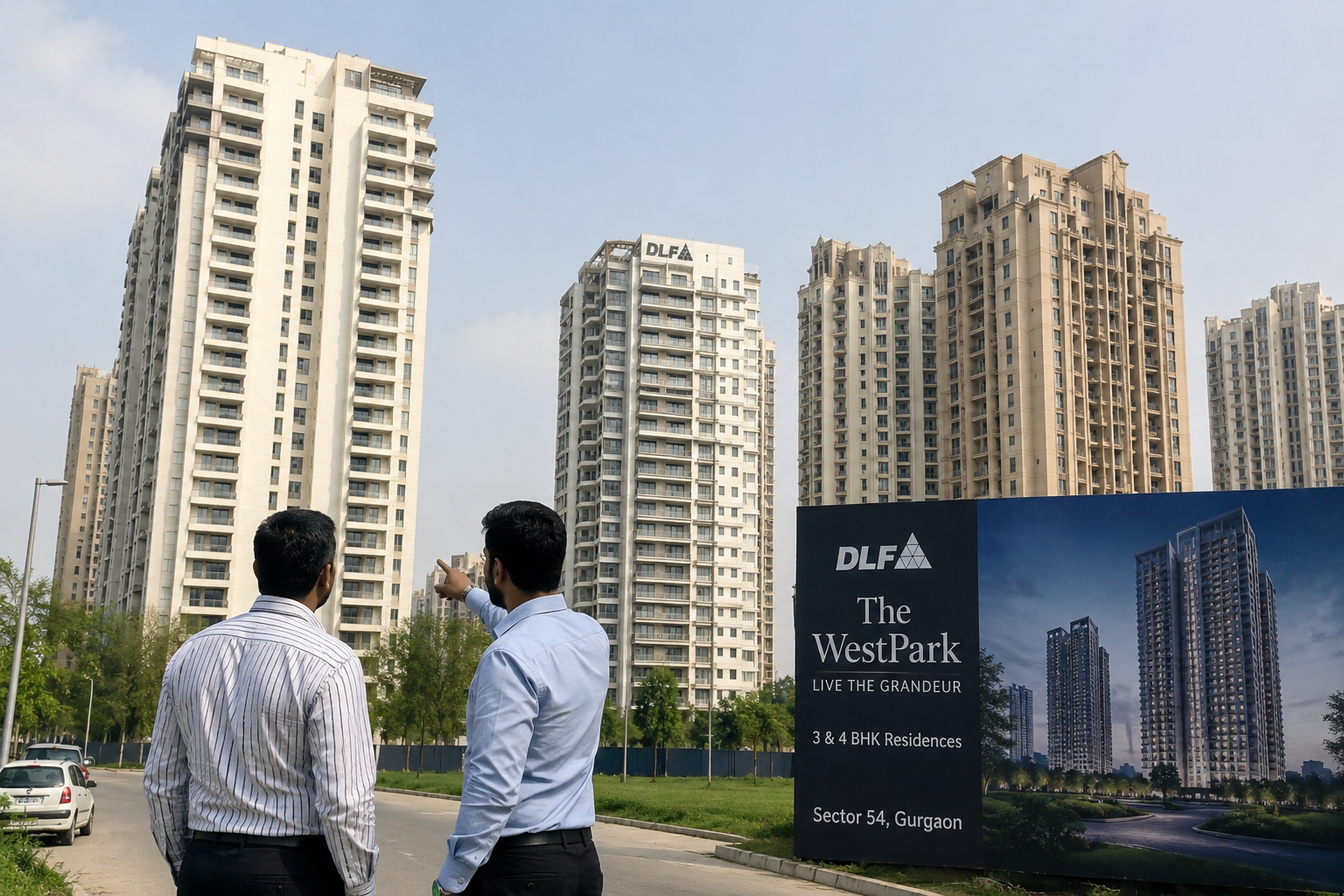
Indian real estate is entering June with a mixed but still constructive setup: residential demand remains resilient in major cities, commercial leasing continues to absorb quality office space, and stock-specific news flow is keeping listed developers in focus. In the last 24 hours, the most relevant market signals have come from DLF’s near-term price action, a new large-format office lease in Gurugram linked to its commercial portfolio, and broader evidence that retail real estate is benefiting from stronger footfalls and spending. For institutional investors, the key question is whether premium housing, office leasing and urban demand—especially in Mumbai and the NCR—can sustain earnings momentum for listed developers amid still-sensitive valuations and execution risk.
Key Highlights
- DLF’s short-term trade setup turned bearish in a recent analyst note, with support flagged at Rs 574 and resistance at Rs 595 after a close at Rs 583 on 29 May 2026.
- A 46,437 sq ft office lease at DLF Cyber City in Gurugram by Airbnb underscores continued demand for high-grade commercial real estate in India’s top office markets.
- Mall operators are seeing a 15-20% sales surge in some formats, suggesting stronger consumer traction for retail-linked real estate assets.
- DLF has scheduled investor conference participation for 3 June 2026, keeping the stock in institutional focus ahead of fresh management commentary.
- Recent news flow remains supportive of India’s property cycle, but investor attention is shifting to execution, pricing discipline and city-wise absorption trends, especially in Mumbai and the NCR.
DLF, Commercial Leasing and Near-term Stock Sentiment
DLF remains the most visible listed real estate name in the near-term news flow, with market commentary pointing to a bearish tactical setup even as broader fundamentals remain tied to premium assets and leasing strength. A recent trading note said DLF closed at Rs 583 on 29 May 2026, with immediate support at Rs 574 and resistance at Rs 595, implying that the stock is likely to remain range-bound unless fresh catalysts emerge. The same note highlighted a broader positive backdrop from GIFT Nifty, but the near-term view on the stock itself was still cautious.
What matters more for fundamental investors is the underlying commercial demand signal. Airbnb has leased 46,437 sq ft at DLF Cyber City in Gurugram at Rs 132.5 per sq ft per month, on a 5-year lease with 5% escalation and a Rs 5.54 crore deposit. That transaction is significant because it reinforces that premium office locations in Gurugram continue to attract multinational tenants willing to commit to long-duration leases. For DLF, this supports the narrative that its annuity and rental assets can remain a stable earnings engine even if residential launches and market pricing fluctuate.
DLF also has an investor conference scheduled for 3 June 2026, according to a stock exchange disclosure. Such management interactions often become important catalysts for institutional positioning, particularly when the market is looking for updates on leasing pipelines, residential bookings and capital allocation. For investors focused on Indian property equities, DLF remains the key benchmark for how premium commercial and mixed-use assets are being valued by the market.
Godrej Properties, Mumbai Real Estate and Residential Demand
Godrej Properties is not in the immediate news flow from the past 24 hours, but it remains central to the broader India residential story, especially in Mumbai where demand for branded, well-located housing continues to shape price realization and absorption trends. In the absence of fresh company-specific headlines in the last 24 hours, investors should view Godrej Properties through the lens of city mix, launch execution and pre-sales conversion rather than short-term trading sentiment.
Mumbai real estate remains the most strategically important urban market for many listed developers because it combines premium pricing, scarcity value and strong end-user demand. For companies such as Godrej Properties, exposure to Mumbai and the surrounding metropolitan region can support higher average selling prices, but it also raises the execution bar. Investors looking to participate in this market movement can open demat account through SEBI-registered brokers to gain access to these property development stocks. In a market where institutional capital is sensitive to inventory overhang, land acquisition discipline and project delivery timelines, the performance of Mumbai launches often becomes a leading indicator for the broader listed residential space.
The latest public news flow also suggests a broader strength in consumption-linked real estate segments. Mall operators and restaurant chains reported stronger footfalls, longer dwell times and higher spending, with some restaurants seeing sales growth of 10-20% amid heatwave and holiday-driven demand. While this is not residential housing data, it matters because retail traction often feeds confidence in urban property markets, especially in consumption-heavy metros such as Mumbai. For developers with mixed-use exposure, stronger retail activity can also improve asset yields and valuation assumptions.
Market Comparison Analysis
| Segment | Latest Signal | Investor Relevance |
|---|---|---|
| DLF commercial portfolio | Airbnb leased 46,437 sq ft at DLF Cyber City | Confirms leasing depth in premium Gurugram office assets |
| DLF stock momentum | Bearish near-term setup, support at Rs 574, resistance at Rs 595 | Indicates range-bound trading unless new catalysts appear |
| Retail real estate | 15-20% sales surge for some mall retailers | Supports footfall-led recovery and tenant productivity |
| Investor engagement | DLF investor conference on 3 June 2026 | Potential source of management commentary and guidance |
| Mumbai residential market | No fresh 24-hour company-specific headline | Remains a key structural market for premium homebuilders such as Godrej Properties |
For institutional investors, the practical takeaway is that Indian real estate should not be treated as a single trade. Commercial leasing in top office micro-markets is giving steadier signals than short-term stock charts, while residential developers remain more dependent on city-specific demand, pricing and execution. This development presents new considerations for stock investment strategies focused on Indian equities. DLF currently has the clearest fresh catalyst set, whereas Godrej Properties remains more of a structural exposure to premium housing and Mumbai demand than a news-driven trade in the latest 24-hour window.
Market Outlook
The outlook for Indian real estate remains constructive, but selective. Premium office assets in Gurugram and other top-tier NCR locations continue to attract large occupiers, which supports rental income visibility for owners with institutional-grade portfolios. Residential demand in Mumbai remains strategically important for premium developers, but investors should monitor booking velocity, average realization and launch discipline before extrapolating sector-wide strength. For listed names, the market will likely reward companies that can demonstrate both sales execution and stable annuity income, while punishing those with stretched balance sheets or weak delivery visibility.
For Indian investors, the key variables to watch are interest rate expectations, liquidity conditions, urban housing affordability and continued absorption in premium office and retail assets. Retail participation has grown significantly as access to a reliable trading platform has become more widespread among individual investors seeking exposure to property sector stocks. If leasing momentum holds and end-user demand remains intact, real estate stocks can continue to outperform broader market defensives. If, however, financing costs rise or demand shifts toward lower-ticket segments, valuation support could become more uneven across the sector.
Conclusion
The latest 24-hour news flow suggests that Indian real estate remains fundamentally supported by premium leasing, resilient consumer demand and continued institutional interest in core urban assets. DLF stands out on both stock-specific and operating news, while Godrej Properties and Mumbai real estate remain central to the broader residential growth story even without a fresh headline in the available window. For institutional investors, the sector’s near-term direction will be shaped less by broad optimism and more by city-level execution, tenant demand and the market’s willingness to pay for quality assets in India’s strongest urban centres.
Trading & Investment Guides
- What is Demat Account?
- What is National Stock Exchange of India?
- What is Bombay Stock Exchange?
- What is Algo Trading?
- Best Algo Trading Platform
Leave a Reply