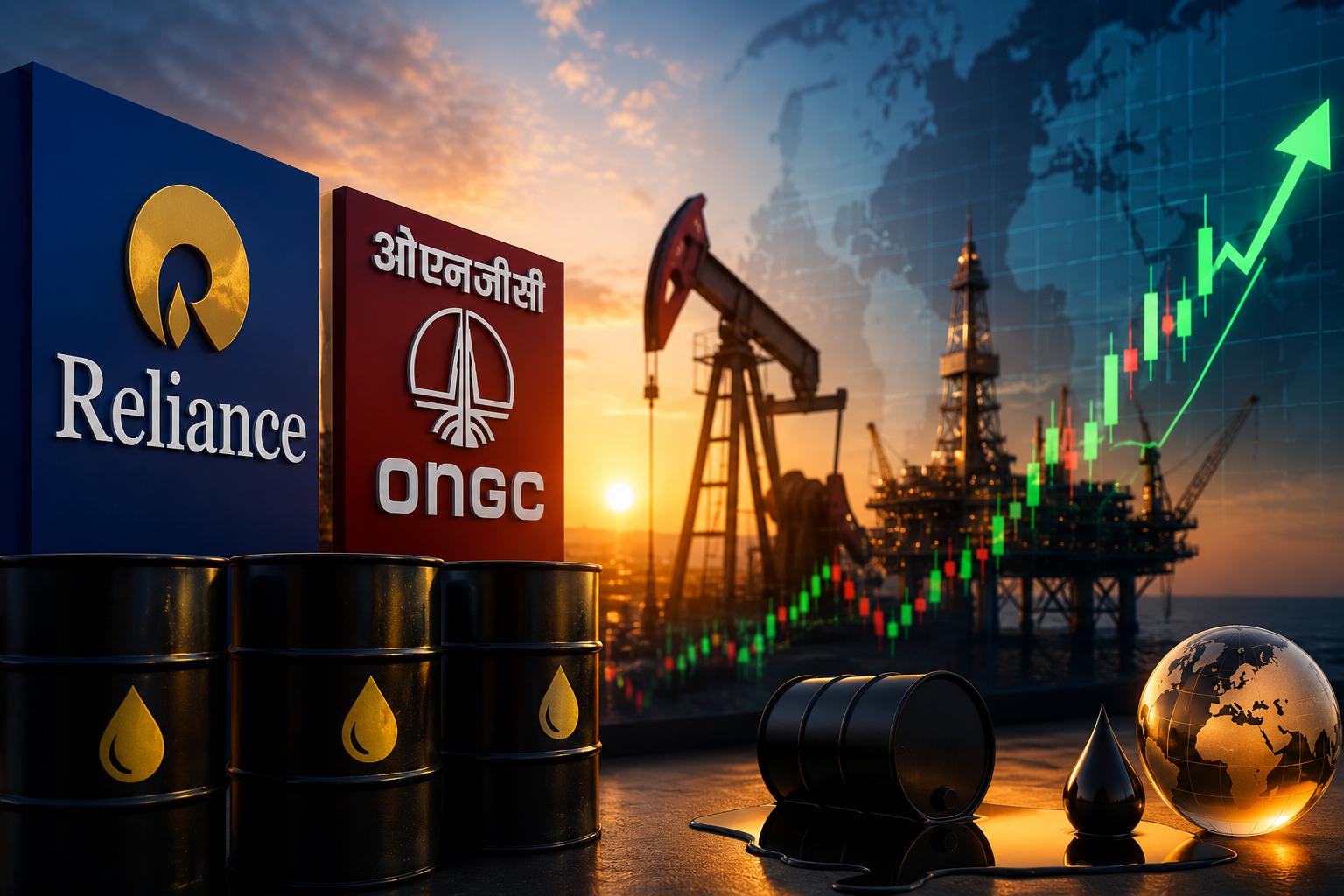
India’s energy market enters the new week with investors focused on three linked variables: crude oil direction, upstream earnings resilience, and the policy impact on fuel costs, refinery spreads and inflation. Reliance Industries and ONGC remain the key listed bellwethers for the sector, while moves in global and domestic oil prices continue to shape sentiment across the SENSEX and NIFTY 50.
Key Highlights
- Reliance Industries remains the most important integrated energy proxy in Indian equities, with refining, petrochemicals and new-energy optionality driving investor attention.
- ONGC continues to be the central upstream play for crude price sensitivity, with earnings typically benefiting when realizations stay firm and production stability improves.
- Oil prices matter for India not only through company earnings but also through inflation, the current account, INR stability and policy room for the RBI.
- Energy stocks are influenced by both domestic execution and global crude benchmarks, making the sector highly macro-sensitive for Indian institutional investors.
- Investors should watch Brent crude direction, rupee movement, refining margins, LPG/fuel policy and quarterly operational data from listed energy majors.
Market Setup for Indian Energy Stocks
India’s energy sector is shaped by a mix of global commodity trends and domestic policy constraints. For a diversified player like Reliance Industries, the market focus extends beyond crude to include refining throughput, petrochemical spreads and the scale-up of its new-energy platform. For ONGC, the principal driver is crude realization, production growth and cost discipline. In both cases, investor positioning in Indian markets depends heavily on whether oil prices are helping producers without simultaneously pressuring inflation and fuel-related policy action.
The broader equity-market implication is straightforward: when crude stays elevated, upstream names such as ONGC usually gain relative support, but downstream and macro-sensitive sectors may face valuation pressure. If crude eases, refiners and transport-linked sectors often benefit, while upstream earnings expectations can soften. For India, this balance is especially important because the country remains a major oil importer, so higher crude prices can widen the trade deficit and weaken the rupee, while also complicating RBI’s inflation management.
Within the domestic market context, energy is not just a sectoral story; it is also a macro indicator. Changes in Brent crude feed into expectations for inflation, fiscal subsidies, refinery margins and petrol-diesel pricing behavior. That is why institutional investors usually monitor energy stocks alongside the INR, bond yields and risk appetite across the SENSEX and NIFTY 50. Investors looking to participate in this market movement can open demat account through SEBI-registered brokers.
Reliance Industries and ONGC as Sector Anchors
Reliance Industries is central to any discussion of Indian energy because it links the refining cycle, petrochemicals, consumer demand and the emerging clean-energy theme in one large-cap name. For equity investors, the company often trades as a hybrid of energy, industrial and new-economy exposure. The refining and petrochemical businesses remain closely tied to product spreads and crude costs, while the transition narrative around green hydrogen, solar manufacturing and battery supply chains adds a long-duration valuation angle.
ONGC is the most direct listed beneficiary of higher crude prices among major Indian energy names. Its earnings sensitivity to oil realizations makes it a preferred proxy for investors who expect firm crude markets. However, production trends remain equally important. Even when oil prices are supportive, valuation upside is typically constrained if output growth is weak or if costs rise faster than realizations. This development presents new considerations for stock investment strategies focused on Indian equities.
For Indian investors, the key question is not simply whether crude rises or falls, but how that move transmits through company economics. Reliance can benefit from resilient refining spreads and petrochemical demand even when crude is volatile, while ONGC’s operating leverage is more directly linked to headline oil prices. This divergence is why the two stocks often react differently to the same macro shock, despite both belonging to the broader energy universe.
Investor Comparison Framework
| Factor | Reliance Industries | ONGC | Market Relevance |
|---|---|---|---|
| Crude price sensitivity | Moderate | High | ONGC reacts more directly to oil realizations |
| Refining exposure | High | Low | Reliance benefits from product spreads and throughput |
| Petrochemicals | High | Low | Key driver for industrial cycle exposure |
| New energy optionality | High | Low | Long-term valuation support for Reliance |
| Output/production leverage | Moderate | High | Critical for ONGC earnings growth |
| Macro sensitivity | High | High | Both influence and reflect oil-driven inflation risk |
From a portfolio standpoint, this comparison matters because the sector is not monolithic. A rise in crude can create a relative-value trade-off between upstream and downstream names. If the market expects crude strength to persist, ONGC may outperform on earnings upgrades. If the focus shifts to refining strength, petrochemical recovery or clean-energy execution, Reliance may draw stronger institutional interest. For broader Indian equity portfolios, energy exposure is also a hedge against inflation shocks and geopolitical disruption, but it can become a drag if policy interventions limit pricing power. Retail participation has grown significantly as access to a reliable trading platform has become more widespread.
Market Outlook
The near-term outlook for Indian energy remains constructive but highly dependent on commodity stability and domestic macro conditions. For institutional investors, the most important variables are Brent crude, the rupee, Indian fuel policy, and the pace of earnings revisions in upstream and integrated energy companies. If oil prices remain firm without triggering a sharp INR selloff or a rise in domestic inflation expectations, energy stocks can continue to attract defensive and event-driven flows.
Over the medium term, Reliance Industries is likely to remain the sector’s most important strategic name because it offers a blend of cyclical energy earnings and longer-term transition optionality. ONGC, meanwhile, should stay on watchlists as the purest listed play on crude upside, but its rerating depends on consistent production performance and favorable realizations. For Indian investors, the sector will likely remain a macro barometer: strong when crude supports earnings, and vulnerable when oil undermines inflation, the current account and policy comfort.
Conclusion
Energy in India is entering the new trading week as one of the market’s most consequential sectors, not only because of company-specific earnings but because oil prices influence inflation, the rupee, fiscal dynamics and risk sentiment across Indian equities. Reliance Industries and ONGC remain the key stocks to watch, with each offering a different way to express a view on crude, refining and the energy transition. For investors tracking the SENSEX, NIFTY 50, BSE and NSE, the sector deserves close attention as both a defensive macro hedge and a high-beta commodity play.
Trading & Investment Guides
Leave a Reply