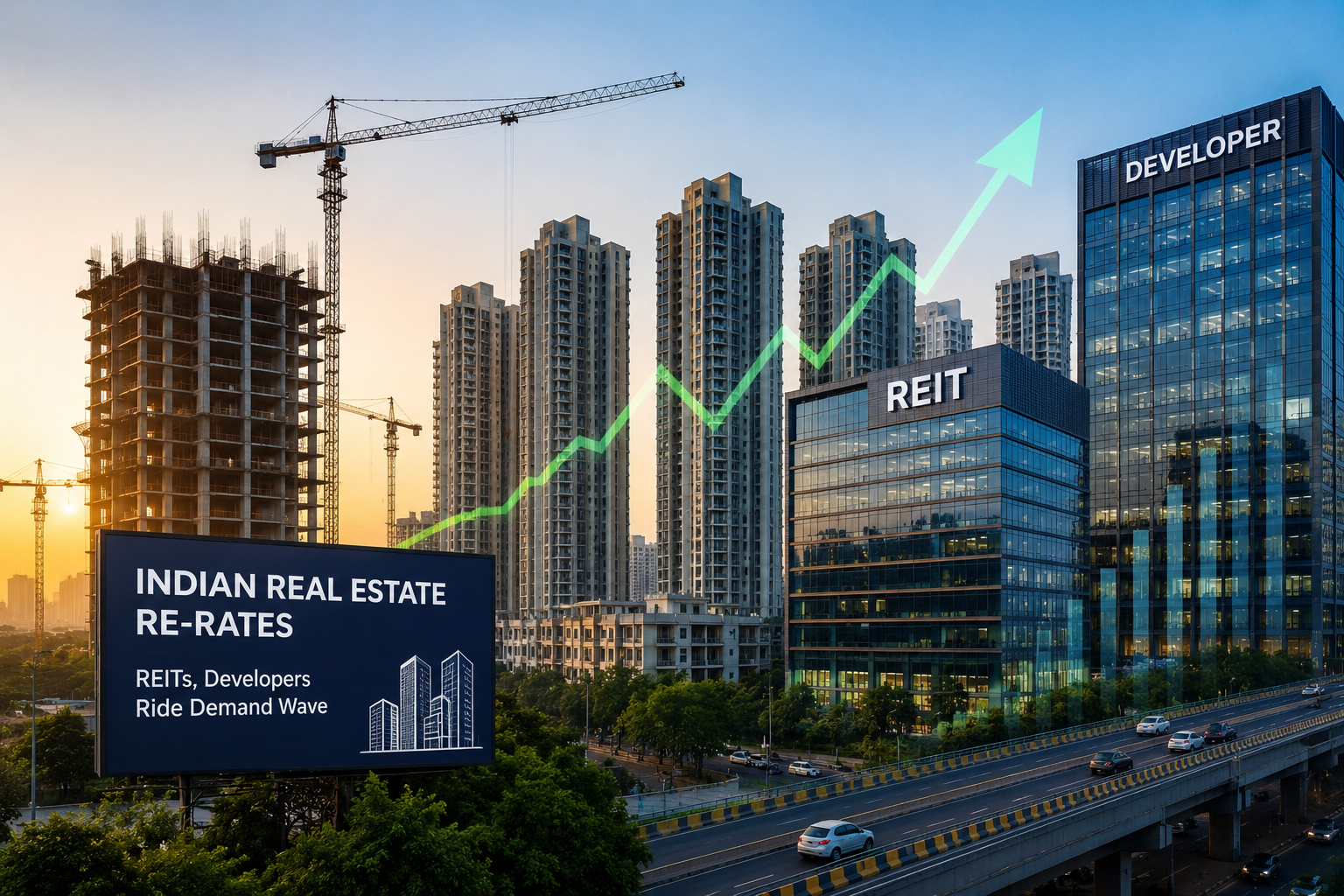
India’s real estate complex is entering a new phase of re-rating, driven by resilient housing demand, record pre-sales by top developers, and a sharp rebound in office and retail leasing even as interest rates remain elevated. Across Mumbai and other top metros, developers such as DLF and Godrej Properties are monetising prime land, accelerating launches, and reporting robust cash flows, while listed REITs signal renewed confidence in commercial real estate. For institutional investors tracking the SENSEX, NIFTY 50 and sectoral indices, real estate is increasingly central to the domestic growth narrative.
Key Highlights
- Strong residential demand in Mumbai, NCR and Bengaluru underpins developer pre-sales and price momentum.
- Large, branded players like DLF and Godrej Properties continue to gain market share from smaller, leveraged developers.
- Commercial real estate shows improving leasing, with REITs indicating steady absorption and stable yields.
- RBI’s extended pause on policy rates supports affordability, but high input and land costs keep prices firm.
- Investors are focusing on balance sheet strength, cash flow visibility, and regulatory execution as key risk filters.
Residential Demand and Mumbai Real Estate Momentum
India’s residential market remains structurally strong, with demand in the mid-income and premium segments outweighing the drag from higher home loan rates. Mumbai, which remains the country’s most expensive market by ticket size, continues to see healthy registrations and steady price appreciation in key micro-markets such as the Western suburbs, Thane, and Navi Mumbai. For institutional investors, the resilience in Mumbai is particularly important because it drives a disproportionate share of value for listed developers and influences sentiment for the broader property complex.
The market remains characterised by clear polarisation. Branded, well-capitalised developers are clocking record pre-sales and faster execution, while many smaller, highly leveraged players remain capacity constrained. In Mumbai, new launches by large corporates and diversified groups have seen strong booking velocity, especially in redevelopment and luxury projects, as affluent buyers treat real estate as both a consumption asset and an inflation hedge. Strong stamp duty collections and steady absorption indicate that the demand is not purely speculative but backed by end-users with formal income profiles.
The demand tailwind is reinforced by relatively benign macro conditions for homebuyers. While lending rates have risen versus pre-pandemic levels, the RBI’s stance of maintaining the policy rate after an aggressive tightening cycle has given a measure of stability to EMIs. At the same time, formal sector employment, particularly in IT/ITES, BFSI, and professional services, continues to support affordability in top metros. As a result, developers with Mumbai-heavy portfolios have been able to push through moderate price increases without materially impacting booking volumes. Investors looking to participate in this market movement can open demat account through SEBI-registered brokers.
DLF, Godrej Properties and the Listed Developer Universe
Among listed Indian developers, DLF and Godrej Properties remain key bellwethers for institutional investors. DLF, with its concentrated exposure to Gurgaon and other NCR micro-markets alongside a growing presence in luxury and super-luxury segments, has consistently delivered strong pre-sales and margin expansion. Its balance sheet deleveraging over the past few years and focus on annuity assets through its rental arm have strengthened its risk profile, making it a preferred play for investors seeking both residential and commercial exposure within a single platform.
Godrej Properties, which operates an asset-light, joint-development-led model, has been aggressively scaling its pan-India footprint, including strategic projects in Mumbai, Pune, NCR, and Bengaluru. The company has leveraged the Godrej group brand to secure prime land parcels through partnerships and redevelopment agreements, allowing it to ramp up launches without overextending its balance sheet. For institutional investors, its high cash flow conversion, disciplined capital allocation, and strong governance standards have been key positives, even as the company navigates the usual execution challenges of a fast-scaling developer.
Beyond these two, the broader listed developer basket—comprising names focused on South India, Pune, and emerging Tier-II markets—has also benefited from consolidation. Banks and NBFCs are visibly preferring large, transparent borrowers, while homebuyers increasingly gravitate to developers with strong delivery track records and robust customer service. Equity markets have rewarded this shift: real estate stocks have seen a material re-rating from pandemic lows, with the BSE and NSE realty indices outperforming broader benchmarks during periods of positive demand data and regulatory clarity. This development presents new considerations for stock investment strategies focused on Indian equities. For SENSEX and NIFTY 50 watchers, the sector’s improving earnings visibility is now a meaningful contributor to index earnings upgrades.
Commercial Real Estate, REITs and Investor Focus
While residential has led the current upcycle, commercial real estate—offices, malls, and warehousing—is steadily recovering and is increasingly accessible to public market investors via REITs. Office assets have seen improving leasing traction as global capability centres, IT services firms, and domestic corporates reaffirm India as a multi-city hub. Despite some pressure from global tech rationalisation, top-grade assets in Bengaluru, Hyderabad, Mumbai, and NCR continue to command interest from both tenants and institutional owners.
From a capital markets standpoint, listed REITs have emerged as a key vehicle for investors seeking steady yields with embedded growth. They offer diversified exposure to Grade-A office portfolios with long-dated leases and largely institutional tenant profiles. Distribution yields, while compressed from initial listing levels due to unit price appreciation and higher interest rates, still offer a spread over long-term government securities, especially when adjusted for embedded rental escalations and potential mark-to-market as older leases roll over. Retail participation has grown significantly as access to a reliable trading platform has become more widespread. For investors benchmarked to the NIFTY and broader indices, REITs have become a credible listed alternative to direct property exposure.
Key investor focal points in commercial and REITs include:
- Lease expiry profiles and the ability to re-lease space at higher rentals.
- Tenant concentration risk and exposure to vulnerable sectors.
- Funding costs, given the RBI’s rate trajectory and global credit conditions.
- Regulatory and tax clarity around REIT distributions and sponsorship structures.
Alongside offices, retail and warehousing assets are seeing structural tailwinds. Organised retail sales are rising on the back of consumption growth, while modern logistics and warehousing demand benefits from e-commerce expansion, manufacturing, and supply chain formalisation. These trends are gradually feeding into both private market transactions and public market narratives around future REIT listings and portfolio diversification.
Market Outlook
Looking ahead, the outlook for Indian real estate hinges on the interplay of demand resilience, monetary policy, and regulatory stability. The RBI’s next steps on interest rates will be critical: a prolonged pause or gradual easing would support affordability and investor risk appetite, while any unexpected tightening could cool marginal demand, especially in price-sensitive segments. On the macro side, continued GDP growth, urbanisation, and rising household incomes are structural tailwinds for both residential and commercial property.
For institutional investors, key variables to monitor include developers’ land acquisition strategies and leverage, execution timelines, and the pace of consolidation in favour of top-tier players. In commercial, global corporate capex cycles, outsourcing trends, and hybrid working models will influence office demand. Currency dynamics—particularly the INR’s relative stability or volatility—may affect foreign participation in REITs and direct real estate investments.
Conclusion
Indian real estate is transitioning from a speculative, fragmented market to a more institutional, data-backed asset class where large developers and REITs dominate value creation. Mumbai and other top metros are anchoring this shift, with companies like DLF and Godrej Properties at the forefront of a consolidation-driven upcycle. For investors tracking SENSEX, NIFTY 50, BSE Realty and NSE Realty indices, the sector now offers a mix of cyclical opportunities and structural growth, tempered by familiar risks around execution, leverage and policy. A disciplined focus on governance, balance sheet quality, and cash flow visibility will be essential to navigate this evolving landscape.
Trading & Investment Guides
- What is Demat Account?
- What is Trading Account?
- How to Open a Demat Account With Findoc?
- What is Algo Trading?
- Best Algo Trading Platform
Leave a Reply