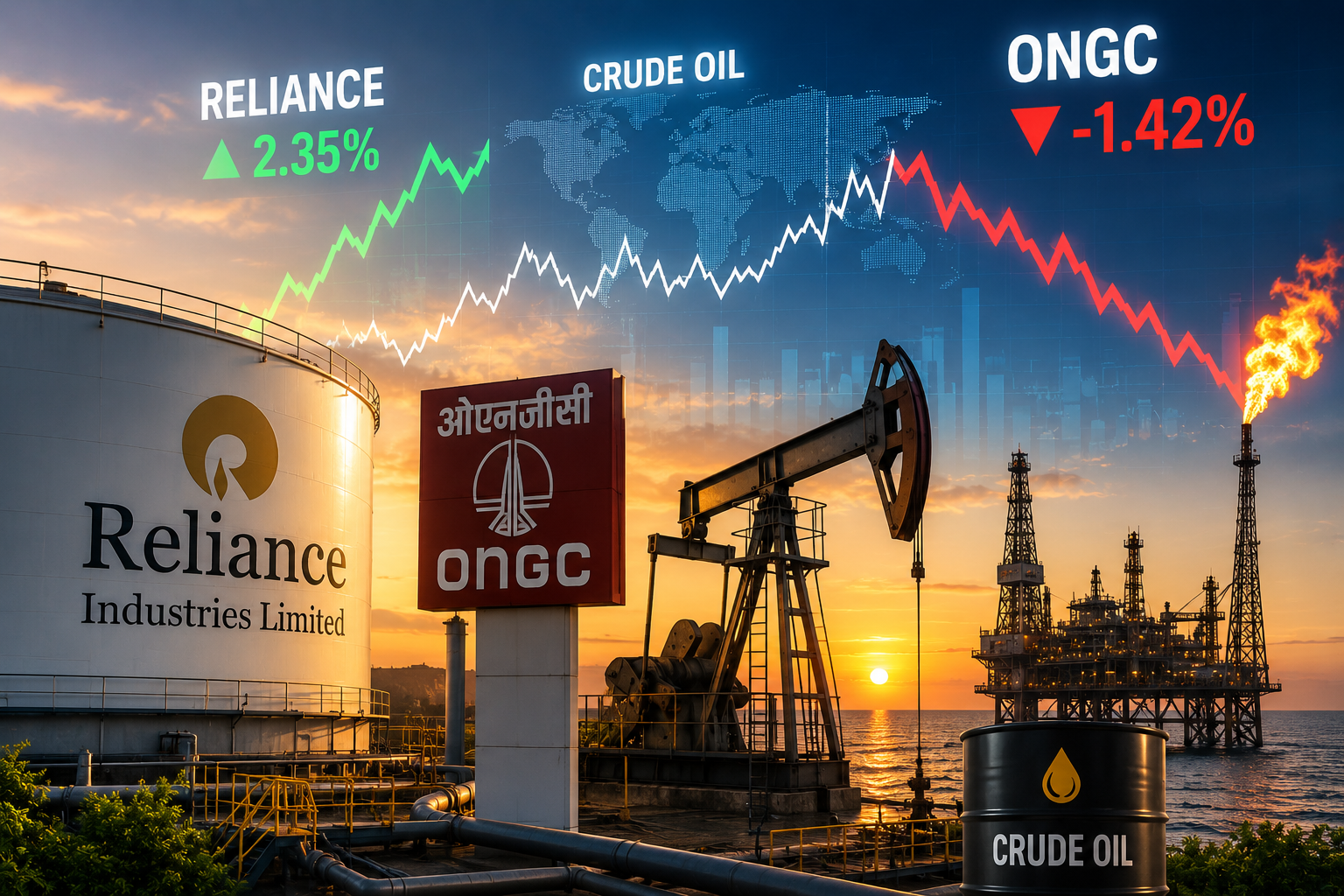
India’s energy complex is entering a more volatile phase as crude benchmarks oscillate amid shifting OPEC+ supply guidance, Middle East risk, and concerns over slowing global demand. In the domestic market, Reliance Industries and ONGC are providing contrasting cues for institutional investors, with refining and petrochemicals under margin pressure even as upstream realisations benefit from higher crude. Against a backdrop of a cautious RBI, range-bound INR, and mixed flows into energy-heavy indices such as the Nifty 50 and Sensex, portfolio positioning in Indian oil and gas names is becoming more nuanced and event-driven.
Key Highlights
- Reliance Industries‘ earnings trajectory remains tied to GRMs and consumer businesses as refining margins soften from recent peaks.
- ONGC’s cash flows are supported by firmer crude but capped domestic gas prices and subsidy concerns temper upside.
- Oil marketing companies (OMCs) face policy overhang on pump prices despite improved balance sheets and lower net debt.
- Sector valuations show a clear bifurcation between old-energy PSUs and private downstream/consumer-centric energy plays.
- Investors are watching monsoon progress, RBI’s policy stance, and any fresh windfall or subsidy measures for cues on sector re‑rating.
Energy Sector Flows and Index Dynamics in India
Energy remains a core pillar of Indian benchmarks, with Reliance Industries, ONGC, Power Grid, NTPC, Coal India, and the OMCs accounting for a substantial share of Nifty and Sensex weights. Recent sessions have seen choppy trade in these counters as crude prices swung in response to evolving OPEC+ commentary and US inventory data. While global Brent has retreated from recent highs, it remains well above levels that would materially ease India’s current account pressures, keeping investors vigilant on the macro-energy nexus.
In the equities space, institutional flows into energy have turned more selective. Long-only global funds have been trimming exposure to pure upstream and coal-linked names, rotating into integrated and utility-like models that offer earnings visibility and policy insulation. Domestic mutual funds, however, continue to accumulate on corrections in select PSUs where dividend yields remain attractive versus government bond yields, especially after the RBI’s cautious tone on inflation and its focus on liquidity management. For energy-sensitive indices, this has translated into modest underperformance versus high-growth sectors like financials and consumer discretionary, but without any sign of capitulation selling.
Market participants also highlight the importance of INR stability in shaping energy sentiment. A stable to mildly depreciating rupee amplifies the impact of any crude spikes on import bills and oil marketing margins, while simultaneously boosting reported rupee earnings for upstream and refining units. This duality is evident in the trading patterns of Reliance and ONGC relative to index moves on days of large currency swings, reinforcing energy’s role as both a macro proxy and a stock investment area for active portfolio managers.
Reliance, ONGC and the Oil Marketing Complex
Reliance Industries remains the single most important energy-linked stock for Indian investors, though its earnings mix has steadily diversified into digital and retail. The refining and petrochemicals segment, however, continues to be highly sensitive to global crack spreads and product demand. Recent commentary from sell-side analysts suggests that gross refining margins (GRMs) for Asian refiners, including complex refiners like Reliance, have softened from the extraordinary levels seen during earlier supply disruptions, though they remain above long-term averages. This implies a moderation in incremental tailwinds from the core energy segment, even as consumer-facing businesses drive valuation.
Analysts covering Reliance are increasingly anchoring their models on the scalability and monetisation of its telecom and retail platforms, treating refining as a cash-generating but cyclical backbone. For energy-focused investors, this means Reliance is no longer a pure play on crude or GRMs; instead, it behaves as a hybrid between a tech-enabled consumer platform and a global-scale refiner. Valuation multiples for Reliance thus trade at a premium to traditional oil and gas peers, reflecting optionality from new energy and digital initiatives, even when near-term refining earnings flatten.
For ONGC, the drivers are more tightly tied to crude realisations and domestic gas price policy. Higher global crude prices have supported revenue, but the upside remains constrained by caps on domestic natural gas prices and intermittent concerns over the re-emergence of subsidy-sharing mechanisms with OMCs if pump prices are held below cost. While ONGC’s balance sheet has strengthened in recent years, investors remain sensitive to any signals of government-directed under-recovery sharing, particularly in an environment where fiscal priorities are being closely watched. The stock therefore trades at low earnings and book multiples relative to global upstream peers, but carries a policy discount that long-term investors must price in.
Oil marketing companies such as Indian Oil Corporation (IOC), Bharat Petroleum (BPCL), and Hindustan Petroleum (HPCL) have seen phases of sharp re-rating as past under-recoveries were addressed, balance sheets repaired, and marketing margins normalised. With pump prices largely stable despite crude volatility, markets infer occasional periods of squeezed marketing margins, partially offset by healthy refining spreads at integrated OMCs. Dividend yields and potential disinvestment or strategic stake-sale themes remain important drivers. However, any talk of renewed price controls, windfall levies, or forced discounts tends to trigger quick derating, highlighting the policy-sensitive nature of these names.
Valuation, Risk and Relative Positioning
A comparison of key listed energy segments in India provides a useful snapshot of how markets are pricing risk and growth:
| Energy Segment | Valuation Profile | Key Characteristics |
|---|---|---|
| Integrated Private Refiner (Reliance Industries) | Premium valuation | Diversified earnings mix, less crude correlation, strong balance sheet |
| Upstream PSU (ONGC, Oil India) | Lower P/E and P/B multiples | Policy overhangs, attractive dividend yield, crude leverage |
| Downstream OMCs (IOC, BPCL, HPCL) | Mixed valuation metrics | Refining asset quality, marketing volatility, policy risk |
| Power/Coal PSUs (NTPC, Power Grid, Coal India) | Utility-like multiples | Regulated operations, high dividend payouts, earnings visibility |
For institutional investors, the key risk factors across the Indian energy complex include: policy unpredictability (price caps, windfall taxes, subsidy-sharing), global crude and product benchmarks, environmental and ESG-related capital allocation biases, and currency volatility. On the opportunity side, India’s structural demand growth for energy, ongoing capex in refining, petrochemicals, gas infrastructure, and renewables, and the government’s push towards energy transition create multiple investable themes that extend beyond traditional oil.
Market Outlook
Looking ahead, Indian investors will closely track three major axes: global crude trajectory, domestic policy stance, and the pace of India’s energy transition. If crude remains elevated but not disorderly, upstream and complex refiners could continue to generate robust cash flows, while OMCs may face intermittent pressure depending on retail price policy. A sharply higher oil price spike, however, could revive fears of renewed subsidy-sharing and windfall measures, especially if accompanied by INR weakness and higher trade deficits. Conversely, a sustained softening of crude would support macro stability and OMC margins but may compress upstream earnings and partially dent refining windfalls.
On policy, RBI’s inflation tolerance and liquidity management will indirectly shape energy sector valuations through their impact on discount rates, currency, and risk appetite. Any explicit government commentary on fuel pricing, potential divestments in OMCs or upstream PSUs, and incentives for gas and renewables will be critical near-term catalysts. At the same time, the market will scrutinise capex plans and capital allocation discipline at Reliance, ONGC, and leading PSUs as they navigate the dual imperatives of sustaining legacy energy businesses and investing in cleaner technologies. Investors looking to participate in these market movements can open demat account through SEBI-registered brokers to access energy sector opportunities.
Market participation has grown significantly as access to a reliable trading platform has become more widespread, allowing retail investors to track energy sector developments alongside institutional players. This increased accessibility has contributed to more dynamic price discovery in energy names across various market capitalisation segments.
Conclusion
India’s energy sector is transitioning from a simple macro-crude proxy to a complex ecosystem of integrated conglomerates, policy-sensitive PSUs, and emerging transition plays. For institutional investors in the Sensex and Nifty, Reliance and ONGC remain anchor positions, but their roles in portfolios are evolving as refining margins normalise, policy risk is repriced, and non-energy earnings streams gain prominence. Selectivity, an eye on regulatory signals, and a nuanced understanding of each sub-segment’s risk-reward profile are now indispensable. In an environment where global energy markets remain volatile and India’s demand trajectory is robust, the energy complex will continue to offer both defensive yield opportunities and cyclical alpha, but only to investors prepared to actively manage policy and commodity risk.
Trading & Investment Guides
- What is Demat Account?
- What is Trading Account?
- How to Open a Demat Account With Findoc?
- What is Algo Trading?
- Best Algo Trading Platform
| Explore More IT Industry Stocks | |
|---|---|
| Bank Nifty | FINNIFTY |
| Nifty Pharma | BSE Largecap |
| Nifty IT | Nifty Commodities |
| Nifty 100 | Nifty 500 |
| BSE BANKEX | BSE MIDCAP |
Leave a Reply