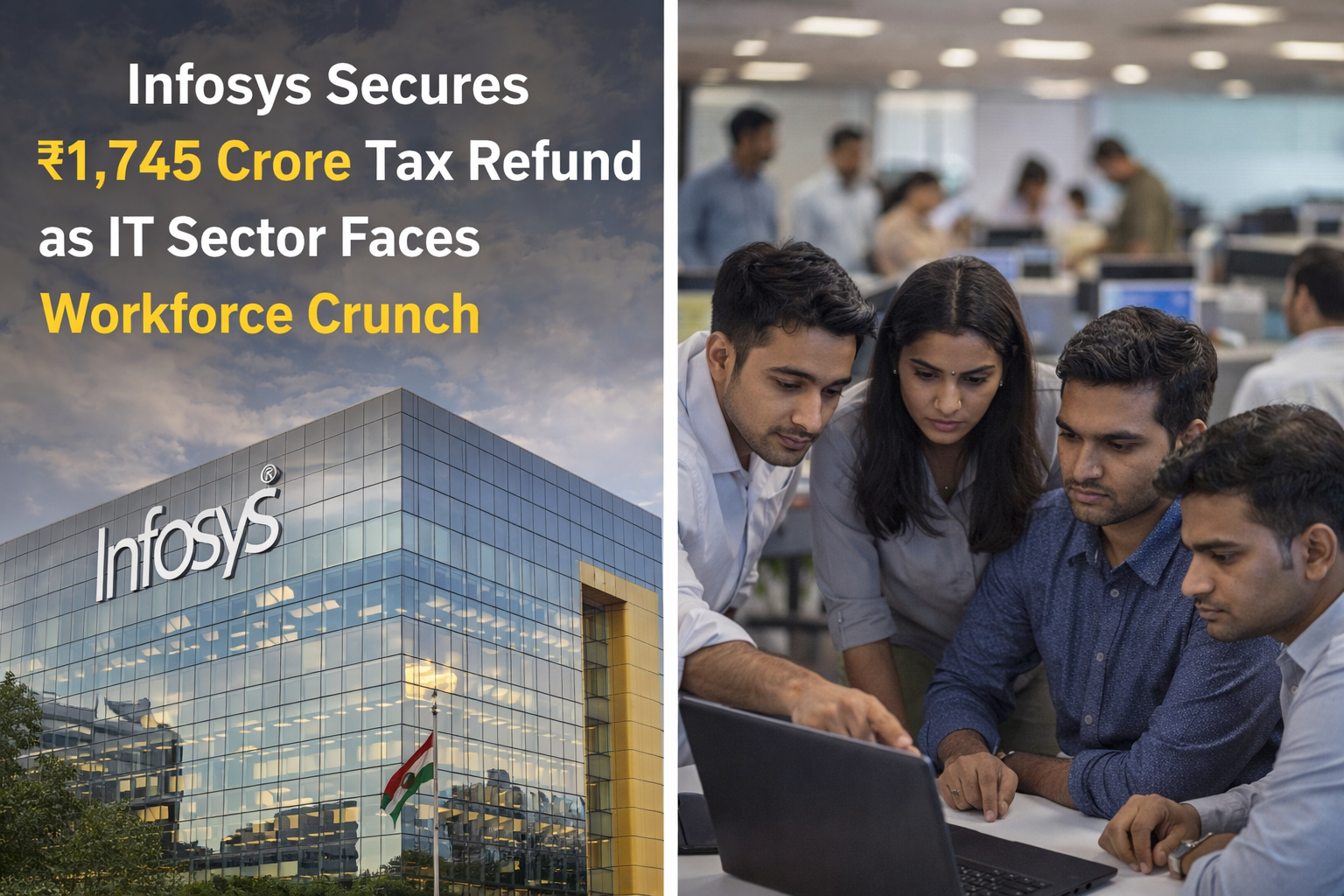
India’s information technology sector enters a new fiscal year with mixed signals as Infosys announces a substantial ₹1,745 crore tax refund while the broader IT industry grapples with significant workforce adjustments. The refund, spanning assessment years from 2013-14 to 2021-22, provides a liquidity boost to the nation’s second-largest IT services company at a critical juncture when the sector faces structural challenges. Meanwhile, major IT firms including TCS, Wipro, HCL Technologies, and Tech Mahindra have collectively reduced their bench strength by approximately 75,000 employees over the past two years, signaling a fundamental shift in workforce management strategies across the industry.
Key Highlights
- Infosys receives ₹1,745 crore cumulative tax refund including interest following assessment orders from the Income-tax Department covering six assessment years
- Assessment orders received between March 26-31, 2026, under Section 250 and Section 254 of the Income-tax Act, 1961
- Indian IT sector bench strength has contracted by 25 percent in two years, declining from approximately 3 lakh to 2.25 lakh employees across major firms
- Infosys stock declined 22 percent in FY26, dropping from ₹2,245 to ₹1,759, with 52-week high of ₹2,613
- HCL Technologies reported weekly return of negative 1.25 percent as of April 1, 2026
Infosys Tax Refund: Liquidity Injection and Financial Implications
Infosys Limited has secured a significant tax refund of ₹1,745 crore following the receipt of income tax assessment orders from the Government of India’s Income-tax Department. The refund encompasses multiple assessment years spanning nearly a decade, from 2013-14 through 2021-22, and includes accrued interest on the principal amount. The assessment orders were issued under Section 250 and Section 254 of the Income-tax Act, 1961, with orders arriving in phases during the final week of March 2026, culminating on March 31, 2026.
The timing of this refund announcement carries particular significance as it arrives at the conclusion of fiscal year 2025-26, potentially providing a material boost to Infosys’s cash position and financial statements for the quarter and year ended March 31, 2026. The company is currently evaluating the precise financial impact of these orders on its reported results. This substantial inflow of capital could influence the company’s capital allocation strategies, including potential investments in technology infrastructure, research and development initiatives, or shareholder returns through dividends or share buyback programs.
The refund represents a favorable resolution of tax disputes spanning multiple assessment years, providing clarity on the company’s tax position for the covered periods. For institutional investors and financial analysts tracking Infosys’s financial health, this development offers a tangible improvement in liquidity metrics and working capital position, though the company has indicated that detailed analysis is underway to determine the precise reflection of this refund in its financial reporting.
IT Sector Workforce Dynamics and Structural Challenges
The Indian IT services sector is undergoing a significant transformation in workforce management, with major industry players substantially reducing their bench strength over the past two years. Across firms including Tata Consultancy Services (TCS), Infosys, Wipro, HCL Technologies, and Tech Mahindra, the number of employees on the bench has declined by approximately 75,000, falling from nearly 3 lakh to approximately 2.25 lakh employees. This represents a contraction of approximately 25 percent in bench strength across these major firms.
Bench strength traditionally serves as a reserve workforce designed to provide a cushion during demand fluctuations and market volatility. The sharp contraction in this buffer indicates a fundamental shift in how IT services companies are managing their human resources and operational flexibility. Industry observers suggest that this reduction may not reverse to earlier levels even if growth revives, indicating a structural rather than cyclical change in workforce management philosophy. The narrowing of unassigned employees reflects companies’ efforts to maintain leaner operations and improve resource utilization metrics, though this approach reduces organizational flexibility during periods of demand uncertainty.
This workforce adjustment occurs against a backdrop of challenging market conditions for Indian IT stocks. Infosys, for instance, experienced a 22 percent decline in its stock price during FY26, dropping from ₹2,245 to ₹1,759, with its 52-week high reaching ₹2,613. The broader market sentiment reflects investor concerns about growth trajectories, margin pressures, and the sector’s ability to navigate macroeconomic headwinds and competitive pressures from global technology services providers.
Comparative Performance and Market Positioning
The IT sector’s performance metrics reveal divergent trajectories across major players. HCL Technologies, one of the sector’s significant players, reported a weekly return of negative 1.25 percent as of April 1, 2026, indicating recent downward pressure on its stock valuation. The company operates within a highly competitive landscape alongside peers including Infosys, TCS, Wipro, LTIMindtree, Mphasis, and Coforge, all competing for talent, client relationships, and market share in digital transformation, cloud services, and artificial intelligence solutions.
Persistent Systems, another notable player in the IT services space, reported Q4 FY25 revenue of ₹3,242.11 crore with profit after tax of ₹395.76 crore, and has articulated an ambitious target of achieving $2 billion in revenue by FY27. This growth trajectory contrasts with the more cautious positioning of larger peers, suggesting differentiated strategies across the sector based on company size, service offerings, and market positioning.
| Company | FY26 Performance | Key Metrics |
|---|---|---|
| Infosys | -22% stock decline | ₹1,745 crore tax refund; Price range ₹1,759-₹2,613 |
| HCL Technologies | -1.25% weekly return | As of April 1, 2026 |
| Persistent Systems | ₹3,242.11 crore revenue | Q4 FY25; ₹395.76 crore PAT; $2B revenue target by FY27 |
Market Outlook
The Indian IT sector faces a critical inflection point as it navigates multiple headwinds including workforce optimization pressures, stock market volatility, and the need to demonstrate sustainable growth in a competitive global environment. The Infosys tax refund provides a near-term liquidity benefit, but the sector’s structural challenges—evidenced by bench strength reductions and stock price declines—suggest that investors looking to participate in this market movement can open demat account through SEBI-registered brokers to maintain a cautious stance while monitoring quarterly results and management guidance closely.
For institutional investors and financial professionals, the key metrics to track include revenue growth trajectories, margin expansion or contraction, capital allocation decisions, and management commentary on demand trends and client spending patterns. This development presents new considerations for stock investment strategies focused on Indian equities. The reduction in bench strength, while improving near-term profitability metrics, may constrain the sector’s ability to capitalize on sudden demand surges, potentially impacting competitive positioning against more flexible competitors.
Retail participation has grown significantly as access to a good trading and investing platform has become more widespread. The sector’s ability to successfully transition to higher-value services in cloud, AI, and digital transformation will determine whether current valuations represent attractive entry points or warrant further caution.
Conclusion
The Indian IT services sector enters fiscal year 2026-27 amid significant transition, with Infosys’s ₹1,745 crore tax refund providing a bright spot in an otherwise challenging environment. The broader industry’s workforce contraction reflects pragmatic responses to market realities but raises questions about organizational agility and growth capacity. Investors should view the sector’s current valuations within the context of structural changes underway, monitoring quarterly performance metrics, management guidance, and capital allocation decisions as key indicators of future trajectory. The sector’s ability to balance operational efficiency with growth investments will ultimately determine whether current market pessimism represents a buying opportunity or a justified reassessment of long-term growth prospects for Indian IT services companies.
Leave a Reply