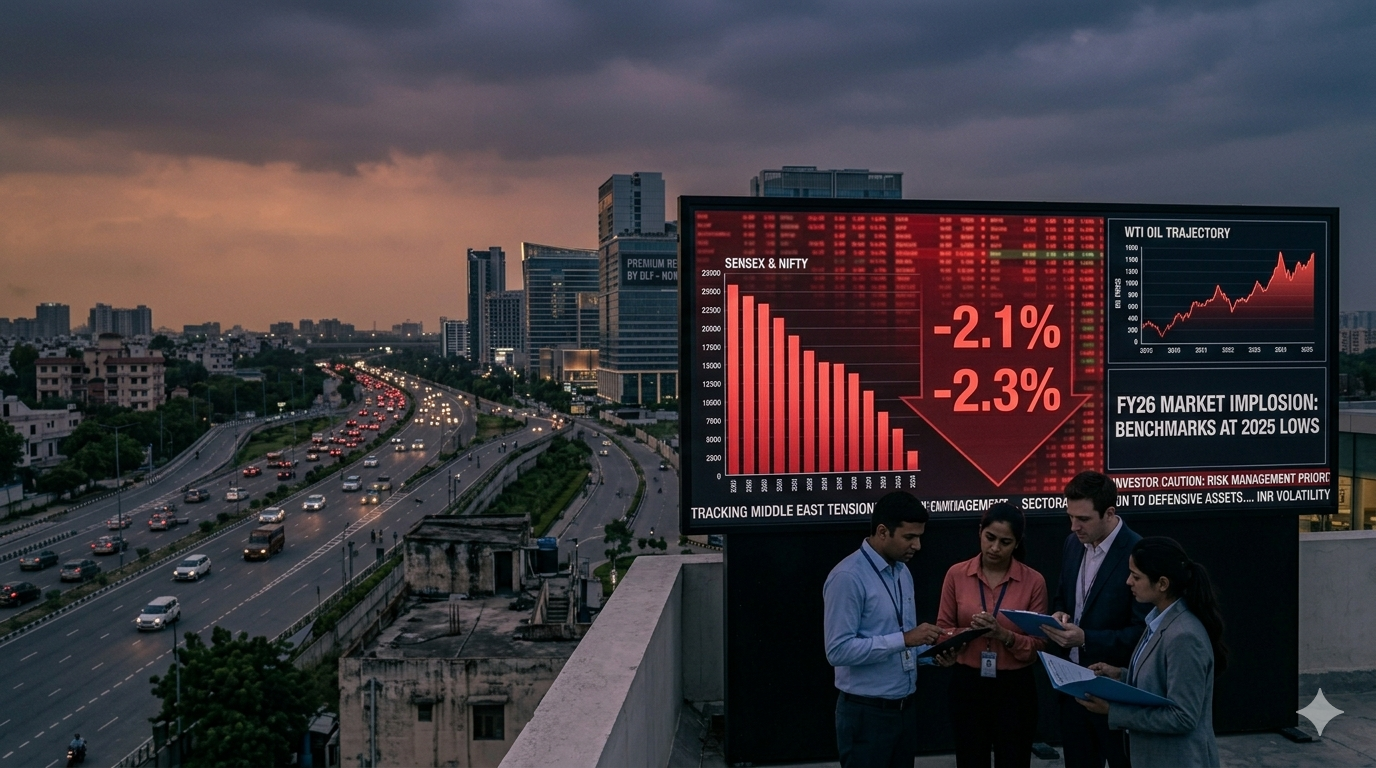
Indian equity benchmarks capped the final trading session of FY26 on March 30 with steep declines, as the BSE Sensex plunged 1,635.67 points or 2.22 percent to settle at 71,947.55, while the Nifty 50 shed 488.40 points or 2.14 percent to close at 22,331.40. The sharp sell-off, marking the eighth session of 1 percent or more losses in the March expiry series, was primarily driven by heavyweights in the banking sector amid escalating geopolitical tensions from the protracted US-Iran conflict and surging oil prices. Broad-based selling across sectors underscored investor concerns over growth slowdown and inflationary pressures, with Bank Nifty underperforming by dropping nearly 3.82 percent to 50,275. Markets remain closed today, March 31, on account of Mahavir Jayanti, leaving traders to assess the damage from this volatile close.
Key Highlights
- Sensex intraday low of 71,774.13 before closing at 71,947.55, down 2.22 percent; Nifty hit 22,283.85 low, settling at 22,331.40, down 2.14 percent.
- Bajaj Finance led Nifty losers with a 4.95 percent drop, followed by Shriram Finance at 3.82 percent, SBI at 3.8 percent, IndiGo at 3.65 percent, and Kotak Mahindra Bank at 3.59 percent.
- Banking stocks across private and public sectors, including HDFC Bank, ICICI Bank, and City Union Bank (down 6 percent), dragged indices lower.
- 23 stocks hit 52-week highs, but 1,219 touched one-year lows, signaling widespread weakness.
- Nifty plunged 11.3 percent in March and 14.54 percent in the March quarter, the worst since 2020; Bank Nifty down 16.94 percent monthly and 15.62 percent quarterly.
Banking Sector Meltdown Drags Nifty Sensex
The banking sector bore the brunt of Monday’s carnage, with Bank Nifty not only extending its downtrend but breaking below its prior swing low of 51,324 from March 23, closing at 50,275 after a 3.82 percent decline. This underperformance highlighted a lack of support from heavyweight constituents, as private sector lenders like Bajaj Finance tanked 4.95 percent, Kotak Mahindra Bank fell 3.59 percent, and HDFC Bank alongside ICICI Bank posted sharp losses. Public sector players were equally battered, with State Bank of India declining 3.8 percent and City Union Bank slumping 6 percent. The index ended FY26 with a 2.50 percent loss, underscoring relative weakness in the latter half of the fiscal year.
This rout in financials amplified broader market fragility, as the price structure for Bank Nifty remains decisively bearish with sustained lower lows and persistent selling pressure. Analysts point to unresolved Middle East tensions fueling fears of higher oil import costs, which could squeeze net interest margins and elevate non-performing assets amid a slowing economy. The sector’s vulnerability was evident in the intraday breach of key supports, with immediate downside risks toward 49,900-49,800, as noted by Sudeep Shah, Head of Technical and Derivatives Research at SBI Securities. Any sustained move below this zone could propel further weakness to 49,500 and 49,200 in the short term.
Compounding the pressure, foreign institutional investors continued their outflows, exacerbating liquidity concerns in a high-valuation environment. Domestic institutions provided some cushion, but it was insufficient against the tide of risk aversion. For institutional investors, this signals a tactical pause in overweight banking exposures, with selective rotation toward defensives potentially warranted. Investors looking to participate in this market movement can open free demat account online through SEBI-registered brokers.
Broad Market Sell-Off Key Losers Gainers
The Nifty 50 saw 44 of its constituents in the red, with only six advancing, reflecting pervasive bearishness on the last day of FY26. Bajaj Finance emerged as the top laggard at 4.95 percent lower, followed closely by Shriram Finance down 3.82 percent, underscoring stress in non-banking financial companies exposed to consumer lending amid rising funding costs. Aviation player IndiGo shed 3.65 percent, hit by fuel price spikes from geopolitical unrest, while Kotak Mahindra Bank and SBI rounded out major drags.
On the flip side, select names like Tech Mahindra, Power Grid Corp, and Reliance Industries bucked the trend as top gainers, offering pockets of resilience amid the downturn. Reliance’s steady performance provided some ballast to the Sensex, given its heavy weighting, while power sector strength in Power Grid hinted at defensive rotations. Broader participation in the decline was stark: 1,219 stocks hit one-year lows against just 23 at 52-week highs, painting a picture of capitulation.
Sectorally, the carnage extended beyond financials, with midcap and smallcap indices mirroring benchmark weakness. The Nifty’s intraday low of 22,283.85 breached key supports at 22,470-22,450, closing at levels unseen since April 7, 2025. This 5 percent FY26 loss for Nifty, coupled with a 2.14 percent daily drop, caps a dismal March where the index fell 11.3 percent—the steepest monthly decline since 2020. This development presents new considerations for stock investment strategies focused on Indian equities.
March Quarter Performance Worst Since 2020
Nifty 50 and Bank Nifty posted their worst March quarter and monthly performances since 2020, with Nifty down 14.54 percent quarterly and 11.3 percent monthly, while Bank Nifty slid 15.62 percent over the quarter and 16.94 percent in March.
| Index | Closing Level | Daily Change (%) | Monthly Change (%) | Quarterly Change (%) |
|---|---|---|---|---|
| Nifty 50 | 22,331.40 | -2.14% | -11.3% | -14.54% |
| Bank Nifty | 50,275 | -3.82% | -16.94% | -15.62% |
| GIFT Nifty | 22,423 | -403 points | – | – |
Nifty closed FY26 at 22,331.40, marking an 8th straight 1 percent-plus loss session in March expiry. Bank Nifty broke swing low of 51,324, ending at 50,275; quarterly loss of 15.62 percent. GIFT Nifty traded at 22,423, down 403 points, signaling continued gap-down pressure post-holiday. VIX at four-year high, weekly options data pins Nifty range at 22,000-22,500 short-term. Resistance at 22,500-22,700; support breach toward 22,000 could accelerate downside.
This table underscores the bearish momentum, with banking’s outsized drag amplifying benchmark losses. Key players like SBI and Bajaj Finance exemplify risks from inflation pass-through failures and geopolitical oil shocks. Retail participation has grown significantly as access to a reliable trading platform has become more widespread.
Market Outlook
Looking ahead, Indian investors face elevated risks from persistent US-Iran hostilities, with oil prices threatening RBI’s inflation targets and INR stability. A breakout from the Nifty’s 22,000-22,500 range will dictate direction: upside beyond 22,700 could stabilize sentiment, but sub-22,000 breaches risk deeper corrections toward 21,500. Institutional players monitor FII flows, RBI liquidity measures, and Q4 earnings for banking resilience. Rotation into power utilities like Power Grid and select IT names offers hedges, while avoiding high-beta financials. Volatility remains high with VIX at multi-year peaks, advising position sizing discipline and stop-losses amid potential post-holiday gaps.
Conclusion
Monday’s 2 percent-plus plunge in Sensex and Nifty, capped by banking sector implosion, crystallizes FY26’s turbulent close amid global headwinds. With benchmarks at 2025 lows and quarterly losses echoing 2020 crashes, the path forward hinges on de-escalation in Middle East tensions and domestic policy support. Investors must prioritize risk management, tracking oil trajectories, INR movements, and sectoral rotations to navigate this bearish setup effectively.
Leave a Reply