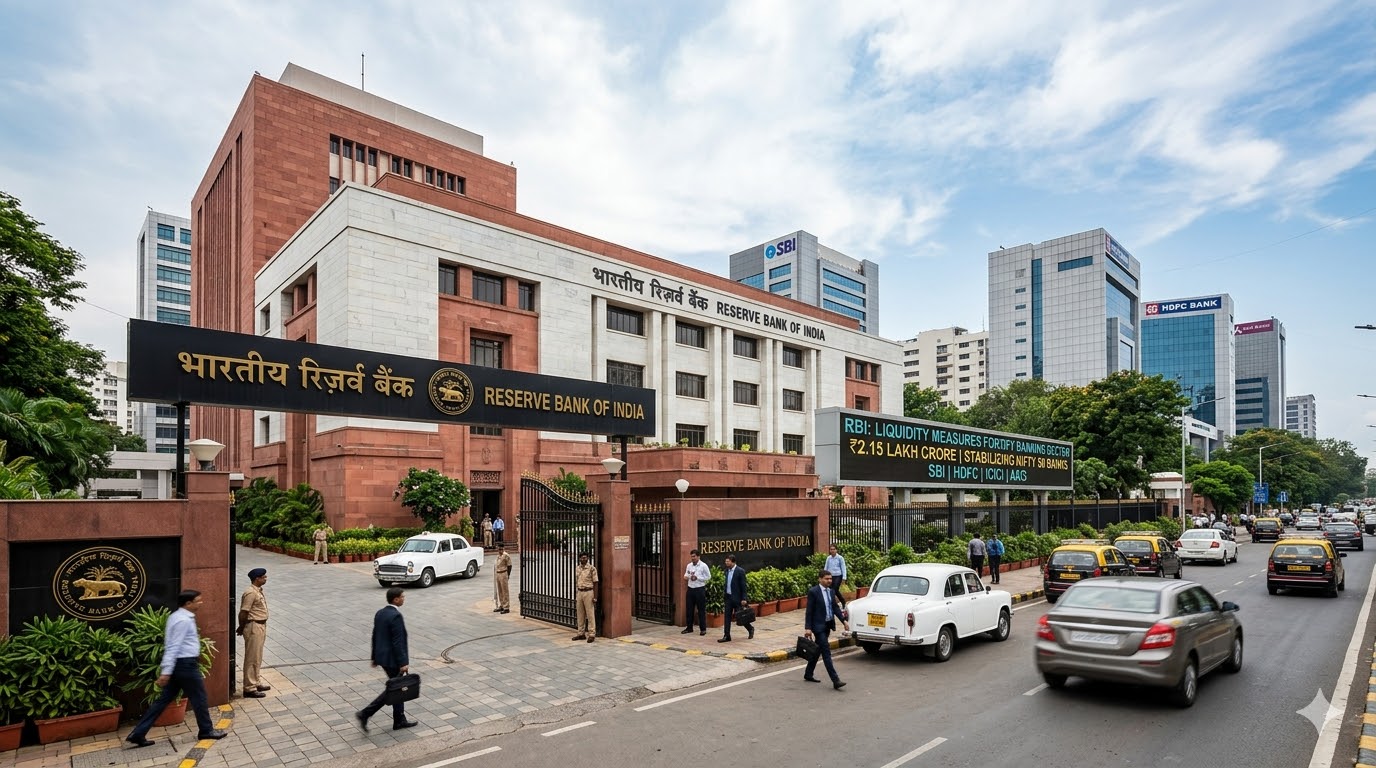
The Reserve Bank of India (RBI) has unveiled a robust ₹2.15 lakh crore liquidity infusion package into the banking system, comprising variable rate repo auctions, forex swaps, and open market operations, to counter tightening liquidity amid year-end credit demands and tax outflows. This intervention, timed between late January and mid-February 2026, arrives as inflation pressures mount with Wholesale Price Index (WPI) projected at 3.2 percent for March 2026, influencing expectations for the upcoming Monetary Policy Committee (MPC) meeting in April. Major private sector banks like HDFC, ICICI, and Axis Bank, alongside public sector leader State Bank of India (SBI), stand to benefit from eased funding costs, potentially stabilizing NIFTY Bank index performance amid SENSEX and NIFTY 50 volatility. As the flexible inflation-targeting framework nears its second review post a decade of MPC operations, these measures underscore RBI’s commitment to financial stability in India’s banking sector.
Key Highlights
- RBI to inject ₹2.15 lakh crore via 90-day Variable Rate Repo (VRR) of ₹25,000 crore on January 30, USD/INR buy-sell swap of USD 10 billion (₹90,000 crore) on February 4, and ₹1 lakh crore OMO purchases in two tranches on February 5 and 12.
- System liquidity tightened due to advance tax and GST outflows, with Weighted Average Call Rate (WACR) exceeding the 5.25 percent policy repo rate in mid-December 2025.
- WPI inflation forecast at 3.2 percent for March 2026, up from 2.1 percent in February, driven by crude oil, natural gas, and edible oil prices amid West Asia tensions.
- MPC completes 10 years with 59 meetings; only 12 rate cuts, 16 hikes, and 31 no-changes, mostly under neutral stance, per SBI Research analysis.
- Inflation targeting framework (4 percent +/- 2 percent) up for second review ending March 31, 2026; CPI at 3.21 percent provides RBI maneuvering room.
RBI Liquidity Measures for Indian Banking Stability
The RBI’s multi-pronged liquidity strategy addresses acute system stress, where short-term borrowing costs had surged above the policy repo rate of 5.25 percent. The 90-day VRR auction of ₹25,000 crore on January 30 marks a pioneering extension from prior 56-day tenors, offering banks like SBI, HDFC Bank, ICICI Bank, and Axis Bank longer-term funding to match liabilities and sustain credit growth into the financial year-end. This is complemented by a three-year USD/INR buy-sell forex swap auction of USD 10 billion on February 4, injecting approximately ₹90,000 crore in durable rupee liquidity while mitigating INR volatility risks.
Open Market Operations (OMOs) form the package’s cornerstone, with ₹1 lakh crore in government security purchases split into ₹50,000 crore tranches on February 5 and 12, directly crediting banks’ reserves and pressuring yields lower to spur lending. For institutional investors tracking NIFTY Bank, these infusions could compress credit spreads, benefiting net interest margins (NIMs) for deposit-heavy players like SBI, whose group chief economic advisor Soumya Kanti Ghosh noted the central bank’s nimble response under neutral stances in MPC history. The timing aligns with seasonal credit surges, preventing a repeat of December 2025’s negative liquidity episodes. Investors looking to participate in this market movement can open demat account online through SEBI-registered brokers.
This proactive calibration reflects RBI Governor Sanjay Malhotra’s tenure, characterized by 86 percent unanimous MPC decisions since December 2024, contrasting Urjit Patel-era splits. Analysts view the package as a bridge to April’s MPC, where liquidity trends will inform stance amid rising inflation.
Inflation Pressures and MPC Implications for Bank Stocks
Rising inflation complicates the liquidity narrative, with ICRA forecasting WPI at 3.2 percent in March 2026—a 21-month high—fueled by crude oil, natural gas, and edible oils amid West Asia conflicts. February’s WPI hit 2.1 percent from January’s 1.8 percent, pressuring bond yields and potentially elevating banks’ cost of funds if MPC signals tightening. CPI remains at 3.21 percent, within the 4 percent +/- 2 percent target, granting RBI flexibility; Vishal Goenka, Co-Founder of Indiabonds.com, asserts, “India’s CPI at 3.21 percent still gives the RBI enough room… rates would actually stay lower for longer because growth is the larger priority.”
For banking heavyweights, this dynamic influences deposit mobilization and loan pricing. SBI, with its vast branch network, could leverage infused liquidity for retail credit expansion, while HDFC Bank—post-merger—focuses on wholesale funding relief via OMOs. ICICI Bank and Axis Bank, with higher loan-to-deposit ratios around 100 percent historically, stand to gain from lower marginal funding costs, potentially boosting quarterly NIMs by 10-20 basis points if WACR realigns to 5.25 percent. This development presents new considerations for stock investment strategies focused on Indian equities. NIFTY 50 and SENSEX banking weights (approximately 25 percent combined) amplify these effects; a sustained liquidity surplus might lift NIFTY Bank by 2-3 percent short-term, per market consensus.
SBI Research highlights MPC’s evolution: over 10 years, 24 rate actions occurred mostly neutrally, reducing hike episodes post-2016 inflation targeting (8 cuts vs. 16 hikes pre-regime). The framework’s first review in March 2021 retained it till March 2026, with RBI reporting Parliament only once during pandemic inflation spikes above 6 percent.
Banking Sector Liquidity Operations Breakdown
The RBI’s package provides a structured liquidity matrix, detailed below for key players’ strategic planning:
| Operation Type | Amount | Scheduled Date(s) | Impact on Banks |
|---|---|---|---|
| 90-Day Variable Rate Repo (VRR) | ₹25,000 crore | January 30, 2026 | Short-to-medium term funding for SBI, HDFC; first 90-day tenor eases liability matching. |
| USD/INR Buy-Sell Swap | USD 10 billion (₹90,000 crore) | February 4, 2026 | Durable rupee injection; stabilizes INR for ICICI, Axis export credit books. |
| OMO Government Security Purchases | ₹1 lakh crore (2 x ₹50,000 crore) | February 5 & 12, 2026 | Lowers yields, boosts reserves; enhances NIMs across PSBs and private banks. |
This table illustrates phased infusion, prioritizing immediate relief via VRR before long-term OMO stability. Risks include swap rollovers in three years if INR weakens, exposing forex-sensitive Axis Bank (noted for 15-20 percent FX exposure). Investors should monitor WACR daily; persistence above 5.50 percent signals incomplete absorption, pressuring SBI’s treasury profits. Retail participation has grown significantly as access to a reliable trading platform has become more widespread.
Market Outlook
Looking ahead, RBI’s ₹2.15 lakh crore infusion positions the Indian banking sector for resilient Q4 FY26 credit growth at 12-14 percent YoY, outpacing 10 percent GDP, but investors must watch April MPC for rate cues amid 3.2 percent WPI risks. NIFTY Bank could target 52,000 if liquidity sustains, rewarding HDFC and ICICI’s retail focus, though Axis Bank’s corporate slippages warrant caution. INR stability near 83.50/USD hinges on swap efficacy, with SENSEX banking drag risks if inflation forces hikes. Key watches: MPC unanimity under Malhotra, GST outflow cycles, and OMO uptake by PSBs like SBI. Institutional portfolios should overweight liquid banks, hedging via NIFTY Bank futures amid volatility.
Conclusion
RBI’s decisive ₹2.15 lakh crore liquidity measures, amid inflating WPI and MPC legacy, fortify India’s banking sector against year-end strains, directly aiding SBI, HDFC, ICICI, and Axis Bank in aligning costs with policy rates. By blending VRR innovation, forex swaps, and OMOs, the central bank reaffirms growth priority within inflation bounds, stabilizing NIFTY 50 banking constituents for investors. As the targeting framework reviews conclude, sustained vigilance on liquidity metrics and inflation will define sector outperformance, underscoring prudent positioning in this dynamic landscape.
Leave a Reply