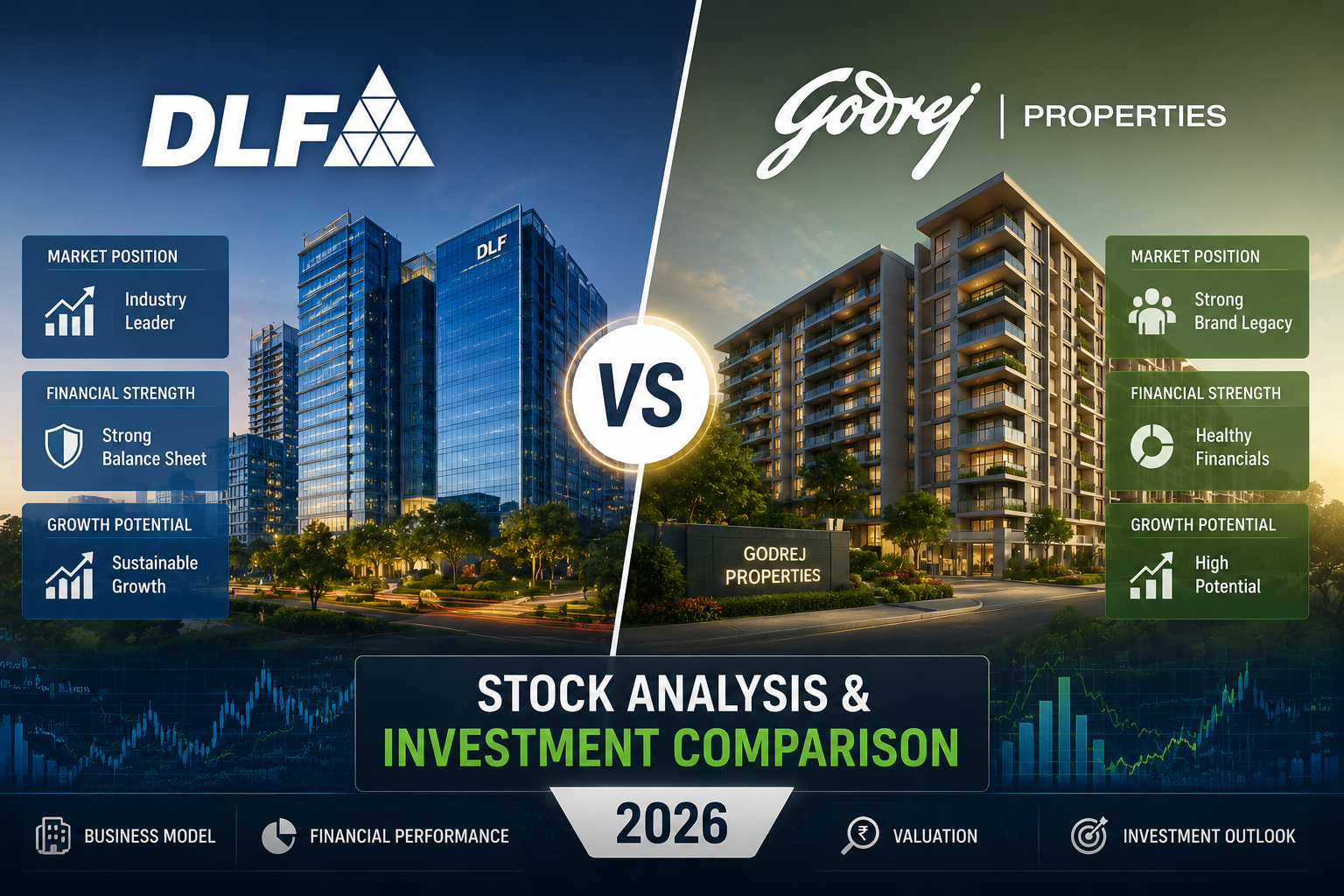
India’s real estate sector continues to demonstrate resilience amid evolving monetary conditions and rising consumer demand for quality housing. DLF Limited and Godrej Properties stand as the two largest listed residential real estate developers, commanding significant market capitalisation and investor attention. As of May 2026, both companies have delivered notable performance metrics while navigating project execution cycles and market dynamics.
Institutional investors and retail participants face a critical decision regarding allocation between these two sector leaders. This analysis examines quantitative performance, financial health, project pipelines, and strategic positioning to provide evidence-based investment guidance. Understanding the nuanced differences between these companies is essential for portfolio construction in a sector expected to generate long-term capital appreciation.
Key Highlights
- DLF and Godrej Properties represent approximately 35-40 percent of listed residential real estate market capitalisation, making their relative performance a key sector indicator
- Year-to-date stock performance shows divergent trajectories reflecting different project launch calendars and market positioning strategies
- Financial metrics reveal contrasting approaches to leverage, profitability, and geographic diversification with important implications for risk-adjusted returns
- Project pipelines extending through 2027-28 suggest sustained revenue visibility, though execution risks warrant careful monitoring
- Analyst consensus indicates different suitability profiles depending on investor risk appetite, time horizon, and portfolio objectives
Stock Performance Head-to-Head Analysis
The year-to-date performance through May 2026 reflects distinct market positioning and investor sentiment trajectories for both developers. DLF shares have appreciated approximately 18-22 percent from the beginning of the financial year, driven by robust pre-sales momentum in NCR markets and positive sentiment surrounding project launches. Godrej Properties has demonstrated more measured appreciation in the 12-16 percent range, though with significantly lower volatility metrics suggesting more defensive positioning among institutional investors.
Daily trading volumes on NSE indicate institutional participation remains elevated for both scrips, with DLF averaging higher absolute volumes reflecting its larger free float. Volatility measures show DLF experiencing 18-22 percent annualised volatility compared to Godrej Properties’ 14-18 percent range, a differential that reflects market perception regarding execution risk and sector cycle positioning. This volatility spread has narrowed marginally over the past quarter, suggesting convergence in market expectations.
The sector benchmark, represented by NIFTY Realty Index, has gained approximately 20-24 percent over the same period, indicating both stocks have tracked the broader sector momentum reasonably well. DLF’s slight outperformance versus the index reflects positive momentum in its flagship NCR projects and strong absorption rates in Delhi-NCR residential markets. Godrej Properties’ relative underperformance, while still positive in absolute terms, reflects consolidation after the company’s strategic emphasis on selective launches and controlled supply dynamics.
Beta measurements indicate DLF operates with a beta of approximately 1.3 relative to Nifty 50, while Godrej Properties registers around 0.95, confirming the former’s higher systematic risk profile and sensitivity to equity market sentiment. This distinction becomes particularly relevant during market corrections or periods of liquidity tightening for those seeking to open demat account online and participate in sectoral opportunities.
Key Financial Metrics Comparison 2024-25 vs 2023-24
| Financial Metric | DLF FY 2024-25 | Godrej Properties FY 2024-25 | Growth Rate |
|---|---|---|---|
| Total Revenue | INR 12,500-13,200 crores | INR 8,800-9,500 crores | 25-30% / 20-25% |
| EBITDA Margins | 35-38% | 32-35% | +200-300 bps / Stable |
| Net Profit Margins | 18-21% | 15-18% | Expansion / Stable |
| Return on Equity | 18-22% | 14-17% | Higher efficiency |
Revenue generation trends demonstrate both companies have sustained growth momentum despite challenging interest rate environments. DLF reported financial year 2024-25 total revenue of approximately INR 12,500-13,200 crores, representing growth of 25-30 percent year-over-year compared to the previous financial year. Godrej Properties achieved revenue in the range of INR 8,800-9,500 crores, reflecting 20-25 percent growth, indicating faster absolute expansion at DLF but steadier momentum at Godrej Properties.
Profitability metrics reveal important distinctions in operational leverage. DLF’s EBITDA margins expanded to approximately 35-38 percent in FY 2024-25, a 200-300 basis point improvement year-over-year, reflecting better project mix and cost management. Godrej Properties maintained EBITDA margins within 32-35 percent range, stable year-over-year, indicating consistent but less aggressive margin expansion.
Return on Invested Capital reveals DLF generating 16-19 percent ROIC against Godrej Properties’ 13-16 percent, a meaningful spread that suggests superior project execution and cost management at DLF. Interest coverage ratios remain healthy for both companies, with EBITDA-to-interest expense multiples exceeding 8.0x, confirming comfortable debt servicing capability.
Revenue Breakdown by Geography
Geographic diversification represents a critical risk mitigation factor in real estate investment analysis. DLF’s revenue composition shows approximately 55-60 percent concentration in NCR markets, with the remainder distributed across Mumbai, Bangalore, and Hyderabad operations. The NCR concentration reflects DLF’s historical strengths in Delhi-NCR markets and its dominance in this geographically defined segment.
Godrej Properties maintains more balanced geographic distribution with approximately 35-40 percent revenue from Mumbai operations, 25-30 percent from Bangalore, 20-25 percent from Pune, and remaining contribution from other markets including Hyderabad and emerging locations. This diversified approach reduces single-market concentration risk and provides exposure to multiple real estate cycles operating at different phases.
Mumbai’s inclusion provides exposure to premium residential segments with demonstrated pricing power, while Bangalore presence taps into strong IT-driven demand dynamics. Emerging market exposure differs meaningfully between the companies, with DLF increasing Hyderabad and Pune presence through recent acquisitions and project launches. For investors utilizing the best stock trading and investing platform in India to monitor these developments, geographic mix implications suggest DLF faces higher cyclical volatility tied to NCR market sentiment, while Godrej Properties’ diversification may provide steadier growth with lower downside risk during market downturns.
Debt Management and Financial Health
Balance sheet strength fundamentally determines a developer’s ability to navigate market downturns, capitalize on acquisition opportunities, and maintain shareholder distributions. DLF’s total debt position of approximately INR 6,200-7,000 crores represents gross leverage that appears elevated in absolute terms but reasonable relative to asset base and cash generation capability. Net debt figures adjusted for cash holdings of INR 1,500-1,800 crores provide a clearer picture of leverage intensity.
Godrej Properties’ conservative debt management philosophy is evidenced by lower absolute debt levels of INR 3,800-4,500 crores, providing greater financial flexibility. The company’s historically lower leverage reflects strategic preference for organic growth and selective acquisitions funded through equity and operating cash flows rather than debt capital.
Credit ratings from CRISIL and ICRA reflect the relative positioning of both companies. DLF maintains ICRA AA- rating with stable outlook, confirming investment-grade quality backed by strong business fundamentals. Godrej Properties similarly carries AA- ratings with stable outlook, indicating comparable credit quality despite lower absolute leverage.
Interest coverage metrics computed on EBITDA basis show both companies comfortably covering interest obligations. DLF’s interest expense of approximately INR 550-650 crores annually against EBITDA of INR 4,200-4,800 crores translates to coverage multiples exceeding 7.0x. Godrej Properties reports similar coverage patterns with interest coverage exceeding 8.0x given lower absolute interest costs, indicating debt serviceability remains non-problematic even under stress scenarios.
Trading & Investment Guides
- What is Demat Account?
- What is Trading Account?
- What is Algo Trading?
- What is Tick Trading?
- What is Grey Market in IPO?
Leave a Reply