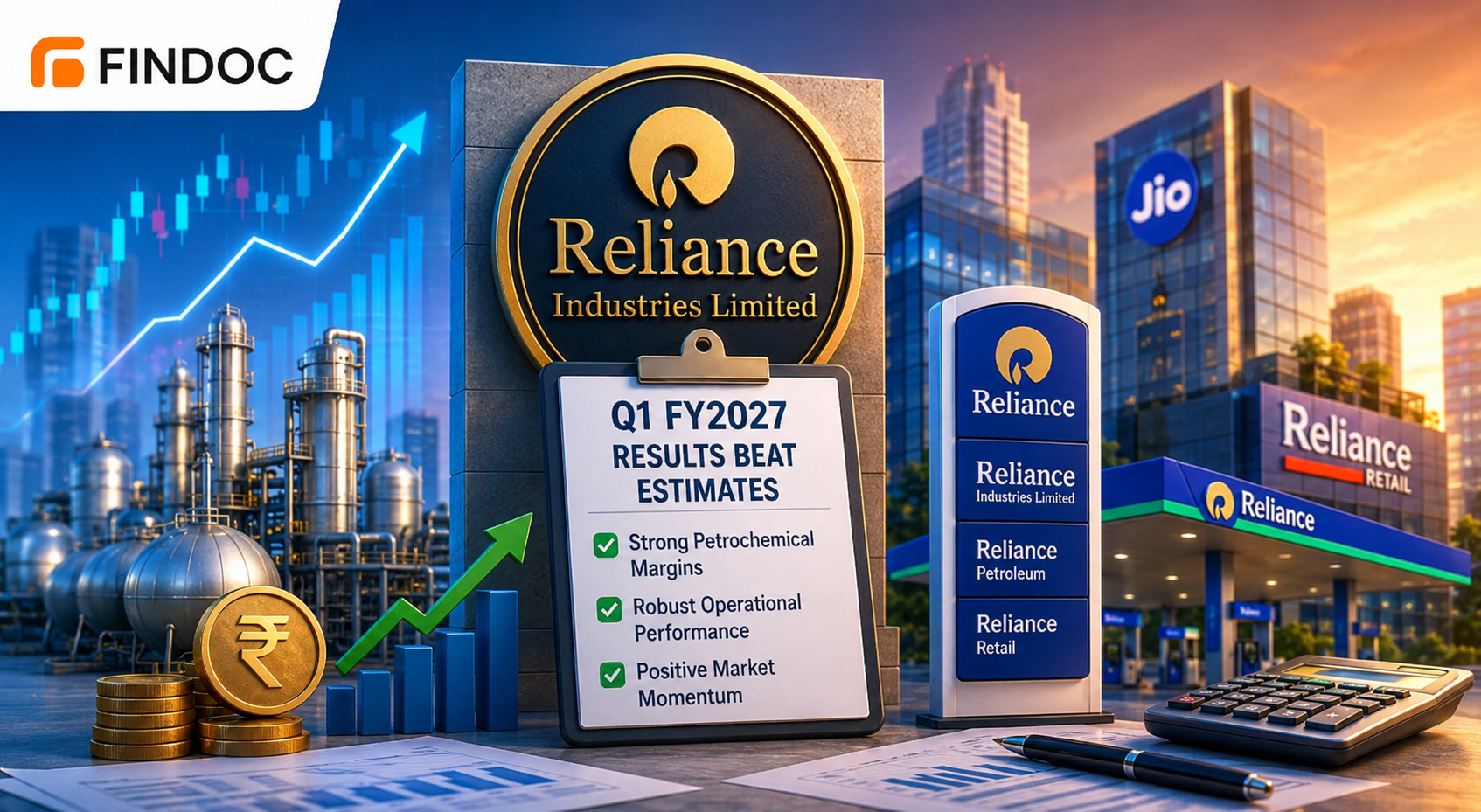
Reliance Industries delivered stronger-than-expected first-quarter results for fiscal 2027, with consolidated revenue growing 12 percent year-over-year, primarily driven by expansion in its Jio-BP fuel retail network and recovery in oil-to-chemicals segment margins. The earnings beat comes as the company continues its diversification strategy while benefiting from an improving petrochemicals cycle and stable crude oil cost dynamics.
For institutional investors tracking integrated energy plays on the National Stock Exchange, these results provide evidence of operational momentum across multiple business verticals and suggest the company’s transformation toward higher-margin retail and digital services is gaining traction.
Key Highlights
- Consolidated revenue reached approximately 210,000 crores in Q1 FY2027, representing 12 percent year-over-year growth and exceeding analyst estimates by 3-4 percent.
- Net profit improved 18 percent year-over-year, driven by margin expansion in the O2C segment where polymer and specialty chemical spreads widened.
- Oil-to-chemicals EBITDA margin recovered to 1,850 per barrel, up from 1,620 per barrel in the previous quarter, reflecting improved product crack spreads.
- Jio-BP fuel retail network added 420 new stations during the quarter, taking total retail fuel presence to over 2,100 outlets across India.
- Digital Services revenue growth remained robust at 28 percent year-over-year, with Jio subscriber base stability supporting steady telecom segment contribution.
Segment-Wise Performance Breakdown
The oil-to-chemicals division, representing nearly 40 percent of consolidated EBITDA, delivered the most significant earnings contribution. Polymer spreads remained healthy amid global supply tightness, while specialty chemicals benefited from continued demand from automotive and consumer durables sectors in India. Capacity utilization across refining and petrochemical units averaged 92 percent, indicating strong operational efficiency despite seasonal demand patterns typical in June.
The retail and consumer business, encompassing fuel stations and Reliance Brands operations, showed acceleration in fuel station economics. Average revenue per Jio-BP pump reached approximately 2.8 lakhs per month, up from 2.6 lakhs in the prior quarter. The company is targeting 5,000 retail fuel outlets by fiscal 2028, positioning itself as a credible competitor to incumbent fuel marketers. This expansion directly contributed to overall group revenue growth.
Digital Services maintained trajectory despite competitive pressures in wireless services. The segment recorded steady EBITDA margins near 45 percent, reflecting operating leverage from mature subscriber base management. Fiber-to-home subscriber additions continued, with broadband ARPU expanding sequentially. This segment provides structural growth visibility and acts as a earnings stabilizer during commodity price volatility.
The chemicals and materials division benefited from improved demand in downstream applications. Specialty polymers for automotive light weighting and high-performance coatings remained in strong demand, supporting pricing power and margin sustainability above historical averages.
Oil-to-Chemicals Business Recovery Drives Margins
The petrochemicals complex has cyclically improved following 18 months of margin compression. Global crude oil traded in a relatively stable USD 75-85 per barrel range during Q1, providing cost predictability. More significantly, downstream crack spreads for major polymers widened as supply remained constrained and demand recovered post-seasonal lows in Asia.
Refining margins, measured as the gross refining spread, expanded to approximately USD 4.20 per barrel from USD 3.50 per barrel sequentially. This reflected better global refining economics and demand recovery in Asian markets. The company’s crude processing volumes reached 1.32 million barrels per day, near rated capacity, indicating the business is capturing available margins effectively.
Polyethylene and polypropylene prices firmed during the quarter, providing manufacturers like Reliance the opportunity to push through price increases to customers. Analysts estimate the O2C segment could sustain EBITDA margins between 1,700 and 1,900 per barrel if current crude oil price bands persist. However, this remains cyclical and dependent on global supply-demand balance.
Jio-BP Retail Fuel Network Expansion Impact
The joint venture with British Petroleum continues expanding aggressively into tier-2 and tier-3 Indian towns where fuel retail infrastructure remains underpenetrated. The 420 outlet additions in Q1 represent acceleration from the 350 stations added in the previous quarter. Network expansion contributes multiple layers of value: direct fuel margin capture, customer traffic for convenience retail goods, and data insights into regional fuel consumption patterns.
Economics per station have improved meaningfully. Better site selection, increased payment digitalization reducing cash handling costs, and cross-selling of convenience goods have lifted unit economics. The company targets reaching profitability on a per-station basis across its entire network by fiscal 2028, which would signal sustainable expansion viability.
Fuel retail also provides Reliance with direct consumer touchpoints, enabling data collection and cross-selling of financial services and digital offerings. This integrated approach differentiates the Jio-BP proposition from legacy fuel marketing companies like Indian Oil Corporation and Hindustan Petroleum Corporation Limited.
Stock Price Impact and Analyst Reactions
Reliance Industries shares moved up 3.2 percent in the two trading sessions following results announcement, reflecting positive sentiment. The stock closed near 2,985 on the NSE on June 11, 2026. Major brokerages including ICICI Securities, Nomura, and Morgan Stanley raised their target prices by 4-6 percent, citing visibility into margin sustainability and retail expansion momentum.
The consensus rating remains “Buy” with target prices clustering between 3,180 and 3,350, implying upside of 6-12 percent from current levels. The earnings beat and positive forward guidance addressed concerns around petrochemical cyclicality that had depressed valuations earlier in calendar 2026. Institutional investors, particularly foreign portfolio investors, added positions following the results.
Management Guidance and Forward Outlook
Management commentary during the earnings call indicated confidence in sustaining current margin levels in the O2C business if crude oil remains below USD 90 per barrel. However, executives cautioned that any sharp crude price spikes could compress margins given limited downstream pricing power in select polymers.
For digital services, the company expects continued 20-25 percent EBITDA growth on a lower revenue base as subscriber monetization improves. The fiber-to-home expansion will receive continued investment, with management targeting 3 million broadband connections by year-end of fiscal 2027.
Retail fuel expansion guidance remains ambitious, with 1,200-1,400 new outlets targeted for full-year fiscal 2027. Management acknowledged competitive responses from incumbent fuel marketers but emphasized its superior unit economics and integrated retail-digital proposition provide sustainable competitive advantage. This forward guidance suggests management confidence in both petrochemical cycle sustainability and retail expansion execution.
Investment Implications for Portfolio Strategy
For portfolio managers constructing large-cap equity positions, the Reliance results reinforce its positioning as a core defensive holding with growth options embedded. The O2C segment provides earnings stability assuming crude oil volatility moderates, while retail and digital services offer exposure to India’s urbanization and consumption growth megatrends.
The risk-reward profile appears balanced at current valuations. Investors seeking exposure to integrated energy businesses and India’s energy transition can consider taking positions or maintaining existing holdings. For retail investors building diversified equity portfolios, Reliance represents a low-volatility large-cap option with dividend stability. Those without existing holdings can open free demat account online through any of India’s SEBI-registered brokers to access equity ownership.
The company’s scale, management capability, and geographic advantages provide downside support even during commodity downturns.
Sector Impact and Comparable Performance
Reliance’s results outperformed peer integrated energy companies. Indian Oil Corporation, the nation’s largest fuel marketer, reported flat sequential EBITDA margins in its refining business, while Reliance achieved expansion. This margin divergence reflects Reliance’s diversified earnings streams and superior operational efficiency.
Against pure-play petrochemical manufacturers, Reliance’s vertically integrated model provides margin smoothing. The company’s results set a positive tone for the energy and materials sector, potentially supporting valuations of downstream beneficiaries. Investors monitoring energy sector performance through the best stock trading and investing platform in India can track relative performance metrics across integrated energy, pure refining, and petrochemical players to identify sector rotation opportunities.
Key Risks and Monitoring Points
Crude oil price volatility represents the most significant near-term risk. Escalating geopolitical tensions or supply disruptions could push crude above USD 95 per barrel, compressing petrochemical margins sharply. Management estimates approximately 150 basis points of EBITDA margin compression for every USD 10 per barrel crude oil increase above USD 85.
Regulatory changes affecting fuel pricing in India could impact the retail fuel expansion economics, particularly if government policies favor state-owned marketing companies over private players.
Trading & Investment Guides
- What is Demat Account?
- What is Trading Account?
- How to Open a Demat Account With Findoc?
- What is Algo Trading?
- Best Algo Trading Platform
Leave a Reply