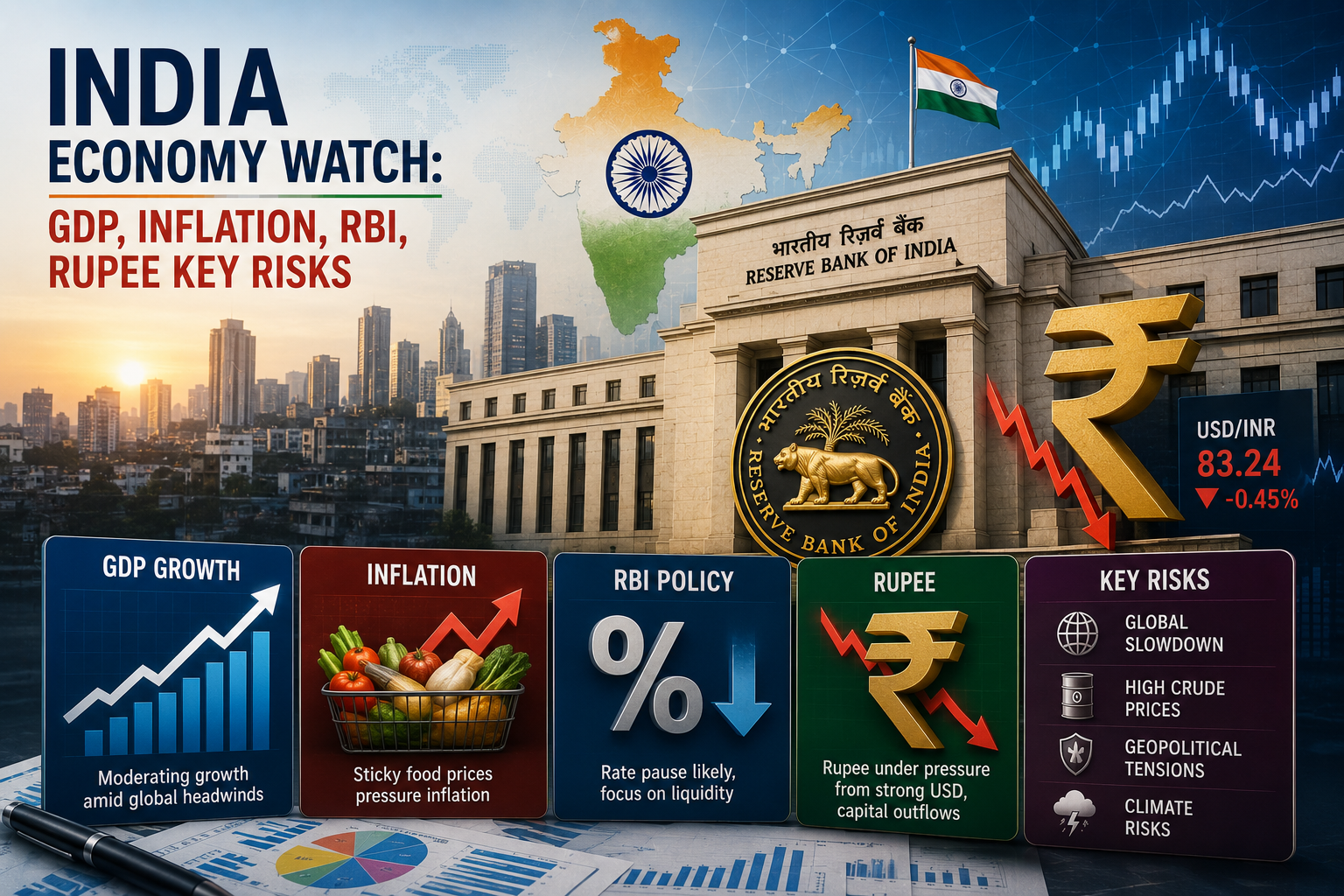
Indian banking is entering a more complex phase of the cycle, with the Reserve Bank of India’s (RBI) liquidity stance, pressure on net interest margins (NIMs), and rising competition for deposits all converging just as credit demand remains robust. Over the past day, markets have focused on the large private lenders—HDFC Bank, ICICI Bank, Axis Bank—and State Bank of India (SBI), as investors reassess earnings resilience, capital buffers and asset quality at a time when system liquidity is tight and policy uncertainty elevated. Banking and finance stocks again dominated turnover on the NSE and BSE, underlining their central role in the Indian equity story.
Key Highlights
- RBI’s tight but calibrated liquidity stance continues to pressure banking system funding costs and short-term money market rates.
- Large banks like HDFC Bank, ICICI Bank, Axis Bank and SBI remain well capitalised, but NIM compression and deposit competition are eroding profitability buffers.
- Credit growth stays in mid-teens, driven by retail and SME, while early signs of stress are visible in select unsecured and NBFC-linked segments.
- PSU banks lag private peers on valuation despite improved asset quality and capitalisation, with SBI remaining the bellwether.
- Bank-heavy indices like NIFTY Bank and financials-linked weights in NIFTY 50 and SENSEX keep sector performance tightly linked to broad market direction.
RBI Stance and System Liquidity: Implications for Banks
The central driver of banking sector sentiment remains the RBI’s monetary and liquidity framework. With policy rates held at restrictive levels relative to pre-pandemic averages and liquidity operations finely tuned to avoid either surplus-driven exuberance or stress, banks are navigating a regime of higher structural funding costs. This has pushed up yields on short-tenor government securities and money market instruments, feeding directly into the marginal cost of funds for the system. For institutional investors, the key question is how long the RBI maintains a tight corridor as it balances inflation risks with the need to support growth and credit transmission.
System liquidity has oscillated between mild deficit and neutral conditions, reinforcing the bargaining power of depositors. Banks that historically relied on low-cost CASA (current and savings accounts) are now being forced to offer higher term deposit rates to retain and attract retail money, particularly in urban and affluent segments where competition from debt mutual funds and alternative fixed-income products is intense. For the large private banks, this has meant an acceleration in term deposit mobilisation and a slower-than-desired recovery in CASA ratios, with direct consequences for NIMs over the last few quarters.
RBI’s continued emphasis on financial stability, including close monitoring of unsecured retail credit, co-lending structures and NBFC-bank linkages, has created a more cautious tone in certain product categories. While not overtly restrictive, guidance from the regulator has encouraged banks to reprice risk, tighten underwriting standards in the most aggressive unsecured sub-segments, and hold additional capital or provisions where warranted. This prudence is being welcomed by long-term investors, but it also moderates near-term loan growth in the highest-yielding parts of the book.
Large Banks’ Performance, Valuations and Asset Quality
On the equity markets, banking remains the core cyclical expression of India’s growth and financialisation story. NIFTY Bank and financial services stocks continue to carry substantial weight in both the NIFTY 50 and the SENSEX, meaning that performance of names like HDFC Bank, ICICI Bank, Axis Bank, Kotak Mahindra Bank, and SBI drives a disproportionate share of index-level moves. Recent trading sessions have seen mixed performance: investors are rewarding banks with superior deposit franchises, stable NIM guidance, and diversified fee income, while remaining wary of those facing sharper-than-expected margin compression.
Among the large private lenders, HDFC Bank remains under close scrutiny. Following its merger with HDFC Ltd, the market has been focused on the integration of the combined balance sheet, the trajectory of cost of funds given the housing finance-heavy asset mix, and the pace at which the bank can rebuild its historical NIM premium. While credit growth remains healthy across retail and wholesale segments, higher funding costs and the need to maintain strong liquidity coverage ratios have limited upside to near-term ROE expectations. Investors looking to participate in this evolving banking landscape can open demat account through SEBI-registered brokers to access these banking sector opportunities.
ICICI Bank and Axis Bank, in contrast, have benefited from a perception of relatively more stable margin profiles and successful execution on corporate and SME lending strategies. Their asset quality continues to show improvement versus the pre-clean-up cycle, with gross and net NPA ratios at multi-year lows, backed by high provision coverage. That said, the market is increasingly sensitive to even small upticks in slippage ratios, especially in unsecured and SME portfolios, given the late-cycle nature of the current credit expansion.
SBI remains the bellwether for public sector banking. Its advances growth, especially in retail and corporate segments, and its ability to sustain a high share of low-cost deposits across a large and granular franchise, are critical to investor confidence in the PSU complex. The bank’s subsidiaries in life, general insurance and asset management add to its sum-of-the-parts narrative, but investors remain mindful of the structural constraints of public ownership, including potential policy-led mandates and slower decision-making. Nonetheless, SBI’s improved asset quality metrics and robust capital ratios have underpinned a rerating of PSU banking valuations compared to the deep discounts seen during the previous NPA cycle.
Comparative Positioning: Private vs PSU, Large vs Mid-sized
| Category | Key Characteristics | Market Position |
|---|---|---|
| Private Banks | Superior ROA/ROE, better technology adoption, agile product innovation and risk management | Command higher valuations (HDFC Bank, ICICI Bank, Axis Bank, Kotak Mahindra Bank) |
| PSU Banks | Meaningful clean-up of legacy NPAs and recapitalisation, led by SBI, Bank of Baroda, Canara Bank | Trade at lower price-to-book multiples due to governance concerns |
| Large Banks | Economies of scale in technology, risk management, diversified fee income | Beta exposure to India’s growth with relatively lower idiosyncratic risk |
| Mid-sized Banks | Higher deposit rates to gain market share, more regional/segment-specific risks | Can provide alpha but require tighter monitoring of asset quality |
Deposit franchises are increasingly differentiated: leading private banks and SBI maintain strong granular deposit bases, while mid-sized PSU and regional lenders must pay higher rates to compete. This development presents new considerations for stock investment strategies focused on Indian equities, particularly in the financial services sector.
Retail and SME credit continue to drive system-level loan growth, particularly in home loans, vehicle finance, unsecured personal loans and business loans. Corporate credit demand has re-accelerated in pockets, supported by capex in infrastructure, manufacturing and energy, but remains more moderate than the pre-2013 boom, which investors generally see as healthier and more sustainable. Unsecured retail and co-lending exposures are receiving heightened attention from both RBI and analysts, with any signs of increasing delinquencies likely to drive swift reassessment of risk premia in affected lenders.
Market Outlook
Looking ahead, the interplay between RBI policy, system liquidity and bank-specific strategies will remain the dominant driver of sector performance. If inflation data allow the central bank to adopt a more accommodative bias over the next few quarters, a gradual easing in funding costs could support NIMs and valuations, especially for deposit-franchise leaders. Conversely, any persistence of tight liquidity or renewed inflationary pressures could prolong the margin squeeze and reinforce the dispersion between strong and weak franchises.
Key monitorables for investors include the trajectory of deposit growth and CASA ratios; early delinquency indicators in unsecured retail, SME and NBFC-linked portfolios; and the pace of corporate capex translating into working capital and project loan demand. Regulatory developments around digital lending, co-lending, data and consumer protection will also shape competitive dynamics between banks, NBFCs and fintech players. Retail participation has grown significantly as access to a reliable trading platform has become more widespread, making banking stocks central to both directional and sector-rotation strategies.
Conclusion
Indian banking is transitioning from a straightforward post-clean-up recovery trade to a more nuanced late-cycle credit and margin story. The sector’s fundamentals remain structurally strong—capital adequacy is robust, asset quality is materially better than in the previous decade, and the long runway for financial deepening in the economy is intact. However, tighter liquidity, intense competition for deposits, and regulatory vigilance on higher-risk products are compressing profitability cushions and increasing the premium on execution.
For institutional investors, this is a stock-picker’s market within a structurally attractive sector: the dispersion between leaders and laggards on deposit franchise strength, risk management and technology adoption is likely to widen, and careful differentiation across RBI policy scenarios, bank size, and business models will be essential to capturing the next leg of returns from Indian banking.
Leave a Reply