findocblog

Blog

  • Gold Rate Today, 15 September 2026: Steady Before Fed Decision

    Gold Rate Today, 15 September 2026: Steady Before Fed Decision

    Gold rates in India barely moved on Tuesday, 15 September 2026, with MCX gold futures at ₹1,51,304 per 10 grams. The bigger event is Wednesday’s US Federal Reserve decision, where a rate hike is widely expected.

    Where Indian Gold Rates Stand Today

    On the Multi Commodity Exchange (MCX), India’s main commodity exchange, gold futures traded at ₹1,51,304 per 10 grams, up about 0.05%. Silver futures were around ₹2,32,750 per kg, up roughly 0.03%.

    Retail rates, the kind a jeweller quotes at the counter, sat higher. Depending on which rate provider you check, 24 carat gold was quoted between ₹1,53,170 and ₹1,54,240 per 10 grams on Tuesday.

    22 carat gold, the purity used for most Indian jewellery, ranged from ₹1,40,400 to ₹1,41,400 per 10 grams. Retail silver was quoted at roughly ₹2,44,900 per kg.

    Item Rate on 15 September 2026 Note
    MCX gold futures ₹1,51,304 per 10 g Up about 0.05%
    Domestic spot gold About ₹1,51,549 per 10 g Latest reported session
    Retail 24 carat gold ₹1,53,170 to ₹1,54,240 per 10 g Varies by data provider
    Retail 22 carat gold ₹1,40,400 to ₹1,41,400 per 10 g Varies by data provider
    Retail 18 carat gold About ₹1,14,880 per 10 g Most cities
    MCX silver futures About ₹2,32,750 per kg Up about 0.03%
    Retail silver About ₹2,44,900 per kg Broadly unchanged

    Rates are indicative and exclude GST, making charges and other jeweller costs.

    Why Every Website Shows You a Different Gold Rate

    If you checked three gold rate pages this morning, you almost certainly saw three different numbers. That is normal, and it is worth understanding before you walk into a showroom.

    MCX gold is a futures contract. It is a standardised exchange traded product that settles in cash, so it carries no making charge and no retail margin.

    Retail “gold rate today” figures come from private data aggregators that poll bullion dealers and jewellers city by city. Different aggregators poll different dealers at different times, which is why today’s 24 carat quotes sit inside a band of about ₹1,070.

    Neither figure is your final bill. On physical jewellery you also pay 3% GST plus making charges, which vary by design and are often negotiable.

    The direction of the move is also disputed today. Some providers showed Delhi’s 24 carat rate down about ₹490 from the previous reading, while others recorded a small gain. Given how narrow the moves are and how wide the gap between providers is, the fair reading for 15 September 2026 is that Indian gold was close to flat.

    The Fed Meeting Is Wednesday’s Real Trigger

    The US Federal Open Market Committee (FOMC), the body that sets American interest rates, began a two-day meeting on Tuesday, 15 September 2026. The decision is due on Wednesday, 16 September at 2:00 PM ET, which is about 11:30 PM IST.

    The current US policy rate range is 3.50% to 3.75%. Markets are now pricing in roughly a 90% probability of a 25 basis point increase, up sharply from about one in three a month ago.

    This matters for gold because bullion pays no interest. When rates go up, interest-bearing assets such as bonds look relatively more attractive, and gold usually comes under pressure.

    The repricing followed last week’s US inflation data. Annual American consumer inflation held at 3.4% in August, and core inflation came in above what economists had forecast.

    Oil Supply Shock Is Pulling Gold the Other Way

    Working against that is a real geopolitical shock. Saudi Arabia shut its East-West crude pipeline after drone attacks, removing a route that lets oil bypass the Strait of Hormuz.

    Brent crude pushed above $108 a barrel intraday on Monday before settling 1.5% higher at $106.23, roughly ₹10,200 a barrel at a rupee near 95.8 to the dollar.

    For gold, expensive oil cuts both ways. Middle East tension supports safe haven buying, but costlier energy feeds inflation fears, which strengthens the case for higher rates.

    So far the rate argument has won. Spot gold settled 1.2% lower at $4,298.80 an ounce on Monday, its weakest level in more than a month and a third straight weekly decline. On Tuesday it held near $4,300, with Comex futures around $4,341.50, down about 0.24% in early trade. A firmer dollar, with the dollar index at 99.60, added to the drag.

    What to Watch Over the Next Two Sessions

    The Fed statement and the accompanying rate projections on Wednesday night IST are the single biggest variable for gold this week. Because a hike is already largely priced in, the tone of the commentary may move prices more than the decision itself.

    Crude oil is the second thing to track. If the Saudi pipeline stays offline and Brent holds above $100, inflation worries are unlikely to fade quickly.

    For buyers, the festive and wedding season is approaching, which usually supports physical demand in India even when international prices soften. If you are buying jewellery, confirm the BIS hallmark and the six digit HUID code, and ask for the making charge in writing before paying.

    Investors who would rather not store metal can look at gold ETFs, which track bullion prices and are held in a demat account instead of a locker. Gold ETFs and MCX gold and silver contracts can be tracked live through an online trading platform during market hours.

    Investments in securities and commodity markets are subject to market risks. This article is for information only and is not investment advice.


    Check Gold Stocks
    Goldiam International Share Price KDDL Share Price
    Titan Company Share Price Kalyan Jewellers Share Price
    Senco Gold Limited Thangamayil Jeweller Share Price
    D.P. Abhushan Share Price Radhika Jeweltech Share Price
    Muthoot Finance Share Price Manappuram Finance Share Price
  • Nifty IT Jumps 5% as Global AI Leaders Call for Slowdown

    Nifty IT Jumps 5% as Global AI Leaders Call for Slowdown

    Nifty IT surged nearly 5% on 15 September 2026 after Anthropic’s Dario Amodei, OpenAI’s Sam Altman and Elon Musk called for slower AI development. The rally eased fears that faster AI progress would disrupt Indian IT services companies.

    What Sparked the Nifty IT Rally

    On 12 September 2026, Anthropic CEO Dario Amodei published an essay urging AI companies to deliberately slow the pace at which they improve frontier AI models, arguing that safety work was not keeping up with capability gains.

    His plan had three parts:

    • Independent, employee-like evaluators placed inside AI labs to check safety commitments
    • Common safety standards adopted across AI companies in democratic countries
    • Eventual international coordination, including with China, to limit the riskiest AI capabilities

    OpenAI CEO Sam Altman and Tesla and xAI’s Elon Musk both backed the idea within hours. Altman said the topic had already been under discussion inside OpenAI and that the company would offer similar outside access to evaluators.

    Indian IT stocks had fallen sharply through 2026 on worries that fast-moving AI tools could replace traditional software services work. The slowdown call flipped that narrative on Tuesday, even as the US Nasdaq index had closed lower overnight on AI-related selling.

    Nifty IT Index and Stock-Wise Gains

    The Nifty IT index rallied 5.06% to touch an intraday high of 30,386, with every constituent trading higher. Nifty IT stocks together added over ₹1.2 lakh crore in market capitalisation during the early session alone.

    Company Change Price
    HCL Technologies +6.79% ₹1,288
    Mphasis +7.02% ₹2,456
    Tech Mahindra +5.5% ₹1,625.80
    Infosys +5.61% ₹1,095.90
    TCS +5.34% ₹2,318.30

    LTIMindtree was the session’s biggest gainer, up 6.7%. Persistent Systems and Oracle Financial Services Software also traded higher, while Coforge was the only Nifty IT stock trading lower.

    Why a Slower AI Pace Helps Indian IT

    Indian IT firms earn a large share of revenue from cloud, testing and software maintenance work for global clients. If frontier AI models advance too fast, this kind of work risks getting automated before companies can adapt, which has been the market’s biggest worry this year.

    Domestic brokerage Choice Institutional Equities said a more measured AI development cycle gives enterprises more visibility on technology choices, and could encourage clients who had paused AI and digital spending to resume it. It sees this as a mild positive for Indian IT, particularly in AI implementation, cloud transformation, governance and cybersecurity work.

    Ravi Singh, Chief Research Officer at Master Capital Services, described the move as a possible near-term relief rally rather than a lasting turnaround, adding that AI-led disruption still remains a key long-term risk for traditional IT companies.

    Kranthi Bathini of WealthMills Securities and Ponmudi R of Enrich Money both pointed to investors rotating out of global technology stocks and into established, traditional Indian IT names after the worldwide AI-linked sell-off.

    Trump Pushes Back on the AI Slowdown Call

    Not everyone agrees with pacing AI development. US President Donald Trump, speaking during a visit to Ireland, opposed the idea, arguing that the United States needs to keep advancing AI to stay ahead of rivals such as China.

    What This Means for Investors

    Tuesday’s bounce looks sentiment-driven after a rough year for the sector Indian IT stocks are still down about 21% on a year-to-date basis. The US Federal Reserve’s policy decision on 16 September is the next big trigger that could sway how these stocks trade this week.

    To actually buy or hold shares of companies like TCS, Infosys or HCL Technologies, investors need an active demat and trading account, since that is what settles and holds the shares. A dependable online trading platform also helps track live price moves in Nifty IT stocks through the day rather than relying only on end-of-day news.

    Investments in the securities market are subject to market risks. This article is for informational purposes only and is not investment advice.

    Explore More Trending Stocks
    Adani Enterprises Share Price TVS Motor Company Share Price
    Yes Bank Share Price HDFC Bank Share Price
    Hindustan Unilever Share Price Kotak Mahindra Bank Share Price
    State Bank Of India Share Price ONGC Share Price
    Tata Motors Share Price Tata Steel Share Price
  • Pranav Constructions Debuts at 33% Premium on NSE

    Pranav Constructions Debuts at 33% Premium on NSE

    Pranav Constructions shares listed at ₹165 on the NSE on 15 September 2026, a 33.06% premium over the ₹124 issue price. The stock then gave up most of that gain within the first hour of trade as early investors booked profits.

    How the Listing Day Played Out

    The Mumbai-based redevelopment company opened at ₹165 on the NSE and at ₹162 on the BSE, a premium of 30.65% on the BSE side. Both prices were measured against the final issue price of ₹124 per share.

    An investor who received one lot of 120 shares was sitting on a notional gain of about ₹4,920 at the NSE opening price. That is calculated as (₹165 minus ₹124) multiplied by 120 shares.

    The gain did not hold. The stock touched a high of ₹165.10 on the NSE and then fell to ₹133.80. On the BSE it moved between ₹164.50 and ₹129.60, and was quoting at ₹136.45 around 10:22 AM IST, up 9.52% over the issue price.

    Listing Day Snapshot NSE BSE
    Issue price ₹124 ₹124
    Listing price ₹165 ₹162
    Listing premium 33.06% 30.65%
    Intraday high ₹165.10 ₹164.50
    Intraday low ₹133.80 ₹129.60

    Prices as reported from exchange data on the morning of 15 September 2026. Intraday levels change through the session.

    The Grey Market Had Signalled a Bigger Pop

    Ahead of the debut, Pranav Constructions IPO was commanding a grey market premium of ₹53 to ₹55 per share. That pointed to a listing somewhere in the 43% to 45% range.

    Grey market premium, or GMP, is the unofficial price at which unlisted shares change hands before listing. It is not published by the NSE or BSE, it is not regulated, and it frequently misses the actual opening price.

    This listing is a clean example of that gap. The actual premium came in at 33.06%, several percentage points below what the grey market was indicating a day earlier.

    Inside the 121 Times Subscription

    The ₹351.03 crore issue was subscribed 121 times overall on the net offer when bidding closed on 9 September 2026. Investors placed bids for 2,71,80,46,080 shares against 2,24,63,137 shares available in the net offer.

    Institutional money drove the book. Qualified institutional buyers bid 267.81 times their reserved portion, while the two non-institutional buckets came in at 243.41 times and 170.83 times.

    Investor Category Times Subscribed
    Qualified institutional buyers (excluding anchors) 267.81
    Non-institutional, above ₹10 lakh 243.41
    Non-institutional, ₹2 lakh to ₹10 lakh 170.83
    Retail individual investors 45.47

    Source: Basis of Allotment advertisement issued by the company, dated 11 September 2026.

    In rupee terms the book attracted bids worth roughly ₹33,872 crore against an issue of ₹351.03 crore. Close to 79.57% of the final demand came in at ₹124, the top of the ₹118 to ₹124 price band, with another 20.26% placed at cut-off.

    How Thin the Retail Odds Were

    Retail investors were allotted 1,27,38,817 shares spread across 1,06,156 successful applicants. In the base retail category of one lot, the allotment ratio worked out to 116 applicants for every 4,503, which is roughly one in every 39 applications.

    Institutions faced no such lottery. Qualified institutional buyers received 45,29,357 shares across just 140 successful applicants, allotted on a proportionate basis.

    The company had also raised ₹84.24 crore on 4 September 2026 by allotting 67,94,034 shares to 14 anchor investors at ₹124 each. Allotment was finalised on 10 September 2026 and shares were credited to the demat account of successful applicants before the 15 September listing.

    What Pranav Constructions Actually Does

    Pranav Constructions is a pure-play redevelopment developer operating under the PCPL brand, focused on the Municipal Corporation of Greater Mumbai region and predominantly on the Western Suburbs.

    Redevelopment means taking over an ageing housing society building, demolishing it, rehousing the existing members in a new structure, and selling the additional units the extra construction rights allow. The developer’s profit sits in those free-sale units.

    As of 31 March 2026, the company had 65 redevelopment projects in its portfolio. That covered 28 completed projects, 20 under construction and 17 upcoming ones, across economical, mid and mass, and aspirational housing segments.

    Brokerage firm Antique, in a note carried ahead of the listing, pointed to an average project construction cycle of about 26 months and described the model as asset-light, while flagging that the concentration in one municipal region remains a live risk.

    FY26 Financials and Valuation at the Issue Price

    The company reported growth in both the top line and the bottom line for the financial year ended 31 March 2026.

    Metric FY26 FY25
    Revenue from operations ₹761.60 crore ₹636.27 crore
    Total income ₹763.93 crore ₹638.24 crore
    Profit after tax ₹71.32 crore ₹62.25 crore
    EBITDA ₹130.83 crore ₹98.54 crore
    Total borrowings ₹258.44 crore ₹196.50 crore

    Figures from the company’s prospectus dated 9 September 2026 and post-listing disclosures on 15 September 2026.

    Net worth stood at ₹246.70 crore and total assets at ₹1,799.19 crore as on 31 March 2026. Basic and diluted earnings per share were ₹8.18, net asset value per share was ₹28.30, and return on net worth for FY26 was 33.78%.

    On valuation, the prospectus put the price to earnings ratio at the upper band of ₹124 at 15.16 times, against an industry peer group average of 113.46 times. The P/E ratio simply divides the share price by earnings per share, and shows how much investors are paying for every ₹1 of profit.

    Applying the same FY26 EPS of ₹8.18 to the NSE listing price of ₹165 works out to about 20.2 times. At the ₹136.45 level seen shortly after listing, it works out to roughly 16.7 times. These are simple calculations on last year’s earnings, not forecasts.

    Where the Fresh Issue Money Goes

    Of the ₹351.03 crore raised, the fresh issue of 2,54,51,612 shares accounts for ₹315.60 crore and goes to the company. The offer for sale of 28,56,869 shares worth ₹35.43 crore went to the selling shareholder, BioUrja India Infra, not into the business.

    The company has earmarked the fresh issue proceeds for funding redevelopment expenses on certain under construction and upcoming projects. This covers government and statutory approvals, the purchase of additional floor space index, and compensation paid to society members for alternate accommodation and hardship.

    Floor space index, or FSI, is the limit on how much floor area can be built on a plot. Buying extra FSI lets a developer construct more saleable area on the same land.

    The balance is set aside for repayment or prepayment of certain borrowings, and for acquiring future redevelopment projects and general corporate purposes. Promoter holding falls from 63.35% before the issue to 49.03% after it.

    Risks Disclosed in the Prospectus

    The offer document lists several risks that continue to apply now that the stock is listed.

    • Revenue from operations is heavily concentrated, with the MCGM region contributing 99.70% in FY26, 99.69% in FY25 and 99.50% in FY24.
    • Operating cash flow was negative in both of the last two years, at an outflow of ₹41.19 crore in FY26 and ₹92.60 crore in FY25.
    • Total borrowings have risen from ₹99.34 crore in FY24 to ₹258.44 crore in FY26.
    • Supplier and contractor dependence is high, with the top 10 suppliers accounting for 61.78% of material costs and the top 10 contractors for 47.10% of contractor payments in FY26.
    • Delays in redevelopment projects can trigger RERA penalties and extended displacement compensation payable to society members.
    • Redevelopment agreements with co-operative housing societies carry the risk of irregularities in land title or land use.

    What to Watch From Here

    The first thing to follow is whether the price settles above or below the ₹124 issue price once listing day volatility passes. Anyone tracking that movement in real time will need an online trading platform with live NSE and BSE quotes.

    Beyond price, the operational markers matter more over the next few quarters. Those include the pace of conversion from the 17 upcoming projects into construction, approval timelines with the MCGM, the direction of the borrowing figure, and whether operating cash flow turns positive.

    The first quarterly results as a listed company, for the quarter ending September 2026, will be the next real checkpoint on whether the FY26 growth rate is holding up.

    Investments in securities are subject to market risks. This article is for information only and is not investment advice.

  • NSE IPO to Open September 17 at ₹1,700–₹1,785: What Investors Should Know Before Applying

    NSE IPO to Open September 17 at ₹1,700–₹1,785: What Investors Should Know Before Applying

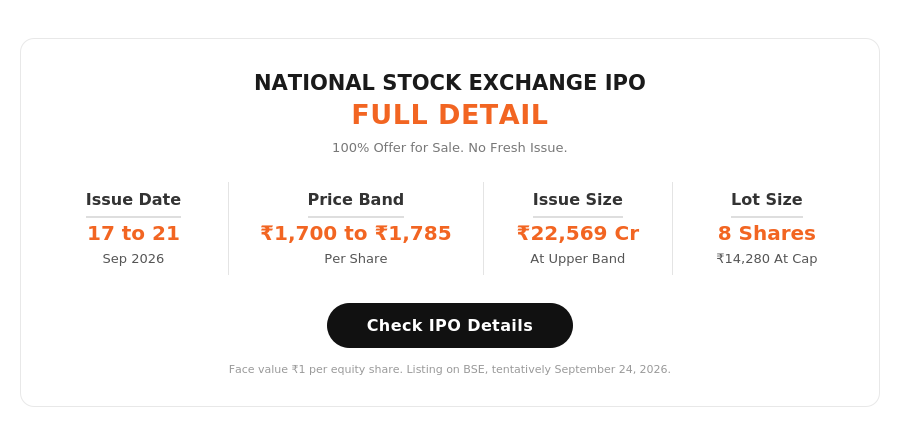
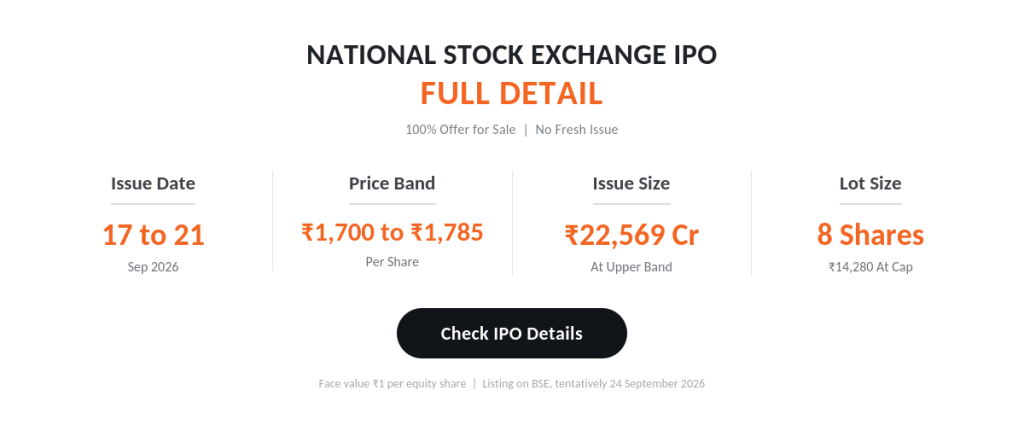
    The NSE IPO opens on Thursday, September 17 and closes on Monday, September 21, with a price band of ₹1,700 to ₹1,785 per share. The offer was cut by about 15% after the draft stage and now raises up to ₹22,569 crore.

    Key Takeaways

    • The NSE IPO price band is ₹1,700 to ₹1,785 per share, on a face value of ₹1.
    • Bidding runs from September 17 to September 21, with listing on BSE tentatively on September 24.
    • The offer shrank from 6.02% of the company in the draft prospectus to about 5.11% in the final one.
    • At the cap, NSE is valued near ₹4.42 lakh crore, or 42.9 times FY26 earnings, against 66.67 times recorded for BSE.
    • Retail investors need a minimum of 8 shares, costing ₹14,280 at the upper end.

    NSE IPO Price Band, Dates and Lot Size

    NSE filed its red herring prospectus with SEBI on September 10, 2026, fixing the terms of the issue. The band spans exactly 5%, the usual width for a book build of this size.

    The entire issue is an offer for sale by existing shareholders, so NSE receives none of the proceeds. Ashishkumar Chauhan is the managing director and chief executive officer.

    NSE IPO DetailParticulars
    Price band₹1,700 to ₹1,785 per share
    Issue opensThursday, September 17, 2026
    Issue closesMonday, September 21, 2026
    Basis of allotmentTuesday, September 22, 2026
    Shares credited and refundsWednesday, September 23, 2026
    Tentative listingThursday, September 24, 2026, on BSE
    Minimum lot8 shares, and multiples of 8 thereafter
    Retail minimum at the cap₹14,280
    Offer typeOffer for sale only, no fresh issue
    RegistrarMUFG Intime India Private Limited

    Offer terms as per the NSE red herring prospectus dated September 10, 2026. Listing dates are tentative.

    What Changed Between the Draft and the Final Prospectus?

    The most significant development is one the headlines mostly skip. NSE trimmed the size of the offer between its draft prospectus of June 17 and the final one of September 10.

    The draft proposed selling up to 14,89,05,525 shares, or 6.02% of the company. The final version offers up to roughly 12.64 crore shares, about 5.11%. That is close to 2.25 crore fewer shares, a reduction of around 15%.

    Offer SizeDraft Prospectus, June 17Red Herring Prospectus, September 10
    Shares offeredUp to 14,89,05,525Up to about 12.64 crore
    Stake on offer6.02%About 5.11%
    National Insurance CompanySelling 60,00,000 sharesNo longer selling
    SBI Capital MarketsNot a selling shareholderAdded, offering about 87.8 lakh shares

    Comparison of the June 17 draft prospectus with the September 10 red herring prospectus.

    State Bank of India, MS Strategic (Mauritius), Bank of Baroda, Stock Holding Corporation of India and General Insurance Corporation of India each reduced the number of shares they intend to sell.

    Canada Pension Plan Investment Board, Aranda Investments (Mauritius), The New India Assurance Company and United India Insurance Company left their portions unchanged.

    How Much Is NSE Worth at This Price Band?

    Applying the band to the full share count of 2,47,50,00,000 shares gives the implied market value of the exchange. Applying it to the shares on offer gives the size of the issue.

    At the Offer PriceFloor, ₹1,700Cap, ₹1,785
    Implied market capitalisation₹4,20,750 crore₹4,41,788 crore
    Size of the offer for saleAbout ₹21,494 croreAbout ₹22,569 crore
    Price to FY26 earnings40.8 times42.9 times
    Price to book value13.1 times13.8 times
    Yield on the FY26 dividend2.06%1.96%

    Multiples computed on FY26 basic and diluted EPS of ₹41.62, book value per share of ₹129.75 and the recommended FY26 dividend of ₹35 per share, as disclosed in the prospectus.

    How Does the NSE IPO Price Compare With BSE?

    The prospectus names BSE Limited as the only listed peer, since it runs a comparable multi-asset exchange with a similar revenue mix.

    It records BSE trading at 66.67 times FY26 diluted earnings, based on a closing price in June 2026. At the cap of ₹1,785, the NSE IPO is priced at 42.9 times the same year’s earnings.

    The comparison needs care. NSE earns roughly 3.4 times BSE’s operating revenue, but BSE reported the higher FY26 EPS at ₹60.61, a higher return on net worth at 45% against 33.21%, and a higher net asset value per share. The BSE multiple also moves with its market price, so check the live figure rather than the June reference.

    What Do the FY26 Numbers Behind the Price Show?

    NSE reported total income of ₹18,713 crore in FY26 and profit after tax of ₹10,302 crore, down 15.47% from ₹12,188 crore the year before. Operating revenue slipped 3.15% to ₹16,601 crore.

    Two things drove the fall. Trading volumes moderated after SEBI’s derivatives measures of October 2024 and May 2025, and the exchange took a one-time provision of ₹1,391.21 crore against settlement applications filed with SEBI.

    Strip out the one-offs and the picture shifts. Normalised operating EBITDA margin moved only from 77.69% to 76.23%, while the reported margin fell from 73.78% to 66.85%. Anyone valuing the issue on trailing earnings is working from a year carrying a large exceptional charge.

    How Is the NSE IPO Split Between Investor Categories?

    • Qualified institutional buyers: 50% of the net offer.
    • Non-institutional investors: 15%, with a minimum application of 120 shares, or ₹2,14,200 at the cap.
    • Retail individual investors: 35%, with a minimum of 8 shares at ₹14,280 at the cap.
    • Eligible employees: a reserved portion of up to 4,33,436 shares, aggregating up to ₹70 crore, with a discount of ₹170 per share.

    The employee discount brings the effective price for staff to ₹1,615 a share at the upper end of the band.

    What Should Investors Check Before Applying?

    The prospectus is candid about concentration. Transaction charges were 78.65% of operating revenue in FY26 and equity options alone contributed 60.22%, so a change in derivatives rules moves most of the business at once.

    The colocation and dark fibre matters also remain open, with settlement applications of ₹1,491.21 crore pending before SEBI and related appeals pending before the Supreme Court.

    Bidding requires a demat account to hold any shares allotted, and subscription figures, allotment status and the listing can be followed through an online trading platform once the issue opens.

    Investments in securities markets are subject to market risks. This article is for information purposes only and is not investment advice.

  • NSE IPO 2026: DRHP, 6.02% Stake Offer & Key Details

    NSE IPO 2026: DRHP, 6.02% Stake Offer & Key Details

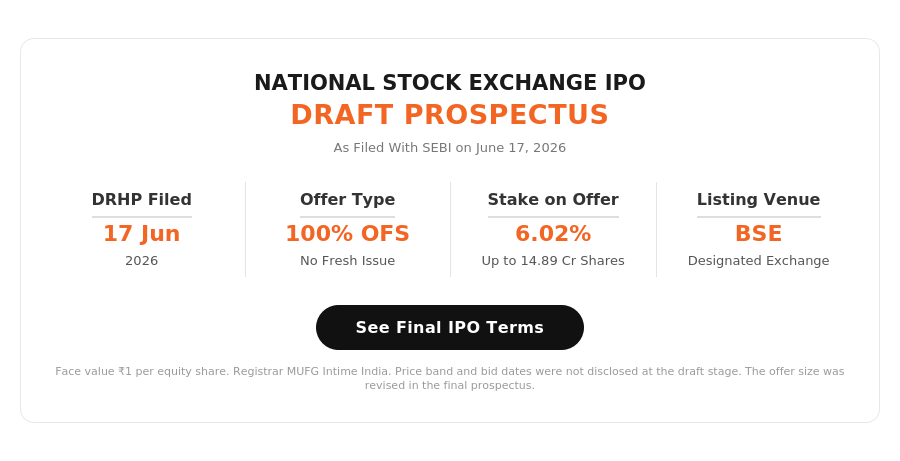
    The NSE IPO moved a step closer as National Stock Exchange of India Limited filed its draft red herring prospectus dated June 17, 2026. Up to 14,89,05,525 shares, roughly 6.02% of its capital, are on offer, with listing proposed on BSE.

    Key Takeaways

    • The NSE IPO is a pure offer for sale of up to 14,89,05,525 shares, about 6.02% of pre-offer capital.
    • NSE itself receives no money from the issue, because there is no fresh issue component.
    • The shares are proposed to be listed on BSE, which is also the designated stock exchange for the offer.
    • Price band, offer size in rupees and bid dates are all still blank in the draft prospectus.

    What Is the NSE IPO and What Does the DRHP Propose?

    National Stock Exchange of India Limited has filed a draft red herring prospectus, or DRHP, for a 100% book-built offer. A DRHP is the draft disclosure document an unlisted company files before an IPO, carrying every material fact except the final price.

    The NSE IPO is for up to 14,89,05,525 equity shares of face value ₹1 each. Against a pre-offer capital of 2,47,50,00,000 shares, that works out to roughly 6.02% of the company.

    The total offer value, price band and minimum bid lot are all left blank in the draft. They will be decided by the company in consultation with the lead managers and advertised in English, Hindi and Marathi newspapers at least two working days before bidding opens.

    NSE IPO DetailAs Stated in the DRHP
    Document typeDraft Red Herring Prospectus, 100% book built
    Date of the draftJune 17, 2026
    Offer typeOffer for sale only, no fresh issue
    Shares offeredUp to 14,89,05,525 equity shares, face value ₹1
    Share of pre-offer capitalApproximately 6.02%
    Pre-offer share capital2,47,50,00,000 shares
    Total offer valueNot yet disclosed
    Proposed listing venueBSE Limited, also the designated stock exchange
    PromoterNo identifiable promoter
    Registrar to the offerMUFG Intime India Private Limited
    Employee quotaReservation for eligible employees, size not yet disclosed

    NSE IPO offer snapshot. Source: NSE Draft Red Herring Prospectus dated June 17, 2026.

    Is the NSE IPO a Fresh Issue or an Offer for Sale?

    The NSE IPO is entirely an offer for sale. There is no fresh issue component at all.

    In an offer for sale, existing shareholders sell their own shares and keep the proceeds. The company itself receives none of the money.

    The prospectus states the objects plainly: to carry out the offer for sale, and to achieve the benefits of listing on BSE. Proceeds go to each selling shareholder after deducting their share of offer expenses and taxes.

    The practical meaning for a reader is that this IPO does not fund any expansion plan. It is a liquidity event for shareholders who have held unlisted stock for years, and a route to a public market price for the exchange.

    Who Are the Selling Shareholders in the NSE IPO?

    The prospectus lists the ten largest selling shareholders on its cover, along with the weighted average cost of acquisition. That is the average price each one originally paid per share, adjusted for later corporate actions such as the bonus issue.

    The spread is striking. State Bank of India’s average cost works out to ₹0.80 a share, while Canada Pension Plan Investment Board’s is ₹324.13.

    Selling ShareholderShares Offered (up to)Avg. Cost per Share (₹)
    State Bank of India2,47,50,0000.80
    MS Strategic (Mauritius) Limited1,60,00,00066.54
    Canada Pension Plan Investment Board1,18,74,060324.13
    Aranda Investments (Mauritius) Pte Ltd1,12,46,33662.38
    Bank of Baroda1,09,86,2500.54
    Stock Holding Corporation of India Limited1,08,90,0000.46
    General Insurance Corporation of India1,06,58,0005.26
    The New India Assurance Company Ltd.1,05,00,0000.32
    National Insurance Company Limited60,00,0000.32
    United India Insurance Company Limited60,00,0000.50

    Top ten selling shareholders in the NSE IPO, as disclosed on the DRHP cover. Acquisition costs certified by Manian & Rao, Chartered Accountants, on June 17, 2026. The complete list appears in Annexure A of the prospectus.

    Who Owns NSE Before the IPO?

    The cover page carries a line most prospectuses do not: the company does not have an identifiable promoter. NSE ownership is spread across insurers, banks, global funds and individuals, with no single controlling group.

    Life Insurance Corporation of India is the largest shareholder at 10.72% of pre-offer capital. The twenty shareholders holding 1% or more together account for 52.76%.

    Largest Pre-Offer ShareholdersSharesStake (%)
    Life Insurance Corporation of India26,52,75,00010.72
    Aranda Investments (Mauritius) Pte Ltd11,24,63,3564.54
    Stock Holding Corporation of India Limited11,00,00,0004.44
    SBI Capital Markets Limited10,72,50,0004.33
    Mahagony Limited9,22,95,0003.73
    State Bank of India7,98,47,0503.23
    PI Opportunities Fund I5,82,00,0002.35
    Crown Capital Limited5,13,55,4652.07
    DVI Fund (Mauritius) Limited4,52,16,2151.83
    TIMF Holdings4,32,30,3571.75
    Radhakishan Shivkishan Damani3,90,84,4001.58
    Total of all shareholders above 1%1,30,61,79,55852.76

    NSE shareholding pattern before the IPO, based on the beneficiary position statement of June 15, 2026. The table shows the eleven largest of the twenty shareholders above 1%.

    How Will NSE IPO Shares Be Allotted?

    The NSE IPO follows the standard book-building split under SEBI ICDR Regulations, applied to the net offer, which is the total offer minus the employee reservation.

    • Qualified institutional buyers: not more than 50% of the net offer. Up to 60% of this can go to anchor investors, of which 33.33% is reserved for domestic mutual funds and 6.67% for life insurers and pension funds.
    • Non-institutional bidders: not less than 15%, split one-third for applications of ₹2 lakh to ₹10 lakh and two-thirds for applications above ₹10 lakh.
    • Retail individual bidders: not less than 35% of the net offer.
    • Eligible employees: a separate reserved portion, allotted proportionately.

    Every category except anchor investors must apply through ASBA, where the application money is blocked in the bank account rather than debited. Retail and employee applicants use the UPI route.

    Which Banks Are Managing the NSE IPO?

    The offer is being managed by twenty book running lead managers, an unusually large syndicate. They are Kotak Mahindra Capital, JM Financial, Morgan Stanley India, Citigroup Global Markets India, HSBC Securities and Capital Markets (India), J.P. Morgan India, SBI Capital Markets, Anand Rathi Advisors, Avendus Capital, Axis Capital, DAM Capital Advisors, Equirus Capital, HDFC Bank, ICICI Securities, IDBI Capital Markets & Securities, IIFL Capital Services, Motilal Oswal Investment Advisors, Nuvama Wealth Management, Pantomath Capital Advisors and 360 ONE WAM.

    Three of them, namely Morgan Stanley India, SBI Capital Markets and ICICI Securities, are associates of selling shareholders. Under the SEBI Merchant Bankers Regulations they will be involved only in marketing the offer, not in the wider due diligence role.

    NSE IPO Price Band and Dates: What Is Still Unknown?

    A draft prospectus is exactly that. The price band, the rupee size of the offer, the bid opening and closing dates, the minimum lot and any employee discount all appear as blanks in this document.

    Those numbers are filled in only at the red herring prospectus stage, after SEBI issues its observations on the draft. Until then, no NSE IPO offer size or valuation can be quoted from this filing.

    Anyone planning to bid when the offer opens will need a demat account to hold the allotted shares, and can track the price band announcement and listing through an online trading platform once the dates are notified.

    Investments in securities markets are subject to market risks. This article is for information purposes only and is not investment advice.
  • Silver, Gold Slide Globally and on MCX Ahead of US CPI

    Silver, Gold Slide Globally and on MCX Ahead of US CPI

    Global silver and gold prices fell further on Friday as hot US producer price data lifted the odds of a Federal Reserve rate hike past 70%, with domestic MCX silver futures also slipping ahead of the day’s US inflation report.

    Why Silver and Gold Prices are Falling

    The US Producer Price Index (PPI), which tracks wholesale prices paid by factories and businesses, rose 5.4% year-on-year in August 2026. The data, released on Thursday, 10 September, came in above the roughly 5.3% that economists had expected.

    A hotter-than-expected PPI reading signals that inflation pressure is building up the supply chain. Traders responded by raising bets that the US Federal Reserve, America’s central bank, will raise interest rates by 25 basis points (0.25 percentage points) at its policy meeting next week.

    According to the CME FedWatch tool, which tracks trader expectations for Fed decisions, the probability of a rate hike jumped from about 61% before the PPI data to more than 70% afterwards.

    Rising oil prices added to the pressure. Crude climbed as tensions between the US and Iran escalated, pushing up energy costs that were a key reason behind August’s hot PPI print.

    Gold and silver are non-yielding assets — they pay no interest or dividend. When expectations of higher interest rates rise, holding cash or bonds becomes relatively more attractive, and demand for gold and silver tends to soften.

    How Much Global Prices Have Fallen

    Spot silver tumbled sharply on Thursday, sliding from a session high near $68.50 to a low around $63.87 an ounce a fall of roughly 5% in a single session. Gold fell far less, down close to 1% to around $4,358 an ounce.

    The slide continued into Friday. Silver was trading around $63.30 to $64 an ounce during Asian and early European hours, taking its loss for the week to nearly 4% its third straight weekly decline.

    Silver falling harder than gold is a familiar pattern. Silver is both a precious metal and an industrial one, used in solar panels, electronics and electric vehicles, which makes it more sensitive to shifts in sentiment than gold. This has widened the gap between the two metals’ prices, a gap traders track as the gold-silver ratio.

    MCX and Domestic Prices Also Slip

    The weakness has carried through to India’s commodity market. On the Multi Commodity Exchange (MCX), silver futures for December delivery fell by ₹735, or 0.31%, to ₹2,33,364 per kilogram on Friday, as traders trimmed their positions.

    Domestic gold and silver retail rates in major Indian cities were also lower through the day, tracking the global sell-off, though the exact rupee figure varies by city, purity and the time it is checked.

    Since silver and gold are priced internationally in US dollars, their price in India also depends on the rupee-dollar exchange rate. A weaker rupee can partly offset a global price fall for Indian investors, while a stronger rupee can add to it.

    Retail investors who want exposure to this price move without holding physical metal typically do so through gold or silver exchange-traded funds (ETFs), which trade on stock exchanges like shares. To buy, hold or sell ETF units, an investor needs a demat account, since the units are held electronically rather than as certificates or physical bars.

    Today’s Key Numbers at a Glance

    Metric Level (11 Sept 2026) Change
    Global spot silver ~$63.30–$64.00/oz Down after ~5% slide on 10 Sept
    Global spot gold ~$4,358/oz Down about 1%
    MCX silver futures (Dec) ₹2,33,364/kg Down 0.31%
    US PPI, August (YoY) 5.4% Above 5.3% forecast
    CME FedWatch hike odds Above 70% Up from ~61% pre-PPI

    What Investors are Watching Next

    The US Consumer Price Index (CPI) report for August, due later on Friday, is the last major inflation reading the Fed will see before its meeting next week. Economists broadly expect headline CPI to hold close to 3.4% year-on-year.

    A hotter-than-expected CPI print could reinforce bets on a rate hike and add further pressure on gold and silver. A softer reading could ease some of that pressure and give the metals room to stabilise.

    Given how quickly international and MCX gold and silver rates are moving through the day, investors and traders following this story can track live prices through an online trading platform rather than relying on a single snapshot.

    Investments in securities and commodities are subject to market risks. This article is for informational purposes only and is not investment advice.

    Check Gold Stocks
    Goldiam International Share Price KDDL Share Price
    Titan Company Share Price Kalyan Jewellers Share Price
    Senco Gold Limited Thangamayil Jeweller Share Price
    D.P. Abhushan Share Price Radhika Jeweltech Share Price
    Muthoot Finance Share Price Manappuram Finance Share Price
  • Cochin Shipyard Shares Fall 9% on FY27 Margin Guidance

    Cochin Shipyard Shares Fall 9% on FY27 Margin Guidance

    Cochin Shipyard shares fell as much as 9% on Friday, 11 September 2026, after the company’s FY27 EBITDA margin guidance of around 14% down from 17% in the June quarter disappointed investors during a Thursday analyst call.

    What Triggered the Selloff in Cochin Shipyard Shares

    Shares of the state-owned shipbuilder fell as much as 9.7% intraday on the NSE to a low of around ₹1,372. They pared some of the losses to trade close to 9% lower, in the ₹1,380–₹1,383 range, against Thursday’s closing price of ₹1,520.40.

    The fall came a day after Cochin Shipyard’s management shared its outlook for the 2026-27 financial year (FY27) at an investor call held on Thursday, 10 September 2026.

    Why FY27 Margin Guidance Fell Short

    EBITDA earnings before interest, tax, depreciation and amortisation, a common measure of a company’s core operating profit is expected to settle at around 14% in FY27. That compares with 17% in the June 2026 quarter (Q1 FY27) and 16% for the full year FY26.

    Management said shipbuilding margins are likely to settle at 10-12%, while ship repair margins should stay higher, at 22-24%. Revenue is expected to grow 12% in FY27, with potential to reach 15%.

    The company also flagged that its previously elevated margins had been supported by high-margin nominated orders and interest income on surplus cash both of which are now expected to normalise.

    The FY27 Guidance at a Glance

    Metric FY27 Guidance
    Overall EBITDA margin ~14% (vs 17% in Q1 FY27, 16% in FY26)
    Shipbuilding margin 10-12%
    Ship repair margin 22-24%
    Revenue growth 12%, with potential to reach 15%
    Revenue mix ~70% shipbuilding, ~30% ship repair

    Q1 FY27 Results Already Flashed Warning Signs

    The margin concerns follow a soft first quarter. Cochin Shipyard’s consolidated net profit fell 27.7% year-on-year to ₹135.8 crore in Q1 FY27, from ₹187.9 crore a year earlier.

    Revenue from operations declined 6.9% to ₹910 crore, against ₹977 crore in the same quarter last year. EBITDA dropped 32.5% to ₹157.6 crore, and the EBITDA margin contracted to 17.33% from 23.91%.

    Order Book and New Ventures Offer Some Cushion

    Despite the margin worries, Cochin Shipyard’s unexecuted order book stood at around ₹21,900 crore. This comprised roughly ₹11,900 crore in defence orders, ₹7,200 crore in commercial export orders, ₹1,600 crore in domestic commercial orders, and ₹1,200 crore in ship repair orders.

    The company has been named the lowest bidder, or “L1” the bidder quoting the lowest price in a government tender for five Next Generation Survey Vessels for the Indian Navy, worth an estimated ₹5,000 crore. Its wider defence pipeline, covering four Landing Platform Docks, 12 Mine Counter Measure Vessels and seven P17 Bravo vessels, carries a combined potential value of more than ₹1.17 lakh crore.

    Separately, the board has approved a 50:50 joint venture with Drydocks World Dubai, a DP World company, to house the Kochi International Ship Repair Facility at Willingdon Island. The facility will be transferred to the joint venture for ₹1,800 crore – ₹900 crore in cash and ₹900 crore in equity shares of the JV subject to regulatory approvals, along with plans to add ten new workstations to expand capacity.

    What This Means for Investors

    For retail investors who want to track and act on price swings like Friday’s, holding shares in dematerialised form starts with an active demat account. Pairing that with a reliable trading platform makes it easier to place orders and follow NSE/BSE price moves in real time.

    Investments in the stock market are subject to market risks. This article is for informational purposes only and is not investment advice.

    Check Indices
    BSE BANKEX Companies BSE Largecap Comapnies
    FINNIFTY Companies Nifty Midcap 50 Companies
    NIFTY MIDCAP 150 Companies Nifty Pharma Companies
    BSE 500 Companies Nifty Smallcap 100 Companies
  • SBI-Led Lenders Agree $3.5 Billion Debt Deal for Vodafone Idea

    SBI-Led Lenders Agree $3.5 Billion Debt Deal for Vodafone Idea

    Vodafone Idea has secured an in principle commitment for about $3.5 billion in debt from an SBI led group of lenders, a long awaited breakthrough that could fund the loss making telecom operator’s network catch up with Airtel and Jio.

    What the SBI-Led Consortium Has Agreed To

    State Bank of India is heading a group of lenders that has committed close to $3.5 billion in fresh debt for Vodafone Idea, Bloomberg reported on 10 September 2026, citing unnamed sources with knowledge of the discussions.

    Two other lenders are part of the consortium: Union Bank of India and the National Bank for Financing Infrastructure and Development, better known as NaBFID.

    In rupee terms, the package works out to roughly ₹35,000 crore a figure Vodafone Idea has been chasing for months as it tries to fund a network turnaround.

    This isn’t a sudden development. CNBC-TV18 had flagged as far back as May 2026 that Vodafone Idea was already in discussions with banks, with SBI tipped to head the consortium.

    Component Amount
    Total proposed funding ₹35,000 crore (~$3.5 billion)
    Funded facilities (term loans) ₹25,000 crore
    Non-funded facilities (guarantees, credit lines) ₹10,000 crore
    Already secured (Q1 FY27) ₹6,400 crore

    The Conditions Attached to the Loan

    The money isn’t unconditional. One requirement is that Kumar Mangalam Birla stay on as Vodafone Idea’s chairman for as long as the loan runs close to a decade.

    Lenders have also built in repayment guarantees to cover themselves if Vodafone Idea defaults, according to the same sourcing.

    None of this is locked in yet. Every lender in the consortium still needs its own board’s sign-off, and past coverage of the talks suggested private banks have been warier than public-sector ones about committing. Vodafone Idea and the lenders have stayed quiet publicly, declining to confirm the details.

    How Vodafone Idea Shares Reacted

    Vodafone Idea stock climbed as much as 2% in Friday’s trade, bucking a weak broader market the Sensex was down roughly 1% at the same time.

    Shares were changing hands near ₹15 by late morning, putting Vodafone Idea’s market value at about ₹1.6 trillion. Over the past 12 months, the stock has nearly doubled, up close to 102%.

    For anyone holding Vi in their demat account, or thinking about it, moves like this are easier to track through an online trading platform that shows live price updates as the story develops.

    Why This Funding Matters for Vodafone Idea’s Turnaround

    The fresh capital is earmarked for 4G and 5G upgrades, aimed squarely at closing the network gap with Bharti Airtel and Reliance Jio. Vodafone Idea has already placed ₹9,000 crore worth of equipment orders with Ericsson, Nokia and Samsung toward that 5G build-out.

    The timing follows a genuinely better quarter. For Q1 FY27 (April–June 2026), revenue climbed 6% year-on-year to ₹11,689 crore, and the net loss shrank to ₹3,754 crore from ₹6,608 crore a year prior.

    EBITDA was up 9.1% at ₹5,034 crore. ARPU what each customer contributes on average every month rose to ₹195 from ₹177, and the company gained subscribers on a net basis for the first time since the 2018 Vodafone-Idea merger, ending the quarter with 193.1 million users.

    Network-wise, 5G is now live across more than 200 cities in Vi’s 17 priority circles, with 4G population coverage at 87% as of June. That’s the base the new debt is meant to build on.

    Policy help has factored in too. A cap on past spectrum dues earlier this year, plus a 2025 conversion of roughly ₹37,000 crore of government dues into equity, pushed the Centre’s stake in Vodafone Idea up to 48.99% from 22.6%.

    What Happens Next

    This debt is one piece of a bigger ₹45,000-crore capex programme Vodafone Idea has planned over three years, centred on rolling out 5G across its 17 priority circles.

    CEO Abhijit Kishore said in August that the company was working three separate lender tracks at once public-sector banks under SBI, private banks, and overseas lenders via external commercial borrowings.

    SBI itself had already cleared its portion of the loan internally back in August, subject to the Aditya Birla Group and Vodafone Group standing behind it with promoter guarantees. Friday’s report suggests the rest of the consortium is now falling in line.

    Nothing is final until every board approves its share so for now, the $3.5 billion is a commitment on paper, not cash Vodafone Idea can draw on yet.

    Investments in securities markets are subject to market risks. This article is for informational purposes only and is not investment advice.

    Explore More Trending Stocks
    BSE Share Price Solar Industries Share Price
    Tata Motors Share Price Life Insurance Corporation of India Share Price
    Adani Ports Share Price Tata Capital Share Price
    CG Power Share Price Axis Bank Share Price
    HDFC Bank Share Price ITC Share Price
  • BSE Shares Fall Around 3% After NSE IPO Announces

    BSE Shares Fall Around 3% After NSE IPO Announces

    BSE shares fell over 3% on 11 September 2026 after rival exchange NSE fixed its IPO price band at ₹1,700–1,785 per share. The pricing values NSE at nearly three times BSE’s market capitalisation, sharpening the competitive picture ahead of NSE’s stock market debut.

    What Triggered Today’s Fall in BSE Shares

    Shares of BSE Ltd fell as much as 3.41 per cent to an intraday low of ₹3,193.20 on Friday, 11 September 2026, taking the stock’s one-month decline to roughly 10.4 per cent.

    The trigger was NSE’s Red Herring Prospectus (RHP), which fixed the price band for its long-awaited initial public offering (IPO) at ₹1,700 to ₹1,785 per equity share. NSE is BSE’s much larger rival in India’s stock exchange business, and Friday’s pricing gave the market its first clear read on how NSE is valued relative to BSE.

    NSE IPO: Size, Sellers and Key Dates

    A price band is simply the price range within which investors can bid for shares in an IPO here, anywhere from ₹1,700 to ₹1,785. The final price at which shares are allotted is decided later, based on demand.

    The NSE IPO is entirely an offer for sale (OFS) of up to 12.64 crore equity shares. In an OFS, existing shareholders sell their own stake to the public; the company itself does not raise any fresh capital through the issue. At the upper end of the price band, the issue size works out to roughly ₹22,560 crore.

    State Bank of India (SBI) is the largest selling shareholder, offering up to 1.6 crore shares. Life Insurance Corporation (LIC), which holds a 10.72 per cent stake in NSE, has chosen not to sell any shares in this round.

    Event Date (IST)
    Anchor investor bidding opens 16 September 2026
    IPO opens for public subscription 17 September 2026
    IPO closes 21 September 2026
    Tentative listing on BSE 24 September 2026

    How NSE’s IPO Pricing Compares with BSE

    At the ₹1,785 upper price band, NSE is valued at about 42.88 times its FY26 earnings per share (EPS) of ₹41.62. BSE, by comparison, trades at around 52.68 times its own FY26 EPS of ₹60.61 meaning NSE’s issue is priced at roughly an 18.6 per cent discount to BSE’s own valuation multiple.

    At the cap price, NSE’s overall valuation works out to about ₹4.4 lakh crore (roughly $46 billion) more than three times BSE’s market capitalisation of around ₹1,30,959 crore. Independent market estimates place this among India’s largest-ever share sales, potentially the country’s third-largest IPO to date.

    Metric NSE (at ₹1,785) BSE
    Market capitalisation ~₹4.4 lakh crore ~₹1,30,959 crore
    FY26 EPS ₹41.62 ₹60.61
    P/E multiple (FY26) 42.88x 52.68x

    NSE runs the world’s largest derivatives exchange by number of contracts traded, which is part of why its listing is being watched so closely across Dalal Street.

    What This Means for BSE Investors

    For now, the direct impact has been a sharp one-day fall in BSE’s share price, even though BSE continues to trade at a higher earnings multiple than NSE’s own IPO pricing implies. Once NSE lists, BSE will have a direct listed peer for the first time, which could keep its stock sensitive to every fresh NSE IPO update between now and the 24 September listing.

    Because the NSE IPO is entirely a sale of existing shares, anyone wanting to apply will need an active demat account and a linked trading account to bid, exactly as for any other mainboard IPO. Retail investors can apply for a minimum lot of 8 shares, which works out to roughly ₹14,280 at the upper price band.

    Existing BSE shareholders and prospective NSE investors alike would do well to track both stocks through their broker’s online trading platform in the run-up to listing, since a price band announcement of this scale can move sentiment across the whole exchange space.

    Investments in the securities market are subject to market risks. This article is for informational purposes only and is not investment advice.

    Check Indices
    BSE BANKEX Companies BSE Largecap Comapnies
    FINNIFTY Companies Nifty Midcap 50 Companies
    NIFTY MIDCAP 150 Companies Nifty Pharma Companies
    BSE 500 Companies Nifty Smallcap 100 Companies
  • NSE IPO 2026: Price Band, Dates, GMP and Full Review

    NSE IPO 2026: Price Band, Dates, GMP and Full Review

    The National Stock Exchange of India Limited (NSE), the country’s largest stock exchange, is finally coming to market after a nearly decade-long wait. The IPO opens for subscription on 17 September 2026 and closes on 21 September 2026, with a price band of ₹1,700 to ₹1,785 per share. Shares are expected to list on the BSE on 24 September 2026.

    This is an entirely Offer for Sale (OFS) existing shareholders are selling part of their stake, and NSE itself will not receive any money from the issue.

    NSE IPO: Key Details at a Glance

    DetailInformation
    Issue typeOffer for Sale (OFS) only, no fresh issue
    Price band₹1,700 – ₹1,785 per share
    Lot size8 shares
    Minimum retail investment₹14,280 (at upper band)
    OFS sizeUp to 12.64 crore equity shares (12,64,36,650)
    Issue sizeApprox. ₹22,569 crore at the upper band
    Anchor bidding16 September 2026
    Subscription opens17 September 2026
    Subscription closes21 September 2026
    Allotment date22 September 2026 (tentative)
    Listing date24 September 2026, BSE only
    RegistrarMUFG Intime India Pvt Ltd
    Lead managerKotak Mahindra Capital Company (with a large syndicate of BRLMs)

    Face value of each share is ₹1. At the top end of the price band, NSE’s market capitalisation works out to roughly ₹4.42 lakh crore. At ₹22,569 crore, this is set to be India’s second-largest IPO ever, behind only Hyundai Motor India’s ₹27,870 crore issue in 2024.

    Why This IPO Matters

    NSE first filed papers for an IPO back in December 2016. The listing was shelved after the co-location controversy allegations that certain brokers got preferential, faster access to NSE’s algorithmic trading servers between 2015 and 2016 pulled the exchange into a long-running SEBI investigation and, later, Supreme Court litigation. Nearly a decade on, SEBI issued a no-objection certificate (NOC) to NSE in early 2026, allowing the exchange to file a fresh Draft Red Herring Prospectus (DRHP) which it did on 17-18 June 2026. SEBI’s observation letter (effectively, its go-ahead) followed on 4 September 2026. One condition attached to the NOC: NSE must complete its listing before 30 January 2027, or seek a fresh approval. Also Read: What is an IPO?

    Who Is Selling, and How Much

    Because this is a pure OFS, the shares are coming from existing shareholders rather than the company. The DRHP originally proposed selling up to 14.89 crore shares; that was trimmed to about 12.64 crore shares as some shareholders chose to hold on, betting on a higher price after listing rather than through the OFS. Selling shareholders include:
    • State Bank of India (around 1.60 crore shares, cut down from an earlier 2.47 crore)
    • Canada Pension Plan Investment Board (CPPIB)
    • Aranda Investments (Mauritius) Pte Ltd
    • MS Strategic (Mauritius)
    • Bank of Baroda
    • Stock Holding Corporation of India
    • General Insurance Corporation of India, New India Assurance, National Insurance Company, and United India Insurance Company
    The offer is reserved 50% for Qualified Institutional Buyers (QIBs), 35% for retail investors, and 15% for Non-Institutional Investors (NIIs).

    NSE IPO GMP Today

    As of midday on 11 September 2026, NSE shares were trading in the grey market at a premium of roughly ₹187–₹200 over the upper price band about 10–11% with slightly different trackers reporting slightly different numbers within that range at the same hour. A word of caution: GMP is an unofficial, unregulated number that can and does swing sharply within a single day, especially for an issue this large and widely tracked. It is not a reliable predictor of listing-day performance and should never be read as a guaranteed return. Treat it as one data point among many, not a forecast. Also Read: What is Grey Market in IPO?

    NSE’s Financial Performance

    NSE’s numbers over the last three financial years (consolidated):
    Particulars (₹ crore) FY 2023-24 FY 2024-25 FY 2025-26 Q1 FY 2026-27 (Apr–Jun 2026)
    Total income 16,352.06 19,176.83 18,713.37 5,252.17
    Profit after tax 8,305.74 12,187.69 10,302.06 3,120.08
    Net worth (year-end) 23,833.10 30,165.05 31,869.72 34,983.74 (as of 30 Jun 2026)
    FY 2025-26 profit came in lower than FY 2024-25 mainly because NSE set aside a one-off provision of about ₹1,297 crore (including interest) toward its proposed settlement with SEBI over the co-location and dark fibre matter not because the core business slowed. On scale, NSE reported roughly 93% market share in the cash market, 99.8% in equity futures, and 77% in equity options for H1 FY 2025-26. It facilitated total fund mobilisation of about ₹20.33 lakh crore in FY 2025-26 and ranks among the top five global exchange groups by capital raised through IPOs. Working out a simple trailing P/E from the FY 2025-26 PAT and the ₹4.42 lakh crore market cap at the upper price band gives a multiple of roughly 43x worth keeping in mind alongside its listed domestic peer, BSE, and global exchanges such as the NYSE, Nasdaq, and the Japan Exchange Group when judging whether the pricing looks rich or reasonable.

    Key Risks to Know Before Applying

    • The co-location case isn’t fully closed. NSE has proposed a ₹1,388 crore settlement with SEBI, and provisioned for it, but the matter is still tied to litigation before the Supreme Court. A less favourable outcome than expected remains a possibility.
    • Revenue depends heavily on trading volumes. Transaction charges are NSE’s single largest revenue line. A prolonged market slowdown, or further SEBI changes to F&O trading rules, would hit income directly.
    • A few subsidiaries are loss-making and may need continued financial support; for instance, NSE IFSC Limited and NAL Academy Limited have both posted losses in recent years.
    • This is a pure OFS. None of the IPO proceeds go into NSE’s own business; they go entirely to the selling shareholders.
    • The listing has a regulatory deadline. Per the terms of its NOC, NSE needs to complete the listing before 30 January 2027.

    How to Apply for the NSE IPO

    You’ll need an active demat account. Once the issue opens on 17 September 2026:
    1. Log in to your broker’s app or your bank’s net banking portal.
    2. Go to the IPO section and select NSE.
    3. Choose your price within the ₹1,700–₹1,785 band and the number of lots (minimum 1 lot = 8 shares).
    4. Apply via UPI (enter your UPI ID and approve the mandate on your UPI app) or via ASBA through net banking.
    5. Funds are blocked in your account until allotment; unallotted amounts are released automatically.
    Note that regular charges brokerage, STT, GST, and stamp duty apply once shares start trading after listing, though not on the IPO application itself. Read Also