
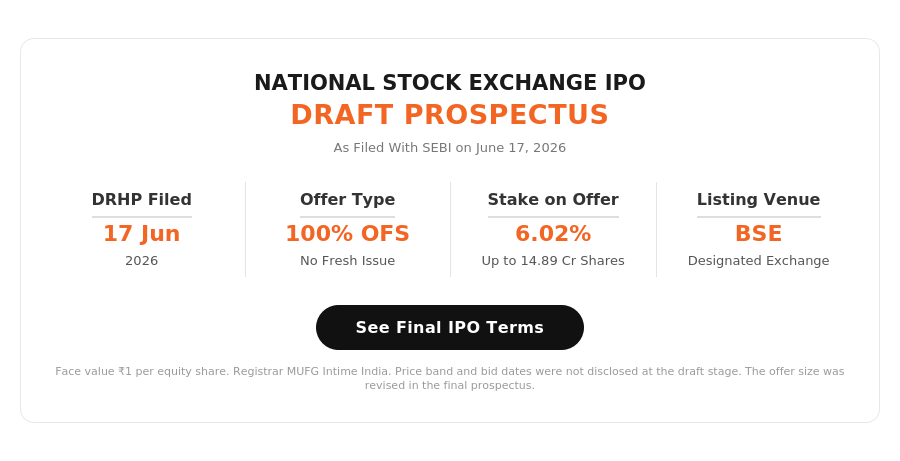
The NSE IPO moved a step closer as National Stock Exchange of India Limited filed its draft red herring prospectus dated June 17, 2026. Up to 14,89,05,525 shares, roughly 6.02% of its capital, are on offer, with listing proposed on BSE.
Key Takeaways
- The NSE IPO is a pure offer for sale of up to 14,89,05,525 shares, about 6.02% of pre-offer capital.
- NSE itself receives no money from the issue, because there is no fresh issue component.
- The shares are proposed to be listed on BSE, which is also the designated stock exchange for the offer.
- Price band, offer size in rupees and bid dates are all still blank in the draft prospectus.
What Is the NSE IPO and What Does the DRHP Propose?
National Stock Exchange of India Limited has filed a draft red herring prospectus, or DRHP, for a 100% book-built offer. A DRHP is the draft disclosure document an unlisted company files before an IPO, carrying every material fact except the final price.
The NSE IPO is for up to 14,89,05,525 equity shares of face value ₹1 each. Against a pre-offer capital of 2,47,50,00,000 shares, that works out to roughly 6.02% of the company.
The total offer value, price band and minimum bid lot are all left blank in the draft. They will be decided by the company in consultation with the lead managers and advertised in English, Hindi and Marathi newspapers at least two working days before bidding opens.
| NSE IPO Detail | As Stated in the DRHP |
|---|---|
| Document type | Draft Red Herring Prospectus, 100% book built |
| Date of the draft | June 17, 2026 |
| Offer type | Offer for sale only, no fresh issue |
| Shares offered | Up to 14,89,05,525 equity shares, face value ₹1 |
| Share of pre-offer capital | Approximately 6.02% |
| Pre-offer share capital | 2,47,50,00,000 shares |
| Total offer value | Not yet disclosed |
| Proposed listing venue | BSE Limited, also the designated stock exchange |
| Promoter | No identifiable promoter |
| Registrar to the offer | MUFG Intime India Private Limited |
| Employee quota | Reservation for eligible employees, size not yet disclosed |
NSE IPO offer snapshot. Source: NSE Draft Red Herring Prospectus dated June 17, 2026.
Is the NSE IPO a Fresh Issue or an Offer for Sale?
The NSE IPO is entirely an offer for sale. There is no fresh issue component at all.
In an offer for sale, existing shareholders sell their own shares and keep the proceeds. The company itself receives none of the money.
The prospectus states the objects plainly: to carry out the offer for sale, and to achieve the benefits of listing on BSE. Proceeds go to each selling shareholder after deducting their share of offer expenses and taxes.
The practical meaning for a reader is that this IPO does not fund any expansion plan. It is a liquidity event for shareholders who have held unlisted stock for years, and a route to a public market price for the exchange.
Who Are the Selling Shareholders in the NSE IPO?
The prospectus lists the ten largest selling shareholders on its cover, along with the weighted average cost of acquisition. That is the average price each one originally paid per share, adjusted for later corporate actions such as the bonus issue.
The spread is striking. State Bank of India’s average cost works out to ₹0.80 a share, while Canada Pension Plan Investment Board’s is ₹324.13.
| Selling Shareholder | Shares Offered (up to) | Avg. Cost per Share (₹) |
|---|---|---|
| State Bank of India | 2,47,50,000 | 0.80 |
| MS Strategic (Mauritius) Limited | 1,60,00,000 | 66.54 |
| Canada Pension Plan Investment Board | 1,18,74,060 | 324.13 |
| Aranda Investments (Mauritius) Pte Ltd | 1,12,46,336 | 62.38 |
| Bank of Baroda | 1,09,86,250 | 0.54 |
| Stock Holding Corporation of India Limited | 1,08,90,000 | 0.46 |
| General Insurance Corporation of India | 1,06,58,000 | 5.26 |
| The New India Assurance Company Ltd. | 1,05,00,000 | 0.32 |
| National Insurance Company Limited | 60,00,000 | 0.32 |
| United India Insurance Company Limited | 60,00,000 | 0.50 |
Top ten selling shareholders in the NSE IPO, as disclosed on the DRHP cover. Acquisition costs certified by Manian & Rao, Chartered Accountants, on June 17, 2026. The complete list appears in Annexure A of the prospectus.
Who Owns NSE Before the IPO?
The cover page carries a line most prospectuses do not: the company does not have an identifiable promoter. NSE ownership is spread across insurers, banks, global funds and individuals, with no single controlling group.
Life Insurance Corporation of India is the largest shareholder at 10.72% of pre-offer capital. The twenty shareholders holding 1% or more together account for 52.76%.
| Largest Pre-Offer Shareholders | Shares | Stake (%) |
|---|---|---|
| Life Insurance Corporation of India | 26,52,75,000 | 10.72 |
| Aranda Investments (Mauritius) Pte Ltd | 11,24,63,356 | 4.54 |
| Stock Holding Corporation of India Limited | 11,00,00,000 | 4.44 |
| SBI Capital Markets Limited | 10,72,50,000 | 4.33 |
| Mahagony Limited | 9,22,95,000 | 3.73 |
| State Bank of India | 7,98,47,050 | 3.23 |
| PI Opportunities Fund I | 5,82,00,000 | 2.35 |
| Crown Capital Limited | 5,13,55,465 | 2.07 |
| DVI Fund (Mauritius) Limited | 4,52,16,215 | 1.83 |
| TIMF Holdings | 4,32,30,357 | 1.75 |
| Radhakishan Shivkishan Damani | 3,90,84,400 | 1.58 |
| Total of all shareholders above 1% | 1,30,61,79,558 | 52.76 |
NSE shareholding pattern before the IPO, based on the beneficiary position statement of June 15, 2026. The table shows the eleven largest of the twenty shareholders above 1%.
How Will NSE IPO Shares Be Allotted?
The NSE IPO follows the standard book-building split under SEBI ICDR Regulations, applied to the net offer, which is the total offer minus the employee reservation.
- Qualified institutional buyers: not more than 50% of the net offer. Up to 60% of this can go to anchor investors, of which 33.33% is reserved for domestic mutual funds and 6.67% for life insurers and pension funds.
- Non-institutional bidders: not less than 15%, split one-third for applications of ₹2 lakh to ₹10 lakh and two-thirds for applications above ₹10 lakh.
- Retail individual bidders: not less than 35% of the net offer.
- Eligible employees: a separate reserved portion, allotted proportionately.
Every category except anchor investors must apply through ASBA, where the application money is blocked in the bank account rather than debited. Retail and employee applicants use the UPI route.
Which Banks Are Managing the NSE IPO?
The offer is being managed by twenty book running lead managers, an unusually large syndicate. They are Kotak Mahindra Capital, JM Financial, Morgan Stanley India, Citigroup Global Markets India, HSBC Securities and Capital Markets (India), J.P. Morgan India, SBI Capital Markets, Anand Rathi Advisors, Avendus Capital, Axis Capital, DAM Capital Advisors, Equirus Capital, HDFC Bank, ICICI Securities, IDBI Capital Markets & Securities, IIFL Capital Services, Motilal Oswal Investment Advisors, Nuvama Wealth Management, Pantomath Capital Advisors and 360 ONE WAM.
Three of them, namely Morgan Stanley India, SBI Capital Markets and ICICI Securities, are associates of selling shareholders. Under the SEBI Merchant Bankers Regulations they will be involved only in marketing the offer, not in the wider due diligence role.
NSE IPO Price Band and Dates: What Is Still Unknown?
A draft prospectus is exactly that. The price band, the rupee size of the offer, the bid opening and closing dates, the minimum lot and any employee discount all appear as blanks in this document.
Those numbers are filled in only at the red herring prospectus stage, after SEBI issues its observations on the draft. Until then, no NSE IPO offer size or valuation can be quoted from this filing.
Anyone planning to bid when the offer opens will need a demat account to hold the allotted shares, and can track the price band announcement and listing through an online trading platform once the dates are notified.
Investments in securities markets are subject to market risks. This article is for information purposes only and is not investment advice.
Leave a Reply