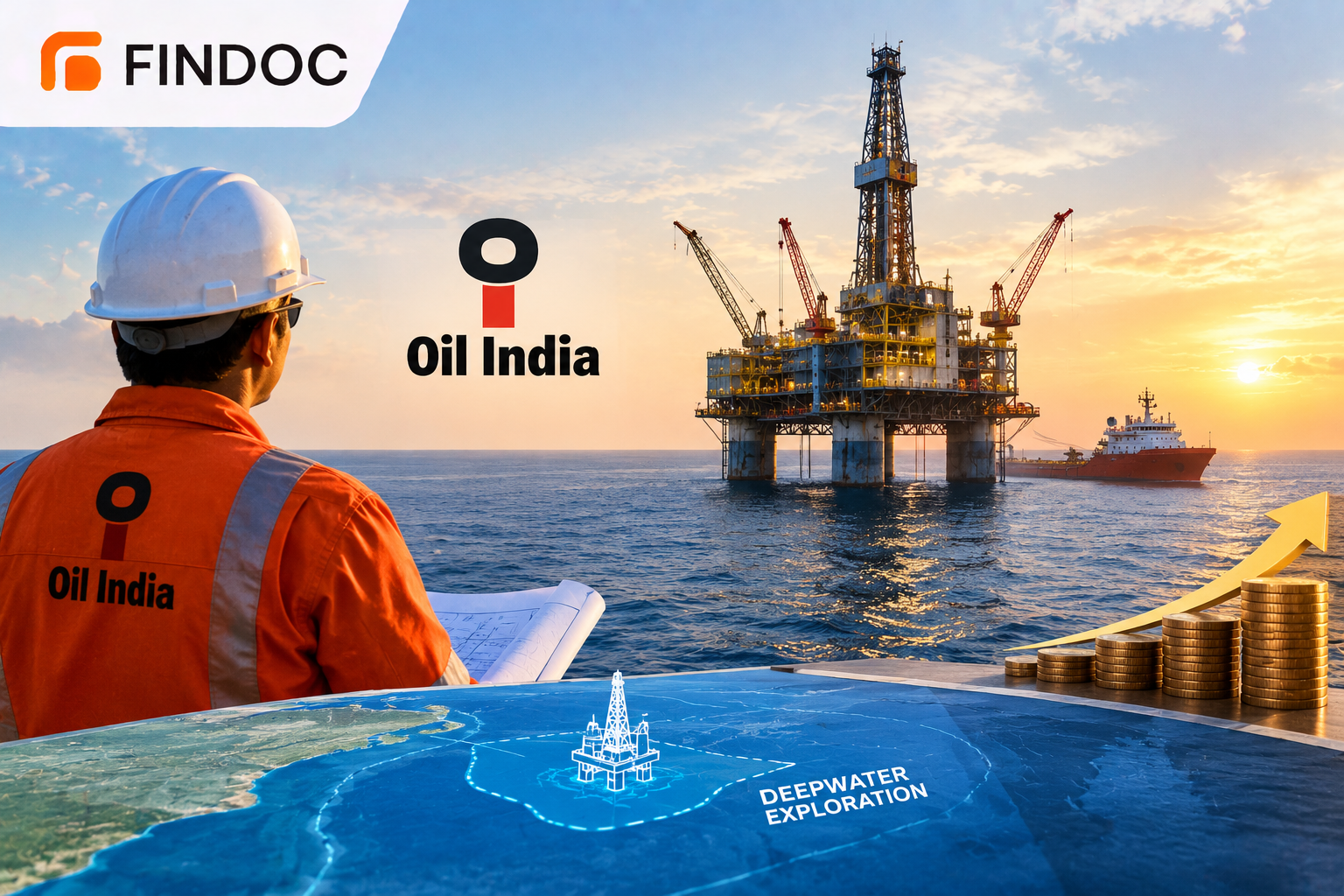
Oil India will set aside about ₹15,000 crore over the next three years to drill deepwater exploration wells, chairman and managing director Ranjit Rath said at a briefing after the company’s annual general meeting on 17 September 2026.
What Rath Said After the AGM
The spending is aimed at deepwater and ultra-deepwater blocks in four offshore areas: the Andaman, Krishna-Godavari, Mahanadi and Kerala-Konkan basins.
Rath described it as a preparedness budget rather than a fixed drilling schedule. The company has acquired about 48,000 sq km of acreage in deep and ultra-deep water, including two blocks in the Krishna-Godavari basin and two in the Mahanadi basin.
Two-dimensional and three-dimensional seismic surveys on those blocks are done, and the data is being processed. Older seismic data is also being reprocessed with current technology. Oil India’s total exploration footprint runs beyond one lakh sq km.
How Samudra Manthan Shares the Risk
The plan leans on Samudra Manthan, a central government scheme that part-funds deepwater and ultra-deepwater exploration in India.
| Samudra Manthan | Detail |
|---|---|
| Approved outlay | ₹84,084 crore |
| Period | Up to 2030-31 |
| Government share of eligible drilling cost | Up to 50 per cent |
| Ceiling per well | ₹675 crore, or 50 per cent, whichever is lower |
The support applies to eligible exploratory wells, which is the part of the business where the money is most likely to be lost.
Why Deepwater Drilling Is a Different Kind of Spend
An exploration well is not a production well. It is drilled to find out whether oil or gas is there at all, and in what quantity. Many exploration wells find nothing, and the money spent on them cannot be recovered.
In deep water, that cost is far higher than on land. Rigs, vessels and specialist services all cost more offshore, which is why Indian explorers have historically been cautious about frontier basins.
A scheme that absorbs part of the drilling cost changes that arithmetic. It does not guarantee a discovery. It reduces how much a single dry well hurts.
Where the Wells Actually Get Drilled Is Still Open
This is the part investors should read carefully. Seismic data tells geologists where a reservoir might be. Only when that data is interpreted does a company pick specific drilling locations.
So the ₹15,000 crore is a budget to convert seismic prospects into drillable wells, not a confirmed list of approved projects. The number of wells and their locations depend on what the interpretation shows.
Beyond Oil: Biogas and the Numaligarh Refinery
Rath said Oil India is also expanding its clean energy portfolio, including solar and compressed biogas. He pointed to the government’s GOBARdhan scheme, under which ₹23,731 crore of financial support was approved last month to develop India’s compressed biogas sector by converting farm waste and municipal refuse into fuel and organic manure.
On the company’s subsidiary Numaligarh Refinery, Rath said the expansion from 3 million tonnes a year to 9 million tonnes is expected to be commissioned by 31 March 2027, with stabilisation taking another nine to twelve months after that.
What to Track From Here
Three markers will show whether this plan is moving: the completion of seismic interpretation, the announcement of specific well locations, and the actual commissioning date at Numaligarh.
Oil India is a listed public sector company, so its shares can be bought and held through a demat account, and the price reaction to announcements like this can be followed live on an online trading platform. Exploration outcomes, though, take years to show up in earnings.
Investments in securities are subject to market risks. Read all related documents carefully before investing. This article is for information only and is not investment advice.
| Check Indices | |
|---|---|
| BSE BANKEX Companies | BSE Largecap Comapnies |
| FINNIFTY Companies | Nifty Midcap 50 Companies |
| NIFTY MIDCAP 150 Companies | Nifty Pharma Companies |
| BSE 500 Companies | Nifty Smallcap 100 Companies |
Leave a Reply