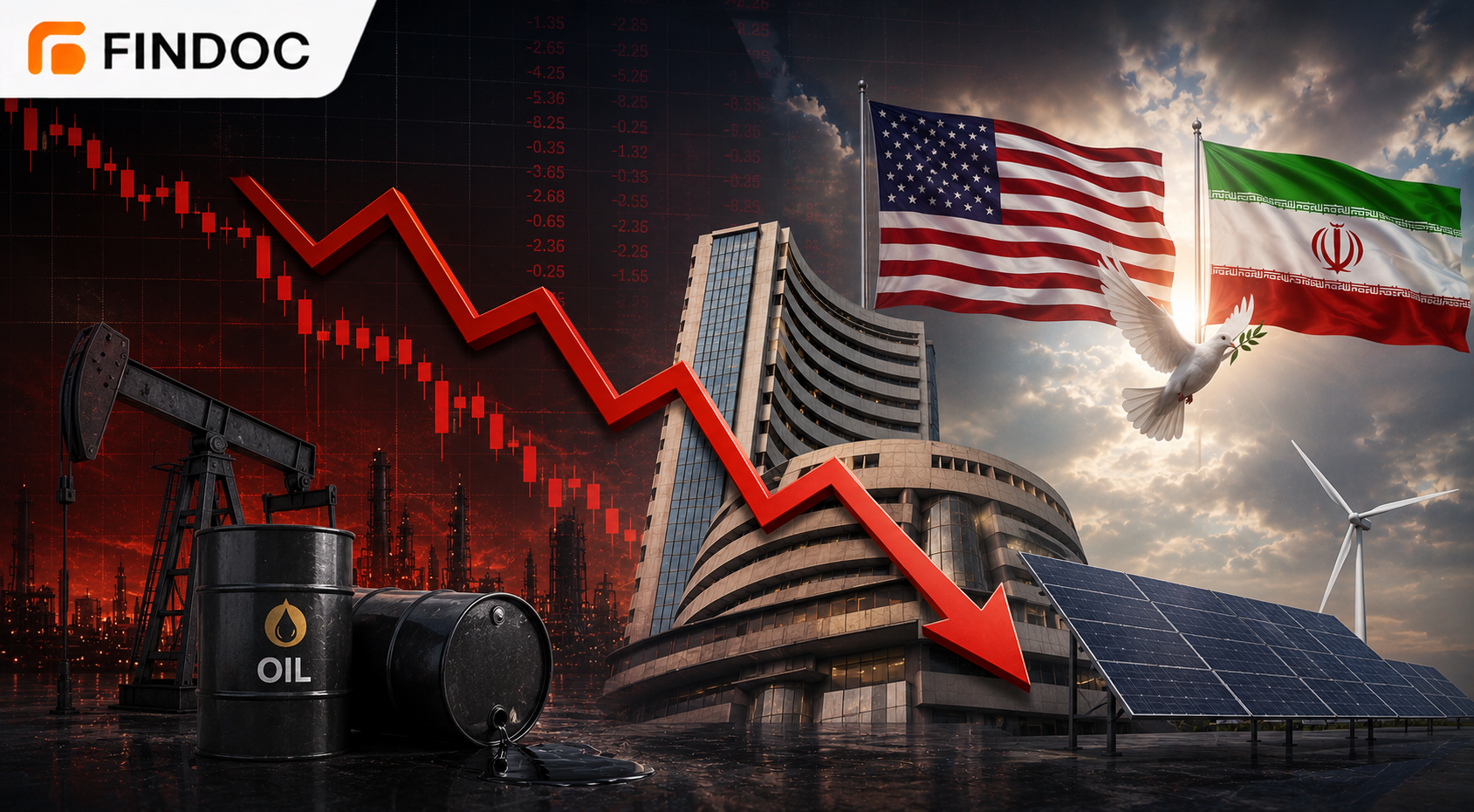
Indian energy equities lagged the broader market over the past 24 hours as crude prices corrected sharply on the announcement of a preliminary US–Iran peace framework, raising the prospect of higher Iranian oil supply and softer refining margins for domestic majors. While benchmark indices on the BSE and NSE extended gains, large-cap energy names such as ONGC and NTPC traded in the red, and Reliance Industries underperformed its 52-week highs despite modest intraday gains. The move underscores a pivot in market focus from near-term earnings support from elevated crude to medium-term volume and pricing risks across the oil and gas value chain.
Key Highlights
- Sensex and Nifty 50 rallied strongly, but energy remained among the key laggard pockets.
- ONGC and NTPC slipped intraday even as most sectors closed in the green.
- Reliance Industries edged up 0.36% but remains well below its recent 52-week high.
- Global crude prices softened on US–Iran peace deal news, tempering India’s inflation and current account risks.
- Analysts remain selectively positive on Reliance while turning more cautious on upstream earnings trajectories.
Crude Correction Hits Indian Oil and Gas Sentiment
Equity markets closed on a strong note in the latest session, with the Sensex up 736 points and the Nifty 50 settling above the 23,800–23,900 zone, driven by broad-based buying across financials, consumption and select cyclicals. However, the oil and gas and energy complex was conspicuous in its underperformance, highlighting the market’s rapid reassessment of the crude outlook and its impact on sector earnings and capex cycles.
The immediate trigger has been the announcement of a US–Iran peace deal framework, which, if implemented, could unlock incremental Iranian barrels into the global market over the coming quarters. For India, which remains a structurally large crude importer with oil imports covering around 85% of its needs, the medium-term macro read-through is supportive: softer Brent typically eases pressure on the current account deficit, imported inflation and, by extension, the RBI’s policy flexibility. For listed energy names, however, the implications are more nuanced and, in some segments, clearly negative.
Upstream producers such as Oil and Natural Gas Corporation (ONGC) are most exposed to downside in realized crude and gas prices. ONGC was among the key laggards on the Nifty in the previous session, even as the benchmark rallied sharply, reflecting concerns that the recent period of elevated realizations may have peaked. Investors considering stock investment in the upstream segment are now recalibrating earnings estimates for FY27 and beyond, with a greater focus on volume growth, cost control and potential changes in government pricing or windfall mechanisms should oil prices stabilize at lower levels.
Reliance Industries, Refining Margins and Energy Transition
Reliance Industries (RIL), India’s largest company by market capitalization and a bellwether for the energy complex, traded with a positive bias but remains significantly below its recent 52-week high. The stock last changed hands at around ₹1,311.70 on the NSE, up about 0.36% from the previous close, with intraday volumes of under 1 million shares indicating a cautious stance ahead of key catalysts. The counter’s 52-week high near ₹1,611.80 underlines the degree of derating already embedded on concerns around refining cycles, petchem spreads and the slower-than-expected monetisation of new energy investments.
Near term, lower crude prices can provide a mixed earnings picture for RIL. On the refining side, a flatter backwardation structure and potential easing of product cracks could limit upside to gross refining margins (GRMs), though lower feedstock costs and still-firm transport fuel demand in India should be partially supportive. For its legacy oil-to-chemicals (O2C) business, the demand–supply balance in key polymers and aromatics remains critical, particularly as incremental Middle East capacity ramps up.
At the same time, the market is increasingly trading RIL on a diversified, quasi-holding-company narrative rather than a pure energy play. Ahead of its upcoming 49th Annual General Meeting, scheduled shortly, investors are focused on guidance around Jio platforms, retail, and particularly the energy transition roadmap. RIL’s recently announced partnership with Meta to build an AI-enabled data centre in Jamnagar, Gujarat, has reinforced the market’s view that future capex will tilt toward digital infrastructure, data centres and new energy ecosystems rather than incremental fossil capacity.
Global brokerage commentary remains constructive: Morgan Stanley continues to list Reliance as a top pick, with an average 12-month street target around ₹1,698.50, implying an upside of nearly 30% from current levels and a strong buy consensus from over 30 analysts. For institutional investors, the key question is whether the next leg of value creation will come from higher cash flows in the O2C segment if crude and petchem cycles surprise positively, or from re-rating in digital, retail and new energy businesses as execution milestones are delivered.
Sector Positioning: Upstream vs Downstream vs Diversified
The current market setup has accentuated relative trade-offs across the energy value chain. For India-focused portfolios, positioning is increasingly differentiated, with selective accumulation and profit-taking rather than a beta-driven sector call. Retail and institutional participants who open demat account through SEBI-registered brokers gain structured access to these differentiated plays across the energy value chain.
Key comparative dynamics across segments are outlined below:
| Segment | Representative Names | Key Risk Factors | Valuation Context |
|---|---|---|---|
| Upstream | ONGC | Crude and gas price normalization; windfall tax risk; gas pricing formula changes | Inexpensive on P/E and P/B; earnings visibility more cyclical |
| Downstream and Utilities | OMCs, NTPC | Policy intervention; marketing margin volatility; renewables execution risk | Regulated returns provide cushion; softer crude margin-positive for OMCs |
| Diversified and New Energy | Reliance Industries | O2C margin pressure; petchem spread volatility; capex execution in new verticals | Valuation driven by digital, retail and new energy narrative; analyst consensus favourable |
For institutional investors benchmarked to Nifty 50 or sectoral indices on BSE/NSE, the result is a more barbelled approach: maintaining core positions in diversified majors such as RIL while using price dislocations in upstream and select downstream names opportunistically, subject to discipline on cycle and policy risks.
Market Outlook: Implications for Indian Portfolios and Macro
If the US–Iran peace framework progresses to formal sanctions relief, consensus expectations point to a gradual softening of global crude benchmarks over the next 12–18 months. For India, this should translate into lower imported inflation, a narrower current account deficit and potentially less pressure on the rupee, giving the RBI greater room to manage its rate cycle with a focus on domestic growth rather than imported price shocks.
From a market standpoint, energy’s underperformance amid a rising Sensex and Nifty suggests that investors are already rotating toward domestic cyclicals and consumption plays that benefit from lower fuel costs. However, the sector’s weight in benchmarks and its centrality to India’s capex and transition story means it cannot be ignored. Over the near term, volatility in global headlines around Iran, OPEC+ policy and US inventory data is likely to remain the primary driver for upstream and refining names, while stock-specific catalysts such as RIL’s AGM commentary will dominate for diversified conglomerates. Access to real-time price data through a reliable trading platform has become increasingly important for investors monitoring these fast-moving sector dynamics.
Institutional investors should watch the following developments closely:
- Concrete timelines and details emerging from US–Iran negotiations and any visible impact on supply expectations.
- Changes in domestic fuel pricing policies, windfall taxation frameworks and gas pricing formula revisions.
- Guidance from managements of Reliance, ONGC and NTPC on capex allocation, leverage and energy-transition milestones.
- RBI commentary on the inflation and balance-of-payments impact of shifting crude forecasts, and any implicit bias change for the rupee.
Conclusion
The latest session in Indian equity markets underscores a critical transition phase for the country’s energy complex. While macro fundamentals stand to benefit from a potential downshift in global crude prices, listed energy names face a more complex earnings and valuation landscape, with upstream players absorbing the brunt of price risk and diversified conglomerates like Reliance trying to convince the market that their future lies beyond hydrocarbons. As Sensex and Nifty hover near record territory, energy is no longer a straightforward cyclical play but a nuanced, stock-specific call on policy, geopolitics and execution in new energy and digital infrastructure. For long-term institutional portfolios, disciplined, differentiated exposure across the value chain — rather than a monolithic overweight energy stance — appears the more considered strategy in this evolving regime.
Leave a Reply