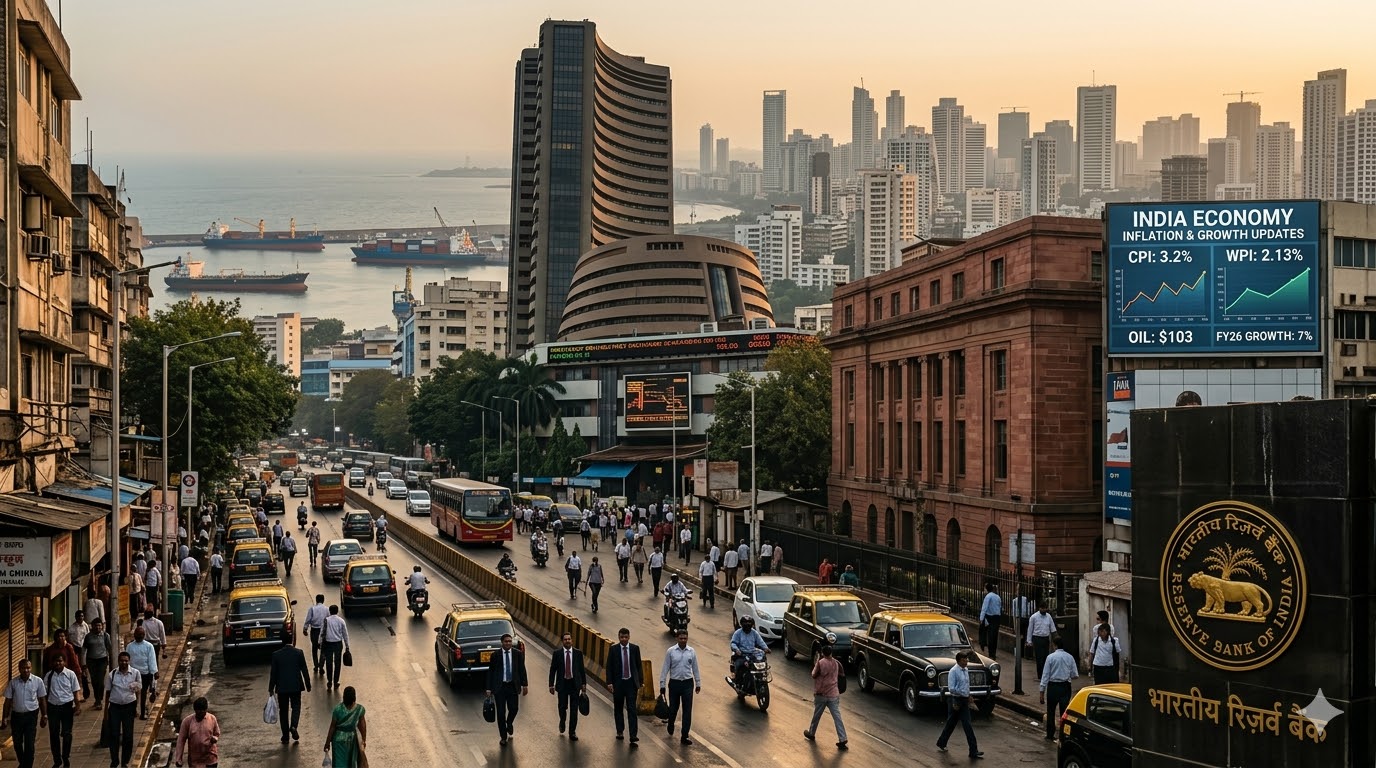
India’s economy faces mounting pressures from accelerating inflation and statistical discrepancies in the newly revised GDP series, even as geopolitical oil shocks threaten to erode hard-won price stability. Wholesale price inflation (WPI) surged to 2.13% in February 2026 from 1.81%, exceeding forecasts of 2.0%, primarily driven by food prices climbing to 2.19% from 1.55%. Consumer price inflation (CPI) edged up to 3.2% from 2.7%, remaining within the Reserve Bank of India’s (RBI) 2-6% tolerance band but vulnerable to Brent crude topping $100 per barrel amid Iran-Israel tensions. The new GDP series with base year 2022-23 reveals rising discrepancies, reaching nearly ₹4.9 lakh crore for FY26 estimates, raising questions on growth reliability. With the rupee hovering around 83-84 to the US dollar and trade deficit narrowing to $27.1 billion, markets like NIFTY 50 and SENSEX remain cautious ahead of RBI’s monetary policy review.
Key Highlights
- WPI inflation accelerates to 2.13% YoY, food component at 2.19%, surpassing 2.0% consensus forecast
- CPI holds at 3.2% for February, up from 2.7%, within RBI target but pressured by oil at $103/barrel
- New GDP series shows discrepancies ballooning to ₹4.9 lakh crore in FY26 from near zero in FY23
- Rupee trades at 83-84/USD amid rising oil import bill; trade deficit shrinks to $27.1 billion from $34.7 billion
- Government projects FY26 growth up to 7.2%, but oil shock dims outlook with CAD at 3.5% of GDP
Inflation Trends and RBI Monetary Policy
India’s inflation landscape deteriorated modestly in February 2026, with WPI rising to 2.13% from 1.81% prior month, driven by food inflation’s sharp rebound to 2.19% from 1.55%. This uptick, above the 2.0% market expectation, signals renewed price pressures in primary articles and underscores the fragility of disinflation gains achieved in late 2025 through favorable base effects. CPI inflation, meanwhile, printed at 3.2%, a 50 basis point increase from January’s 2.7%, yet comfortably within RBI’s medium-term target of 4% with upper tolerance at 6%. Finance Minister Nirmala Sitharaman highlighted this resilience, projecting annual inflation between 3-4% for FY26, but cautioned on external vulnerabilities.
The RBI’s monetary policy stance remains pivotal, with no immediate rate decision in the past 24 hours but heightened vigilance implied amid global oil volatility. Brent crude’s rally to $103, fueled by Iran-Israel conflict, poses imported inflation risks, as India imports over 85% of its crude needs. Analysts estimate a sustained $10/barrel increase could add 0.2-0.3% to CPI, potentially pushing it toward 4% in Q1 FY26. This echoes historical shocks that widened the current account deficit (CAD) and pressured the rupee, which weakened to 83-84/USD levels, inflating the oil import bill. RBI Governor’s anticipated comments in the upcoming policy review will be scrutinized for hints on repo rate adjustments, currently steady post-2025 easing cycle. Investors looking to participate in this market movement can open demat account through SEBI-registered brokers. Market participants on NSE and BSE platforms note implied yields on 10-year G-Secs edging higher, reflecting inflation repricing.
Domestic factors compound these pressures, including kitchen inflation trends where vegetable and protein prices contribute to headline stickiness. While core CPI components show moderation, energy pass-through via transportation and manufacturing costs remains a wildcard. Policymakers’ balancing act—sustaining 7%+ growth without fueling inflation—will test RBI’s credibility, especially with discrepancies clouding growth data.
GDP Data Revisions and Growth Metrics
The Ministry of Statistics and Programme Implementation (MoSPI) unveiled a new GDP series on February 27, 2026, shifting the base year to 2022-23 from 2011-12, aiming to capture structural shifts in the economy. However, this revision has spotlighted escalating statistical discrepancies—the gap between production and expenditure-side estimates—which surged from near zero in FY23 to ₹1 lakh crore in FY24 and an estimated ₹4.9 lakh crore in FY26. As a percentage of GDP, these exceed the ideal threshold of below 2%, distorting real growth figures and eroding data credibility for investors tracking NIFTY 50 heavyweights like Reliance Industries and HDFC Bank.
Real GDP growth under the new series stood at 7.2% for FY24, with private final consumption expenditure (PFCE) at 5.7% and gross fixed capital formation (GFCF) contributing around 30% to nominal GDP. FY25 saw 7.1% overall growth, but component growth lagged at 6.1%, bridged by a 230% jump in discrepancies to ₹3.5 lakh crore. Nominal GDP growth for FY26 is pegged at 8%, implying real growth of ~7.4%, though critics like Arvind Subramanian argue historical overestimation by 1.5-2% annually since 2011. Deflator inaccuracies, with MoSPI expanding from 180 to 600 indices, exacerbate issues as distance from the base year grows, leading to distorted real GDP.
Market implications are evident in BSE Sensex and NSE NIFTY 50, which dipped amid oil-led growth dimming, with government FY26 projection at up to 7.2% now at risk. This development presents new considerations for stock investment strategies focused on Indian equities. Key players like Larsen & Toubro in infrastructure (GFCF proxy) and ITC in consumption face scrutiny, as incomplete informal sector data fuels gaps. Trade dynamics offer some relief: imports fell to $63.7 billion, narrowing deficit to $27.1 billion.
CPI vs WPI Inflation Comparison
| Metric | February 2026 | January 2026 | Forecast | Key Driver |
|---|---|---|---|---|
| CPI YoY | 3.2% | 2.7% | N/A | Energy pass-through, food |
| WPI YoY | 2.13% | 1.81% | 2.0% | Food (2.19%), primary articles |
| Impact on Rupee | 83-84/USD | Stable | N/A | Oil bill rise |
| CAD % GDP | ~3.5% | N/A | N/A | Energy imports (85% reliance) |
This table underscores WPI’s faster acceleration, signaling upstream pressures likely to filter into CPI via manufacturing. Rupee depreciation amplifies CAD risks, with oil at $103 adding ~0.3% to inflation per $10 rise. Investors should monitor food sub-indices and Brent futures for divergence signals.
Market Outlook
Looking ahead, Indian investors face a cautious environment with RBI policy as the linchpin. Oil persistence above $100 could shave 0.5-1% off FY26 growth from 7.2%, widening CAD and forcing rupee interventions, per economist projections. NIFTY 50 and SENSEX may consolidate around 24,000-25,000 levels, favoring defensives like Hindustan Unilever over cyclicals. Retail participation has grown significantly as access to a reliable trading platform has become more widespread. Key watches: Q1 GDP flash (discrepancies), March CPI/WPI, and RBI’s April review for rate signals. Downside risks include sticky 4%+ inflation; upsides hinge on West Asia de-escalation. Portfolio tilts toward gold (nearing ₹1.6 lakh) offer hedges.
Conclusion
India’s economy navigates a precarious equilibrium, with inflation upticks to 3.2% CPI and 2.13% WPI, compounded by ₹4.9 lakh crore GDP discrepancies, testing RBI’s resolve amid oil at $103. Narrowing trade gaps provide ballast, but rupee pressures and external shocks demand vigilant policy. For institutional investors, this milieu underscores diversification, data skepticism, and focus on resilient sectors—positioning for volatility while eyeing 7% growth potential will define returns in FY26.
Leave a Reply