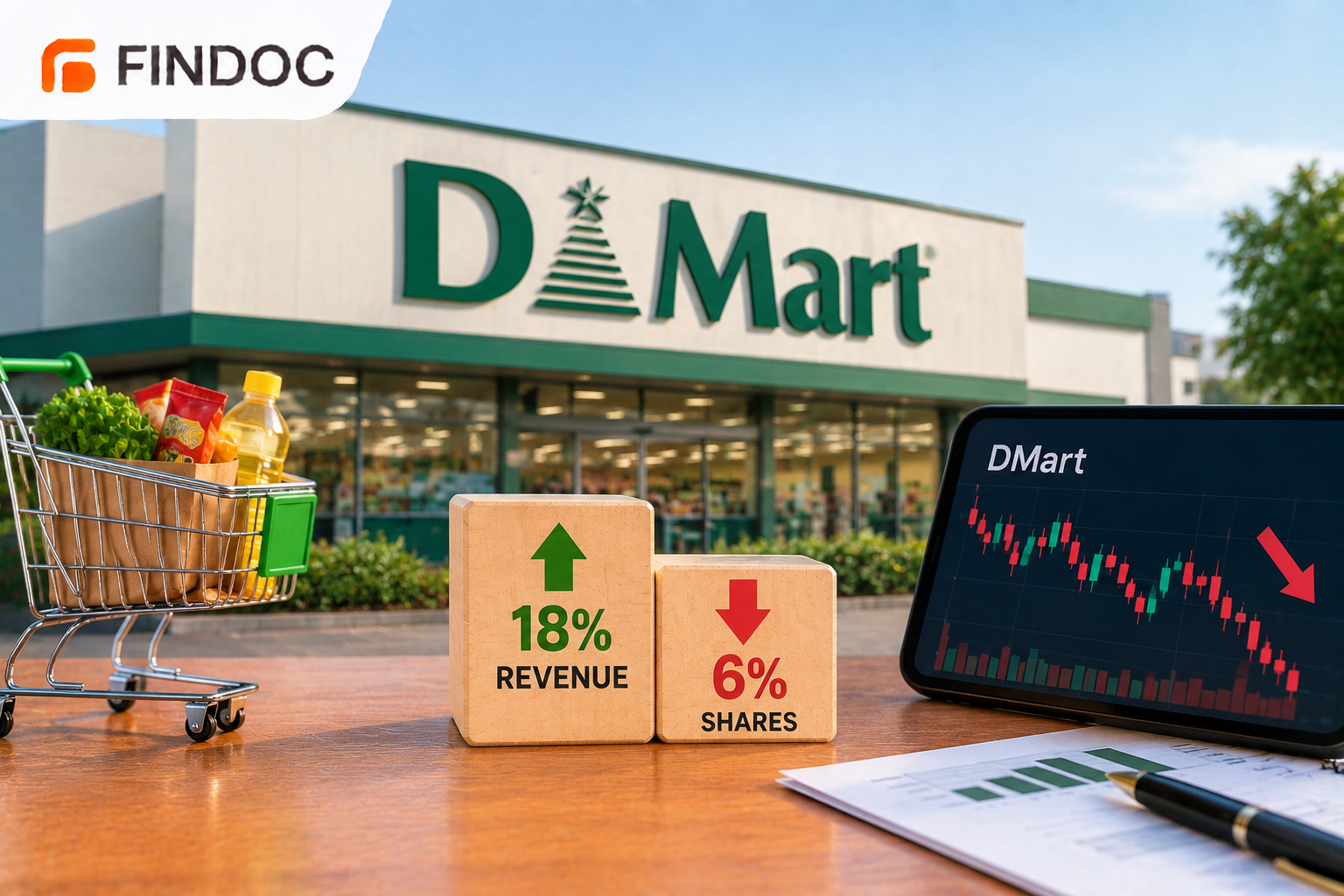
Avenue Supermarts shares fell up to 6% on 5 October 2026 even as Q2 revenue rose 18.4%. Investors are weighing the same‑store slowdown, premium valuation and quick‑commerce pressure ahead of results on 10 October.
Stock reaction: DMart falls while broader market holds up
Avenue Supermarts, the operator of the DMart chain, saw its shares slide as much as 6.22% during Monday’s session, touching an intraday low of Rs 3,575.70 on NSE. The stock, which closed at Rs 3,813 on 1 October, was trading near its 52‑week low of Rs 3,528.65 even as major indices were in positive territory.
The sharp move came a day after the company’s Q2 FY27 business update and alongside fresh brokerage commentary, with Citi reiterating a ‘Sell’ rating and a target of Rs 3,300, and Goldman Sachs also on ‘Sell’ with a Rs 3,800 target.
Q2 business update: Strong top‑line, limited detail
For the quarter ended 30 September 2026, Avenue Supermarts reported standalone revenue of Rs 19,206.18 crore, up 18.4% year on year from Rs 16,218.79 crore in Q2 FY26 and 4.7% quarter on quarter from Rs 18,343.49 crore in Q1 FY27.
The retailer ended the quarter with 518 stores, adding 15 locations in Q2 FY27. In the first half of the fiscal, it opened 18 stores, only slightly ahead of the 17 stores added in H1 FY26.
However, the update did not disclose key profitability metrics or like‑for‑like (same‑store) growth for Q2, leaving analysts and investors to infer trends from prior quarters and commentary.
Why the market is worried: same‑store trends and competition
The disconnect between double‑digit revenue growth and a falling share price reflects deeper concerns about store productivity. In Q1 FY27, like‑for‑like growth for stores older than two years had already slowed to 5.5% from 7.1% a year earlier, with older metro stores showing flat sales, a trend analysts have linked to rising competition from quick‑commerce platforms such as Blinkit, Zepto and Swiggy Instamart.
DMart’s online arm, DMart Ready, has also faced headwinds. The service was scaled back from 25 cities to 11, even as FY26 online revenue stood at Rs 4,093 crore, up 17% year on year. In Q1 FY27, the subsidiary’s loss widened 32% to Rs 75.3 crore, adding to concerns about the cost of defending share in metros.
Citi has noted that profit growth has lagged revenue growth in 10 of the last 13 quarters, a pattern that makes the stock’s premium valuation harder to justify for some investors.
Valuation debate: premium multiple meets slower earnings momentum
At recent levels, Avenue Supermarts trades at roughly 77–81 times earnings and about 10 times book value, with a market capitalisation near Rs 2.36 lakh crore before Monday’s decline. The stock’s 52‑week range is Rs 3,528.65 to Rs 4,644.
Brokerage targets highlight the split in views. While Citi and Goldman Sachs are on ‘Sell’ with targets of Rs 3,300 and Rs 3,800 respectively, Morgan Stanley remains ‘Overweight’ with a Rs 4,464 target, CLSA has a ‘High Conviction Outperform’ rating and a Rs 5,723 target, and Bernstein is ‘Outperform’ with a Rs 5,000 target.
For long‑term holders, the key question is whether store expansion and operating leverage can offset pressure on same‑store sales and margins in a more competitive metro environment.
What Q2 results on 10 October must clarify
The board will meet on 10 October 2026 to approve unaudited standalone and consolidated results for Q2 and H1 FY27. Investors will focus on:
- EBITDA and net profit margins after the revenue beat
- Like‑for‑like growth trends, especially in older metro stores
- Commentary on store productivity and any change in expansion pace
- Performance and loss trajectory of the DMart Ready subsidiary
Clearer data on these points will determine whether the current valuation can be sustained or whether a deeper derating is likely.
Sector signal and investor context
DMart is a large‑cap bellwether for Indian organised retail, and its stock movement influences sentiment across the sector and related indices. Monday’s fall, alongside weakness in peers such as V2 Retail, underscores caution around high‑multiple retail names when same‑store growth shows signs of fatigue.
For retail investors tracking DMart or building exposure to the consumption theme, having a demat account with a SEBI‑registered broker is essential to hold the shares and react around result dates. To monitor key support and resistance levels, set price alerts and act quickly when results are announced, many investors rely on a reliable stock trading platform that offers real‑time data and corporate‑announcement feeds.
Key levels and risks to watch
Technically, the 52‑week low around Rs 3,528 is a critical support. A sustained break below this zone could open the door to further downside, while a decisive recovery above Rs 3,800–3,850 may indicate that the worst of the near‑term selling is over.
Key risks include:
- Further slowdown in like‑for‑like sales in metros
- Margin pressure from competition and online losses
- Any disappointment in H1 FY27 earnings versus street expectations
- Broader market volatility affecting high‑P/E large caps
With Q2 results just days away, the next major trigger for DMart’s stock will be the actual numbers and management’s outlook for store productivity and profitability.
Related Stock Market Insights
- What is a Demat Account?
- How to Open a Demat Account Online?
- What is Algo Trading?
- What are Growth Stocks?
- Top AI Stocks in India
- Top Semiconductor Stocks in India
| Check Indices | |
|---|---|
| BSE BANKEX Companies | BSE Largecap Comapnies |
| FINNIFTY Companies | Nifty Midcap 50 Companies |
| NIFTY MIDCAP 150 Companies | Nifty Pharma Companies |
| BSE 500 Companies | Nifty Smallcap 100 Companies |
Leave a Reply