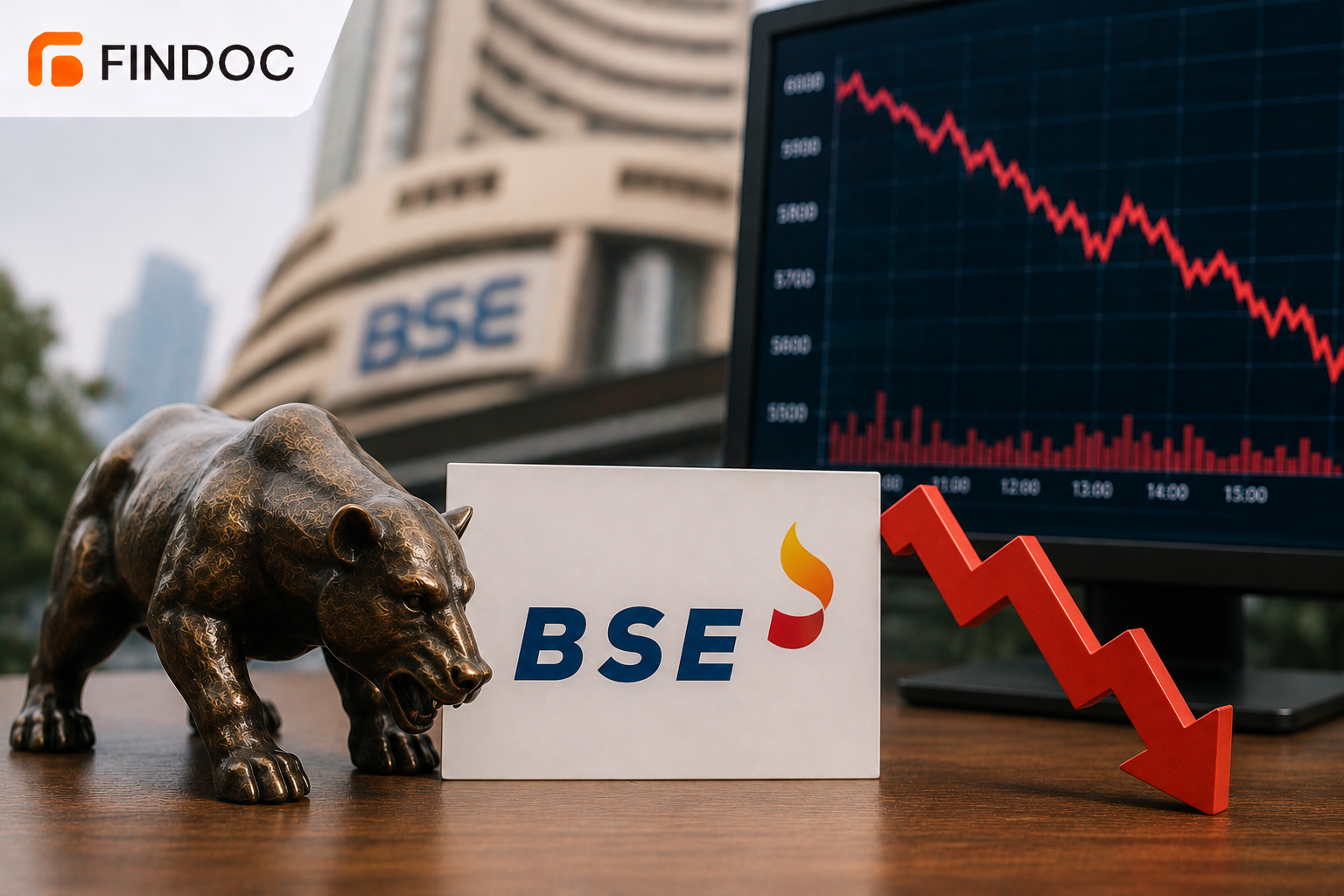
Shares of BSE fell sharply on Monday after global brokerage firm Jefferies downgraded the stock to Underperform and cut its target price. The selling pressure pushed BSE shares down as much as 5% to a day’s low of Rs 3,283 on the NSE. The move marked a notable reversal in sentiment toward the exchange operator, despite its recently reported strong financial performance. Investors tracking this development may find it useful to open demat account access and review their exchange-linked holdings in light of the changed analyst outlook.
Jefferies Downgrade and Revised Target Price
Jefferies revised its rating on BSE from Hold to Underperform, simultaneously trimming its target price to Rs 2,940 from Rs 3,520. The new target implies a downside of approximately 16% from the prevailing market level. The downgrade and target cut were the primary drivers behind the intraday decline in the stock.
The reaction in BSE shares came against the backdrop of strong Q1FY27 numbers, with BSE having reported robust profit and revenue growth for the quarter. However, Jefferies chose to focus on emerging risks to the business, particularly in the derivatives segment, which in its view could weigh on future earnings and justify a lower valuation multiple.
Revenue Headwinds Cited by Jefferies
Jefferies highlighted several factors it believes pose risks to BSE’s revenue, especially from domestic proprietary traders. According to the brokerage, proprietary traders account for around 50–60% of equity options notional turnover, with domestic prop traders likely contributing about half of overall turnover. This concentration makes BSE’s options business sensitive to changes affecting these participants.
Key headwinds identified by Jefferies include:
- Securities Transaction Tax (STT) hike: Higher transaction costs can reduce trading activity, particularly in options segments driven by active traders, potentially dampening growth in average daily turnover and affecting BSE’s fee income.
- RBI bank guarantee norms: Tightened norms from the Reserve Bank of India could adversely affect premium turnover. Jefferies estimated that premium turnover may be impacted by up to 10% over the next year due to these norms.
- Closing Auction Session (CAS): The introduction of CAS has become a point of stress for domestic proprietary traders. A recent interaction with an F&O trader cited in the Jefferies report indicated that CAS is resulting in higher losses for domestic prop traders, which can translate into weaker volumes for the exchange.
Impact of Closing Auction Session on Options Turnover
Jefferies provided specific data on how the Closing Auction Session has affected options trading activity on BSE and NSE. Options average daily turnover (ADTO) for NSE and BSE in August 2026 so far was down 14% and 12%, respectively, compared with July. This decline indicates that trading volumes softened after CAS came into effect.
The brokerage further observed that options ADTO declined 20–23% for both BSE and NSE in the second week of CAS compared with the first week. This drop during the early phase of CAS suggests that the new session has had a noticeable impact on trader behaviour and turnover. For an exchange working to grow its derivatives franchise, such declines can be significant.
Jefferies noted that consensus expects BSE’s Sensex to continue gaining market share. However, it pointed out that BSE’s expiry-day market share is now similar to NSE, while market-share gains outside T-0 and T-1 days have slowed. The moderation in market share growth, combined with weaker ADTO data, forms part of the brokerage’s cautious stance on the stock.
Earnings Estimate Cuts and Valuation Changes
Alongside the downgrade and target price reduction, Jefferies cut its FY27–29 earnings per share (EPS) estimates for BSE by 5–12%, citing expectations of slower ADTO growth and higher clearing costs as the main reasons for these downward revisions.
The revised target price of Rs 2,940 is based on 34 times September 2028 estimated core EPS approximately 6% below its earlier fair multiple of 36 times reflecting what Jefferies described as rising concerns over ADTO growth. By lowering both earnings estimates and the valuation multiple, the brokerage arrived at a significantly reduced target for the stock.
Jefferies also noted that if BSE’s market share remains flat in FY28–29 compared with FY27, it sees a further 2–5% downside to earnings. This scenario analysis highlights the sensitivity of BSE’s earnings trajectory to changes in market share and turnover, particularly in the options segment. For participants using any stock investment strategy that includes exchange-listed infrastructure stocks, such scenario analyses from major brokerages are typically factored into portfolio reviews.
Management Developments at BSE
The Jefferies report also touched on management and regulatory developments relevant to BSE. It cited news reports indicating that SEBI‘s proposal to raise the upper age limit for managing directors and CEOs of market infrastructure institutions has faced resistance. BSE’s MD and CEO is set to approach the existing age threshold in June 2027.
In the meantime, BSE has been strengthening its leadership team with key appointments:
- Saurabh Shukla has been named Executive Director in charge of Critical Operations.
- Gopalan S. Raghavan has been appointed Executive Director responsible for Regulatory, Compliance, Risk Management, and Investor Grievances.
These appointments are aimed at enhancing operational and regulatory oversight at the exchange. While Jefferies’ downgrade was driven mainly by trading and revenue-related factors, governance and leadership dynamics remain on the radar of market participants.
Market Reaction and Context
The 5% fall in BSE shares on Monday needs to be seen in the context of the stock’s recent performance. BSE had reported strong profit and revenue growth in Q1FY27, which had supported a positive view on the company. Despite this, Jefferies chose to reassess its stance in light of emerging pressures on the derivatives side and regulatory changes affecting key trading segments.
The downgrade from Hold to Underperform, combined with the target price cut to Rs 2,940 from Rs 3,520, sent a strong signal to the market. The implied downside of 16% from the prevailing level contributed to the selling pressure observed during the session. Those monitoring BSE through a trading platform would have noted the sharp intraday move and the volume accompanying the decline.
In summary, the fall in BSE shares on Monday was closely tied to Jefferies’ downgrade, earnings estimate cuts, and concerns around proprietary trading activity, STT changes, RBI bank guarantee norms, and the Closing Auction Session. These factors combined to create a cautious narrative around the stock, even as BSE’s recent quarterly performance remained strong.
Summary: BSE shares fell up to 5% on Monday after Jefferies downgraded the stock to Underperform and cut its target price to Rs 2,940 from Rs 3,520, citing risks from STT hikes, RBI norms, and the Closing Auction Session’s impact on derivatives turnover.
Leave a Reply