
findocblog

Author: findocadmin

  • Park Medi World IPO: Should You Invest in This Healthcare Giant

    Park Medi World IPO: Should You Invest in This Healthcare Giant

    The Indian healthcare sector is experiencing a significant growth spurt, and a major player is about to enter the stock market. Park Medi World, also known as Park Hospitals, is launching its Initial Public Offering (IPO), creating a new opportunity for investors. As one of North India’s largest private hospital chains, this IPO is drawing considerable attention. Let’s explore the details of the Park Medi World IPO and determine if it’s the right investment for your portfolio.

    For those looking to make a quick decision, here is the most crucial information about the Park Medi World IPO.

    • IPO Dates: The subscription period opens on December 10, 2025, and closes on December 12, 2025.
    • Price Band: The IPO price is set between ₹154 and ₹162 per share.
    • Lot Size: Investors must bid for a minimum of 92 shares in a single lot.
    • Investment: A minimum investment of ₹14,904 is required for one lot at the upper price band.
    • Total Issue Size: The company aims to raise ₹920 crores through this public issue.
    • Listing Date: The shares are expected to be listed on the BSE and NSE on December 17, 2025.

    Building Interest: What is Park Medi World?

    Founded in 2011, Park Medi World Limited has established itself as the second-largest private hospital chain in North India, boasting a capacity of 3,000 beds. The company operates a network of 14 multi-super specialty hospitals under the “Park” brand, with a strong presence in Haryana, Delhi, Punjab, and Rajasthan.

    Park Hospitals offer a wide range of over 30 specialty services, including cardiology, oncology, neurology, and orthopedics. Their focus on providing high-quality, affordable healthcare has made them a trusted name in the region, particularly in Tier-2 and Tier-3 cities.

    A Look at the Financials

    A company’s financial health is a key indicator for investors. Park Medi World has shown steady growth. Between the financial years ending March 31, 2024, and March 31, 2025, the company’s revenue increased by 13%, and its profit after tax (PAT) jumped by an impressive 40%. This financial stability is a positive sign for potential investors.

    Period Ended Assets (₹ Cr) Total Income (₹ Cr) Profit After Tax (₹ Cr)
    Mar 31, 2025 2,133.70 1,425.97 213.22
    Mar 31, 2024 1,912.10 1,263.08 152.01
    Mar 31, 2023 1,592.82 1,272.18 228.19

    Creating Desire: Why Consider Investing in the Park Hospital IPO?

    Every investment comes with its own set of potential rewards and risks. A thorough Park Medi review reveals several factors that make this IPO an attractive proposition.

    Strengths and Opportunities

    • Regional Dominance: Park Medi World is the largest private hospital chain in Haryana. This strong foothold in a key North Indian market provides a competitive edge.
    • Strategic Use of Funds: A significant portion of the IPO proceeds, around ₹380 crores, will be used to repay outstanding debts. Lowering debt can lead to improved profit margins and a healthier balance sheet.
    • Expansion Plans: The company plans to use the funds for capital expenditure, including developing new hospitals and expanding existing ones. This signals a clear path for future growth.
    • Affordable Care Model: By targeting the middle-class segment with quality healthcare at accessible prices, Park Hospitals caters to a vast and growing demographic.

    Potential Risks and Challenges

    • Geographical Concentration: The company’s heavy reliance on the North Indian market makes it vulnerable to regional economic or regulatory shifts.
    • Intense Competition: The healthcare sector is competitive, with established players like Fortis and Apollo also having a strong presence. Park Medi will need to continue innovating to maintain its market share.
    • Dependency on Professionals: Like any hospital, its success is tied to its ability to attract and retain skilled doctors, nurses, and other medical staff.

    Take Action: How to Apply for the Park Medi World IPO

    If the Park Medi World IPO aligns with your investment goals, applying is a straightforward process. You can apply for the IPO through your existing demat and trading account. Platforms like Findoc offer easy access to apply for ongoing IPOs. To learn more about the application process, you can explore detailed guides on IPO investment strategies.

    The key steps generally involve:

    1. Logging into your trading platform.
    2. Navigating to the IPO section.
    3. Selecting the Park Medi World IPO and entering your bid details (lot size and price).
    4. Submitting your application using your UPI ID.
    5. Approving the fund-blocking mandate on your UPI app.

    Conclusion

    The Park Medi World IPO presents a compelling opportunity to invest in a leading player within India’s booming healthcare industry. The company’s strong market position, solid financials, and clear growth strategy are all promising indicators. While it’s essential to consider the associated risks, a detailed review suggests this could be a valuable addition to a long-term investment portfolio. Analyzing the Park Medi World IPO GMP (Grey Market Premium) closer to the opening date can also provide insights into market sentiment.

    For a deeper dive into the sector, consider reading about healthcare sector analysis to understand the broader trends influencing this investment.

    Frequently Asked Questions

    The IPO opens on December 10, 2025, and closes on December 12, 2025. The allotment is expected on December 15, and listing is scheduled for December 17, 2025.

    The price band is ₹154 to ₹162 per share.

    The minimum investment is ₹14,904 for one lot of 92 shares at the upper price band.

    The Draft Red Herring Prospectus (DRHP) is available on the SEBI website as well as on the websites of the lead managers handling the IPO.

    You can check the allotment status on the registrar’s website, Kfin Technologies Ltd., after the allotment date.
  • Rupee in Crisis: Why It’s Falling to ₹90.03 and How It Hits Your Pocket

    Rupee in Crisis: Why It’s Falling to ₹90.03 and How It Hits Your Pocket

    You may have seen the headlines: “Rupee Hits Historic Low.” It sounds serious, but what does it actually mean when a currency like the Indian Rupee falls against the US dollar? Is it just a problem for big businesses and the government, or does it affect your daily life?

    The short answer is: it affects everyone. The value of our rupee has a direct impact on the price of fuel, the cost of studying abroad, and even the price of some groceries.

    This post will break down why the rupee is currently in a tough spot. We’ll explore the simple reasons behind its fall in easy-to-understand terms, show you how it trickles down to your household budget, and look at what can be done to help stabilize it.

    What Does It Mean When the Rupee Falls?

    First, let’s get the basics right. When you hear that the rupee has fallen, it means you need more rupees to buy one US dollar. For example, if the exchange rate goes from ₹85 to ₹90 per dollar, the rupee has weakened or “fallen.” The dollar has become more expensive for us to buy.

    Since the US dollar is the world’s primary currency for trade, a weaker rupee makes imported goods more expensive for India. This is the root of the problem.

    Key Reasons for the Rupee’s Recent Fall

    A currency’s value is a lot like the price of anything else—it’s determined by supply and demand. Right now, the demand for US dollars in India is high, and the supply is not keeping up. Here are the main reasons why.

    1. Slowdown in Foreign Investment

    Foreign investors bring US dollars into India when they invest in our stock market or set up businesses. This increases the supply of dollars, which helps keep the rupee strong. However, when these investors get worried about the global economy or find better opportunities elsewhere, they pull their money out.

    To take their money out, they sell their Indian investments (in rupees) and buy US dollars to send back home. This year, we’ve seen a significant outflow of capital, with foreign investors selling off Indian stocks. This creates a huge demand for dollars, putting pressure on the rupee.

    2. A Widening Trade Deficit

    The trade deficit is the difference between how much a country imports and how much it exports. India currently imports more than it exports, creating a deficit.

    • Expensive Imports: We rely on other countries for crucial things like crude oil, electronics, and machinery. We have to pay for these goods in US dollars. When global prices for commodities like oil and metals rise, our import bill gets bigger.
    • Strained Exports: At the same time, challenges like high US tariffs on Indian goods can make our products more expensive for others to buy, hurting our export income.

    When our import bill is much higher than our export earnings, we need to buy more dollars than we are earning. This imbalance pushes the rupee’s value down.

    3. Limited Intervention from the RBI

    The Reserve Bank of India (RBI) is like the guardian of the rupee. It holds a large reserve of foreign currencies, including US dollars. When the rupee starts falling too fast, the RBI can step in and sell some of its dollars in the market. This increases the supply of dollars and helps stabilize the rupee.

    Recently, however, the RBI’s intervention has been more limited. Selling too many dollars can drain the country’s precious foreign exchange reserves, which are needed for other essential payments. While the RBI does intervene to prevent extreme volatility, it can’t fight the broader economic trend indefinitely.

    How a Weaker Rupee Affects You

    This isn’t just a problem for economists. A falling rupee has real-world consequences for your wallet.

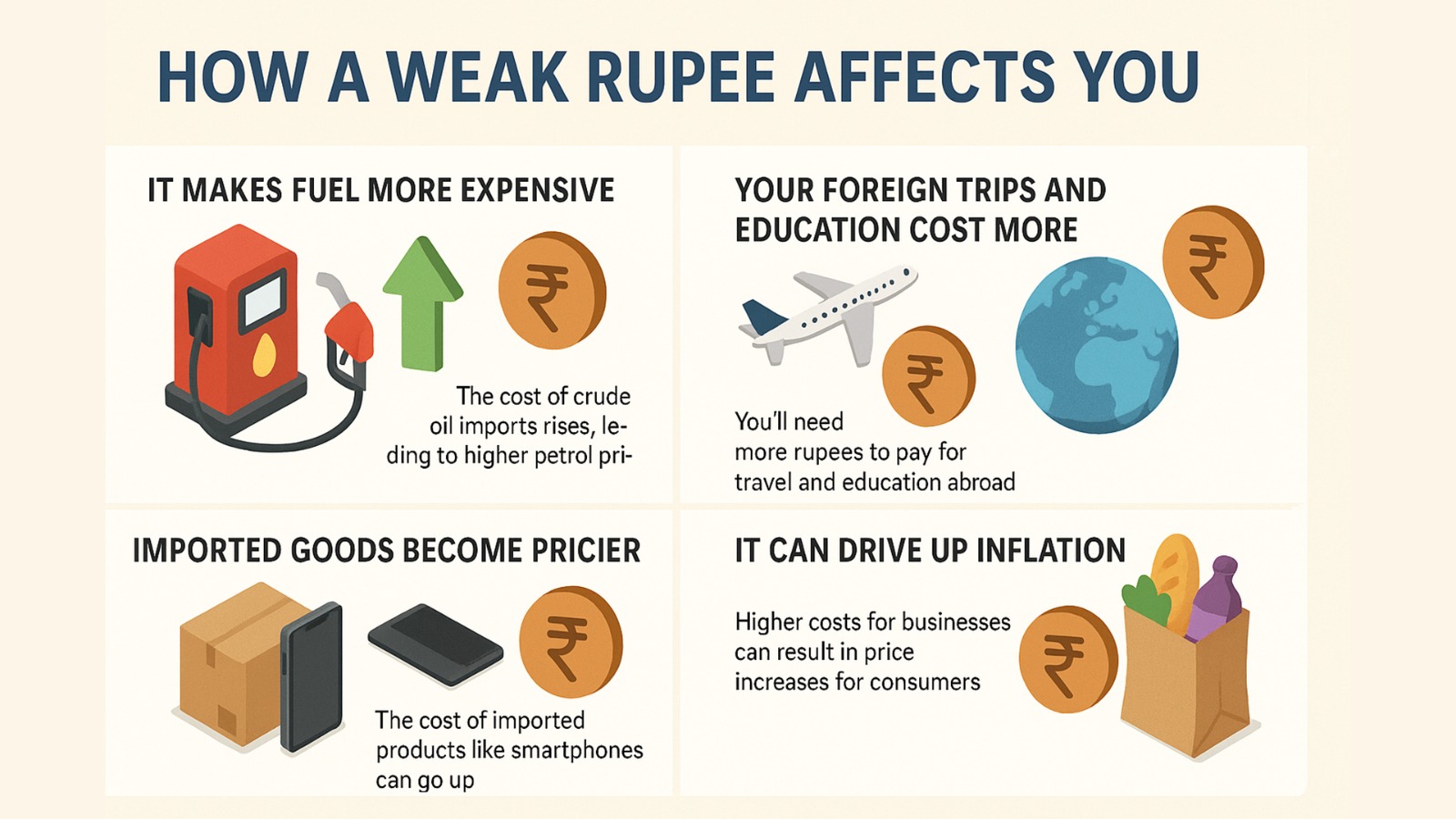
    It Makes Fuel More Expensive

    India imports over 85% of its crude oil, and all of it is paid for in US dollars. When the rupee falls, oil companies have to spend more rupees to buy the same amount of oil. This extra cost is eventually passed on to you at the petrol pump.

    Your Foreign Trips and Education Cost More

    Planning a vacation abroad or sending your child to a university in the US, UK, or Europe? A weaker rupee means your budget will need to be bigger. You will have to spend more rupees to get the same amount of dollars, euros, or pounds needed for tuition fees, accommodation, and travel expenses.

    Imported Goods Become Pricier

    Many products we use daily, from smartphones and laptops to certain appliances, are either fully imported or made with imported components. A weak rupee increases the cost of bringing these items into the country, leading to higher price tags in stores.

    It Can Drive Up Inflation

    When the costs of fuel and raw materials go up for businesses, they often pass those costs on to consumers. This can lead to a general rise in the prices of goods and services, a phenomenon known as inflation. Everything from your grocery bill to transportation costs can start to creep up.

    What Can Be Done to Stabilize the Rupee?

    There is no magic wand, but a combination of government policies and RBI actions can help.

    1. Boosting Exports: The government can introduce policies that make it easier and more profitable for Indian companies to sell their products abroad. This would bring more dollars into the country.
    2. Attracting Foreign Investment: Creating a stable and attractive business environment encourages long-term foreign direct investment (FDI), which provides a steady flow of dollars.
    3. Controlling Imports: While we can’t stop importing essential goods like oil, promoting local manufacturing through initiatives like “Make in India” can reduce our dependence on foreign goods in the long run.
    4. RBI’s Monetary Policy: The RBI can use tools like increasing interest rates to make investing in India more attractive for foreign capital. This can help pull in more dollars, but it’s a delicate balancing act as higher rates can also slow down economic growth.

    The road to a stable rupee involves managing these complex factors. For now, the focus remains on navigating the current economic challenges while building a more resilient economy for the future.

    Frequently Asked Questions (FAQs)

    No. A weaker rupee can benefit exporters because Indian goods and services become cheaper for foreign buyers. Sectors like software services, textiles, and pharmaceuticals often gain from this as it boosts their global competitiveness and sales.

    The US dollar is the most widely used currency for global trade and financial transactions. Since crucial imports like crude oil are priced in dollars, the USD/INR rate becomes the primary benchmark for assessing the rupee’s strength.

    No. Currency movements happen in cycles. While the rupee may weaken during periods of high inflation, global uncertainty, or rising US interest rates, it can strengthen again when economic fundamentals and external conditions improve.

    The RBI intervenes not to fix the rupee at a specific level but to reduce excessive volatility. If the rupee moves too sharply within a short time, the RBI sells or buys dollars to stabilize the market and maintain orderly currency movements.

    Individuals cannot directly influence the exchange rate, but they can make informed choices. Supporting local products reduces import dependence, and understanding how currency changes impact travel, investments, and inflation can help with smarter financial planning.

  • Mutual Fund

    A mutual fund pools money from multiple investors to invest in a diversified portfolio of stocks, bonds, or other securities. Managed by professional fund managers, it allows individuals to invest with relatively low capital while spreading risk across various assets.

  • Demat Account

    A DEMAT or Dematerialised account is a digital depository for holding stocks, bonds, mutual funds, and exchange-traded funds (ETFs). It replaces the conventional tangible share certificates with electronic records. Since the entire process is digital, it enhances the efficiency and safety of securities operations in the financial markets. In India, around 25 million DEMAT accounts were opened during the Financial Year 2023.

  • Stock Trading

    Stock trading offers investors the opportunity to buy and sell shares of companies on the stock market, aiming to profit from price fluctuations.

  • Initial Public Offering (IPO)

    It outlines the process through which private businesses or companies make their shares available for sale to the public. The aim is to raise equity-based capital funds from retail public investors. However, a private company should convert into a public company to become eligible for launching an IPO in the market.
  • Derivatives

    Derivatives are like financial contracts whose value is defined by the underlying asset or a group of assets. These include currencies, stocks, bonds, commodities, and market indices. The value of the underlying assets fluctuates according to market conditions.

  • Futures and Options Trading

    Futures and Options are two important pillars of stock derivatives. These are financial contracts signed by buyer and a seller to trade the stock assets at a pre-defined price on a future date. The primary objective of these contracts is to mitigate market volatility by securing the stock price in advance.

  • Commodities Trading

    Commodities are basic goods generally traded in large volumes. They can be interchangeable or exchanged with other goods or commodities of the same classification. In spot trading, commodities are instantly delivered, whereas, in futures trading, they are dealt with on a conveyance-later basis. The trading market for commodities can be in physical and virtual form, which is the stock exchange.

  • Share Market

    The share market is a regulated financial platform where equity shares of publicly listed companies are issued and traded. It facilitates capital raising for businesses and provides investors with opportunities to participate in corporate growth. Prices are determined by demand–supply dynamics and influenced by economic indicators, corporate performance, and global developments, within a framework governed by regulatory authorities to ensure transparency and investor protection.

