
The NSE IPO opens on Thursday, September 17 and closes on Monday, September 21, with a price band of ₹1,700 to ₹1,785 per share. The offer was cut by about 15% after the draft stage and now raises up to ₹22,569 crore.
Key Takeaways
- The NSE IPO price band is ₹1,700 to ₹1,785 per share, on a face value of ₹1.
- Bidding runs from September 17 to September 21, with listing on BSE tentatively on September 24.
- The offer shrank from 6.02% of the company in the draft prospectus to about 5.11% in the final one.
- At the cap, NSE is valued near ₹4.42 lakh crore, or 42.9 times FY26 earnings, against 66.67 times recorded for BSE.
- Retail investors need a minimum of 8 shares, costing ₹14,280 at the upper end.
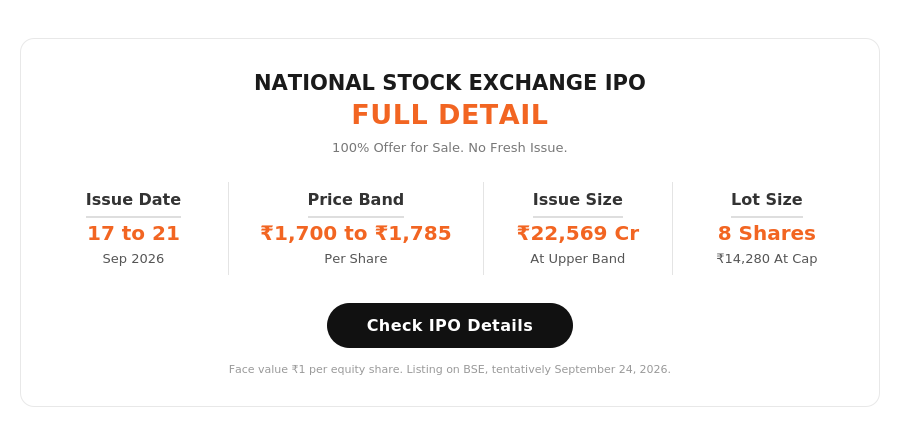
NSE IPO Price Band, Dates and Lot Size
NSE filed its red herring prospectus with SEBI on September 10, 2026, fixing the terms of the issue. The band spans exactly 5%, the usual width for a book build of this size.
The entire issue is an offer for sale by existing shareholders, so NSE receives none of the proceeds. Ashishkumar Chauhan is the managing director and chief executive officer.
| NSE IPO Detail | Particulars |
|---|---|
| Price band | ₹1,700 to ₹1,785 per share |
| Issue opens | Thursday, September 17, 2026 |
| Issue closes | Monday, September 21, 2026 |
| Basis of allotment | Tuesday, September 22, 2026 |
| Shares credited and refunds | Wednesday, September 23, 2026 |
| Tentative listing | Thursday, September 24, 2026, on BSE |
| Minimum lot | 8 shares, and multiples of 8 thereafter |
| Retail minimum at the cap | ₹14,280 |
| Offer type | Offer for sale only, no fresh issue |
| Registrar | MUFG Intime India Private Limited |
Offer terms as per the NSE red herring prospectus dated September 10, 2026. Listing dates are tentative.
What Changed Between the Draft and the Final Prospectus?
The most significant development is one the headlines mostly skip. NSE trimmed the size of the offer between its draft prospectus of June 17 and the final one of September 10.
The draft proposed selling up to 14,89,05,525 shares, or 6.02% of the company. The final version offers up to roughly 12.64 crore shares, about 5.11%. That is close to 2.25 crore fewer shares, a reduction of around 15%.
| Offer Size | Draft Prospectus, June 17 | Red Herring Prospectus, September 10 |
|---|---|---|
| Shares offered | Up to 14,89,05,525 | Up to about 12.64 crore |
| Stake on offer | 6.02% | About 5.11% |
| National Insurance Company | Selling 60,00,000 shares | No longer selling |
| SBI Capital Markets | Not a selling shareholder | Added, offering about 87.8 lakh shares |
Comparison of the June 17 draft prospectus with the September 10 red herring prospectus.
State Bank of India, MS Strategic (Mauritius), Bank of Baroda, Stock Holding Corporation of India and General Insurance Corporation of India each reduced the number of shares they intend to sell.
Canada Pension Plan Investment Board, Aranda Investments (Mauritius), The New India Assurance Company and United India Insurance Company left their portions unchanged.
How Much Is NSE Worth at This Price Band?
Applying the band to the full share count of 2,47,50,00,000 shares gives the implied market value of the exchange. Applying it to the shares on offer gives the size of the issue.
| At the Offer Price | Floor, ₹1,700 | Cap, ₹1,785 |
|---|---|---|
| Implied market capitalisation | ₹4,20,750 crore | ₹4,41,788 crore |
| Size of the offer for sale | About ₹21,494 crore | About ₹22,569 crore |
| Price to FY26 earnings | 40.8 times | 42.9 times |
| Price to book value | 13.1 times | 13.8 times |
| Yield on the FY26 dividend | 2.06% | 1.96% |
Multiples computed on FY26 basic and diluted EPS of ₹41.62, book value per share of ₹129.75 and the recommended FY26 dividend of ₹35 per share, as disclosed in the prospectus.
How Does the NSE IPO Price Compare With BSE?
The prospectus names BSE Limited as the only listed peer, since it runs a comparable multi-asset exchange with a similar revenue mix.
It records BSE trading at 66.67 times FY26 diluted earnings, based on a closing price in June 2026. At the cap of ₹1,785, the NSE IPO is priced at 42.9 times the same year’s earnings.
The comparison needs care. NSE earns roughly 3.4 times BSE’s operating revenue, but BSE reported the higher FY26 EPS at ₹60.61, a higher return on net worth at 45% against 33.21%, and a higher net asset value per share. The BSE multiple also moves with its market price, so check the live figure rather than the June reference.
What Do the FY26 Numbers Behind the Price Show?
NSE reported total income of ₹18,713 crore in FY26 and profit after tax of ₹10,302 crore, down 15.47% from ₹12,188 crore the year before. Operating revenue slipped 3.15% to ₹16,601 crore.
Two things drove the fall. Trading volumes moderated after SEBI’s derivatives measures of October 2024 and May 2025, and the exchange took a one-time provision of ₹1,391.21 crore against settlement applications filed with SEBI.
Strip out the one-offs and the picture shifts. Normalised operating EBITDA margin moved only from 77.69% to 76.23%, while the reported margin fell from 73.78% to 66.85%. Anyone valuing the issue on trailing earnings is working from a year carrying a large exceptional charge.
How Is the NSE IPO Split Between Investor Categories?
- Qualified institutional buyers: 50% of the net offer.
- Non-institutional investors: 15%, with a minimum application of 120 shares, or ₹2,14,200 at the cap.
- Retail individual investors: 35%, with a minimum of 8 shares at ₹14,280 at the cap.
- Eligible employees: a reserved portion of up to 4,33,436 shares, aggregating up to ₹70 crore, with a discount of ₹170 per share.
The employee discount brings the effective price for staff to ₹1,615 a share at the upper end of the band.
What Should Investors Check Before Applying?
The prospectus is candid about concentration. Transaction charges were 78.65% of operating revenue in FY26 and equity options alone contributed 60.22%, so a change in derivatives rules moves most of the business at once.
The colocation and dark fibre matters also remain open, with settlement applications of ₹1,491.21 crore pending before SEBI and related appeals pending before the Supreme Court.
Bidding requires a demat account to hold any shares allotted, and subscription figures, allotment status and the listing can be followed through an online trading platform once the issue opens.
Investments in securities markets are subject to market risks. This article is for information purposes only and is not investment advice.
Leave a Reply