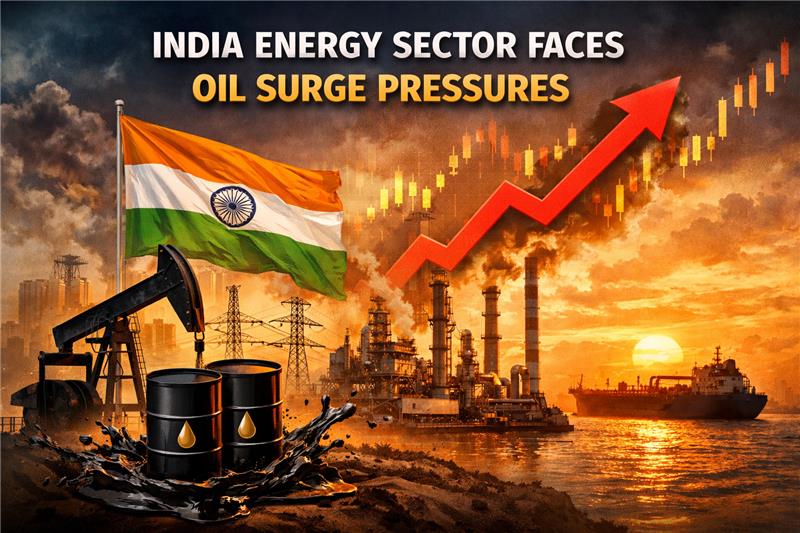
The Indian energy sector is navigating heightened volatility as global oil prices spike above $100 per barrel for Brent crude, triggered by the collapse of U.S.-Iran talks and a subsequent U.S. blockade of the Strait of Hormuz. This geopolitical escalation, announced over the weekend, has sent shockwaves through domestic markets, with implications for key players like Reliance Industries and ONGC. On Monday, the NIFTY 50 dipped 0.8% to close at 23,450 points, while the SENSEX shed 650 points to 77,200, reflecting investor caution amid rising import costs for crude oil, which constitutes over 85% of India’s energy needs. The Reserve Bank of India (RBI) faces mounting pressure to manage inflationary risks, with analysts warning of a potential 50-70 paisa depreciation in the INR per dollar in the near term. Energy stocks bore the brunt, with Reliance Industries shares falling 2.1% and ONGC declining 3.4%, underscoring the sector’s vulnerability to external shocks.
Key Highlights
- Brent crude surges above $100/bbl following U.S. blockade of Strait of Hormuz after failed U.S.-Iran talks.
- NIFTY Energy index drops 4.2% on Monday, dragging NIFTY 50 lower by 0.8% to 23,450.
- Reliance Industries market cap erodes by Rs 28,000 crore; ONGC loses 5% in value amid refining margin squeeze.
- INR weakens 0.6% to 84.75/USD, amplifying oil import bill estimated at $12 billion monthly.
- Analysts project 11-15% YoY rise in India’s energy inflation, pressuring RBI’s 4-6% CPI target.
Oil Price Shock Hits Indian Refiners
The abrupt rise in Brent crude to over $100 per barrel has intensified cost pressures on India’s oil refining giants, particularly Reliance Industries and ONGC. Reliance, India’s largest refiner with a capacity of 1.24 million barrels per day at its Jamnagar complex, saw its gross refining margins (GRM) compress by an estimated 20% in Q1 FY27 previews, as higher crude input costs outpaced product realizations. Trading data from NSE shows Reliance’s stock trading at a forward P/E of 22x, down from 25x a week ago, with intraday volumes surging 40% to 12 million shares on Monday.
ONGC, the nation’s biggest explorer, faces dual headwinds: elevated drilling costs and stalled output growth amid geopolitical disruptions in key supply routes. The company’s oil and gas production dipped 2.3% YoY in the latest quarter, with realizations per barrel jumping 18% but insufficient to offset capex overruns. BSE data indicates ONGC’s market cap at Rs 3.8 lakh crore post-decline, with foreign institutional investors (FIIs) offloading Rs 1,200 crore worth of shares in the energy basket over the past 24 hours. “The Strait blockade risks pushing oil towards $130/bbl, a level that could erode 300-400 basis points from refiners’ EBITDA margins,” noted Kotak Institutional Equities analyst Ravi Shah in a client note.
RBI’s forex reserves, at $680 billion as of last Friday, provide a buffer, but sustained high oil prices could widen the current account deficit to 2.2% of GDP from 1.8%, per HSBC estimates. The central bank’s recent 25 bps repo rate cut to 6.25% now appears vulnerable to reversal if pass-through inflation accelerates. Investors looking to participate in this market movement can open demat account through SEBI-registered brokers.
Energy Stocks Drag Benchmarks Lower
Indian benchmarks closed sharply lower on Monday, with the NIFTY 50 at 23,450 (-0.8%) and SENSEX at 77,200 (-0.8%), led by a 4.2% plunge in the NIFTY Energy index to 18,950 points. Reliance Industries, weighting 12% in NIFTY 50, contributed 45 points to the decline, while ONGC’s 1.5% weight amplified losses in midcap energy plays. NSE turnover hit Rs 1.2 lakh crore, with energy sector open interest rising 15% in crude oil futures, signaling hedging activity.
Broader energy firms like BPCL and HPCL shed 5-7%, as India’s oil import dependency—4.8 million barrels per day—translates to a $140 billion annual bill at current prices. “Refiners are passing on 60-70% of crude hikes to consumers, but diesel and aviation fuel margins are thinning fastest,” observed Motilal Oswal’s sector head Prashant Jain. ONGC’s gas segment offers some respite, with domestic pricing reforms boosting realizations to $8.5/MMBtu, up 12% YoY, though volumes remain flat at 62 MMSCMD.
INR depreciation to 84.75/USD exacerbated the pain, lifting the oil bill by Rs 5,000 crore monthly per 1% currency slide, per SBI Caps calculations. FII outflows totaled Rs 2,800 crore on Monday, with energy attracting 40% of the selling, per NSE data. This development presents new considerations for stock investment strategies focused on Indian equities.
Key Players Performance Snapshot
| Company | Share Price Change | Current Price (Rs) | Key Metrics |
|---|---|---|---|
| Reliance Industries | -2.1% | 2,810 | YTD -5%; GRM outlook 8-10 USD/bbl Q2 FY27 |
| ONGC | -3.4% | 245 | Production 22.5 MMT oil equiv. FY26; Dividend yield 4.2% |
| BPCL | -5.8% | 580 | Capacity utilization 105%; Debt/equity 0.65x |
| HPCL | -6.2% | 420 | Marketing margins Rs 1.2/bbl; Capex Rs 65,000 crore FY27 |
| IOC | -4.9% | 145 | Upstream stake sales eyed for Rs 10,000 crore proceeds |
This snapshot reveals refiners underperforming explorers, with ONGC’s upstream exposure providing relative stability despite price volatility. Midcaps like GAIL (-2.9%) and Petronet LNG (-3.1%) lagged, as LNG imports at $13/MMBtu face substitution risks from pricier spot crude.
Market Outlook
Looking ahead, Indian investors should monitor Strait of Hormuz flows, with any escalation to $130/bbl risking a 1-1.5% GDP drag via higher inflation and tighter RBI policy. Reliance’s green energy pivot—Rs 75,000 crore capex in solar and hydrogen—positions it for long-term resilience, potentially lifting EBITDA 15% by FY28. ONGC’s KG basin ramp-up to 20 MMT/year could shield 10-12% of output from imports. Watch RBI’s April 30 policy for hawkish signals, NIFTY Energy support at 18,000, and INR at 85/USD. Upside catalysts include U.S.-Iran de-escalation or OPEC+ hikes, but downside risks dominate near-term. Retail participation has grown significantly as access to a reliable trading platform has become more widespread.
Conclusion
India’s energy sector stands at a geopolitical inflection point, with oil above $100/bbl testing the resilience of Reliance, ONGC, and peers amid benchmark declines and INR pressures. While RBI buffers and domestic reforms mitigate shocks, investors must prioritize hedged positions in upstream assets and diversify into renewables. Strategic vigilance on global supply chains will define portfolio outcomes, as the sector’s fundamentals—bolstered by rising domestic consumption at 5.5% CAGR—underpin a measured recovery trajectory.
Leave a Reply