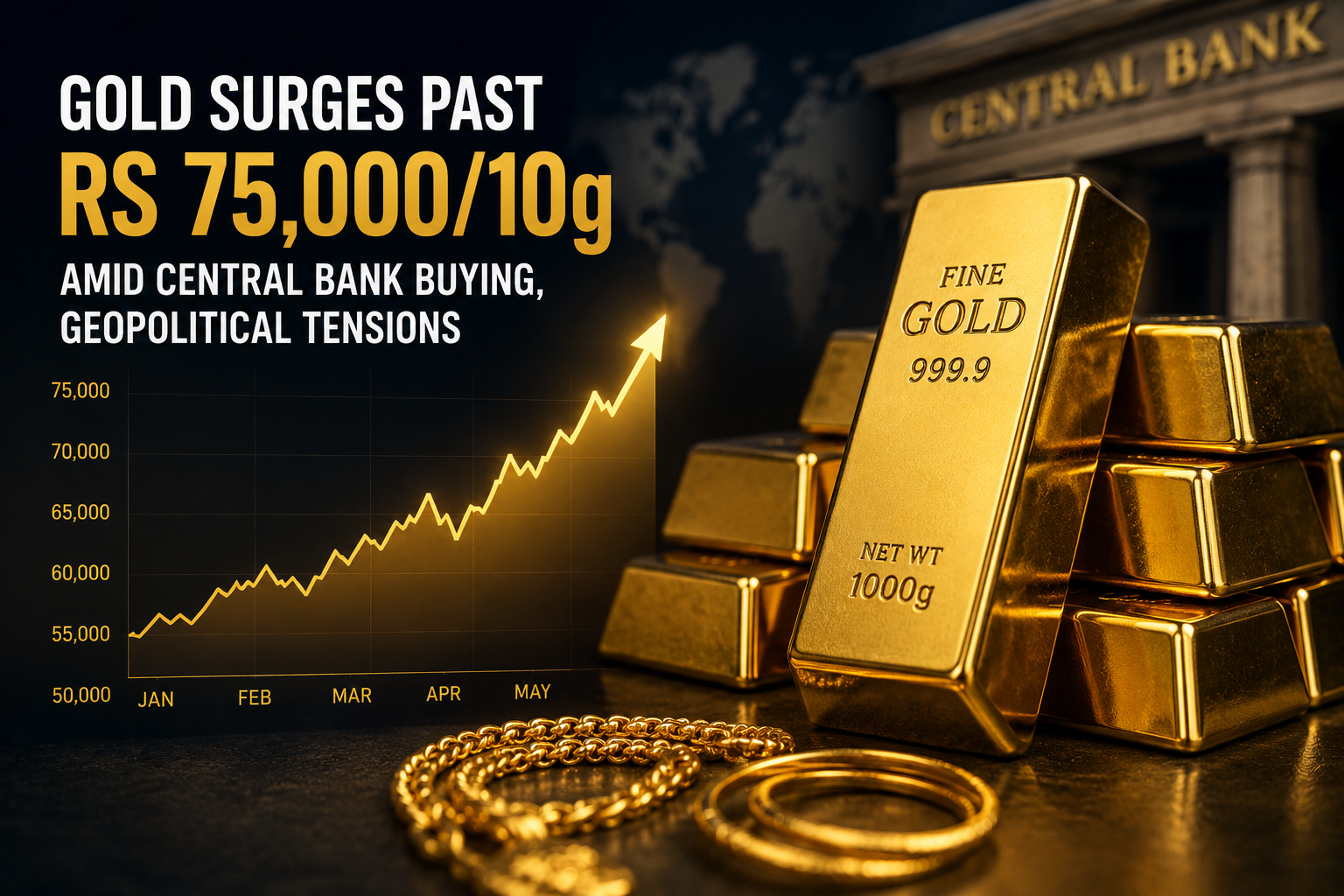
Gold prices in India have breached the psychologically significant Rs 75,000 per 10-gram mark this week, marking fresh all-time highs in the domestic bullion market. The rally, driven by sustained central bank purchases globally and escalating geopolitical tensions, represents the strongest gold market environment in over a decade. For Indian investors accustomed to viewing gold as a portfolio stabilizer and inflation hedge, understanding the mechanics behind this surge and its sustainability becomes crucial for asset allocation decisions. This analysis examines the fundamental drivers, technical positioning, and strategic implications for Indian wealth management.
Key Highlights
- MCX gold futures have surged past Rs 75,000 per 10 grams, with spot prices following suit, representing gains of approximately 18-22 percent over the past 12 months
- Global central banks have collectively purchased over 1,000 tonnes of gold annually in recent quarters, the highest pace since the financial crisis, with emerging market central banks leading demand
- Geopolitical flashpoints across multiple regions have rekindled safe-haven demand, with investors reducing exposure to currency-based assets and shifting toward tangible stores of value
- Gold ETF inflows into Indian equity-linked gold schemes have accelerated, with investors seeking exposure without physical storage constraints
- Mining stocks listed on Indian bourses have rebounded sharply, with major players delivering stock price gains exceeding 35 percent year-to-date as operational leverage to higher gold prices kicks in
What’s Driving Gold to Record Highs
The unprecedented surge in gold prices reflects a convergence of structural and cyclical factors reshaping global financial dynamics. Central bank gold accumulation stands as the primary catalyst, with monetary authorities in developing economies treating gold as a reserve asset alternative to weakening foreign currencies. This systematic buying, coupled with concerns regarding currency reserves and geopolitical alignments, has created a persistent bid under the precious metal.
Simultaneously, elevated geopolitical tensions across multiple regions have rekindled safe-haven demand. Investors globally are reassessing currency exposure and portfolio concentration in government securities, driving a reallocation toward gold and precious metals. The perception of delayed monetary policy normalization in major economies, combined with persistent inflation expectations, has further supported gold valuations.
For Indian investors specifically, weakening rupee dynamics relative to developed market currencies have amplified the appeal of gold holdings. The rupee’s depreciation against the US dollar by approximately 3-4 percent over recent months has made rupee-denominated gold prices rise more sharply than underlying spot prices in international markets. This currency component creates an additional tailwind for domestic precious metals demand.
Supply constraints also merit consideration. Mining production globally faces disruptions from energy costs and environmental regulations, while recycled gold supply remains limited. This supply-demand imbalance, absent a significant demand destruction, should continue supporting price floors at elevated levels. The confluence of these factors suggests this is not merely a speculative bubble but a fundamental repricing of gold’s role in global portfolios.
Global Central Bank Gold Purchases Surge
Central banks worldwide have emerged as the dominant structural buyer in precious metals markets. In the past four quarters, global central banks have collectively purchased approximately 1,100-1,200 tonnes of gold, representing the strongest accumulation trend since the immediate post-financial crisis period. This purchasing rate exceeds pre-pandemic averages by approximately 40 percent, signaling a deliberate strategic shift.
Emerging market central banks, particularly those in Asia and Central Asia, account for roughly 70 percent of these purchases. Nations seeking to diversify away from dollar holdings and strengthen foreign exchange reserves have prioritized gold accumulation. The BRICS bloc nations, including India’s own RBI, have incrementally increased gold reserves as part of broader de-dollarization initiatives, though at a measured pace consistent with market stability.
Developed market central banks, traditionally net sellers, have shifted to neutral or modest accumulation positions. This reversal of historical patterns, where Western central banks were gold reserve accumulators during the Bretton Woods era and then diversified away during the dollar-dominant post-Cold War period, signals profound changes in confidence structures. The quarterly pace of central bank purchases has remained remarkably consistent, suggesting policy-driven rather than speculative demand.
Geopolitical Tensions and Safe Haven Demand
Regional conflicts and political uncertainties have systematically elevated gold’s appeal as a portfolio stabilizer. Investors facing currency risks from sanctions regimes, capital controls, or currency debasement fears have increased gold allocations as non-correlated assets. This dynamic particularly affects portfolios exposed to emerging market currencies, where depreciation risks remain tangible despite central bank intervention efforts.
The fragmentation of the global financial system, with parallel structures emerging as alternatives to Western-dominated payment systems, has elevated the strategic value of gold holdings for central banks and institutional investors. Gold’s universal acceptance and divisibility make it an optimal reserve asset in scenarios of financial system disruption. This geopolitical dimension, distinct from traditional cyclical demand drivers, imparts structural characteristics to the current bull market.
Gold Price Technical Analysis and Key Levels
From a technical perspective, MCX gold has decisively broken above key resistance levels. The previous resistance around Rs 72,500 was breached in recent weeks, with the current breakout above Rs 75,000 establishing new highs. Volume analysis shows this breakout accompanied by elevated trading activity, suggesting conviction rather than narrow speculative momentum. Traders are observing this as a confirmed uptrend structure rather than a short-term spike.
The immediate technical target for MCX gold futures extends toward Rs 78,000-80,000 per 10 grams, based on standard chart projections and fibonacci extensions from recent lows. Key support levels are established around Rs 73,500 and Rs 72,000, with any pullback toward Rs 70,000 representing more significant support in the intermediate term.
Volatility metrics show elevated realized volatility, with daily price swings of 200-300 rupees becoming routine. This expanded price range reflects genuine underlying uncertainty and positioning shifts rather than illiquidity. Retail investor participation through commodity exchanges has intensified, bringing retail buying alongside institutional accumulation.
The technical setup suggests further upside remains plausible, though at increasingly stretched valuations. Any significant negative catalysts regarding geopolitical risks or central bank policy could trigger profit-taking from 20-30 percent from current levels before finding support.
Impact on Indian Gold Market and Investors
Elevated gold prices create nuanced consequences across India’s domestic gold market. Jewelry demand, which accounts for approximately 40-45 percent of India’s annual gold consumption, faces potential headwinds as retail purchasing power declines at higher price points. Historical data shows jewelry demand elasticity of approximately -0.6, meaning each 10 percent price increase reduces volume demand by roughly 6 percent. Wedding season consumption and festival-period purchases may contract marginally despite cultural preferences.
However, the investment component of Indian gold demand shows counter-cyclical behavior. Higher prices trigger insurance-type buying from wealth-conscious investors viewing gold as financial protection. The net impact on total demand remains uncertain, though volumes across MCX and spot markets have increased substantially. The gold loan sector, which intermediates approximately 2,500-3,000 tonnes annually in India, faces improved margins as collateral values rise, benefiting NBFC and bank balance sheets.
The RBI’s regulatory stance toward gold remains accommodative. Gold monetization schemes and digital gold platforms have normalized precious metals access for retail investors without physical handling. This infrastructure development creates tailwinds for sustained investment demand regardless of spot price levels, as younger cohorts access gold through technology-enabled channels rather than traditional jewelers.
Gold ETF Inflows and Performance
Gold-focused ETFs and fund of funds in India have experienced exceptional inflows this year. Schemes tracking MCX gold and international gold benchmarks have collectively gathered approximately Rs 8,000-10,000 crore in net inflows since the calendar year began. Performance has been commendable, with leading gold ETFs delivering returns exceeding 18-20 percent, substantially outperforming broad equity indices.
Investors seeking exposure without physical storage constraints or making-charges have increasingly favored these vehicles. Digital platforms have simplified accessibility, allowing investors to open demat account online and gain commodities exposure within minutes. The convenience factor has democratized precious metals investment, bringing retail participation from tier-2 and tier-3 geographies that previously accessed gold exclusively through physical channels.
Expense ratios for domestic gold ETFs range from 0.40 percent to 0.65 percent annually, competitive against international alternatives. The combination of liquid underlying assets, transparent pricing, and tax-efficient structures has elevated gold ETFs as core portfolio holdings for financial advisors structuring balanced portfolios.
Gold Mining Stocks Rally
Indian gold mining stocks have responded vigorously to the precious metals rally. Major listed entities in the gold mining and exploration space have delivered stock price appreciation of 35-45 percent year-to-date, benefiting from operational leverage to higher commodity prices. These companies, which were trading at compressed valuations during the prolonged gold bear market, now present interesting opportunities for investors seeking exposure to the precious metals theme through equity markets available on the best stock trading and investing platform in India.
Trading & Investment Guides
- What is Demat Account?
- What are Exchange Traded Funds (ETFs)?
- What is Silver ETF?
- What is Gold ETF?
- Best Algo Trading Platform
Leave a Reply