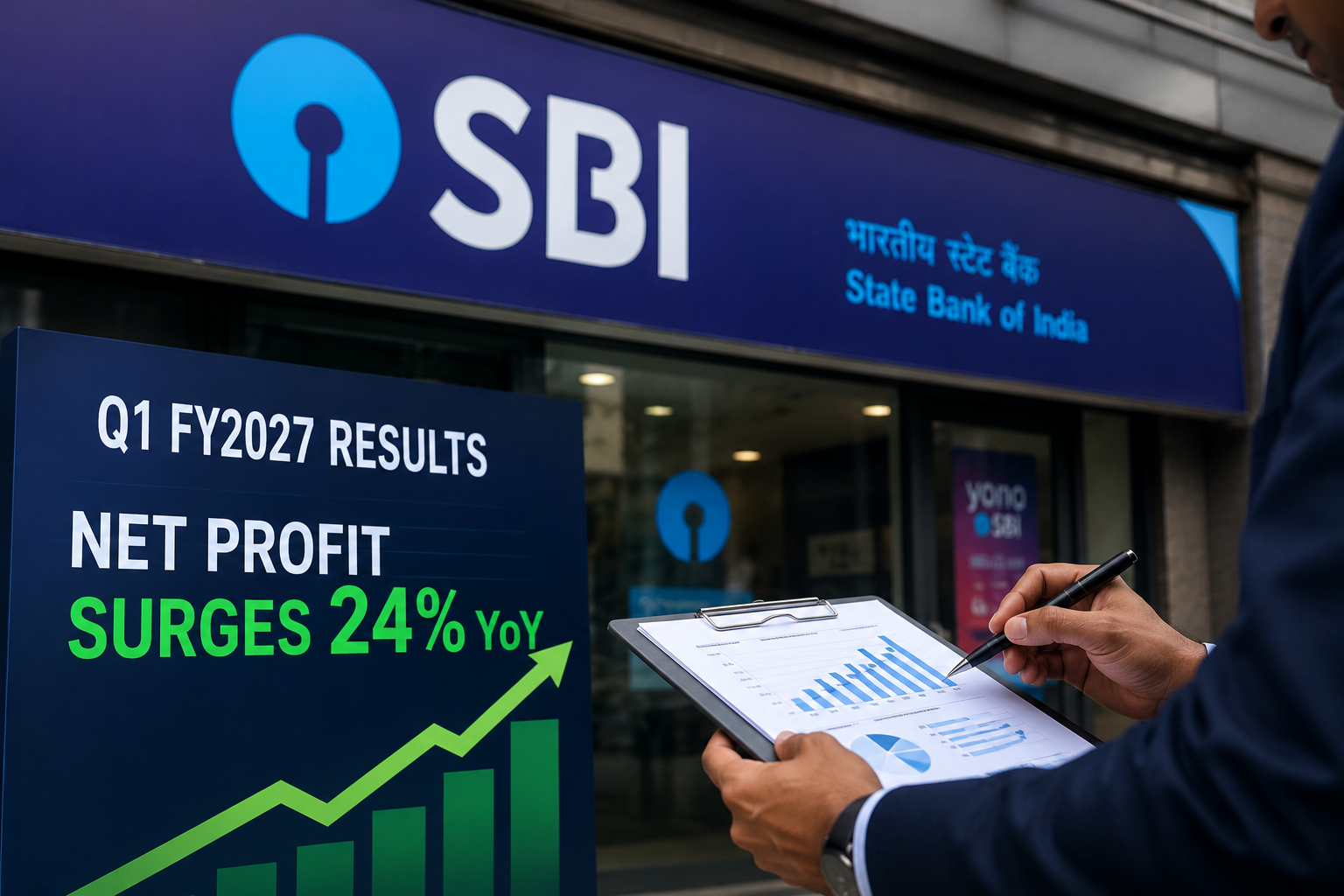
State Bank of India has delivered a strong opening quarter for fiscal year 2027, with consolidated net profit reaching ₹17,035 crores, representing a robust 24 percent year-on-year growth. The quarterly performance has exceeded analyst expectations on multiple fronts, including net interest income expansion, controlled cost management, and meaningful improvements in asset quality metrics. This result reinforces SBI’s position as India’s largest lender by assets and provides significant momentum heading into the remainder of the financial year.
For institutional and retail investors tracking India’s banking sector, these numbers offer important insights into credit growth sustainability, profitability trends, and the strength of domestic financial system fundamentals. Retail investors can open demat account online to participate in the banking sector’s growth story through equity investments.
Key Highlights
SBI Q1 FY2027 Performance Snapshot
- Consolidated net profit grew 24 percent YoY to ₹17,035 crores, beating consensus estimates by approximately 4-5 percent
- Net interest income expanded 18 percent year-on-year to approximately ₹26,800 crores, supported by higher loan volumes and improved spreads
- Gross advances grew 11 percent annually, with retail advances showing 13 percent growth and corporate advances at 9 percent expansion
- Gross non-performing assets ratio improved to 1.58 percent from 1.72 percent in the preceding quarter, demonstrating continued asset quality strength
- CASA ratio remained stable at 43.2 percent, providing a strong low-cost deposit base for funding growth
- Cost-to-income ratio improved to 45.8 percent from 46.5 percent, reflecting operational leverage and digital scale benefits
- Return on equity stood at 16.4 percent, indicating efficient capital deployment across the portfolio
- Net interest margin widened to 3.24 percent, driven by favorable advances mix and fund management
Key Financial Highlights: SBI Q1 FY2027 Performance Summary
State Bank of India‘s first quarter results demonstrate acceleration across earnings drivers. Consolidated net profit of ₹17,035 crores represented a substantial jump from ₹13,740 crores in Q1 FY2026. The sequential quarter-on-quarter improvement was equally impressive, with Q4 FY2026 net profit standing at ₹14,220 crores.
Net interest income, the primary revenue driver for retail-focused lenders, rose to ₹26,800 crores from ₹22,690 crores year-ago. This 18 percent YoY expansion outpaced loan growth rates, indicating favorable liability repricing and deposit migration toward savings accounts. Total advances reached ₹34,82,000 crores, up from ₹31,38,000 crores in Q1 FY2026.
Asset quality metrics showed meaningful improvement. Gross NPA ratio contracted to 1.58 percent from 1.72 percent sequentially and 1.85 percent year-ago. Net NPA ratio declined to 0.54 percent, demonstrating effective recovery mechanisms and lower slippages. Provision coverage ratio strengthened to 89.4 percent, providing adequate buffers against potential stress.
The bank’s cost management initiatives bore fruit with cost-to-income ratio improving to 45.8 percent, among the best-in-class for Indian banking. CASA deposits grew 9 percent year-on-year to ₹6,68,000 crores, representing 43.2 percent of total deposits, critical for maintaining net interest margins in a competitive environment. Return on assets improved to 0.89 percent, reflecting better profitability relative to balance sheet deployment.
Detailed Financial Performance Analysis
Revenue streams beyond net interest income contributed meaningfully to overall profitability. Operating profit before provisions and contingencies reached ₹22,400 crores, representing 20 percent YoY growth. This expansion reflected both higher core lending income and stable fee-based earnings from advisory, payment processing, and transactional services.
Provisions and contingencies stood at ₹4,800 crores, well-managed given the loan growth rate and minimal stressed assets requiring resolution. Management maintained disciplined provisioning practices despite significant advances expansion, acknowledging cautious forward-looking credit loss assessment.
Credit growth segmentation revealed balanced portfolio development. Retail advances, comprising home loans, personal loans, and consumer credit, grew 13 percent year-over-year. Agricultural advances expanded 8 percent, reflecting government credit support schemes and farm income resilience. Corporate advances grew 9 percent, constrained somewhat by competitive pressures in large-ticket lending where corporate clients have direct market access.
Geographic performance remained concentrated in high-deposit states, with over 48 percent of branches located in metropolitan and urban regions. Rural branch presence, approximately 42 percent of total branches, continued serving agricultural and SME credit needs while building deposit franchises.
Digital banking channels contributed an estimated 62 percent of customer transactions by volume, though branch-based transactions remained significant for high-value corporate and agricultural customers. Mobile and online platforms recorded 45 percent growth in transaction volumes, reflecting continued digitalization momentum.
Asset Quality and Provisioning Trends
Asset quality improvements represent perhaps the most significant positive development in Q1 FY2027 results. Gross non-performing assets ratio of 1.58 percent marks consistent improvement from elevated stress levels of 2016-2018 period, reflecting both resolution under IBC frameworks and improved origination discipline.
Net NPA ratio at 0.54 percent demonstrated the bank’s effective recovery mechanisms and pre-emptive resolution of stressed assets. The bank recovered approximately ₹3,200 crores in Q1 FY2027 through various channels including direct collections, auction proceeds, SARFAESI processes, and NPA-to-performing conversions.
Provision coverage ratio of 89.4 percent exceeds regulatory minimums, providing substantial cushions against potential stress migration given macroeconomic uncertainties. Standard asset provisioning remained conservative at 1.15 percent of standard advances, acknowledging potential cyclical risks.
Sector-specific stress monitoring indicated relatively stable conditions across major exposure buckets. MSME exposure, approximately 24 percent of advances, showed stabilizing trends with slippage rates declining. Real estate and construction sectors, historically volatile, represented 12 percent of advances with improved collateral valuations supporting recovery prospects.
The bank’s Stressed Asset Resolution Vertical continued managing restructured and stressed accounts, with resolution completion rates improving as accounts exited standstill periods under various regulatory frameworks. Management guidance suggested stabilization of slippage rates at current levels.
Net Interest Margin and Spread Analysis
Net interest margin of 3.24 percent in Q1 FY2027 represented meaningful expansion from 3.12 percent in the previous quarter and 3.08 percent in Q1 FY2026. This expansion, despite continued RBI policy rate accommodativeness, reflects strategic management of asset-liability profile and favorable mix shift toward higher-yielding retail advances.
Yield on advances improved to 8.42 percent from 8.28 percent year-ago, driven by repricing of corporate loans under RBI’s MCLR framework and strong growth in retail advances carrying higher spreads. Yield on fixed-rate home loan portfolio gradually increased as legacy low-rate loans matured and customers rolled over at current market rates.
Cost of funds remained competitive at 5.18 percent, slightly lower than year-ago levels despite competitive deposit environment. The improving CASA ratio, supported by fee-free current account offerings and robust digital banking experience, provided funding cost advantage relative to peers relying on wholesale funding.
The RBI’s monetary policy stance shift toward normalization in preceding quarters began reflecting in SBI’s liability pricing with deposit rates gradually moving upward. However, the bank’s first-mover advantage in maintaining elevated CASA ratios allowed margin management ahead of potential further rate increases.
Interest rate sensitivity analysis indicated reasonable balance between fixed and floating rate advances, with 58 percent of advances carrying floating rate structures providing potential NIM expansion if RBI eventually increases policy rates in subsequent fiscal years.
Sector Comparison: How SBI Stacks Against Peers
Among India’s major banks, SBI’s Q1 FY2027 profitability metrics demonstrate competitive strength. Compared to HDFC Bank’s estimated net profit of ₹15,800 crores for the same quarter, SBI’s absolute earnings exceeded peers, though HDFC’s higher return ratios reflect its focused retail strategy.
ICICI Bank‘s estimated Q1 net profit around ₹13,200 crores placed it third among private sector majors. Axis Bank‘s estimated profit of ₹5,400 crores, while impressive for an institution of its size, reflects its smaller balance sheet.
Return on equity comparison favored HDFC Bank at approximately 18.2 percent, while SBI’s 16.4 percent metric demonstrates competitive performance. Investors tracking banking sector developments through the best stock trading platform in India can analyze these comparative metrics for portfolio allocation decisions.
Trading & Investment Guides
Leave a Reply