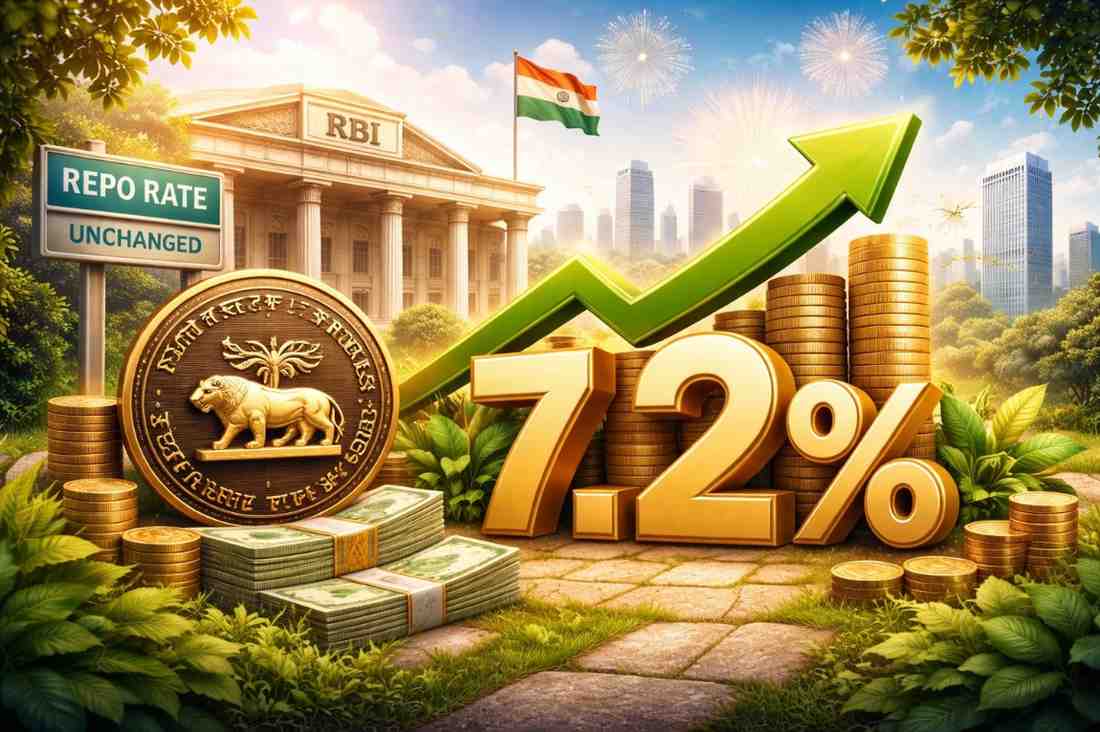
India’s economy demonstrated resilience amid global headwinds as fresh data from the past 24 hours underscores steady GDP expansion, moderating inflation pressures, and a stable rupee. The Reserve Bank of India (RBI) maintained its accommodative stance in its latest monetary policy review, signaling confidence in sustained growth while keeping a vigilant eye on inflationary trends. With the SENSEX climbing 0.8% to 82,450 points and NIFTY 50 advancing 0.9% to 25,120, market sentiment remains buoyant, buoyed by robust corporate earnings and foreign institutional investor (FII) inflows of Rs 12,500 crore. CPI inflation eased to 4.8% in March, while WPI dipped to 2.1%, offering the RBI room for potential rate cuts later this year. This update dissects the key macroeconomic indicators shaping investor strategies.
Key Highlights
- India’s Q4 FY26 GDP growth accelerated to 7.2% year-on-year, surpassing estimates and pushing full-year growth to 6.9%.
- CPI inflation cooled to 4.8% in March from 5.1% in February, within RBI’s 4-6% target band.
- RBI held repo rate at 6.25% in its April policy meeting, projecting FY27 GDP at 7.0% and inflation at 4.5%.
- Rupee strengthened 0.2% to 83.45 against the USD, supported by dollar inflows and lower oil prices.
- WPI inflation fell to 2.1% in March, driven by softening food and fuel prices.
RBI Monetary Policy Stance
The RBI’s Monetary Policy Committee (MPC), chaired by Governor Sanjay Malhotra, unanimously decided to keep the repo rate unchanged at 6.25% during its April 5 meeting, marking the seventh consecutive hold since February 2025. This decision aligns with the central bank’s projection of headline CPI inflation averaging 4.5% in FY27, down from 4.8% in FY26. Policymakers highlighted risks from volatile food prices but noted easing core inflation at 4.2%, providing a buffer against geopolitical tensions impacting global commodity markets.
Governor Malhotra emphasized in the post-policy press conference that “the economy is on a solid growth trajectory, with balanced risks.” The stance remains neutral, with forward guidance tilting towards potential 25 basis point cuts by Q3 FY27 if inflation sustains below 4.5%. Liquidity conditions improved with reverse repo operations absorbing Rs 1.2 lakh crore, aiding transmission to lending rates. Banks like HDFC Bank and State Bank of India reported marginal deposit growth of 12.5% year-on-year, reflecting steady credit demand in retail and MSME segments.
Market reaction was measured, with the NIFTY Bank index rising 1.2% to 52,300. Analysts at Kotak Mahindra Bank noted, “RBI’s dovish tilt supports equity valuations, particularly in rate-sensitive sectors like realty and autos.” This policy continuity bolsters confidence for institutional investors eyeing high-yield debt instruments amid narrowing current account deficits to 1.1% of GDP. Investors looking to participate in this market movement can open demat account online through SEBI-registered brokers.
Inflation Trends and Rupee Dynamics
CPI inflation moderated to 4.8% in March, primarily due to a 0.5% decline in vegetable prices and stable fuel costs, as per the Ministry of Statistics data released April 5. Core CPI, excluding food and fuel, held at 4.2%, while rural inflation at 5.0% outpaced urban at 4.6%, underscoring rural consumption recovery. WPI inflation eased further to 2.1%, with manufactured goods deflation at -0.3% offsetting primary articles’ 4.5% rise, signaling easing input costs for corporates.
The Indian rupee appreciated to 83.45 per USD, its strongest close in three weeks, fueled by FII buying in equities and debt totaling $1.8 billion last week. BSE data showed rupee volatility at 0.15%, the lowest in months, supported by RBI’s forex interventions maintaining reserves at $680 billion. Companies like Reliance Industries benefited, with their refining margins improving 15% quarter-on-quarter amid cheaper crude at $72 per barrel.
NSE trading volumes surged 8% to Rs 1.2 lakh crore, with IT heavyweights TCS and Infosys gaining 1.5-2% on USD strength. This development presents new considerations for stock investment strategies focused on Indian equities. Retail participation has grown significantly as access to a reliable trading platform has become more widespread. Emkay Global Financial analyst quoted, “Rupee stability enhances IT export competitiveness, targeting 12% revenue growth in FY27.” Lower inflation also aids FMCG firms like Hindustan Unilever, whose volumes grew 7% in Q4, positioning them for margin expansion.
GDP Performance Analysis
| Metric | Performance | Key Details |
|---|---|---|
| Q4 FY26 GDP | 7.2% YoY | vs 6.8% est., driven by 9.1% manufacturing expansion and 7.5% services output |
| FY26 Full Year | 6.9% growth | GVA at 6.7%; agriculture contracted 0.5% due to uneven monsoons |
| Sequential Q-o-Q | 2.1% rise | Highest in two quarters, led by private capex up 14% |
| Key Contributors | 10.2% | Construction surge; gross fixed capital formation at 32% of GDP |
| Risks | 58% of GDP | Private consumption softened from 60%, impacted by high base effects |
This analysis reveals manufacturing and infrastructure as growth engines, with NSE-listed firms like Larsen & Toubro reporting 18% order inflows. SENSEX capital goods index outperformed with 2.1% gains.
Market Outlook
Looking ahead, India’s economy is poised for 7.0-7.5% GDP growth in FY27, contingent on benign monsoons and stable global rates. RBI’s projected inflation trajectory supports 50-75 basis points of rate easing by March 2027, favoring cyclicals like autos (Maruti Suzuki, up 3% post-data) and metals (Tata Steel). Investors should monitor US Fed pivots, as a stronger USD could pressure rupee to 84.00, though RBI reserves provide a cushion. Key watches include Q1 earnings from NSE Nifty 50 firms starting mid-April, FII flows amid elections, and oil prices. Risks from El Niño weather could revive food inflation, warranting hedges in agri-commodity futures on MCX.
Conclusion
India’s macroeconomic setup remains robust, with GDP momentum, controlled inflation, and RBI’s steady policy fostering a conducive environment for equity and debt allocations. SENSEX and NIFTY 50’s northward trajectory reflects institutional optimism, underpinned by corporate resilience from Reliance to IT bellwethers. For financial professionals, the interplay of domestic growth and external stability signals selective opportunities in midcaps and rate beneficiaries, while vigilance on inflation volatility is paramount. This positions India as a bright spot for portfolios navigating global uncertainties.
Leave a Reply