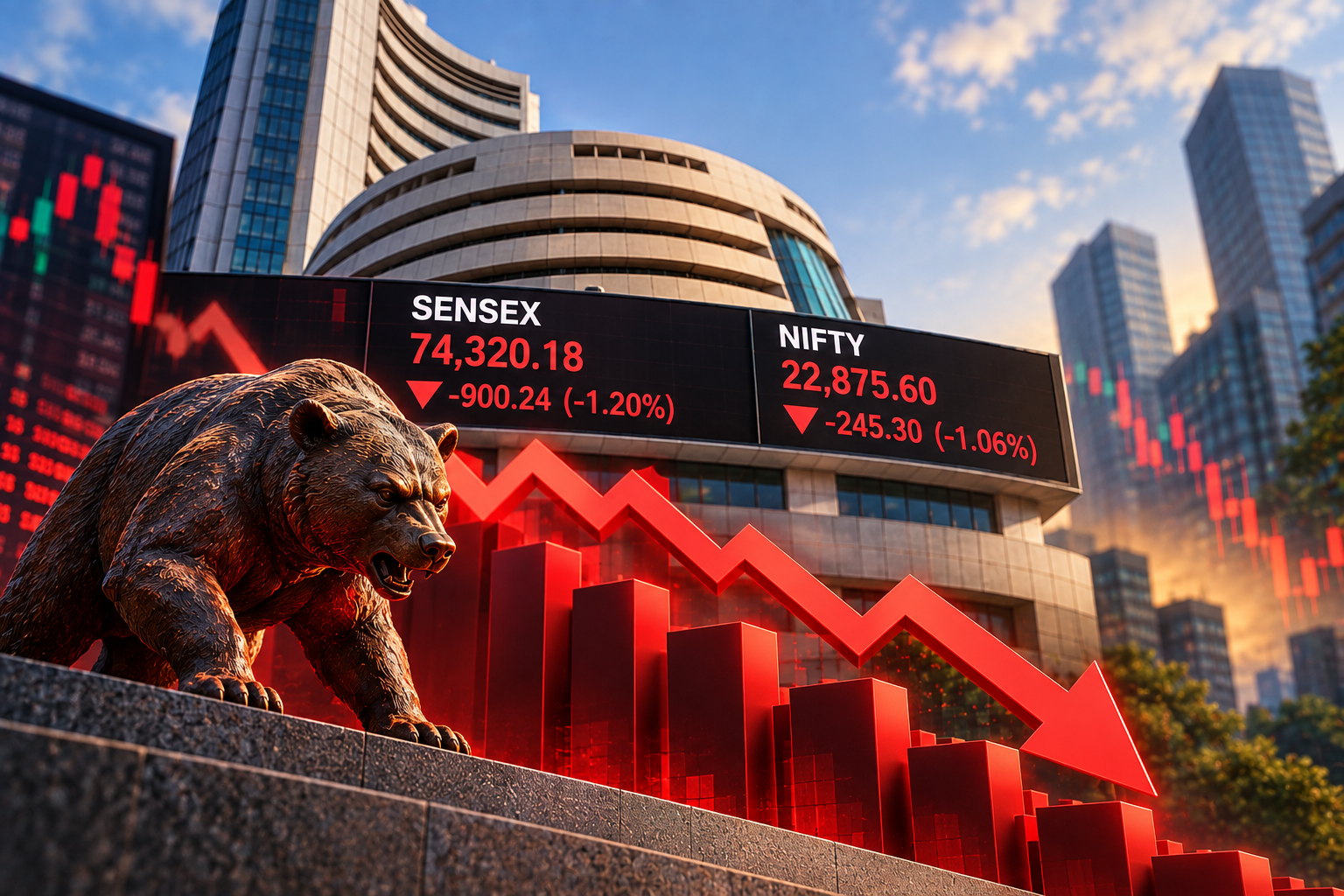
Indian benchmark indices fell sharply in early trade on Monday, 28 September 2026, extending losses after their longest weekly losing streak since 2020. The BSE Sensex declined as much as 900 points, or 1.21 per cent, to 72,995, while the NSE Nifty 50 lost 284 points, or 1.22 per cent, to 22,856.
Higher crude oil prices and a spike in global bond yields, following US President Donald Trump’s rejection of Iran’s latest proposal to reopen the Strait of Hormuz, dampened investor sentiment through the session. All sectoral indices traded in the red in early deals.
How Deep the Fall Went
Broader markets faced intense selling pressure alongside the benchmark indices, with both the midcap and smallcap indices down about 1 per cent each. By around 10:40 am, the Sensex had extended its fall to 935.64 points, or 1.27 per cent, trading at 72,960, while the Nifty slipped to 22,841, down about 300 points.
| Parameter | Details |
|---|---|
| Sensex Intraday Fall | Up to 900 to 936 points (about 1.2-1.3%), to a low near 72,960-72,995 |
| Nifty 50 Intraday Fall | Up to 284 to 300 points (about 1.2%), to a low near 22,841-22,856 |
| Midcap and Smallcap Indices | Both down about 1% in early trade |
| Brent Crude | Up 2.2% to about $106.6 a barrel |
| US WTI Crude | Up 1.45% to about $93.76 a barrel |
| US 10-Year Treasury Yield | Around 5.2% |
Hindalco Industries, Max Healthcare Institute and Kotak Mahindra Bank were among the top losers on the Nifty 50 in early trade. As of 10:00 am, the Sensex was down 858.51 points, or 1.16 per cent, at 73,037.23, and the Nifty 50 was down 258.35 points, or 1.12 per cent, at 22,882.15, with the Nifty Midcap and Smallcap indices down 0.62 per cent and 0.61 per cent respectively at that point.
What’s Driving the Sell-Off
Worries over supply concerns amid the lack of a resolution to the West Asia crisis kept oil prices elevated through Monday’s session. Higher crude prices threaten to drive inflation and widen India’s current account deficit, since the country remains the world’s third-largest oil importer.
Brent crude futures rallied 2.2 per cent to $106.6 a barrel, while US WTI crude jumped 1.45 per cent to $93.76 a barrel. The moves followed President Trump’s rejection of Iran’s proposal, with Iran insisting that only diplomacy can resolve its conflict with the United States and Israel.
- The Sensex and Nifty extended losses after their longest weekly losing streak since the 2020 crash.
- Elevated Brent crude near $106 a barrel and US 10-year yields near 5.2% are cited as the main headwinds.
- Foreign portfolio investors (FPIs), buyers in July and August, turned sellers again in September.
- All sectoral indices traded lower in early deals, with broader midcap and smallcap indices also under pressure.
What Analysts Are Saying
Dr V K Vijayakumar, chief investment strategist at Geojit Investments, said Brent crude at $106 and the US 10-year yield at 5.2 per cent are strong headwinds weighing on markets. He noted that FPIs, who had turned buyers in July and August, turned sellers again in September, a scenario he said would keep the market under pressure in the near term.
The combination of elevated crude, higher global bond yields and renewed FPI selling has been a recurring theme through September, with Monday’s session extending a pattern that began building over the preceding weeks.
How This Connects to the Broader Correction
Monday’s fall builds on a period in which a large share of Nifty stocks have already corrected meaningfully from their 52-week highs, with earlier data showing 18 of the 50 Nifty constituents down more than 20 per cent from their peaks. The fresh intraday fall on Monday adds to that pressure rather than marking a new, unrelated development.
- Crude oil and bond yields remain the two most-cited triggers for the ongoing weakness.
- FPI selling flows are a variable market participants are watching closely this week.
- Broader market indices (midcap, smallcap) are moving in step with the benchmark fall.
- Stock-specific reactions varied, with some counters like Clean Max Enviro Energy defying the broader trend.
What Investors Should Track Next
For long-term investors, a sharp single-day fall driven by external triggers, oil prices and global bond yields, is different from a company-specific development, and the two call for different responses. Reviewing whether portfolio holdings are affected by sector-wide pressure (energy-sensitive sectors, rate-sensitive financials) versus stock-specific news can help make sense of a broad move like Monday’s.
Investors tracking their holdings through a demat and trading account can watch how Brent crude and US Treasury yields evolve over the coming sessions, since both were the most-cited drivers of Monday’s fall. Traders using a trading platform intraday may also want to note the elevated volatility, given the size and speed of Monday’s move relative to recent sessions.
Leave a Reply