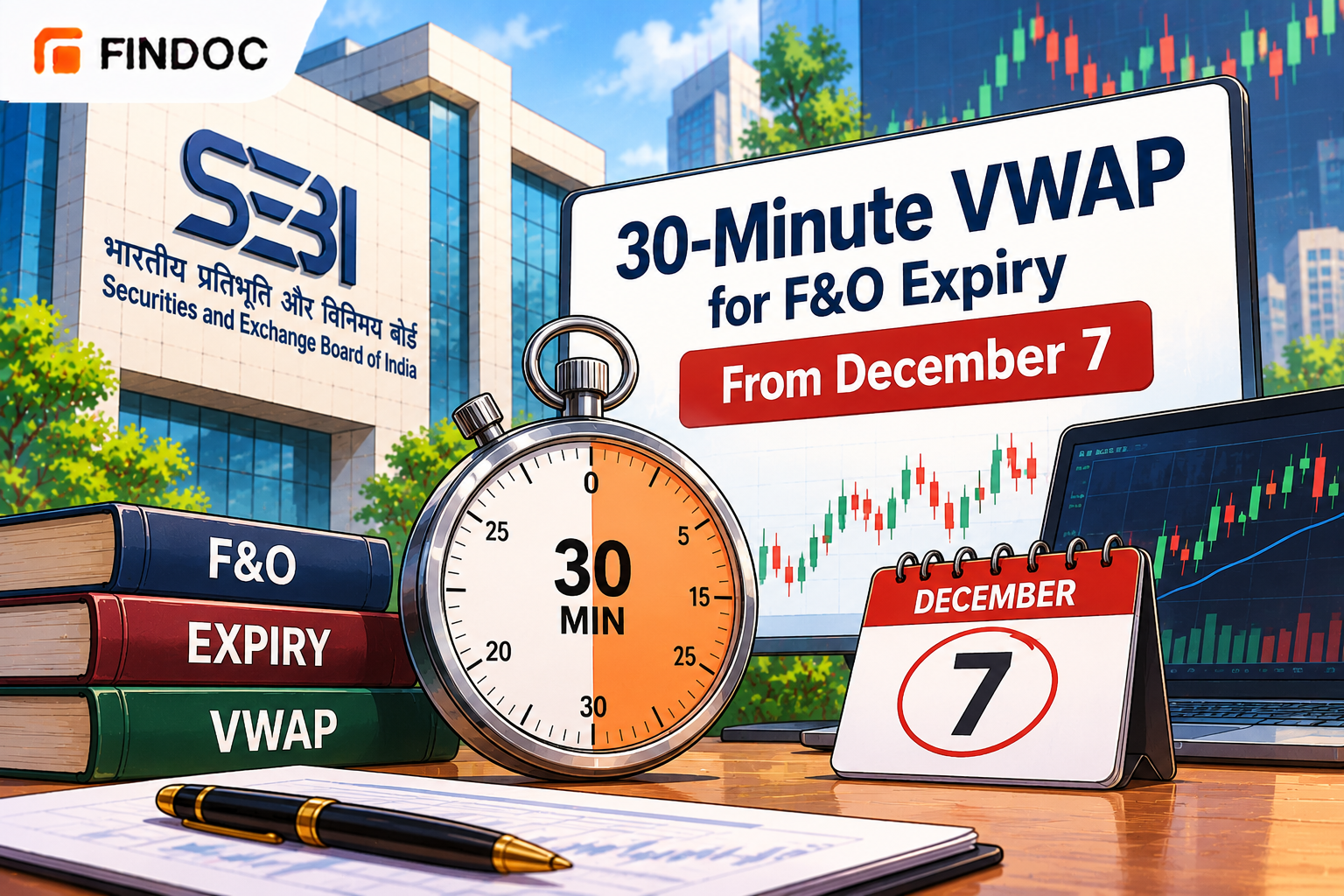
The Securities and Exchange Board of India (SEBI) has reversed a key feature of its closing auction session (CAS) framework. In a circular dated 15 October 2026, the regulator said expiry-day settlement of index and stock derivatives will use the volume-weighted average price (VWAP) of the last 30 minutes of continuous trading, not the CAS closing price. Most of the changes apply from 7 December 2026.
The circular reviews the CAS, market timings and the settlement methodology for derivatives contracts. It follows a consultation paper issued on 12 September 2026 and the public comments received on it.
What SEBI Changed in the Closing Auction Session Rules
SEBI introduced the CAS in the equity cash segment through a circular dated 16 January 2026. The aim was to improve price discovery of closing prices, and the session went live on 3 August. Under that framework, expiry settlement of derivatives was tied to the closing price determined in the auction.
The revised circular delinks the two. The CAS continues to set closing prices in the cash market, but those prices will no longer decide settlement of expiring futures and options.
SEBI’s revised CAS and derivatives settlement framework
| Feature | Revised provision |
|---|---|
| Circular date | 15 October 2026 |
| Closing auction session | 10 minutes, from 3:30 pm to 3:40 pm |
| Index derivatives expiry settlement | Index value based on VWAP of constituent securities in the last 30 minutes of continuous trading |
| Stock derivatives expiry settlement | VWAP of the underlying stock in the last 30 minutes of continuous trading across all exchanges |
| Expiring index derivatives | Stop trading at 3:30 pm on expiry days |
| Stock derivatives | Trade until 3:45 pm, including on expiry days |
| Effective date | 7 December 2026 for most changes |
How Expiry Settlement Will Work From 7 December
For index derivatives, the settlement price on expiry day will be set from the value of the underlying index, calculated using the VWAP of its constituent securities during the last 30 minutes of the continuous trading session in the cash segment. That window runs from 3:00 pm to 3:30 pm.
For stock derivatives, the clearing corporations will determine the settlement price using the VWAP of the underlying stock during the same 30 minutes, across all stock exchanges. The VWAP method was the standard approach before the CAS was introduced.
The new rules take effect on 7 December 2026, so the change applies only from that date. Outlook Money reported that order-transition provisions in the circular start later, on 8 February.
Why SEBI Revisited the Closing Auction Framework
The auction system drew complaints after it began. Bloomberg reported that it produced wild swings in the reference price and caused confusion among market participants. In August, the month the CAS was introduced, average daily turnover in equity derivatives fell to an 18-month low on the NSE and dropped by one-third on the smaller BSE. There was a slight rebound in September.
The circular also addresses operational concerns raised by market participants. It sets out separate CAS timings and defines the treatment and priority of unexecuted limit and iceberg orders.
Liquidity Concerns Raised by Brokers
Eshaan Lazarus, founder and chief executive of broker 021 Trade, said low liquidity in the auction allowed participants with smaller books to influence closing prices, especially in thinly traded instruments. He said a return to VWAP would reduce the scope for such swings and could bring back traders who stayed away over concerns about unfair settlement prices.
Market Reaction and What Analysts Expect
Dhiraj Relli, managing director of HDFC Securities, said participants will now have more clarity and predictability around expiry settlement prices. He expects the move to help restore trader confidence and could bring derivatives volumes closer to levels seen before the CAS over time.
Jefferies analysts said the change should reduce volatility on expiry days, which could benefit brokers whose order volumes remain below pre-auction levels. Market watchers quoted by Bloomberg expect trading in options and futures to improve over time. They added that SEBI’s wider push to curb speculative excesses in derivatives remains in place.
- Proprietary trading desks may find it easier to manage expiry risk.
- Arbitrageurs may find hedging across cash and derivatives easier to execute.
- Brokers and exchanges could see a lift in transaction revenue if activity recovers.
What Derivatives Traders Should Note
Anyone who wants to trade in F&O needs a trading account with the derivatives segment activated, and expiry-day rules affect every open position that runs to settlement. The timing differences between index and stock derivatives matter in particular. Index contracts stop trading at 3:30 pm on expiry days, while stock derivatives continue to 3:45 pm.
Traders who use an online trading platform should check that their broker has updated expiry-day timings and settlement information before 7 December. The exact circular, number HO/47/11/11(3)2025-MRD-POD2/I/23843/2026, is available on the SEBI website.
Timeline of the CAS Framework
Closing auction session: key dates
| Date | Development |
|---|---|
| 16 January 2026 | SEBI introduces the CAS in the equity cash segment |
| 3 August 2026 | CAS goes live |
| 12 September 2026 | SEBI issues a consultation paper on a review |
| 15 October 2026 | SEBI issues the revised circular |
| 7 December 2026 | Revised settlement and timing rules take effect |
The circular is the final framework, so the 30-minute VWAP method returns for expiry settlement after the review. Further operational details will come from the exchanges and clearing corporations.
Related Stock Market Insights
- SEBI – Everything You Should Know About The Stock Market Regulator
- What Are Unlisted Shares? Meaning & Tax Explained
- What Are Dividend Stocks and How to Invest in Them in India?
- What is Option Chain? How to Read NSE Option Chain Data
- What are Futures and Options (F&O)?
Leave a Reply