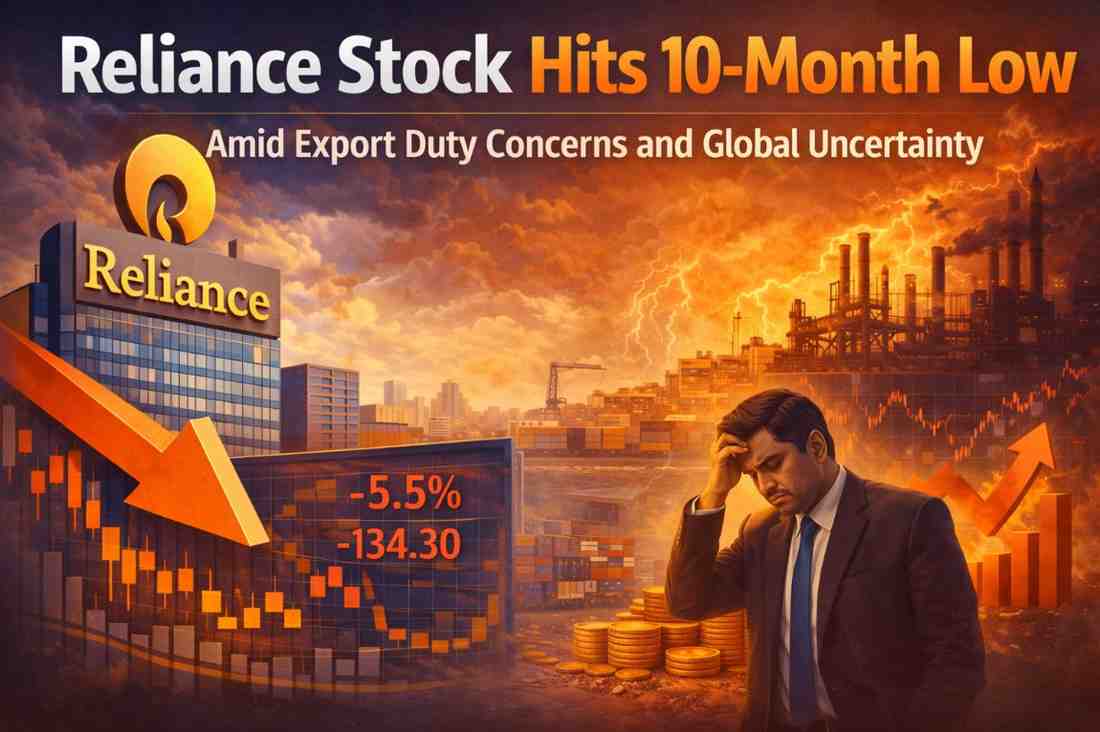
Reliance Industries, India’s most valued company by market capitalisation, is navigating a challenging period as its stock price has declined to over 10-month lows, reflecting broader concerns about government policy interventions and margin compression in the energy sector. The company’s share price fell to Rs 1,300.20 during intraday trading on Monday, marking a 19 percent correction from its 52-week high of Rs 1,611.80 touched on January 5, 2026. This sharp downturn has eroded investor confidence and raised critical questions about the sustainability of refining margins amid new export duties on petroleum products and elevated freight costs. The broader market environment remains cautious, with the Sensex trading near 52-week lows, compounding pressures on heavyweight energy stocks.
Key Highlights
- Reliance Industries stock declined 4 percent on Monday to hit an over 10-month low of Rs 1,300.20, with cumulative losses of 4.70 percent over two consecutive trading sessions
- Government’s new export duty of Rs 21.5 per litre on diesel and Rs 29.5 per litre on aviation turbine fuel is estimated to impact gross refining margins by approximately $2 per barrel
- The stock has corrected 19 percent from its 52-week high, with market capitalisation falling below Rs 18 trillion amid sectoral weakness
- Technical indicators show the stock trading below all major moving averages, signalling sustained downward momentum across multiple timeframes
- Three-month returns have declined 13.46 percent, reflecting deteriorating investor sentiment and margin compression concerns
Export Duty Impact and Margin Compression Concerns
The primary catalyst for Reliance’s recent weakness stems from the government’s decision to impose export duties on refined petroleum products, announced by Union Finance Minister Nirmala Sitharaman on March 27, 2026. The duty structure of Rs 21.5 per litre on diesel and Rs 29.5 per litre on aviation turbine fuel was implemented to ensure adequate domestic availability of these critical products. However, this policy intervention has created significant headwinds for India’s largest refiner, which derives substantial revenue from petroleum product exports.
Analysts at Motilal Oswal Financial Services estimate that the export duty will reduce Reliance’s overall gross refining margin by approximately $2 per barrel, assuming the tax does not apply to the company’s Special Economic Zone volumes. This margin compression represents a material impact on profitability, particularly given the already challenging operating environment characterised by elevated crude oil prices and volatile international markets. The uncertainty surrounding the precise applicability of these duties to different product streams and export destinations has added to investor anxiety.
Beyond the export duty, Reliance faces additional operational headwinds. The company has diverted propane production toward liquefied petroleum gas to address domestic LPG shortages, a decision that weighs on overall profitability despite its social utility. Furthermore, despite sharp increases in crude oil prices, Reliance has refrained from implementing retail fuel price hikes, absorbing margin pressures to maintain competitive positioning in the domestic market. These strategic decisions, while prudent from a market share perspective, have constrained near-term earnings visibility and affected overall stock investment considerations in the energy sector.
Technical Deterioration and Sectoral Weakness
The technical positioning of Reliance Industries stock presents a concerning picture for near-term investors. The stock is currently trading below all major moving averages, including the 5-day, 20-day, 50-day, 100-day, and 200-day averages, indicating sustained downward momentum across multiple timeframes. This technical breakdown suggests limited immediate support levels and reflects the severity of selling pressure that has accumulated over recent weeks.
On April 6, 2026, Reliance declined 3.06 percent, underperforming the broader Oil Exploration and Refineries sector, which itself fell 2.36 percent. The intraday low of Rs 1,312 marked a 2.88 percent decrease from the previous close, extending the stock’s losing streak to two consecutive days. The broader market environment has also deteriorated, with the Sensex closing down 0.39 percent at 73,032.04 points, trading just 2.2 percent above its 52-week low of 71,425.01 points. This proximity to 52-week lows across the benchmark index has created a cautious market environment that has disproportionately affected heavyweight stocks like Reliance.
Rating agencies have responded to the deteriorating technical picture by downgrading their assessments. Markets MOJO assigned Reliance a Mojo Score of 47.0 with a Sell grade as of February 25, 2026, downgrading from its previous Hold rating. This downgrade reflects deterioration in the stock’s quality and momentum metrics, aligning with recent price weakness and technical signals. The combination of sectoral weakness, technical bearishness, and policy headwinds has created a challenging near-term outlook for the stock. Retail participation has grown significantly as access to a reliable trading platform has become more widespread, allowing individual investors to track these technical developments more closely.
Analyst Perspectives and Fundamental Assessment
Despite the near-term challenges, market veterans maintain that Reliance’s fundamental business model remains intact. Deven Choksey, Managing Director at DRChoksey FinServ Pvt, noted that while the company faces some adversity in raw material prices affecting its oil and chemical businesses, this should not be generalised across all product segments. The Jio Platforms digital business and retail segments are not facing material headwinds, suggesting that the current weakness is concentrated in the refining and petrochemical divisions rather than representing a company-wide deterioration.
Choksey also attributed part of the recent selling pressure to technical factors unrelated to fundamentals, including margin requirements in the derivative market that came into force in April 2026. This forced unwinding of proprietary trades and collateral repayment obligations may have exacerbated the stock’s decline beyond what underlying business fundamentals would justify. Investors looking to participate in this market movement can open free demat and trading account online through SEBI-registered brokers to access these opportunities as they develop.
Market Outlook
The outlook for Reliance Industries remains mixed, with near-term pressures likely to persist but longer-term fundamentals potentially offering recovery opportunities. The export duty regime will require careful monitoring as the government calibrates policy to balance domestic fuel availability with refiner profitability. Any moderation in crude oil prices or international freight costs could provide relief to margins, while further policy interventions could extend the current weakness. Investors should closely track quarterly earnings announcements to assess the actual impact of export duties on profitability and management commentary on margin recovery prospects. The company’s strategic initiatives in renewable energy and digital platforms may provide diversification benefits, though near-term returns will likely remain constrained by refining margin pressures.
Conclusion
Reliance Industries faces a critical juncture as policy interventions and operational challenges converge to pressure near-term profitability and investor sentiment. The 19 percent correction from 52-week highs and technical breakdown across all major moving averages signal that the market has repriced the stock to reflect these headwinds. However, the maintenance of BUY ratings by major brokerages and the company’s diversified business portfolio suggest that current weakness may present opportunities for patient investors with longer time horizons. The energy sector’s performance will remain central to Indian market dynamics, and Reliance’s ability to navigate export duty constraints while maintaining operational efficiency will be critical to determining whether the current weakness represents a temporary correction or the beginning of a more prolonged period of underperformance.
| Explore More Market Insights | |
|---|---|
| Top Gainers Today | Highs & Lows Today |
| Top Losers Today | Advances & Declines |
| Penny Stocks | Penny Stocks Under ₹1 |
| Penny Stocks Under ₹5 | Penny Stocks Under ₹10 |
Leave a Reply