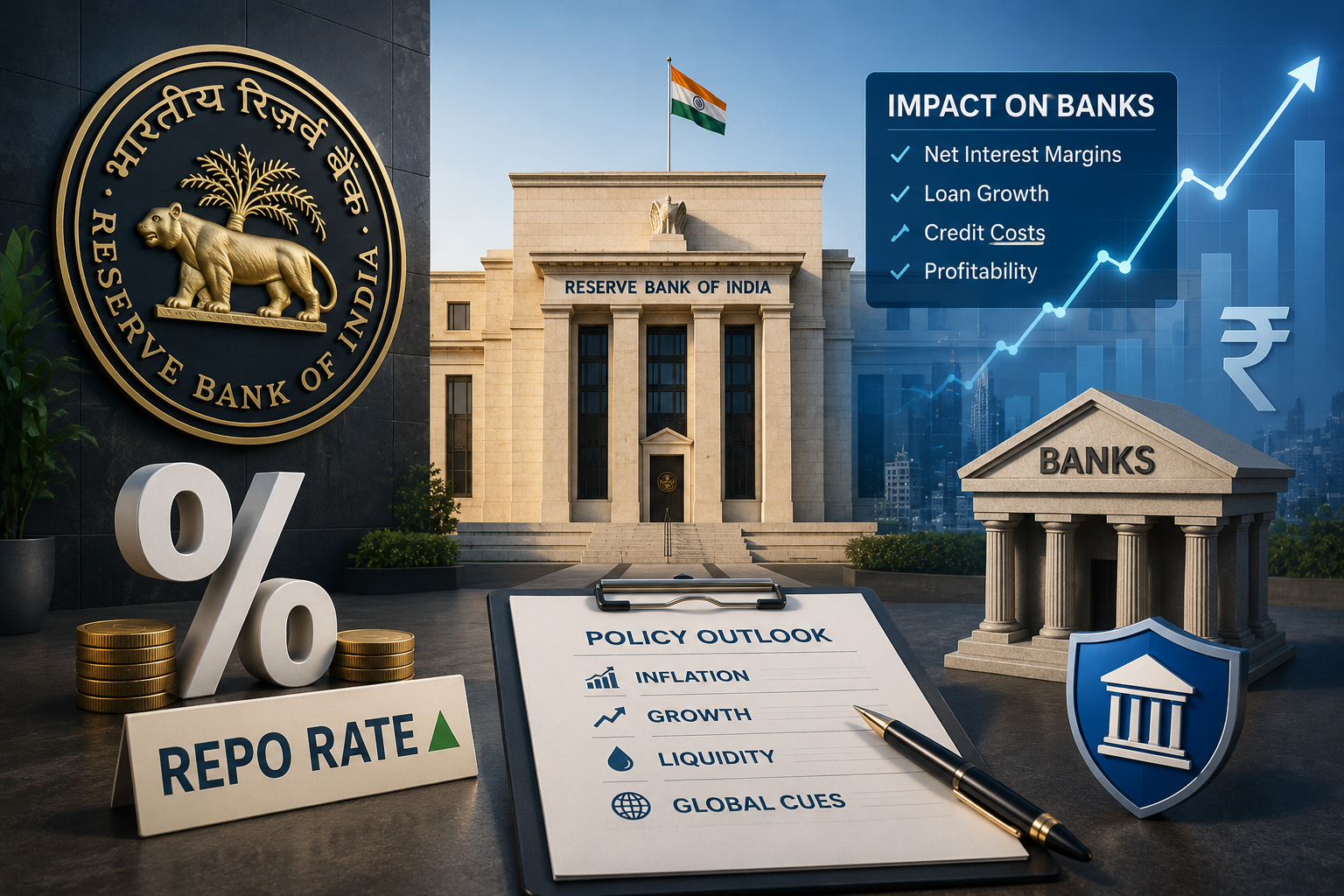
The Reserve Bank of India’s Monetary Policy Committee concluded its May 2026 meeting today with critical decisions on the repo rate and monetary stance that will reverberate through India’s banking sector and investment landscape. The committee’s decision carries particular significance as economic data reveals mixed signals on inflation and growth ahead of the festive season and monsoon-dependent agricultural output. For institutional investors and retail equity participants, understanding these policy shifts is essential for portfolio positioning in banking stocks and fixed-income allocations before the Q1 FY27 earnings season begins.
- RBI maintains accommodative stance while keeping repo rate unchanged at 6.25 percent, signaling patient approach to future policy decisions
- MPC voted 4-2 to hold rates steady, indicating divided opinion on further easing amid persistent inflation concerns
- CRR remains at 4.50 percent and reverse repo at 5.75 percent, preserving liquidity transmission mechanisms in the banking system
- RBI Governor signaled gradual progress toward neutral stance in coming months, subject to inflation behavior and monsoon outcomes
- Banking sector responds with mixed trading as margin compression concerns offset dividend yield support for institutional investors
RBI Monetary Policy May 2026: Repo Rate Decision and Key Highlights for Investors
The RBI’s Monetary Policy Committee maintained the repo rate at 6.25 percent in its May 2026 meeting, keeping the benchmark lending rate unchanged despite expectations among some analysts for a 25 basis point cut. The committee retained its accommodative stance but signaled a more measured approach toward future rate adjustments, conditional on inflation trajectories and monsoon performance.
The 4-2 vote split reveals internal debate within the committee, with two members advocating for a rate reduction to support growth. This division reflects broader economic uncertainty: inflation remains elevated at 5.4 percent against the RBI’s medium-term target of 4 percent, while growth concerns linger following April’s softer industrial output data. The effective date for these decisions is May 27, 2026, immediately impacting new borrowing costs and deposit rate expectations across the banking system.
Key Policy Decisions and Rate Changes Quick Summary
| Policy Rate | Current Rate | Previous Rate |
|---|---|---|
| Repo Rate | 6.25% | 6.25% |
| Reverse Repo Rate | 5.75% | 5.75% |
| Cash Reserve Ratio | 4.50% | 4.50% |
| Statutory Liquidity Ratio | 18.00% | 18.00% |
| Marginal Standing Facility | 6.50% | 6.50% |
The decision to maintain all operational rates without adjustment reflects the RBI’s calibrated approach to managing multiple macroeconomic objectives simultaneously. With repo rate unchanged, the corridor remains intact, providing banking system stability. The pause offers clarity to markets after three consecutive 25 basis point cuts delivered in late 2025 and early 2026, allowing time to assess transmission and inflation dynamics.
Banking Sector Immediate Impact Analysis
India’s banking sector faces a complex operating environment following today’s policy hold. Net interest margins, which measure the difference between lending and deposit rates, will come under continued pressure as banks navigate slower rate transmission and competitive deposit mobilization. For investors looking to open demat account online and participate in banking stock investments, understanding these margin dynamics is crucial for sector allocation decisions.
State Bank of India and HDFC Bank, the nation’s largest lenders, face margin compression from two directions: on assets, as existing high-cost loans mature and repricing occurs at lower rates, and on liabilities, as increased competition forces deposit rate increases. The rate hold provides temporary relief by preventing further margin dilution that another cut would trigger. Analysts estimate net interest margins across large PSU banks could compress by 15-20 basis points in Q1 FY27 from Q4 levels, though this reflects prior rate cuts rather than today’s decision.
ICICI Bank, with its higher proportion of floating-rate advances, faces somewhat different dynamics but similar pressure. Axis Bank and private sector peers anticipate the deposit rate competition will intensify, as customers holding savings accounts and fixed deposits increasingly migrate toward higher yields offered by small finance banks and non-bank lenders. The policy hold provides temporary breathing space, but banks will likely maintain deposit rate increases in the 20-30 basis point range to prevent deposit outflows.
The lending rate response will likely follow within two weeks across major banks. Home loan rates, currently in the 8.25-8.75 percent range, may see modest reductions of 10-15 basis points as banks pass through prior cut benefits. However, the rate hold suggests no immediate pressure for fresh lending rate cuts, allowing banks to defend margins through gradual transmission rather than accelerated repricing.
Major Bank Stock Performance Post-Announcement
Banking stocks displayed divergent movements in afternoon trading following the announcement. SBI closed the day with 1.2 percent decline as market participants reassessed margin trajectory expectations. HDFC Bank fell 0.8 percent amid concerns about deposit rate competition in a stabilized rate environment. ICICI Bank edged down 0.4 percent on profit-taking after earlier institutional accumulation.
The divergence reflects nuanced market interpretation. The rate hold eliminates expectations for near-term relief from margin pressure, yet removes downside risk of an aggressive cutting cycle damaging profitability further. Trading volumes in banking index futures remained elevated at 18 percent above average, indicating active rebalancing among institutional investors using the best stock trading and investing platform in India for portfolio adjustments.
Several brokerages maintained their “accumulate” stance on banking stocks, noting that valuations remain attractive relative to Q1 earnings growth expectations. SBI trades at 0.95 times current financial year book value, while HDFC Bank hovers near 3.2 times, reflecting the divergent risk-return profiles between PSU and private sector lenders. Analysts estimate these valuations offer downside protection if rates remain stable through monsoon season.
Impact on Borrowers EMI and Loan Rate Changes
Home loan borrowers will face extended stable payment obligations under the rate hold policy. The pause in rate adjustments means existing floating-rate loans tied to external benchmarks will likely see no downward adjustment in the June-July period, contrary to earlier expectations.
New borrowers initiating home loans today will encounter rates around 8.5-8.65 percent for 20-year tenures, reflecting both the stable repo rate and banks’ deposit rate pressures. EMI calculations for a 50-lakh rupee home loan at 8.5 percent over 20 years will amount to approximately 42,500 rupees monthly, stable from May levels. Borrowers fixed at lower rates from earlier 2025 cuts have locked in relative advantages compared to fresh market entrants.
Personal loan rates, typically 50-100 basis points above home loans, will remain sticky at current 9.5-10.5 percent levels. Credit card interest rates, averaging 40 percent annually, are unlikely to move materially as these remain unlinked to repo rates. The rate hold delays any relief for unsecured borrowers, though it removes the risk of rates stabilizing at higher levels.
The rate transmission timeline typically extends three to four weeks, so most borrowers will see updated statement notifications in mid-June reflecting any deposit rate changes banks implement this week. Automobile and personal loan customers should monitor bank announcements rather than expecting immediate repricing.
RBI Governor’s Forward Guidance and Market Outlook
RBI Governor Sanjay Malhotra provided cautious forward guidance, indicating the monetary policy committee will remain “data-dependent” with a gradual shift from accommodative to neutral stance possible in coming months if inflation moderates. The Governor specifically highlighted monsoon rainfall patterns as a critical variable, noting that below-normal precipitation could reignite food price pressures, complicating the inflation narrative.
The Governor’s comments on growth acknowledged recent industrial output weakness and services sector moderation, validating the committee’s cautious approach. However, he emphasized that the 4 percent inflation target remains paramount, preventing aggressive rate cuts despite growth concerns. This dual-mandate tension explains the 4-2 vote split, where two members sought to prioritize growth through rate reduction.
Market interpretation suggests the next policy decision in June 2026 (if an inter-meeting assessment occurs) or August 2026 (at the regular policy window) will depend critically on June-July inflation print and monsoon progress. The Governor provided no signals suggesting emergency measures or sustained rate cuts, implicitly encouraging markets to price in rate stability through Q2 FY27.
Inflation and Growth Projections Updated
The RBI revised its FY27 inflation projection to 5.1 percent (April-March average), moderately above the 4 percent target, acknowledging sticky food price inflation and global commodity pressures. This projection incorporates assumptions of normal monsoon rainfall and continued moderation in core inflation, particularly in transport and energy components.
The updated growth forecast remains at 7.2 percent for FY27, maintaining the previous estimate despite recent industrial output weakness. This reflects the central bank’s confidence in services sector resilience and expectations for agricultural sector recovery with adequate monsoon rainfall. However, the projection carries downside risks from global economic slowdown and domestic consumption moderation.
Leave a Reply