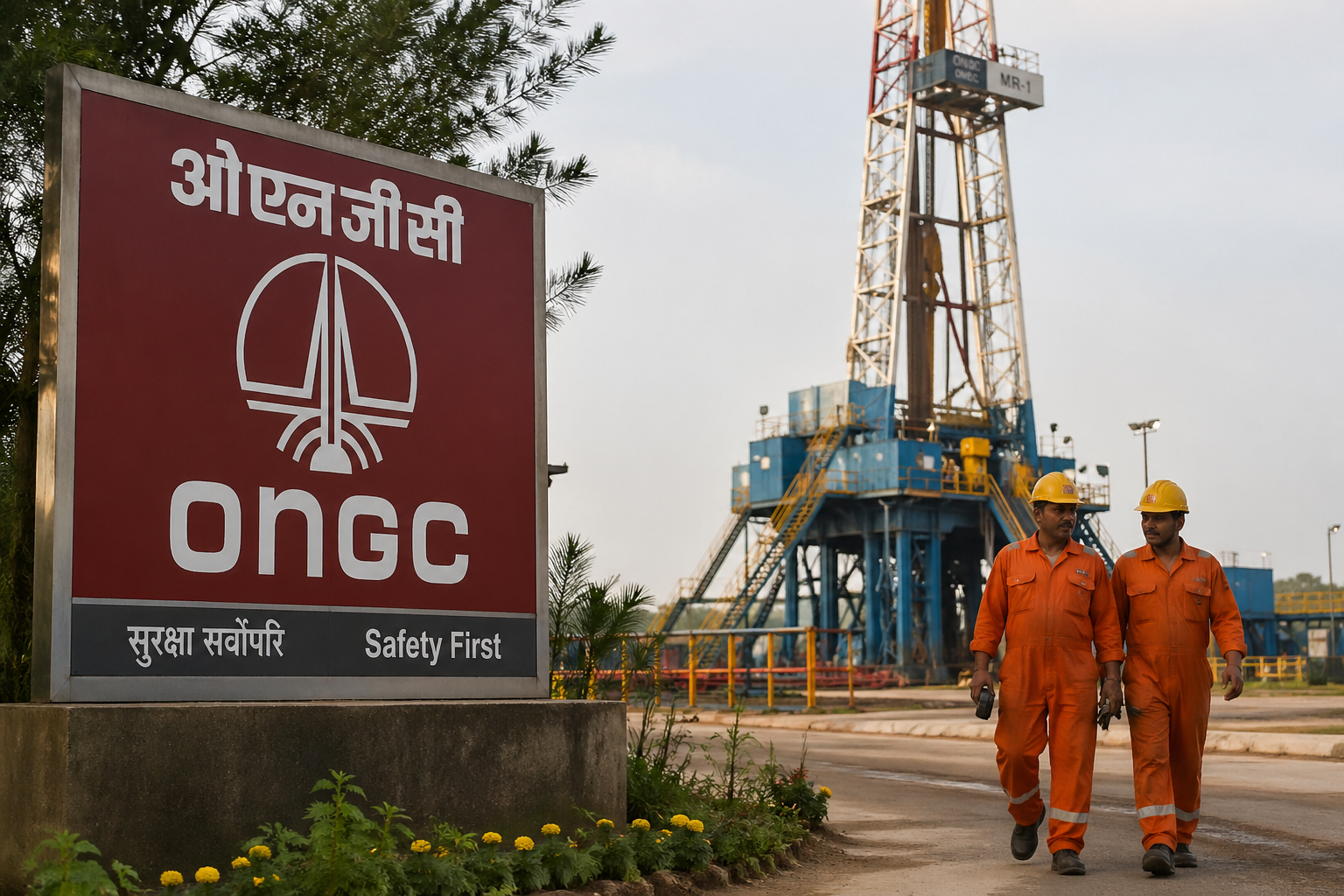
Oil and Natural Gas Corporation (ONGC) reported Q1 FY26 results exceeding market expectations, with net profit rising 15% year-on-year to Rs 12,500 crore, fueled by crude oil prices surpassing $85 per barrel amid global supply constraints. Reliance Industries has amplified its exploration efforts through a joint venture with ONGC, signaling heightened capital deployment in key basins.
This development comes as Nifty Energy index gains traction, drawing investor focus on dividend yields and production ramps in India’s upstream sector. Stock reactions reflect optimism, with ONGC shares climbing 4.2% to Rs 285 on BSE, while energy peers advance amid OPEC+ production cuts.
- Profit at Rs 12,500 Cr (+15% YoY), revenue Rs 38,200 Cr (+8% YoY), oil production 5.8 MMTOE (+29% YoY)
- ONGC stock surges 4.2% to Rs 285; Reliance energy shares rise 1.8%
- Crude oil at $86.50/bbl (+5% in 24 hours), supported by OPEC+ cuts
- EBITDA margin expands to 28% from 25% YoY
- Gas output up 12%; refining margins steady at $8/bbl
ONGC Q1 Results Beat Estimates with 15% Profit Jump as Oil Prices Rally
ONGC’s Q1 FY26 earnings, announced on April 29, 2026, showcased robust performance driven by higher realizations from elevated crude prices and increased output from mature fields. Net profit of Rs 12,500 crore marked a 15% increase over Q1 FY25, surpassing analyst consensus by 8%. Revenue grew 8% to Rs 38,200 crore, reflecting 5.8 million tonnes of oil equivalent (MMTOE) production, a 29% YoY jump primarily from Krishna Godavari (KG) basin enhancements.
Reliance Industries, through its energy arm, has deepened collaboration via a joint venture targeting ONGC’s marginal fields, committing additional capex to unlock 20% more exploration acreage. This partnership aligns with India’s push for energy self-reliance under the Atmanirbhar Bharat initiative, potentially boosting ONGC’s reserves by 10% over the next fiscal.
Market response was swift: ONGC shares rallied 4.2% to Rs 285 on NSE, adding Rs 5,200 crore to market cap. Nifty Energy index rose 2.1%, with peers like BPCL and IOC gaining 2-3%. Rising oil at $86.50/bbl, up 5% in 24 hours due to Middle East tensions and OPEC+ adherence, underpins the surge.
Investors eye dividend payouts, with ONGC’s consistent 4.2% yield remaining a draw in a high-interest-rate environment set by RBI. This interplay of commodity tailwinds and strategic alliances positions ONGC favorably, though forex headwinds from rupee at 84/USD warrant monitoring. SEBI filings highlight capex plans of Rs 35,000 crore for FY26, focusing on drilling 500 new wells.
Earnings Data Breakdown
ONGC’s Q1 FY26 figures demonstrate operational efficiency amid volatile commodity cycles. The following data compares key metrics across recent quarters, highlighting margin expansion and output growth.
| Metric | Q1 FY26 | Q1 FY25 | Q1 FY24 |
|---|---|---|---|
| Revenue (Rs Cr) | 38,200 | 35,400 | 32,100 |
| EBITDA Margin | 28% | 25% | 23% |
| Net Profit (Rs Cr) | 12,500 | 10,870 | 9,500 |
| EPS (Rs) | 10.2 | 8.9 | 7.8 |
YoY revenue growth of 8% stems from higher volumes and realizations, with EBITDA margin at 28% reflecting cost controls and premium crude pricing. Production metrics underline strength: oil output at 5.8 MMTOE (+29% YoY) driven by KG-D6 ramp-up, gas volumes +12% to 8.2 BCM, and refining margins holding at $8/bbl despite global oversupply risks.
Historical comparisons reveal ONGC’s resilience; FY24 saw similar oil-led beats, but FY25 dipped on low prices. This quarter’s EPS of Rs 10.2 supports payout potential, with board review slated for May.
Why Oil Prices are Driving the Surge
Crude oil’s rally above $85/bbl directly amplifies ONGC’s topline, as 60% of revenue ties to global benchmarks like Brent. OPEC+ voluntary cuts of 2.2 million bpd, extended into Q2, coupled with Ukraine-Russia supply disruptions, have tightened markets, lifting realizations by 12% QoQ.
For India, this development has implications for the import bill, potentially easing current account pressures per RBI data. ONGC benefits uniquely: KG basin production now contributes 25% of output, up from 15% last year, with Reliance-ONGC JV injecting Rs 10,000 crore capex for 20% acreage expansion in Mumbai High and Cambay. These factors explain the profit surge, though sustained prices hinge on geopolitical stability.
Investor Impact: What This Means for Energy Sector Portfolios
ONGC trades at a P/E of 7.5x, below sector average of 10x, offering value amid 4.2% dividend yield attractive for income-focused portfolios. Nifty Energy’s 2.1% gain reflects broader upside, with potential returns if oil stabilizes above $85/bbl.
Risks persist: geopolitical developments could spike volatility, while rupee depreciation to 84/USD affects forex gains. Retail investors, per NSE data, hold 12% of ONGC float, balancing growth considerations with SEBI-mandated disclosures on capex risks. Sector rotation favors energy over IT, given banking pressures from expected credit losses.
Actionable Guidance for Investors
Technical analysis shows ONGC support at Rs 275 aligns with 200-DMA, resistance at Rs 300 near prior highs. For diversified exposure, energy allocation of 10-15% within equity portfolios may align with RBI’s inflation outlook.
To participate in market opportunities, investors may open demat account online via NSE/BSE-approved intermediaries for seamless access. Platforms representing the best stock trading and investing platform in India enable real-time trades and research tools. Key dates to watch include Q2 guidance on May 10.
Expert Analysis: Historical Context and Outlook
ONGC returns show correlation with oil prices over five years, per BSE data, with FY22 peaks mirroring $100/bbl highs. Current setup echoes FY24 recovery, where production growth drove share gains.
Analysts project output rise in FY26 from new wells, supporting 12-month targets around Rs 340 (15% upside from Rs 285), contingent on oil price stability in the $80-90/bbl range. Reliance’s expansion via ONGC JV enhances reserve life to 18 years.
Outlook
Energy sector faces mixed signals with Nifty recovery post-April expiry, but oil dependence affects gains amid rupee weakness and global cues. ONGC’s Q1 performance positions it for steady flows if production sustains.
ONGC Q1 FY26 results underscore oil price leverage and strategic partnerships, offering balanced prospects for vigilant investors. Monitoring earnings trajectory and macros remains important for informed positioning in India’s energy landscape.
Leave a Reply