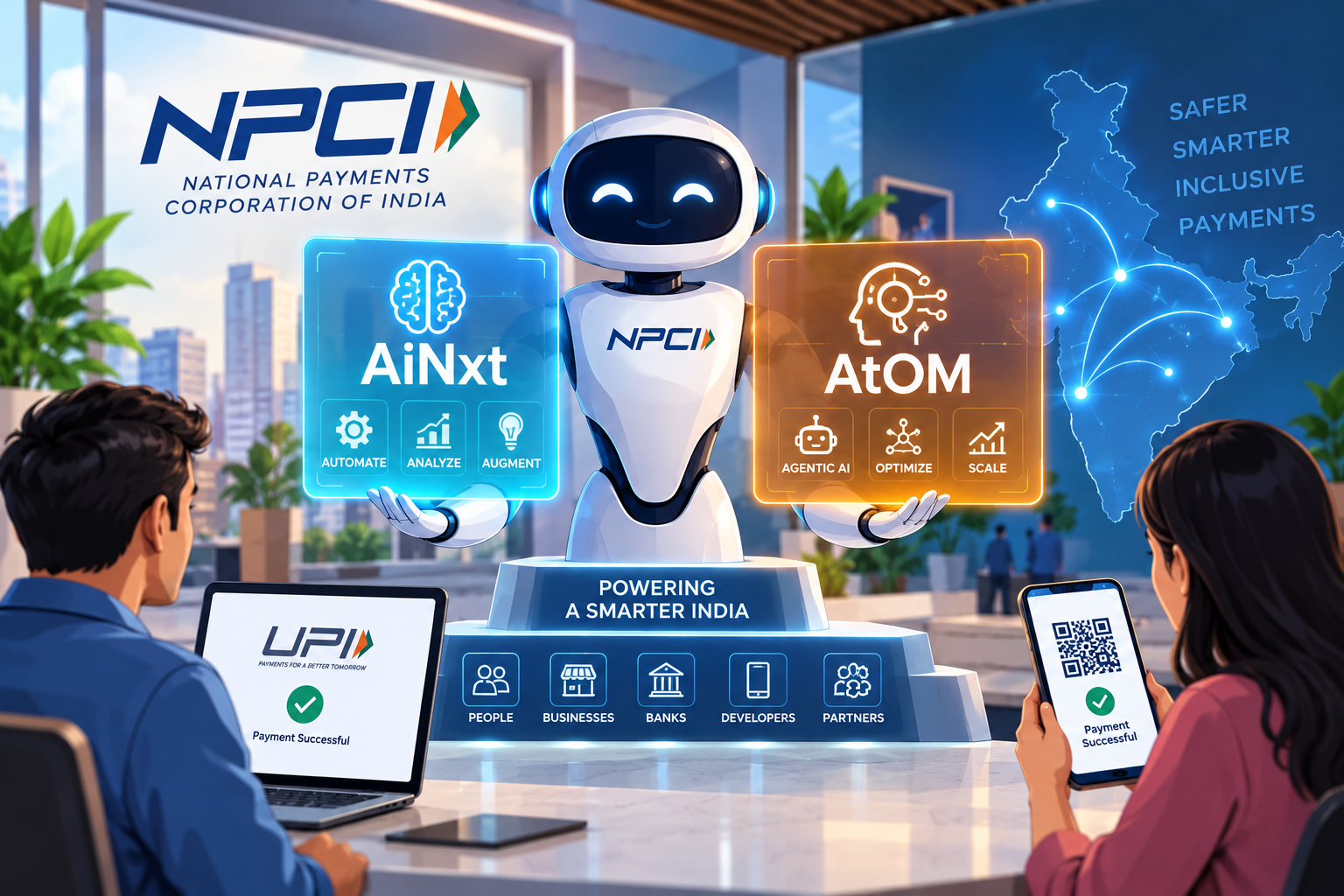
NPCI launched two new agentic AI platforms, AiNxt and AtOM, at Global Fintech Fest 2026 in Mumbai. The tools aim to help enterprises build AI agents and speed up UPI–linked partner onboarding and certification workflows.
What NPCI Announced at Global Fintech Fest 2026
The National Payments Corporation of India (NPCI) launched two new agentic artificial intelligence (AI) platforms AiNxt and Agentic Orchestration & Messaging (AtOM) on Wednesday at the Global Fintech Fest (GFF) 2026 in Mumbai.
NPCI operates several of India’s core retail payment systems, including UPI, RuPay, and FASTag. GFF 2026 is running from 8 to 11 September 2026 at the Jio World Centre in Mumbai, with this year’s theme built around agentic AI, tokenisation, and quantum technology.
“Agentic AI” refers to AI systems that can carry out multi-step tasks on their own, with less step-by-step human handling than a typical chatbot or software tool.
AiNxt: A Platform to Build and Deploy AI Agents
AiNxt is pitched as an enterprise-grade platform that lets organisations and individual developers create, test, and deploy their own AI agents. It follows a bring-your-own-model (BYOM) approach, so users are not locked into one AI provider and can plug in whichever model suits their use case.
The suite has four components:
- AiNxt OS – the core operating layer for running AI agents
- AiNxt Code – a plugin for use inside development environments (IDEs)
- AiNxt CLI – a command-line interface for developers
- AiNxt Enterprise – the enterprise deployment layer
It also offers no-code and low-code options alongside developer-first tools, so both technical and non-technical teams can build agents. Multiple reports have also described AiNxt as open-source, which would let it be adopted well beyond NPCI’s own ecosystem.
AtOM: Automating Partner Onboarding Across UPI
The second platform, AtOM, works differently. Instead of a general agent-building tool, it is designed for agent-to-agent orchestration within the payments ecosystem itself – handling system integration, change management, partner onboarding, testing, and certification through a single workflow.
Its first use case is UPI, where any change usually has to be implemented and certified across dozens of banks and payment service providers (PSPs) before it can go live. AtOM is meant to cut down that manual back-and-forth and help banks and PSPs roll out UPI feature changes faster.
| Platform | Primary Focus | Key Capability |
|---|---|---|
| AiNxt | Building and deploying AI agents | BYOM model support; OS, Code, CLI and Enterprise components |
| AtOM | Orchestrating UPI partner processes | Automates integration, onboarding and certification via digitally signed, machine-readable messages |
AtOM’s interactions are machine-readable and digitally signed, which NPCI says can support compliance and audit requirements – useful for regulated entities that need a verifiable trail of what changed and when. The platform’s architecture is based on JSON-RPC 2.0, an open messaging standard, and NPCI has indicated it could eventually be extended to other NPCI products beyond UPI.
Why This Launch Matters for India’s Payments Ecosystem
This launch continues NPCI’s push to bring AI deeper into India’s digital payments infrastructure. On the same day at GFF 2026, NPCI also introduced other initiatives, including open-source Android ATMs aimed at rural and corporate hubs, underlining a broader shift toward AI-led automation across its product lines.
For now, banks and PSPs are the primary audience for both platforms, since AtOM’s initial rollout is tied to UPI feature certification, and AiNxt is aimed at enterprises building their own agents. How quickly banks and fintechs actually adopt these tools over the coming months will be the real test of their impact.
| Check Indices | |
|---|---|
| BSE BANKEX Companies | BSE Largecap Comapnies |
| FINNIFTY Companies | Nifty Midcap 50 Companies |
| NIFTY MIDCAP 150 Companies | Nifty Pharma Companies |
| BSE 500 Companies | Nifty Smallcap 100 Companies |
Leave a Reply