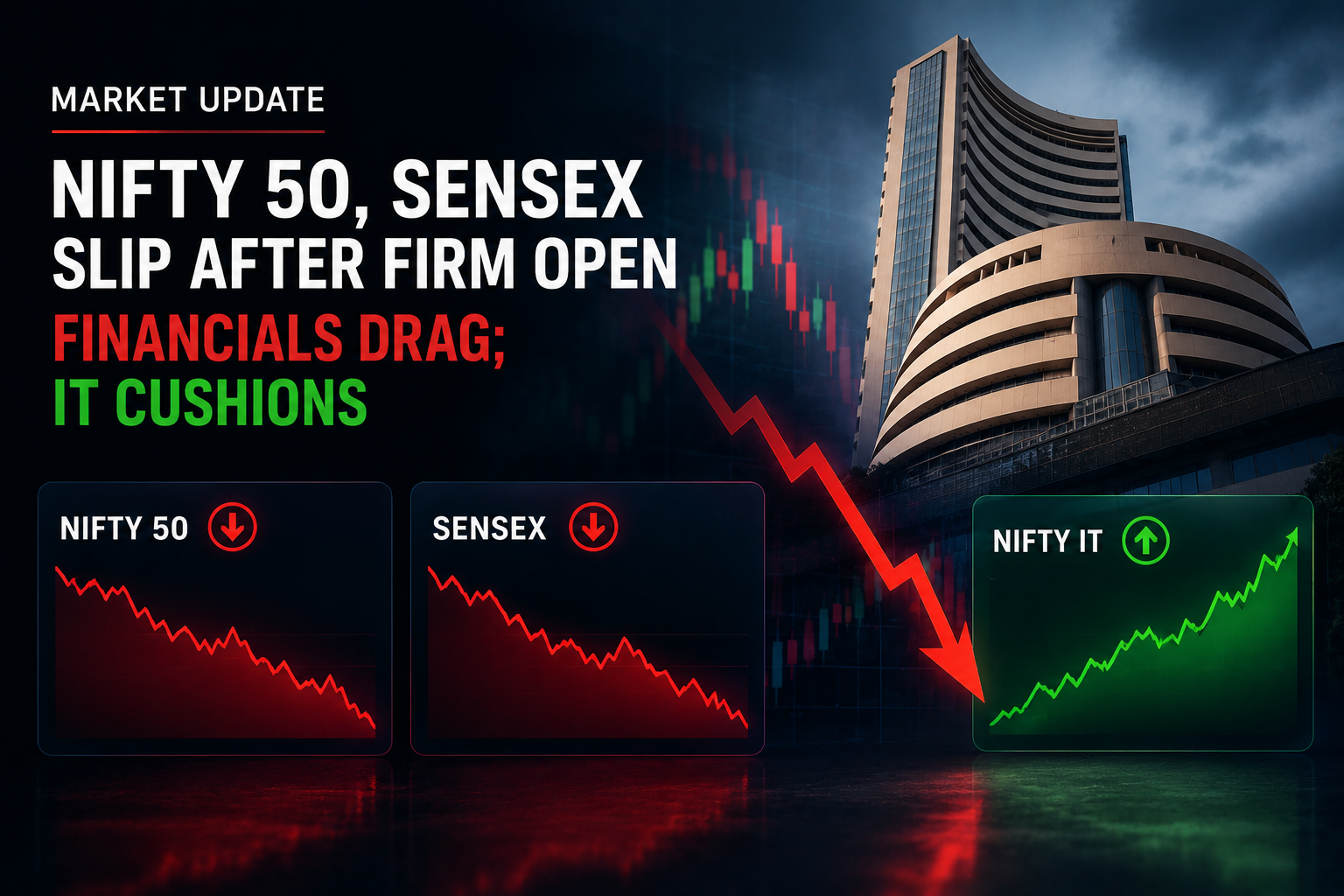
Indian equities opened on a positive note but quickly surrendered early gains as profit-taking in financials, FMCG and PSU banks dragged benchmark indices lower in mid-session trade. Participants remained cautious after the previous sharp correction, with the Nifty 50 slipping below the 23,500 mark and the Sensex giving up over 250 points intraday. A strong rebound in IT stocks and resilient global risk sentiment helped limit the downside, but technical indicators and options positioning point to a market still locked in a consolidation band with a mildly negative bias.
Key Highlights
- Sensex trims early gains, falls over 250 points after firm start
- Nifty 50 trades below 23,500; resistance seen near 23,800–24,000
- Financials, PSU banks, FMCG and realty lead declines; IT outperforms
- Nifty IT index gains around 3%, with Infosys, TCS, Tech Mahindra up to 5%
- Technicals, options data signal consolidation with key support near 23,250–23,400
Nifty 50 and Sensex Price Action and Market Structure
Indian benchmarks started the session on a constructive note, tracking positive global cues and a firmer GIFT Nifty, but the tone weakened as the day progressed. GIFT Nifty was indicating a mildly positive start, trading around 23,705 with a small gain, suggesting a stable opening for domestic equities. Early on, the Sensex climbed more than 500 points and the Nifty 50 moved towards the 23,700 zone before sellers emerged, reversing a portion of the advance as intraday sentiment turned cautious.
By mid-day, the Nifty 50 had slipped below the psychologically important 23,500 level, while the Sensex was down more than 250 points from the day’s high. The move followed a sharp correction in the previous session, when the Nifty 50 had closed about 1.5% lower at 23,547.75 and the Sensex finished 1.44% down at 74,775.74, underscoring heightened sensitivity to profit-taking after an extended rally. The short-term structure, as tracked by institutional desks, remains one of broad consolidation rather than outright trend reversal, with support in the 23,200–23,300 band and resistance in the 23,750–24,050 zone.
Technical research houses highlighted growing signs of fatigue at higher levels. Analysts tracking derivative and price data flagged increasing bearishness and weakening momentum, with the Nifty’s immediate support cited around 23,400–23,250. A decisive break below this zone could accelerate downside towards lower supports, while sustaining trade above 23,800–24,000 is seen as essential to re-establish upward momentum. One technical analyst from a domestic brokerage noted that the index continues to trade below key short-term moving averages, and that traders are likely to remain defensive until a clear breakout is registered.
Sectoral Performance and Stock-Specific Developments
Beneath the headline indices, the day’s trade highlighted a stark divergence between sectors. Banking, financial services, FMCG, consumer durables and realty were the key drags, reflecting pressure on rate-sensitive and consumption-linked counters. Financials in particular were described as the biggest drag on the market, consistent with the previous session’s broader de-risking from high-beta names. PSU banks also underperformed, suggesting that investors remain selective on balance sheet and asset-quality risk amid an elevated-rate environment.
In contrast, the IT pack emerged as the clear outperformer and the principal cushion for the headline indices. The Nifty IT index rose around 3%, making it the top sectoral gainer for the day. Large-cap names such as Infosys, Tech Mahindra and Tata Consultancy Services rallied by up to 5% as multiple tailwinds, including stable global risk sentiment and expectations of a supportive US rate trajectory, improved appetite for export-oriented technology counters. The strength in IT helped offset part of the weakness in domestic cyclicals and kept broader index losses contained.
On the stock-specific side, aviation, digital financials and FMCG names drew attention following recent corporate developments. IndiGo’s parent, InterGlobe Aviation, remained in focus after the airline reported a consolidated net loss of ₹2,536.3 crore for the March quarter, narrowing from ₹3,067.5 crore a year earlier but still reflecting weaker operating performance and exceptional charges of ₹250 crore. The market has been weighing the sustainability of capacity expansion and fare discipline against cost pressures and regulatory overhangs.
PB Fintech, the parent of Policybazaar, was also on institutional radar after a block deal of roughly ₹665 crore on Friday, in which co-founders Yashish Dahiya and Alok Bansal sold shares to a mix of domestic and foreign institutional investors, potentially improving free float and liquidity. In consumer names, Patanjali Foods reported a 46% year-on-year increase in net profit for the March quarter, driven by its edible oils and FMCG business, though higher raw material and packaging costs compressed margins, prompting some debate on the durability of earnings momentum in the broader staples space.
Technical and Derivatives Analysis
From a positioning standpoint, options data on the Nifty 50 underline the market’s current sell-on-rise bias within a defined band. Investors looking to participate in this market movement can open demat account through SEBI-registered brokers to access these equity markets and derivative instruments.
| Index/Level | Support Zone | Resistance Zone | Key Observation |
|---|---|---|---|
| Nifty 50 | 23,400–23,250 | 23,800–24,000 | Immediate support zone critical |
| Broader Range | 23,200–23,300 | 23,750–24,050 | Range-bound trading focus |
| Bank Nifty | 53,700–53,500 | 55,200–55,550 | Bearish candle with upper shadow |
Analysts at domestic brokerages emphasise that momentum indicators point to weakening bearish pressure, but they stress that the broader trend remains cautious as long as the benchmarks hover below their key moving averages and fail to take out resistance zones decisively. For institutional and leveraged participants, the risk-reward currently favours tactical, level-based trading rather than directional bets. A decisive break below the cited support levels could trigger faster downside via unwinding of long index futures, while a clean close above 23,800 on the Nifty 50 is viewed as a prerequisite for any renewed attempt at record highs.
Market Outlook and Key Factors to Monitor
Looking ahead, domestic equities are likely to remain driven by a combination of global risk cues, earnings follow-through and expectations around the Reserve Bank of India’s policy path. With the RBI focused on anchoring inflation while supporting growth, short-term rate expectations remain broadly stable, but any hawkish commentary, upside surprise in inflation prints, or signs of fiscal loosening could put fresh pressure on financials and rate-sensitive pockets. The rupee’s trajectory against the US dollar will also be closely monitored, given its implications for imported inflation, IT earnings translation, and foreign investor sentiment.
Foreign portfolio flow trends will be an important swing factor. After heavy institutional rotation earlier in the year, global funds remain selective on Indian valuations, which are still at a premium to most emerging-market peers. This development presents new considerations for stock investment strategies focused on Indian equities, particularly as institutional participants evaluate sector rotation opportunities amid changing global dynamics.
Stronger-than-expected earnings delivery from key index constituents in IT, financials, autos and industrials could justify current multiples and attract incremental allocations, while missed expectations could catalyse a further consolidation or mild de-rating. Retail participation has grown significantly as access to a reliable trading platform has become more widespread, contributing to increased market depth and liquidity across various segments.
For now, the base case among several global strategists remains moderate upside for the Nifty 50 over the medium term, supported by structurally improving earnings and robust domestic demand, albeit with periodic bouts of volatility around global macro or policy events.
Conclusion
The current phase of trade in the Indian equity market is best characterised as a consolidation within a structurally positive medium-term trend. The Nifty 50 and Sensex are oscillating within well-defined technical bands, with pressure evident in financials, PSU banks and consumption-linked names, even as IT outperforms and offers a defensive hedge.
For institutional investors, the immediate focus is on how the indices behave around the 23,250–23,400 support zone and the 23,800–24,000 resistance band, and whether Bank Nifty can reclaim its overhead hurdles. Until a decisive breakout emerges, portfolio strategy is likely to tilt towards stock- and sector-specific positioning, with an emphasis on earnings resilience, balance-sheet strength and sensitivity to domestic rates and currency moves, rather than aggressive index-level risk-taking.
Trading & Investment Guides
Leave a Reply