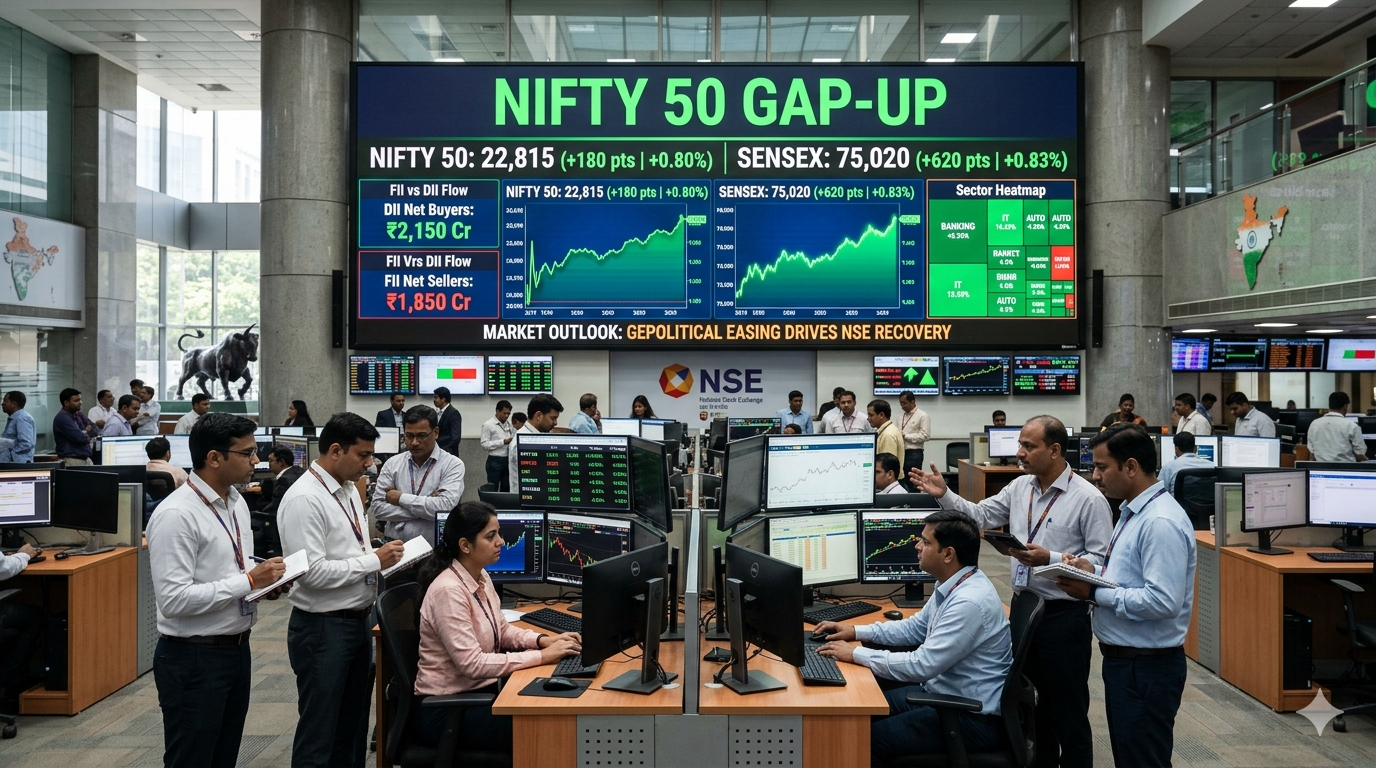
https://www.findoc.com/learn/futures-and-options/what-is-f-and-o-ban-in-stock-marketIndian equity markets are poised for a sharp gap-up opening on Tuesday following a ceasefire announcement in the U.S.-Iran conflict, with GIFT Nifty signaling over 300 points higher at around 22,836 to 23,215 levels. This comes after a brutal Monday session where the Nifty 50 plunged 601.85 points or 2.60 percent to close at 22,512.65, and the Sensex shed 1,836.57 points or 2.46 percent to end at 72,696.39, driven by escalating geopolitical tensions and surging crude oil prices that hit $114 per barrel intraday before retreating below $100. Foreign institutional investors continued their 17th straight session of net selling, offloading Rs 10,414.23 crore on March 23, while domestic institutions countered with Rs 12,033.97 crore in purchases, underscoring persistent FII outflows totaling over Rs 69,000 crore in recent sessions. Broader markets underperformed, with banking stocks leading the rout as Nifty Bank tumbled 3.72 percent to 51,437.75.
Key Highlights
- GIFT Nifty up 371 points to 22,836 and as high as 23,215 with 3.34 percent gain, pointing to volatility but positive start.
- FIIs net sellers for 17 sessions, dumping Rs 10,414 crore on March 23; DIIs absorb with Rs 12,034 crore buying.
- Nifty options data shows max put OI at 22,000 strike for support, max call OI at 23,000 for resistance; PCR at 0.69.
- Crude oil slump below $100/barrel post-ceasefire eases input cost pressures; US indices rally 1-1.38 percent.
- SEBI approves eased FPI settlement norms, revised intermediary frameworks, and stricter disclosure rules for officials.
Nifty 50, Sensex Plunge Analysis
The benchmark indices endured one of their steepest single-day declines in recent memory on Monday, with the Nifty 50 breaching key support at 22,700 and forming a pattern of lower highs and lower lows, signaling a bearish bias in both short and medium terms. This downturn was exacerbated by heightened U.S.-Iran tensions, which propelled crude oil to intraday peaks of $114 per barrel, inflating import costs and stoking inflation fears for oil-dependent India. Market volatility spiked, with broader indices lagging sharply as midcaps and smallcaps amplified the losses.
Technically, Monday’s high of 22,856 now poses immediate resistance for Nifty, while a sustained drop below 22,700 could accelerate selling toward 22,400, 22,300, and even 22,200 in follow-through weakness. Daily and weekly oscillators hover near oversold territory, hinting at potential short-term relief, but analysts caution that elevated volatility persists amid uncertain global cues. The U.S. dollar index’s 0.2 percent rise to 99.35 adds pressure on the INR, which weakened amid risk-off sentiment, though exact levels remain fluid pre-open.
FII activity remains a critical drag, with net sales accelerating to Rs 10,414 crore on March 23 from Rs 5,518 crore on March 20, reflecting broader emerging market outflows. DIIs have valiantly stemmed the tide, netting Rs 12,034 crore purchases on March 23, but their capacity to fully offset FII exits is tested as valuations compress. Sectors like banking bore the brunt, with Nifty Bank violating 52,500 support and plunging below 51,500, exposing vulnerabilities in loan growth amid rising funding costs.
FII DII Flows and Sector Impacts
Foreign portfolio investors’ relentless selling spree, now spanning 17 sessions, has drained over Rs 69,000 crore from Indian equities since early March, with daily figures showing Rs 10,716 crore on March 13, Rs 9,365 crore on March 16, and consistent outflows thereafter. This capitulation aligns with global risk aversion, but domestic mutual funds and insurance giants stepped up, logging Rs 12,593 crore buys on March 16 and Rs 9,977 crore on March 13, bolstering resilience in largecaps.
Banking emerged as the epicenter of Monday’s carnage, with Nifty Bank cratering 3.72 percent to 51,437.75 after breaching 52,500 support. Key drags included major lenders like HDFC Bank, ICICI Bank, and State Bank of India, which saw amplified losses amid fears of margin compression from elevated oil prices and potential RBI rate pauses. Private banks faced sharper hits due to high FPI exposure, while public sector banks offered relative stability on DII backing.
IT and metals also faltered, with companies like Tata Consultancy Services, Infosys, and Tata Steel under pressure from dollar strength and commodity volatility. Conversely, select defensives like Hindustan Unilever and ITC showed mild resilience. Investors looking to participate in this market movement can open demat account through SEBI-registered brokers as pre-market cues from GIFT Nifty’s surge suggest rotation potential into rate-sensitive sectors if the gap-up holds, but Sammaan Capital and SAIL remain in F&O ban, curbing derivative plays.
Japan’s softening PMIs—manufacturing at 51.4, services at 52.8—signal global demand moderation, indirectly pressuring Indian exporters. SEBI’s regulatory tweaks, including eased FPI settlement and intermediary norms, aim to enhance liquidity, potentially aiding inflows once sentiment stabilizes.
Technical Levels and Options Data
Nifty 50 faces pivotal levels post-Monday’s breach:
- Key Support: 22,700 (immediate), 22,400-22,300 (next), 22,000 (strong put OI base), 22,200 (follow-through downside).
- Key Resistance: 22,856 (Monday high), 23,000 (max call OI), 23,075 (upside target).
- Bank Nifty Support: 51,500 (breached), 50,700-50,000 (critical).
- Bank Nifty Resistance: 52,665-53,297 (gap area).
Options chain reveals Put-Call Ratio at 0.69, with heavy put OI buildup at 22,300 and 22,000 strikes underscoring downside protection, while call OI clusters from 22,500-23,000 signal overhead supply. Expiry dynamics favor bulls above 23,042 for call strategies and bears below 22,445 for puts, but sustaining 23,000 close is essential for momentum.
This development presents new considerations for stock investment strategies focused on Indian equities, as broader FII/DII flows highlight the trend:
| Date | FII Net (Rs Cr) | DII Net (Rs Cr) |
|---|---|---|
| 23 Mar | -10,414 | 12,034 |
| 20 Mar | -5,518 | 5,706 |
| 19 Mar | -7,558 | 3,864 |
| 18 Mar | -2,714 | 3,253 |
| 17 Mar | -4,741 | 5,225 |
This underscores DIIs’ role as stabilizers amid FII flight.
Market Outlook
Indian investors face a high-stakes session with gap-up potential testing 23,000, but sustainability hinges on holding above this psychological barrier amid expiry volatility and lingering geopolitical risks. A ceasefire-driven crude retreat below $100/barrel offers relief on inflation and CAD fronts, potentially prompting RBI vigilance on INR stability around 83-84 levels. Key watches include FPI flows reversing post-SEBI easing, Bank Nifty rebound from oversold, and rotation to IT/metals if global PMIs stabilize. Retail participation has grown significantly as access to a reliable trading platform has become more widespread, while risks persist from U.S. policy shifts under Trump and oil spikes; institutional players may eye dips to 22,300 for accumulation, prioritizing quality largecaps with strong DII support. Volatility index remains elevated, favoring hedged strategies.
Conclusion
Tuesday’s anticipated gap-up reprieve underscores Indian markets’ resilience amid global turbulence, with DII buying countering FII outflows and technical oversold signals hinting at tactical bounces. Yet, the bearish structure of lower highs/lows and breached supports demands caution, as renewed U.S.-Iran flares or crude surges could drag indices toward 22,000. For institutional investors, focus on sector rotation, F&O expiry plays, and regulatory tailwinds positions portfolios for volatility harvesting, ensuring disciplined risk management in this fluid environment.
Leave a Reply