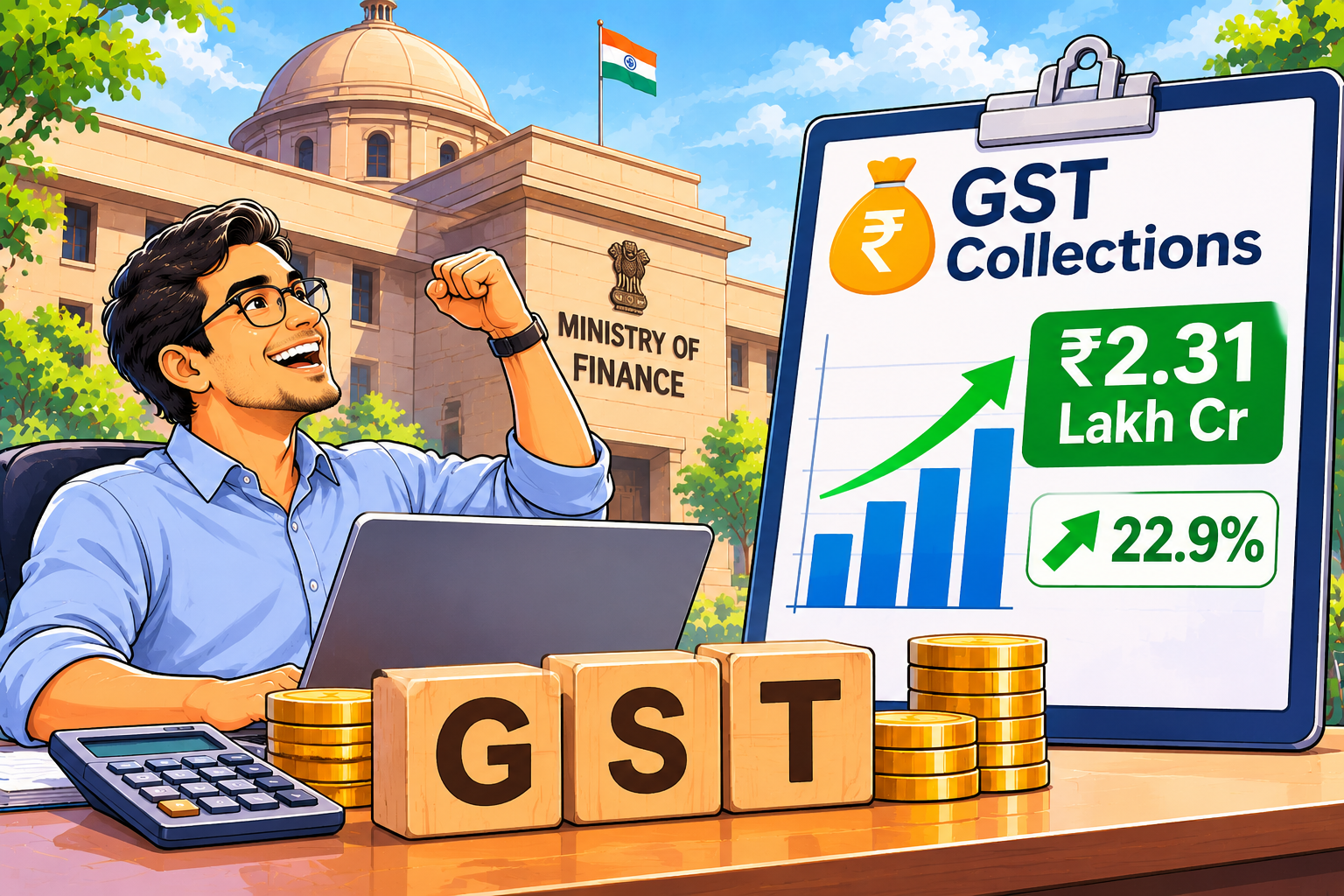
India’s gross GST collections rose 22.9% year on year to about ₹2.31 lakh crore in October 2026, according to provisional data released on November 1. After refunds, net GST revenue grew 25.6% to ₹2.03 lakh crore, the fastest net growth of FY27 so far.
October 2026 GST Collections at a Glance
Gross collections were ₹2,31,290 crore, compared with ₹1,88,124 crore in October 2025, an increase of about ₹43,000 crore. Domestic revenue rose 15.8% and import-related revenue rose 42.2%.
| Component | October 2026 (₹ crore) | October 2025 (₹ crore) | Change |
|---|---|---|---|
| Gross domestic revenue | 1,59,044 | 1,37,328 | Up 15.8% |
| Revenue from imports | 72,246 | 50,796 | Up 42.2% |
| Central GST (CGST) | 42,935 | 36,547 | Up |
| State GST (SGST) | 51,340 | 45,134 | Up |
| Total refunds | 27,934 | 26,225 | Up 6.5% |
| Net GST revenue | 2,03,356 | 1,61,900 | Up 25.6% |
Integrated GST (IGST) was over ₹1.37 lakh crore. Refunds comprised ₹14,007 crore of domestic refunds and ₹13,927 crore of import and export refunds.
Why the Net GST Growth Looks So Strong
Part of the jump comes from a weak base. In October 2025, net GST revenue grew only 0.6%, because October collections reflect transactions made in September, and the GST rate rationalisation took effect on September 22, 2025. A tax adviser quoted in coverage of the data noted that October 2025 was the first full month in which the rate changes showed in revenue numbers.
This base effect does not explain everything. Domestic revenue grew a healthy 15.8% even against that base, and imports grew faster at 42.2%. The October figures also followed gross collections of ₹2,03,521 crore in September, which had risen 14.7% year on year. For April to September, gross collections stood at ₹12,46,278 crore, up 11.6%.
Three factors explain the size of the jump:
- A weak base: net GST revenue grew only 0.6% in October 2025.
- Imports: import-related revenue rose 42.2% to ₹72,246 crore.
- Slower refunds: refunds rose 6.5%, much slower than gross collections.
April to October FY27: The Cumulative Picture
Gross collections for the first seven months of FY27 rose 13.2% to about ₹14.77 lakh crore. Net collections grew 12.6% to ₹12.69 lakh crore from ₹11.27 lakh crore a year earlier. Refunds for April to October rose 16.9% to ₹2.08 lakh crore.
| April to October | FY27 | Change year on year |
|---|---|---|
| Gross GST collection | About ₹14.77 lakh crore | Up 13.2% |
| Net GST collection | ₹12.69 lakh crore | Up 12.6% |
| Refunds | ₹2.08 lakh crore | Up 16.9% |
Net growth in the first seven months is lower than the 25.6% recorded in October alone, which shows how much the single month stands out from the year’s trend.
Refunds Take a Smaller Share of Gross Collections
Refunds rose 6.5%, far slower than gross collections, so they took a smaller share of the total. Based on the reported figures, refunds were about 12.1% of gross collections in October 2026, against about 13.9% in October 2025. These percentages are calculated from the reported numbers, and they explain why net growth of 25.6% exceeded gross growth of 22.9%.
| Measure | October 2026 | October 2025 |
|---|---|---|
| Refunds as share of gross (calculated) | About 12.1% | About 13.9% |
| Gross collections (₹ crore) | 2,31,290 | 1,88,124 |
| Net collections (₹ crore) | 2,03,356 | 1,61,900 |
Over April to October, refunds grew 16.9%, faster than the 13.2% growth in gross collections. This is why cumulative net growth of 12.6% trails gross growth, while the single month of October shows the opposite pattern.
What Drove October Collections
Collections in a month reflect the previous month’s transactions, so October’s numbers capture September activity. Coverage of the data attributed the rise to strong sales, and the 42.2% jump in import-related revenue shows that imports contributed a large part of the increase.
Other data released on November 1 showed a festive surge in car sales as well. Maruti Suzuki, Hyundai and Kia reported record domestic sales for October, which are a separate dataset from the GST figures but point in the same direction on consumer demand.
What the GST Data Means for Taxpayers and Investors
GST collections are a widely followed gauge of economic activity, and the monthly release shows how consumption, trade and the tax system are moving together. A high month does not guarantee that the next month will match it, and the base effect makes October’s growth rate unusually large.
Investors who follow consumption-linked sectors can track these releases alongside company results. Anyone who wants to hold shares of such companies needs to open a demat account, and price movements can then be followed on a share market app that provides access to NSE and BSE.
Read Stock Market Guides
- What is Algo Trading?
- Algo Trading Platform in India
- What is High Frequency Trading?
- How to Start Algorithmic Trading?
- High-Frequency Trading vs Algorithmic Trading
Leave a Reply