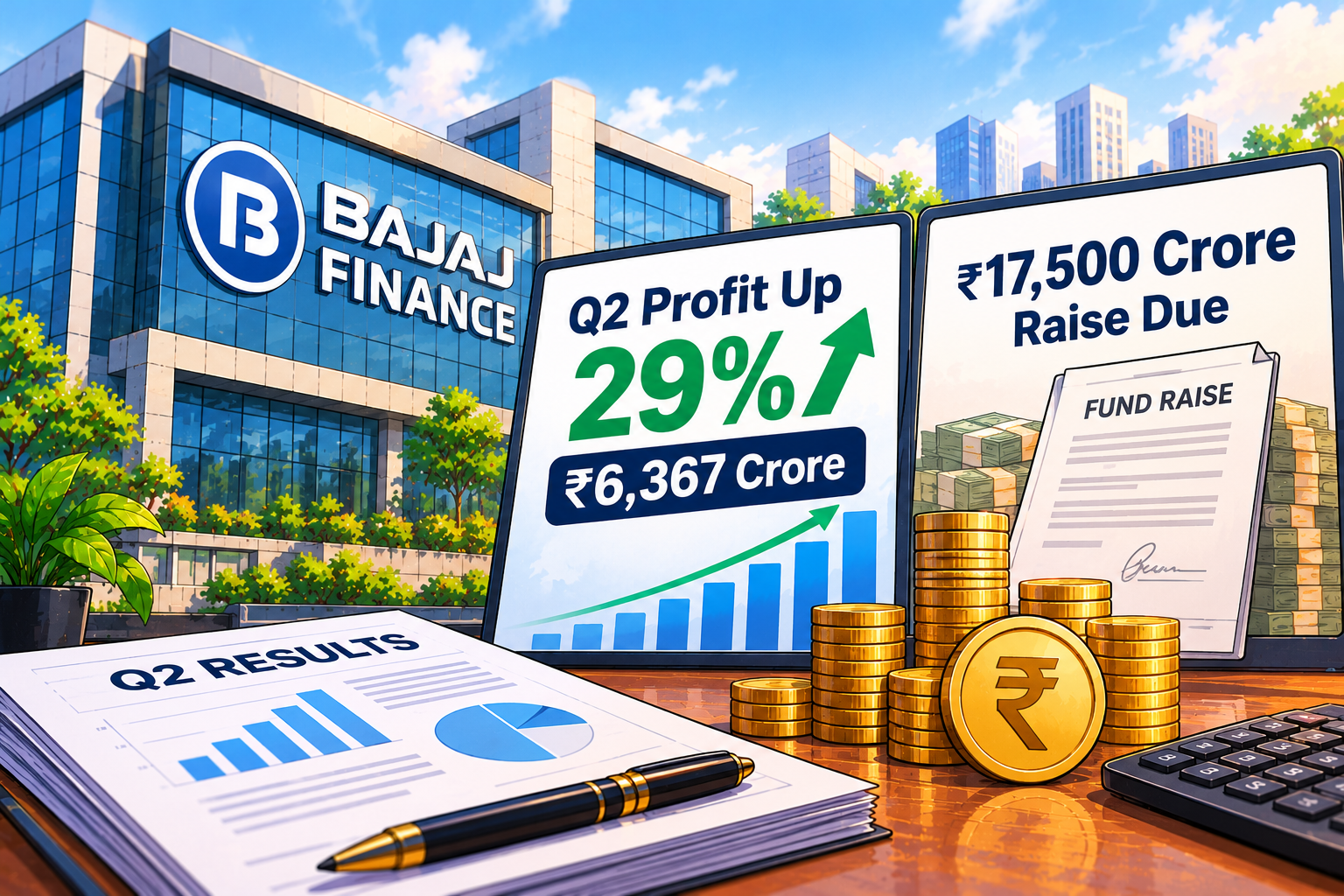
Bajaj Finance reported a 29% rise in consolidated net profit to ₹6,367 crore for the July to September quarter of FY27, as assets under management grew 26% to ₹5.85 trillion. The non-bank lender announced the Q2 results on 19 October 2026 and said it plans to raise up to ₹17,500 crore through a qualified institutional placement (QIP) and warrants.
The stock is in focus on 21 October, after markets were closed on 20 October for Dussehra.
Bajaj Finance Q2 FY27 Results at a Glance
Net interest income (NII) grew 24% to ₹13,335 crore from ₹10,785 crore a year earlier, and net total income rose 23% to ₹15,974 crore. Profit before tax grew 29% to ₹8,537 crore, with a return on assets of 4.6% and a return on equity of 20.6%.
Bajaj Finance Q2 FY27 key numbers
| Metric | Q2 FY27 | Change |
|---|---|---|
| Consolidated net profit | ₹6,367 crore | 29% YoY |
| Net interest income | ₹13,335 crore | 24% YoY |
| Net total income | ₹15,974 crore | 23% YoY |
| Assets under management | ₹5.85 trillion | 26% YoY |
| New loans booked | 13.45 million | 11% YoY |
| Loan losses and provisions | ₹2,166 crore | 4% YoY |
The company added ₹37,680 crore to its AUM during the quarter. It said year-on-year growth in loan volumes is not strictly comparable because the festive season started earlier last year.
Asset Quality and Credit Cost
Loan losses and provisions rose 4% to ₹2,166 crore, which included a prudent management and macroeconomic provision of ₹337 crore. Excluding it, provisions fell 12% to ₹1,829 crore. Credit cost fell to 1.56% from 1.88% a year earlier, or 1.32% excluding the additional provision.
- The gross NPA ratio improved to 1.06% from 1.24% a year ago.
- The net NPA ratio fell to 0.42% from 0.60%.
- Stage 2 and Stage 3 assets rose during the quarter, partly because of a transitional movement in the gold loan portfolio.
- The lender said it does not expect the transitional rise in Stage 2 gold loans to affect credit costs.
On the earnings call, management said about ₹550 crore of the roughly ₹1,100 crore Stage 2 increase from gold loans had already moved back to Stage 1.
Customers, Gold Loans and Deposits
Bajaj Finance added 4.42 million customers in the quarter and took its customer franchise to 128.85 million. For FY27, it expects to book 60 to 62 million new loans and add 18 to 20 million customers.
The gold loan portfolio is just over ₹24,000 crore, or about 4.1% of the balance sheet. The lender added 321 branches in the quarter, taking its gold loan network to 2,022 branches, and plans 2,700 to 2,800 by the end of FY27. Its deposit book stood at ₹69,754 crore, or 14% of consolidated borrowings.
The ₹17,500 Crore QIP and Warrants Plan
The board has approved raising up to ₹11,700 crore through a QIP and up to ₹5,800 crore through warrants convertible into equity shares, issued to promoter and holding company Bajaj Finserv. Both proposals need shareholder approval, and the company said it will convene an extraordinary general meeting for the QIP.
The company’s late-night exchange notice on 1 October described the plan, according to a TradingView report. It is the first equity fundraising by the company since a ₹10,000 crore raise in November 2023.
Management’s Rationale
Rajeev Jain, Vice Chairman and Managing Director, said the raise is principally for growth. He noted that the balance sheet has roughly doubled since the last raise three years ago, so the amount is smaller relative to the size of the business. The capital adequacy ratio was 20.33% at the end of September, with Tier-I capital at 19.43%.
Earnings Call Highlights
On the earnings call, management discussed AUM growth of 26.5% to ₹5,84,624 crore and net AUM addition of about ₹38,000 crore in the quarter. Profit before tax grew 29% to ₹8,537 crore, in line with profit after tax.
Management also said the company is on track to meet its FY27 targets for new loans and customer additions. It linked the capital raise to the growth outlook rather than to any stress on capital ratios, pointing to the strong capital adequacy of 20.33%.
Margins and What Analysts Watch
The chief financial officer said the net interest margin in the first half was about 5 basis points lower than in March, with Q2 down 10 to 12 basis points. Management said profitability and return ratios should be managed through lower operating expenses and credit costs.
Anyone who wants to buy NBFC shares needs to open demat account online with a depository participant and a trading account. Those who follow results-day moves on an online trading platform will see how the price reacts to the profit numbers and the dilution plan together.
Key Dates and Documents to Follow
The next steps are the shareholder approvals, the EGM notice and the pricing of the QIP. Bajaj Finance’s exchange filings carry each of these, along with the investor presentation for the quarter.
Related Stock Market Insights
- What is Equity?
- What is Current Ratio?
- What is Quick Ratio?
- What is National Stock Exchange of India?
- What is Bombay Stock Exchange?
Leave a Reply