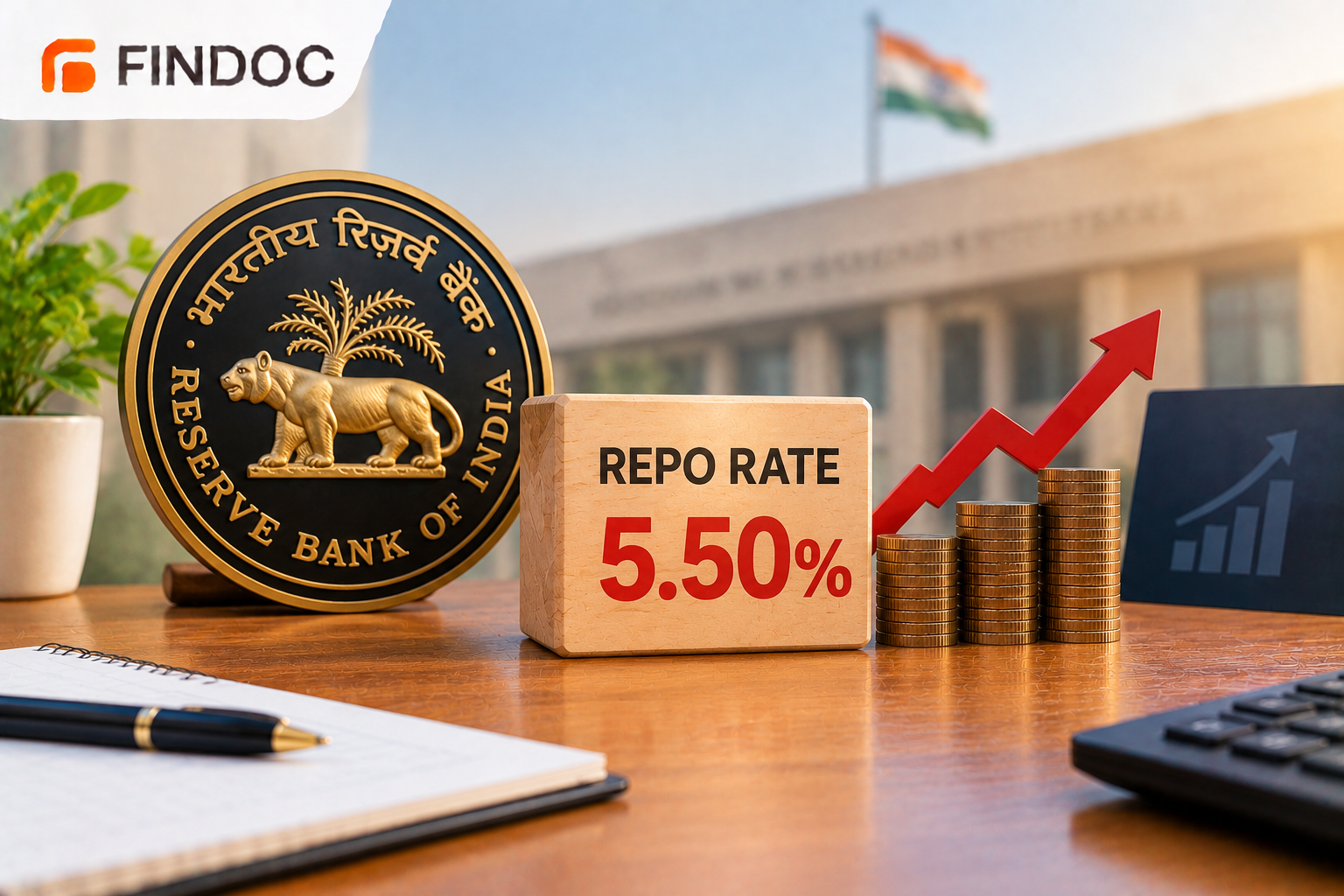
The Reserve Bank of India (RBI) raised its policy repo rate by 25 basis points to 5.50% on Wednesday, 7 October 2026, and changed its policy stance to calibrated tightening. The Monetary Policy Committee (MPC) voted unanimously for both decisions.
It is the first RBI rate hike in more than three and a half years. Equity markets closed lower on the day of the announcement, and the Sensex was trading in the red again on Thursday, 8 October.
What the RBI repo rate hike changes in the rate corridor
The MPC held its 63rd meeting from 5 to 7 October under Governor Sanjay Malhotra. After assessing the macroeconomic and financial outlook, it raised the repo rate, the rate at which the RBI lends short-term money to banks, from 5.25% to 5.50%.
The rest of the corridor moved with it. The standing deposit facility (SDF) rate, which acts as the floor, now stands at 5.25%, while the marginal standing facility (MSF) rate and the Bank Rate are both at 5.75%.
| Policy variable | Position after the 7 October 2026 decision |
|---|---|
| Policy repo rate | 5.50% (earlier 5.25%) |
| SDF rate | 5.25% |
| MSF rate and Bank Rate | 5.75% |
| Policy stance | Calibrated tightening (earlier neutral) |
| 2026-27 CPI inflation forecast | 5.2% (earlier 4.8%) |
| 2026-27 real GDP growth forecast | 7.1% (up 40 basis points) |
The change in stance carries as much weight as the rate move itself. By shifting from neutral to calibrated tightening, the MPC signalled that rate cuts are unlikely in the near term.
How the rate-cut cycle turned
The repo rate stood at 6.50% in February 2025. Between February and June 2025 the MPC cut it by a total of 100 basis points to 5.50%, and a further 25 basis point cut in December 2025 took it to 5.25%.
Wednesday’s decision reverses part of that easing. The hike had been widely anticipated by brokerages: HSBC Global Investment Research had predicted a 25 basis point increase, and Goldman Sachs had forecast hikes of the same size in October and December 2026.
Inflation and growth forecasts behind the decision
The RBI now expects consumer price index (CPI) inflation of 5.2% for 2026-27, against 4.8% in its earlier projection. It expects inflation to remain elevated through the rest of the year, citing persistent inflation risks and global supply pressures.
Growth, by contrast, was revised upward. The central bank now projects real GDP growth of 7.1% for the year, 40 basis points higher than before.
The RBI’s medium-term inflation target is 4%, with a tolerance band of 2 percentage points on either side. A 5.2% projection sits inside that band but well above the target, which is the backdrop for the shift in stance.
How the Sensex and Nifty reacted to the rate hike
On 7 October, the Sensex fell 429 points to close at 72,638.70, while the Nifty 50 ended near 22,603.05. Business Today reported that metal stocks were the biggest drag, followed by realty, auto, IT and consumer shares, while PSU banks and media ended with modest gains.
The weakness carried into Thursday. At 11:00 AM IST, the Sensex was down 466.82 points, or 0.64%, at 72,171.88, and the Nifty 50 was trading around 22,450. The Nifty Midcap and Nifty Smallcap indices were lower by 0.92% and 1.06% respectively at about 11:10 AM.
| Indicator | Reading | Timing |
|---|---|---|
| Sensex | 72,638.70, down 429 points | Close, 7 October |
| Nifty 50 | 22,603.05 | Close, 7 October |
| Sensex | 72,171.88, down 0.64% | 11:00 AM IST, 8 October |
| Nifty 50 | Around 22,450 | 11:00 AM IST, 8 October |
| Nifty Midcap and Nifty Smallcap | Down 0.92% and down 1.06% | About 11:10 AM IST, 8 October |
| Rupee against the US dollar | 96.72 at open (previous close 96.78) | 8 October |
Global cues added pressure. India TV reported that Asian shares fell after Wall Street retreated from its record, with the US 10-year Treasury yield briefly touching 5.36% before settling near 5.28%. Nifty IT was the only major sectoral index in the green early on, with TCS shares rising ahead of its Q2 results.
What the hike means for banks, borrowers and savers
Business Standard reported that brokerages and analysts view the rate hike and the calibrated tightening stance as supportive for the earnings outlook of private banks, public sector banks and housing finance companies. ICRA’s Aditi Nayar was quoted as saying that the inflation trajectory holds the key to any further hikes.
The practical effects depend on the type of loan, deposit or investment:
- Floating-rate borrowers: Loans tied to external benchmarks such as the repo rate are the ones that typically reset after a policy change, so lenders’ notices on revised rates are worth reading.
- Equity investors: The sector moves on 7 October were uneven, which matters for anyone reviewing sector exposure in a demat and trading account.
- Debt and deposit investors: Higher policy rates generally push up yields on new deposits and bonds over time, and many people compare these on an investing platform before choosing a tenure.
- Rate watchers: Future MPC decisions will depend on how inflation tracks against the 5.2% forecast for 2026-27.
The next signals will come from inflation data and from how banks pass the 25 basis point increase on to lending and deposit rates.
Related Stock Market Insights
- What is a Demat Account?
- How to Open a Demat Account Online?
- What is Algo Trading?
- What are Growth Stocks?
- Top AI Stocks in India
- Top Semiconductor Stocks in India
| Check Indices | |
|---|---|
| BSE BANKEX Companies | BSE Largecap Comapnies |
| FINNIFTY Companies | Nifty Midcap 50 Companies |
| NIFTY MIDCAP 150 Companies | Nifty Pharma Companies |
| BSE 500 Companies | Nifty Smallcap 100 Companies |
Leave a Reply