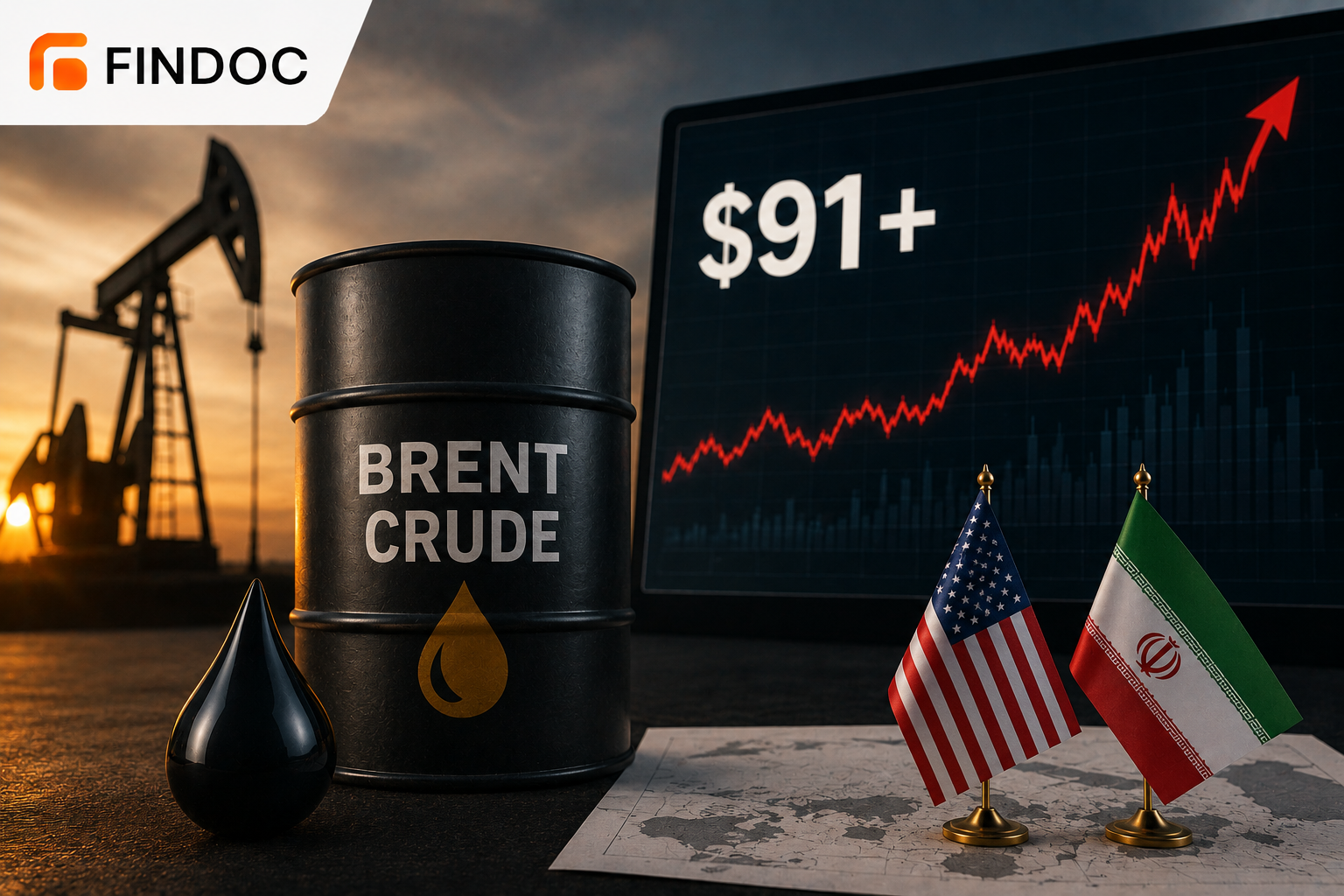
Brent crude climbed past $90-91 a barrel on Tuesday as renewed military tension between the United States and Iran rattled global energy markets, adding a fresh headwind for oil-importing economies like India just as domestic growth data came in stronger than expected.
US-Iran Tensions And Global Bond Selloff Push Brent Higher
Crude prices rose amid fresh US-Iran attacks over the weekend, pushing Brent, the international benchmark price against which roughly two-thirds of the world’s physically traded crude oil is priced, to around $90-91 a barrel through Tuesday’s session. The move came alongside a broader selloff in global bond markets, which pushed sovereign yields higher and added to risk-off sentiment across emerging-market equities, including India.
The US-Iran conflict has been a recurring source of volatility in oil markets through 2026, with earlier flare-ups in the year having pushed Brent to considerably higher levels before easing back. Tuesday’s move to the low $90s represents a fresh escalation rather than an isolated spike, and market participants are treating it as part of an ongoing, unresolved geopolitical situation rather than a one-off event.
Oil marketing companies such as Bharat Petroleum, Hindustan Petroleum and Indian Oil Corporation are typically among the first stocks investors watch when crude moves sharply, since their profitability depends heavily on the spread between crude procurement costs and the prices at which they sell refined products domestically. When crude rises quickly and retail fuel prices don’t move in step, often for policy or political reasons, OMC margins can come under pressure within days.
India’s Oil Import Bill And Sector-Level Cost Pressure
India imports the bulk of its crude oil requirement, so a sustained rise in prices has a direct bearing on the country’s import bill, inflation trajectory and currency. When crude prices rise, India’s oil marketing companies face higher procurement costs, which can either squeeze their refining and marketing margins or, if passed through to consumers, add to retail fuel inflation. A wider import bill also tends to pressure the rupee, since more dollars are needed to pay for the same volume of oil.
Higher energy costs typically increase input expenses for several fuel-sensitive sectors:
- Aviation: aviation turbine fuel (ATF) is a major cost component for airlines, and airlines often cannot immediately pass higher fuel costs through to fares
- Paints: manufacturers depend heavily on crude-linked petrochemical derivatives such as solvents and resins for their raw materials
- Tyres: synthetic rubber and carbon black, both petroleum derivatives, are key tyre-manufacturing inputs
- Chemicals and logistics: broader input and fuel costs climb across the value chain, from raw material transport to finished-goods distribution
The timing is notable: the crude spike coincided with data showing India’s economy grew a stronger-than-expected 7.8% in the April-June quarter of FY27, and market watchers noted that this domestic growth cushion may be one reason equity indices have not reacted more sharply to the oil-driven risk-off mood. In effect, strong GDP data gave investors a reason to look past near-term oil-price pressure, at least for now.
Sensex, Nifty And Sectoral Indices React
Indian equity benchmarks traded with a mild negative bias through Tuesday’s session, with banking and broader mid- and small-cap stocks under relatively more pressure than the headline indices. Twelve of sixteen major sectoral indices were trading lower during early deals, reflecting sentiment that ran weaker than the modest declines in Sensex and Nifty might suggest on the surface, a common pattern when a handful of large, heavily weighted stocks mask broader weakness underneath.
Gold and silver prices in India also reflected the day’s cross-currents, with bullion markets responding to the same mix of geopolitical uncertainty and shifting rate expectations that has driven crude, though precious-metal price moves on the day were mixed across data sources and less directionally clear than the crude oil story.
US-Iran Standoff Remains The Key Swing Factor
Market participants are likely to keep a close eye on how the US-Iran situation develops in the coming sessions, since any further escalation or de-escalation could swing crude prices meaningfully in either direction. A sustained move above current levels would raise the risk of further pressure on oil-linked sectors and the rupee, while any easing in tensions could quickly reverse the recent risk-off mood. Historically, oil-price shocks tied to Middle East tensions have tended to be sharp but short-lived when the underlying conflict doesn’t disrupt actual crude supply. The bigger risk for markets is a scenario in which shipping routes such as the Strait of Hormuz, a critical transit corridor for global oil trade, face genuine disruption rather than just headline risk.
For investors looking to track crude-sensitive stocks and index movements as this situation develops, a reliable online trading platform can help monitor sectoral shifts in real time across aviation, paints, tyres and OMC counters; those looking to act on these moves directly will need an active demat and trading account to do so.
Crude oil prices and market levels are live and subject to change. This report is for informational purposes only and does not constitute investment advice.
Leave a Reply