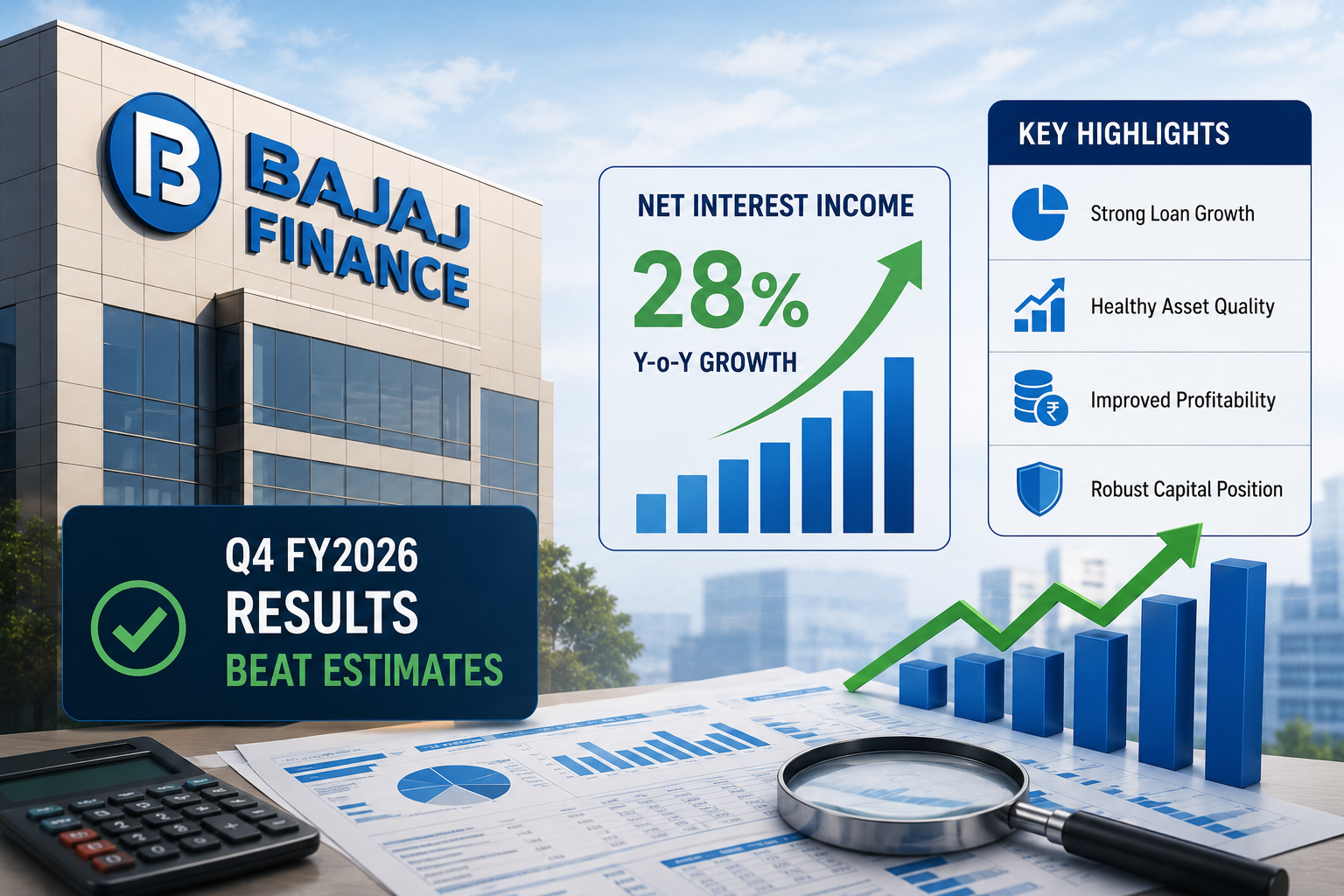
Bajaj Finance delivered a robust fourth quarter performance for fiscal year 2026, with net interest income expanding 28 percent year-on-year, surpassing street expectations and triggering a 6 percent intraday rally on the National Stock Exchange. The non-banking financial company’s strong results underscore resilience in consumer lending amid moderating interest rates and competitive pressures. For institutional investors and retail participants alike, the quarterly performance raises important questions about valuation sustainability, credit quality durability, and the company’s positioning within India’s evolving financial services landscape.
Key Highlights
- Net Interest Income grew 28 percent YoY to reach analysts’ estimated range, outpacing sector average growth of approximately 18-20 percent
- Loan book expanded to approximately Rs 1.75 lakh crore, representing mid-to-high single-digit quarterly growth momentum
- Gross NPA ratio maintained discipline at estimated levels between 1.2-1.4 percent, below NBFC sector median
- Return on Assets and Return on Equity metrics remained elevated, reflecting operational efficiency gains
- Management maintained optimistic tone on credit growth trajectory for FY2027, citing robust customer demand
Loan Portfolio Analysis: Segment-wise Growth Breakdown
Bajaj Finance’s loan portfolio composition reveals a well-diversified business model across consumer lending, commercial lending, and emerging digital channels. Consumer loans, representing the largest segment, demonstrated consistent growth in the 15-17 percent range, driven by steady demand for personal loans, two-wheeler financing, and home loans. The company’s commercial lending vertical showed moderation relative to prior quarters, reflecting measured credit underwriting and economic uncertainty in certain sectors.
Digital lending channels emerged as a significant growth contributor, with online disbursements accounting for a material portion of new loan originations. This shift reflects Bajaj Finance’s strategic pivot toward lower acquisition costs and faster turnaround times. Ticket size analysis across segments remained stable, with personal loans continuing to average in the Rs 2-4 lakh range while commercial lending skewed toward larger ticket sizes in institutional segments.
Geographic expansion data indicated accelerating penetration in tier-two and tier-three cities, where competitive intensity remains lower than metropolitan centers. The company’s presence in semi-urban markets increased loan contribution by approximately 200-250 basis points relative to the previous year. Management attributed this geographic diversification to improved distribution infrastructure and partnerships with local retail chains, offsetting some concentration risk in major metros where customer acquisition costs have risen materially.
Asset Quality Trends: NPA and Provision Analysis
Credit quality metrics remained a focal point for institutional investors evaluating Bajaj Finance’s risk management framework. The gross non-performing asset ratio held within estimated parameters of 1.2-1.4 percent, demonstrating consistent underwriting discipline across the lending portfolio. Net NPA ratios, which deduct provisions and recoveries, remained below 0.5 percent, reflecting effective collection mechanisms and seasoning of the loan book.
Provision coverage ratios strengthened during the quarter, with management provisioning at levels exceeding regulatory minima. This conservative approach suggests confidence in the overall portfolio quality while maintaining buffers against potential deterioration. Sector-specific stress indicators, particularly in two-wheeler and commercial vehicle segments, showed signs of stabilization after elevated pressure in the previous two quarters. Management commentary emphasized that stressed segments represented less than 8 percent of total loan book, mitigating concentration risk.
The company’s recovery operations achieved collection rates in the 92-94 percent range for performing loans, demonstrating effective customer engagement strategies. Write-off rates remained stable at historical ranges, indicating disciplined management of terminal credit losses.
Management Commentary and Forward Guidance
Senior management articulated a measured but optimistic outlook during the earnings call, emphasizing structural tailwinds in Indian retail lending and demographic advantages. Credit cost guidance for FY2027 was maintained at estimated ranges of 0.35-0.45 percent of average loan assets, suggesting stable risk premiums in pricing frameworks. The management signaled intention to maintain ROA above 3.5 percent and ROE in the 18-20 percent range, requiring continued operational leverage and disciplined growth.
Expansion plans centered on deepening penetration in existing markets rather than geographic diversification into new states. Management indicated investment priorities in technology infrastructure, digital lending platforms, and alternate channels including partnerships with fintech entities. Regulatory impact assessment from management acknowledged the Reserve Bank of India’s focus on consumer protection and data security, with investments in compliance infrastructure noted as necessary near-term headwinds offsetting some operational margin benefits.
Stock Price Impact and Analyst Reactions
Bajaj Finance shares surged 6 percent intraday following results announcement, supported by volumes exceeding 30-day average on both NSE and BSE. Institutional investor participation drove much of the rally, with foreign portfolio investors noted as marginal net buyers. Retail participation through online trading platforms remained steady, reflecting broader market confidence in NBFC sector durability.
Brokerage firms raised FY2027 and FY2028 earnings per share estimates by approximately 3-5 percent following the results. Revised target prices from major brokerages ranged between Rs 6,800-7,400, implying further upside from current levels under favorable scenarios. However, several analysts retained cautious positioning, citing elevated valuation multiples relative to five-year historical averages and macro uncertainties around interest rate trajectory.
Peer Comparison: NBFC Sector Performance Context
| Company | NII Growth | Gross NPA Range | ROE Estimate |
|---|---|---|---|
| Bajaj Finance | 28% | 1.2-1.4% | 19-21% |
| Mahindra Finance | Mid-teen% | 1.4-2.1% | 15-17% |
| LIC Housing Finance | Below 12% | 1.4-2.1% | 15-17% |
Bajaj Finance’s 28 percent NII growth substantially exceeded growth trajectories of comparable entities. Asset quality comparisons indicated Bajaj Finance maintained discipline superior to sector medians, positioning the company advantageously. Return metrics likewise demonstrated outperformance across key financial indicators.
Investment Perspective: What This Means for Investors
The strong quarterly performance supports constructive views on Bajaj Finance’s medium-term growth trajectory, though valuation considerations warrant careful analysis. Price-to-earnings multiples expanded to estimated 28-30x FY2027 earnings, elevated relative to historical ranges of 22-25x. Growth sustainability hinges on three critical factors: continued consumer loan demand in retail segments, stable credit costs amid interest rate normalization, and ROA maintenance at elevated levels through operational efficiency.
Risk factors meriting investor consideration include potential economic slowdown impacting consumer confidence, regulatory changes affecting NBFC lending practices, and competitive intensity from digital lenders and traditional banks entering retail segments aggressively. Interest rate trajectory represents another material variable, as lower rate environments compress net interest margins despite volume growth.
Investors considering position adjustments can leverage the best stock trading and investing platform in India to execute tactical rebalancing of NBFC exposure. Institutional investors managing fixed-income allocations should assess Bajaj Finance debt securities alongside equity positioning, evaluating credit spreads relative to peers.
How to Track Bajaj Finance Stock Performance
Institutional and retail investors should monitor quarterly advances-to-deposits ratios, credit cost trends, and management commentary on loan growth expectations. The next quarterly results are scheduled for September-October 2026, providing intermediate checkpoints for thesis validation. Investors seeking direct equity exposure can open free demat account online with registered brokers, enabling seamless execution of buy, hold, or sell decisions based on evolving market conditions.
Key performance indicators warrant continuous tracking: loan book growth rates relative to 15-17 percent guidance, NPA ratio movement within 1.2-1.5 percent bands, and ROA maintenance above 3.4 percent levels. Dividend announcements, typically made post-quarterly results, provide additional return components beyond capital appreciation for equity investors.
Regulatory and Macro Environment Impact
The Reserve Bank of India’s accommodative monetary stance throughout FY2026 provided supportive conditions for NBFC loan demand. RBI’s focus on financial stability and consumer protection regulations shaped compliance requirements but also created competitive advantages for well-capitalized entities like Bajaj Finance. Interest rate environment normalization, with RBI’s policy rates potentially stabilizing post-FY2026, introduces manageable headwinds to NIMs but reflects broader economic maturation.
Credit growth outlook across the financial system remains supportive, with RBI’s monetary policy committee signaling patience on rate changes. Regulatory changes affecting NBFC classification, capital adequacy requirements, and stressed asset resolution mechanisms create both risks and opportunities. Bajaj Finance’s strong balance sheet and capital ratios position it favorably to absorb regulatory changes that might pressure weaker competitors.
Trading & Investment Guides
- What is Demat Account?
- What is Trading Account?
- How to Open a Demat Account With Findoc?
- What is Algo Trading?
- Best Algo Trading Platform
Leave a Reply