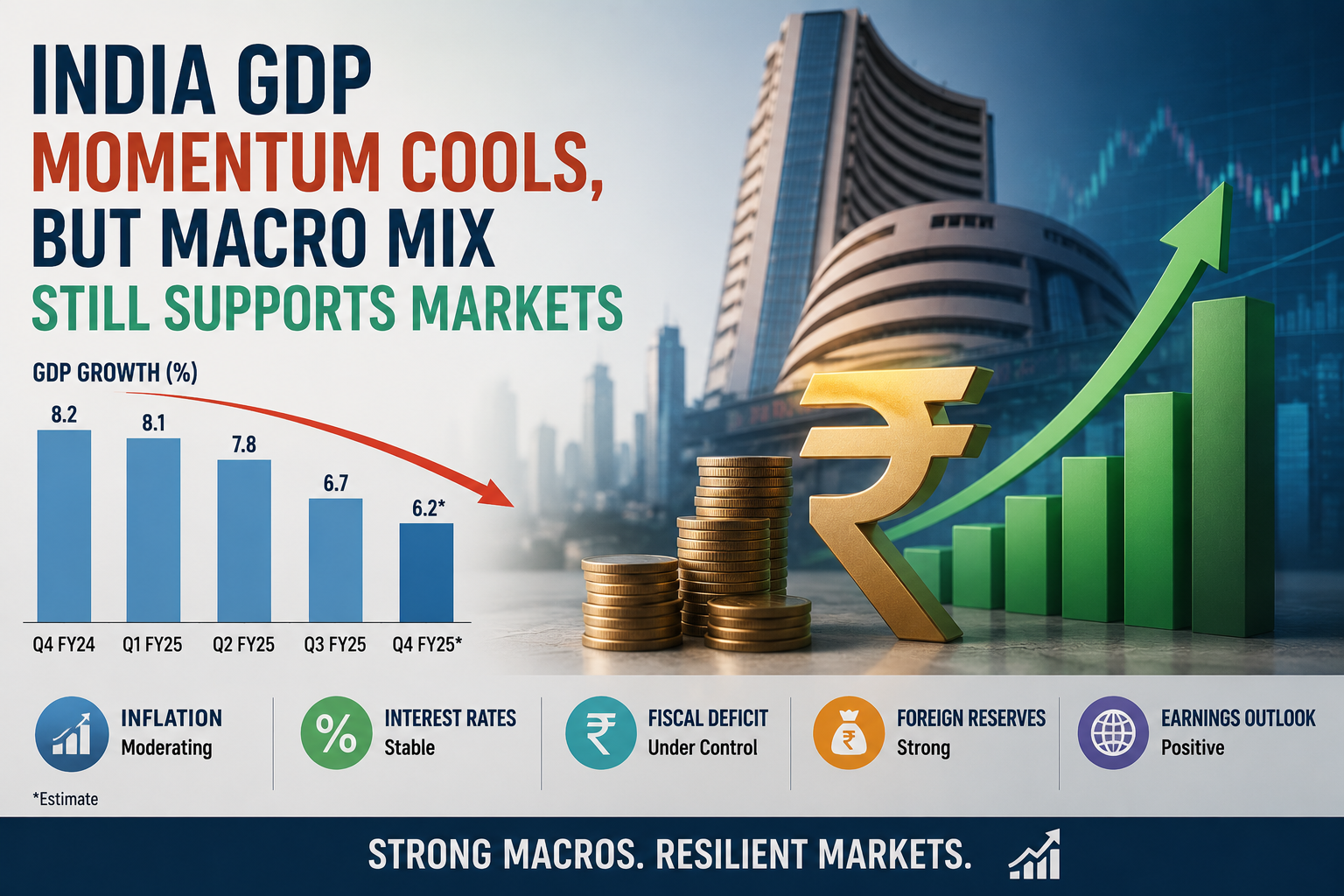
India’s economy is entering mid-2026 with growth still robust by global standards, but with clear signs of moderation across GDP, inflation, and currency indicators that will shape the Reserve Bank of India’s next moves. High-frequency data and fresh economist polls point to softer real GDP growth in the March quarter amid weaker external demand and supply-chain frictions from the West Asia conflict, even as domestic demand and public capex remain supportive. For institutional investors, the interplay between easing growth, range-bound inflation, and a cautious RBI is now central to positioning across equities, rates, and the rupee.
Key Highlights
- Q4 FY26 GDP growth seen slowing to around 7.2–7.3% from 7.8% in Q3
- Core domestic demand remains resilient despite softer exports and industrial activity
- Headline CPI near the upper half of RBI’s 2–6% band limits near-term easing
- INR trades under mild pressure as global yields stay elevated, but remains broadly stable
- Markets price a shallow RBI easing cycle in late 2026, contingent on food inflation risks
GDP Growth and Macro Backdrop
Economist polls released over the past 24 hours indicate that India’s real GDP growth likely slowed sequentially in the January–March 2026 quarter, with consensus estimates clustering around 7.2–7.3%, down from 7.8% in the previous quarter. The moderation is being attributed primarily to softer external demand, weaker industrial production momentum, and residual supply-chain disruptions linked to the ongoing West Asia crisis, which affected shipping routes and import costs in March. Yet, on a level basis, India remains one of the fastest-growing major economies, significantly outpacing growth in advanced markets.
Domestic demand continues to provide the main buffer. Analysts point to resilient private consumption in urban centres, underpinned by services, discretionary spending, and steady credit growth. Government capital expenditure on infrastructure, transport, and energy remains a key driver, with project execution supporting construction, cement, and capital goods segments. However, some softness has emerged in export-oriented manufacturing, particularly in sectors tied to Europe and parts of Asia, as well as in select labour-intensive categories where global orders have been volatile.
The latest commentary from sell-side research desks highlights a growing divergence between strong headline GDP prints and more mixed high-frequency indicators. Freight volumes, power demand, and GST collections still suggest healthy activity, but the pace of improvement is less broad-based than in the prior two quarters. This development presents new considerations for stock investment strategies focused on Indian equities. Economists also note that base effects are becoming less favourable, making it harder to sustain near-8% growth. Consensus for full-year FY26 growth is now gravitating towards the low-7% handle, with upside risks contingent on a benign monsoon and a faster recovery in global trade.
Inflation, RBI Policy, and Market Pricing
On inflation, the narrative is increasingly nuanced. Headline CPI remains within the RBI’s 2–6% tolerance band but is seen hovering in the 4.5–5.0% region in recent prints, with food and certain services components keeping core pressures sticky. The earlier disinflation impulse from fuel and tradables has largely played out, while intermittent spikes in vegetable prices and cereals have kept expectations cautious ahead of the monsoon season. Wholesale price inflation, which had been subdued, has turned mildly positive, reflecting input cost normalisation and some pass-through from global commodity prices.
For the Monetary Policy Committee, this macro mix argues for continued caution. While the growth moderation is now evident in the data, the RBI has signalled that it wants “durable” alignment of inflation with the 4% target before contemplating any meaningful easing cycle. As a result, the policy stance remains “withdrawal of accommodation”, with the repo rate steady at restrictive levels and liquidity conditions managed in a relatively neutral-to-tight corridor. Money market pricing implies that the first shallow cut is more likely in late 2026 than in the immediate meetings, barring a sharp downside surprise in inflation.
Bond markets have reacted by flattening the yield curve. Short-end rates remain anchored by the repo rate and core liquidity, while the 10-year government bond yield trades in a relatively tight range as investors weigh domestic disinflation against still-elevated global yields. Demand from long-term domestic investors, including banks and insurance companies, continues to support the sovereign curve. Corporate spreads have been broadly stable, with high-grade issuers benefiting from steady risk appetite, although primary issuance is slightly more selective as investors differentiate more sharply on credit quality and sectoral outlook.
Rupee, Equities, and Sectoral Implications
In currency markets, the rupee has been under mild but contained pressure against the US dollar, reflecting the combination of a still-strong dollar environment, elevated US real yields, and periodic risk-off episodes linked to geopolitical developments. The INR has largely traded in a narrow band, with the RBI seen actively smoothing volatility via spot and forward market operations. Adequate FX reserves and steady services exports provide a buffer, but portfolio flows have turned more two-way, especially in rate-sensitive and export-heavy sectors.
For Indian equities, the macro configuration of mid-7% growth, mid-single-digit inflation, and a cautious central bank remains broadly supportive, but sectoral rotation is pronounced. The Nifty 50 and Sensex have been driven by large-cap financials, select IT majors, and private sector industrials, even as some exporters face earnings pressure from weaker external demand. Domestic cyclicals tied to government capex and consumption themes continue to attract institutional interest, while more rate-sensitive pockets such as real estate and small finance companies are waiting for clearer signals on the timing and magnitude of RBI easing.
Key sectors and macro linkages currently in focus for investors can be summarised as follows:
- Banks and NBFCs: Beneficiaries of still-healthy credit growth and relatively benign asset quality, but margins are nearing a cyclical peak as funding costs catch up with lending rate resets.
- IT and services exporters: Revenue visibility remains reasonable, but the growth moderation in key global markets and cautious client spending are tempering earnings upgrades. A stable-to-weaker INR offers some margin relief.
- Capital goods, infrastructure, and construction: Supported by government-led capex, order books are robust, though execution risks and input cost volatility are being closely watched.
- Consumer staples and discretionary: Urban demand is healthy, but rural recovery is uneven and sensitive to food inflation and monsoon outcomes, which will influence volume growth over the next two quarters.
Market Outlook
Looking ahead, the balance of risks for India’s macroeconomy appears finely poised. On the upside, a normal monsoon, continued public investment, and an eventual recovery in global trade could keep GDP growth near or slightly above 7% for FY26, providing a solid backdrop for corporate earnings. On the downside, renewed food price shocks, higher-for-longer global interest rates, and an escalation of geopolitical tensions could constrain the RBI’s room to ease, pressure the rupee, and tighten domestic financial conditions.
For institutional investors, the key variables to monitor over the coming months are: the trajectory of food and core inflation relative to the 4% CPI target; the RBI’s communication on the timing and extent of any policy pivot; the resilience of high-frequency activity indicators as base effects turn less favourable; and the sustainability of portfolio and FDI flows in an environment of shifting global risk appetite. Retail participation has grown significantly as access to a reliable trading platform has become more widespread. Positioning is increasingly likely to favour quality large caps with strong balance sheets and pricing power, alongside selective exposure to rate-sensitive assets that would benefit from a gradual easing cycle.
Conclusion
India enters the middle of 2026 with its growth-inflation mix still more favourable than that of most major economies, but the phase of effortless upside surprises is likely behind us. GDP growth remains strong but is no longer accelerating; inflation is contained but not yet comfortably anchored at target; and the RBI is signalling patience rather than urgency on rate cuts. For markets, this argues less for a directional macro trade and more for careful calibration: differentiating across sectors and credits, managing duration risk amid an uncertain global rates backdrop, and staying alert to turning points in inflation and policy guidance. Investors looking to participate in this market movement can open demat account through SEBI-registered brokers. In this environment, disciplined macro monitoring and selective active positioning will be essential for generating excess returns in Indian assets.
Trading & Investment Guides
Leave a Reply