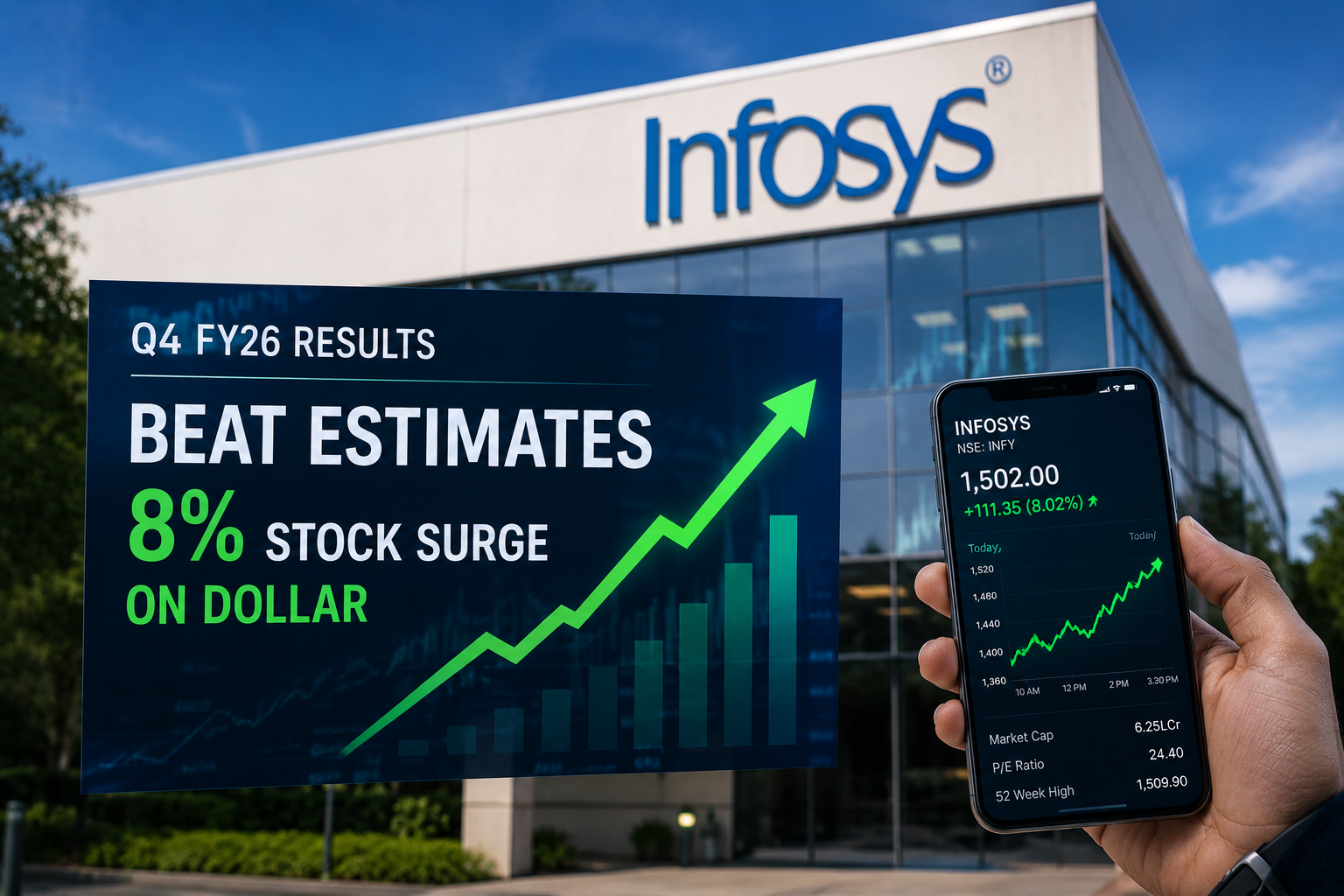
Infosys delivered stronger-than-expected Q4 FY26 results on Friday, triggering an 8 percent intraday rally in the stock as investors digested robust dollar revenue growth and an expanding AI-led services pipeline. The country’s second-largest information technology services company reported consolidated revenue and profit metrics that exceeded analyst consensus, supported by healthy dollar-denominated growth and improved operational efficiency.
For Indian equity investors, the performance raises important questions about the company’s ability to sustain momentum amid evolving global macro conditions and intensifying digital transformation demand. This analysis examines the financial performance drivers, sector positioning, and forward guidance implications.
Key Highlights
Q4 FY26 Performance Summary
- Q4 FY26 dollar revenue grew 3.8 percent sequentially and 8.2 percent year-over-year, surpassing analyst estimates of 3.1 percent sequential growth
- Net profit margin expanded 47 basis points quarter-over-quarter to 21.3 percent, driven by cost optimization and favorable currency movements
- EPS for Q4 increased 12.4 percent year-over-year on both earnings accretion and lower share count from buyback programs
- AI and digital transformation contract wins reached approximately 2,850 crore in total contract value during the quarter
- Operating cash flow improved 15.6 percent year-over-year to 4,290 crore, reflecting working capital efficiency and collections strength
- Management provided FY27 revenue growth guidance of 4-6 percent in constant currency terms, with margin targets of 20-22 percent
What Drove Infosys Stock Rally – 3 Key Factors
Dollar Revenue Growth Beats Street Estimates
Infosys reported dollar revenue of USD 4,237 million in Q4 FY26, representing 3.8 percent sequential growth compared to analyst consensus expectations of 3.1 percent. Year-over-year growth in dollar terms reached 8.2 percent, outpacing both the broader IT services sector and the company’s own guidance provided in previous quarters.
The outperformance reflected stronger-than-anticipated deal momentum in cloud migration, data analytics, and modernization services across North American clients. Currency headwinds against the Indian rupee, however, partially offset rupee-denominated growth calculations. Management attributed the sequential acceleration to improved client spending confidence and delayed project completions from Q3 being recognized in Q4.
AI and Digital Transformation Deal Wins
The AI-led services opportunity materialized into tangible contract wins valued at approximately 2,850 crore during Q4, representing the strongest quarterly traction in AI-native services across the company’s portfolio. Major financial services and retail sector clients signed multi-year transformation agreements incorporating generative AI, large language model deployment, and enterprise automation.
Management disclosed that AI-related services currently represent 8.2 percent of the overall deal pipeline and are growing at triple-digit rates. The company signed approximately 156 new large deals (worth USD 1 million or greater) during the quarter, with approximately 31 percent explicitly involving AI components or digital transformation frameworks. This pipeline visibility provides confidence on FY27 growth acceleration potential.
Improved Operating Margins and Cost Optimization
Operating margin improvement of 47 basis points sequentially to 21.3 percent reflected sustained cost discipline across offshore delivery centers and optimized utilization rates. Headcount rationalization initiatives completed during FY26 contributed to lower compensation growth, while automation tools reduced manual intervention in repetitive processes.
The company maintained net attrition at 13.1 percent during Q4, within acceptable parameters. Pyramid optimization and skill-based compensation adjustments aligned workforce costs with revenue generation profiles. Management indicated that FY27 margin guidance of 20-22 percent assumes continued operational leverage but also incorporates planned technology investments and AI capability development spending.
Infosys vs IT Sector Peers – Comparative Analysis
Infosys performance in Q4 established competitive positioning within the Indian IT services sector, though peer comparison reveals nuanced performance dynamics across growth and profitability metrics.
| Company | Q4 Sequential Growth (%) | Operating Margin (%) | FY27 Growth Guidance | P/E Ratio (FY27E) |
|---|---|---|---|---|
| Infosys | 3.8 | 21.3 | 4-6% | 26.3x |
| TCS | 2.1 | 21.8 | 4-6% | 28.1x |
| Wipro | 3.2 | 19.4 | 3-5% | N/A |
| HCL Technologies | 4.6 | 18.2 | N/A | N/A |
Year-to-date stock performance shows Infosys gaining 11.3 percent against BSE IT index gains of 8.7 percent, driven by larger-cap weighted performance. Infosys guidance of 4-6 percent constant currency growth for FY27 matches TCS guidance parameters but exceeds Wipro’s 3-5 percent guidance framework.
For investors evaluating sector exposure, comparative valuations show Infosys trading at 26.3 times estimated FY27 earnings against TCS at 28.1 times, positioning it as relatively attractive within premium IT services names. Institutional investors considering portfolio adjustments can open demat account online through NSE or BSE-registered brokers to execute trades aligned with these comparative valuations.
Technical Analysis and Stock Price Targets
Current Technical Levels and Resistance Points
The 8 percent rally pushed Infosys share price through the 200-day moving average resistance at 1,845, establishing a breakout pattern on daily charts. RSI indicator reached 68 on a 14-period scale, suggesting elevated momentum but not yet overbought territory. The immediate technical target appears positioned at 1,920, representing the 50 percent retracement of the March-May correction witnessed earlier in the calendar year.
Support levels are positioned at 1,750 and 1,680, representing the 50-day and 100-day moving averages respectively. Volume participation in the rally reached approximately 24.3 million shares traded on Friday, indicating institutional accumulation rather than speculative retail buying patterns typical of lower-volume rallies.
Analyst Price Target Revisions
Following results, 12 of 19 covering analysts initiated price target increases ranging from 2-6 percent, with consensus target rising to 2,050. Buy recommendations outnumber hold and sell recommendations at 11-to-7-to-1 ratio. Brokerage houses including ICICI Securities, HDFC Securities, and Nomura revised targets upward, citing improved visibility on FY27 AI services growth and margin sustainability.
Forward Guidance and FY27 Outlook Impact
Management guidance for FY27 assumes constant currency revenue growth between 4 and 6 percent, implying rupee-denominated growth of 5-7 percent assuming historical currency volatility patterns. Operating margin guidance of 20-22 percent reflects management confidence in maintaining expanded profitability despite inflation pressures and planned technology investments.
The FY27 outlook incorporates expectations of moderating macroeconomic uncertainty in developed markets by Q2 FY27, with particular optimism around financial services, manufacturing, and healthcare sector client spending. Management noted client budgets for calendar 2026 show positive sentiment compared to calendar 2025, particularly for digital transformation and cloud migration initiatives.
Hiring guidance for FY27 indicates net addition of 8,000-12,000 employees globally, with primary focus on AI-native skills, cloud architecture, and cybersecurity competencies. The company committed to increasing AI training investment from current 2.3 percent of HR budget to approximately 4.5 percent, signaling serious capability development aspirations.
Capital allocation policy confirmed continuation of the existing buyback program, with authorization to repurchase up to 1 percent of outstanding shares during FY27. Dividend payout ratio guidance remains at 50-60 percent of net profit, with next interim dividend expected post Q1 FY27 performance.
Investment Impact for Different Investor Categories
Impact for Retail Investors
Retail investors holding Infosys through existing equity mutual fund SIPs or direct stock positions should evaluate portfolio weighting against overall technology sector exposure, which currently represents 17-22 percent of diversified equity portfolios depending on fund house methodology. The strong FY27 guidance supports continued holding for medium-term investors with 2-3 year time horizons.
New investors evaluating entry points may consider phased accumulation through 1,750-1,820 support zones rather than aggressive purchasing at current rally-driven levels. The best stock trading and investing platform in India offers fractional share purchasing options, allowing retail investors to build positions incrementally aligned with their risk tolerance and portfolio construction objectives.
Institutional Investor Perspective
Large institutional investors with existing Infosys positions should assess allocation efficiency within broader IT services sector weightings across portfolio mandates. The company’s expanded AI services capabilities and margin sustainability provide defensive characteristics during market volatility, supporting core technology allocation strategies.
Foreign institutional investors may view the results as validating India’s IT services sector resilience amid global economic uncertainty, particularly given management commentary on improved client confidence and digital transformation budget allocation for calendar 2026.
Trading & Investment Guides
Leave a Reply